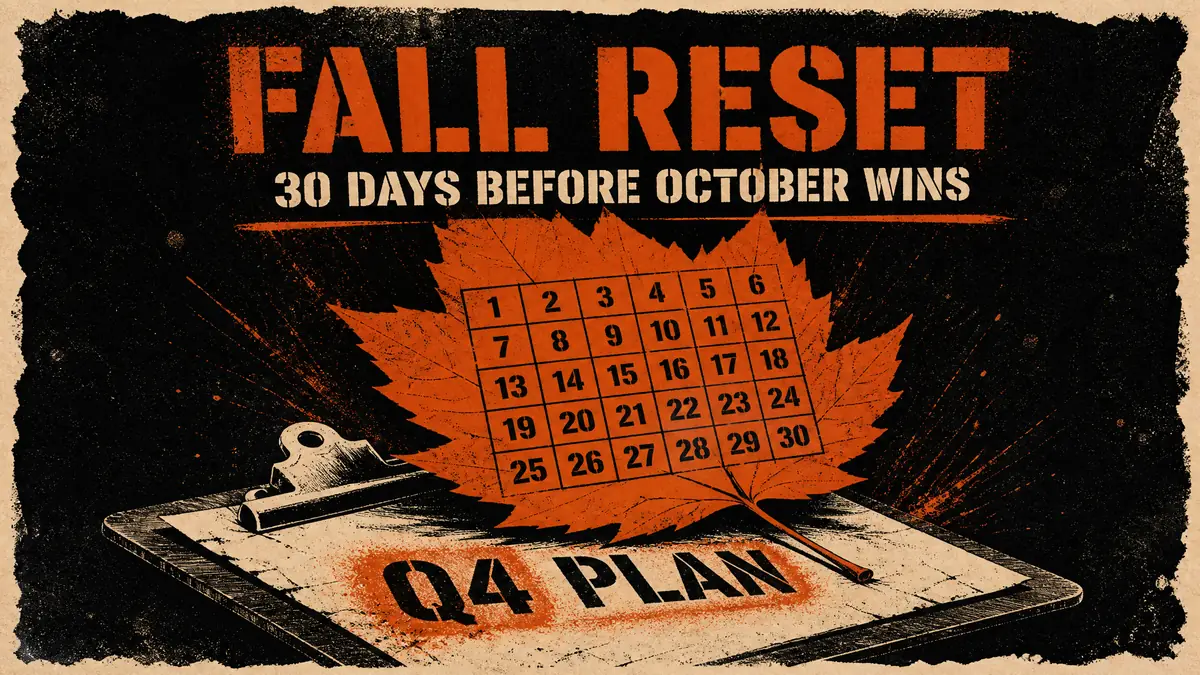
The Fall Reset Is the Real New Year
September has better financial energy than January. There, forbidden truth delivered before the pumpkin candle has even been lit.
January gets the branding. New planner. New tabs. New gym shoes still shaped like hope. But fall is where the useful work happens. The school-year rhythm is back. Holiday spending is visible on the horizon. Tax year-end is close enough to matter. Q4 is not a vague future blob anymore. It is standing in the driveway holding a clipboard.
Behavioral researchers Hengchen Dai, Katherine Milkman, and Jason Riis found in The Fresh Start Effect that people are more likely to start aspirational goals after temporal landmarks: a new week, month, year, semester, birthday, or holiday. Personal finance people heard that and built a small shrine to January 1. Cute. Too late.
The smarter move is to use September as the landmark. The forbidden rule is that you do not need a new year to start acting like a person with a plan. You need a month, four focused passes, and a refusal to let Black Friday, estimated taxes, travel booking, and expired subscriptions sneak up dressed as normal life.
If you already ran the Q3 Money Reset: A 7-Day Plan to Start the Second Half Strong, this is the longer version. If you did not, no public shaming ceremony. We are simply beginning where you are, because that is where all useful budgets begin.
TL;DR
- Week 1 clears the financial desk: accounts, recurring charges, statements, and old services.
- Week 2 refills the buffers: sinking funds, emergency cash, and portfolio drift.
- Week 3 handles tax pre-game before December starts breathing on your neck.
- Week 4 locks holidays early so January is not a receipt hangover.
| Week | Focus | Key tasks | Time required |
|---|---|---|---|
| Week 1 | Clean slate | Audit accounts, cancel unused services, pull statements | 2 to 3 hours |
| Week 2 | Rebalance and refill | Refresh sinking funds, top up emergency cash, rebalance investments | 2 to 4 hours |
| Week 3 | Tax pre-game | Check estimated payments, review harvesting eligibility, draft giving plan | 2 to 3 hours |
| Week 4 | Holiday plan-ahead | Lock gift list, book travel, set Black Friday boundaries | 2 to 3 hours |
Week 1: Clean Slate
The first week is not about becoming a spreadsheet monk. It is about finding the financial surfaces you have stopped looking at.
Start with an account inventory. Checking. Savings. Credit cards. Brokerage. Retirement. HSA. Mortgage. Student loans. Buy-now-pay-later accounts, because apparently every checkout screen now wants to become a lender. Write down the institution, login status, balance, interest rate if debt is involved, autopay status, and whether the account still has a job.
Then run the recurring-charge sweep. The Consumer Financial Protection Bureau says automatic payments can prevent late fees, but also warns that low balances can trigger overdraft or nonsufficient-funds fees and that you should monitor timing and amounts. Translation: autopay is useful, but it is not a babysitter.
Pull the last 90 days of checking and credit card transactions. Search for words like subscription, renewal, premium, app, cloud, storage, member, annual, and trial. Search merchant names you barely recognize. Recurring charges love aliases. They have witness protection energy.
This is where Your Forgotten Subscriptions Are Bleeding You Dry earns its keep. Cancel the dead stuff. Downgrade the bloated stuff. Keep the services you actually use without apologizing to the personal-finance comment section. If the streaming subscription gets used every night and keeps your household from collectively unraveling, fine. The problem is not joy. The problem is paid amnesia.
Now pull statements. Download year-to-date statements for bank accounts, credit cards, brokerage accounts, retirement accounts, mortgage or rent records, student loans, charitable gifts, medical spending, and business income if you have it. Put them in a folder with boring names. Boring is beautiful here. Future you does not need a file named final_final_money_stuff_v3.
By the end of Week 1, you should know what accounts exist, what is charging you on repeat, and where your records live. Not perfect. Knowable.
Days 1-7 checklist
- Day 1: List every financial account and confirm you can log in.
- Day 2: Note balances, interest rates, and autopay status.
- Day 3: Pull 90 days of transactions from checking and credit cards.
- Day 4: Identify recurring charges and renewals.
- Day 5: Cancel, pause, or downgrade anything unused.
- Day 6: Download year-to-date statements.
- Day 7: Store statements in one folder and write down what still needs chasing.
Week 2: Rebalance and Refill
Week 2 is the refill station. Less dramatic than a debt payoff montage. More useful than buying another planner in a color called oat fog.
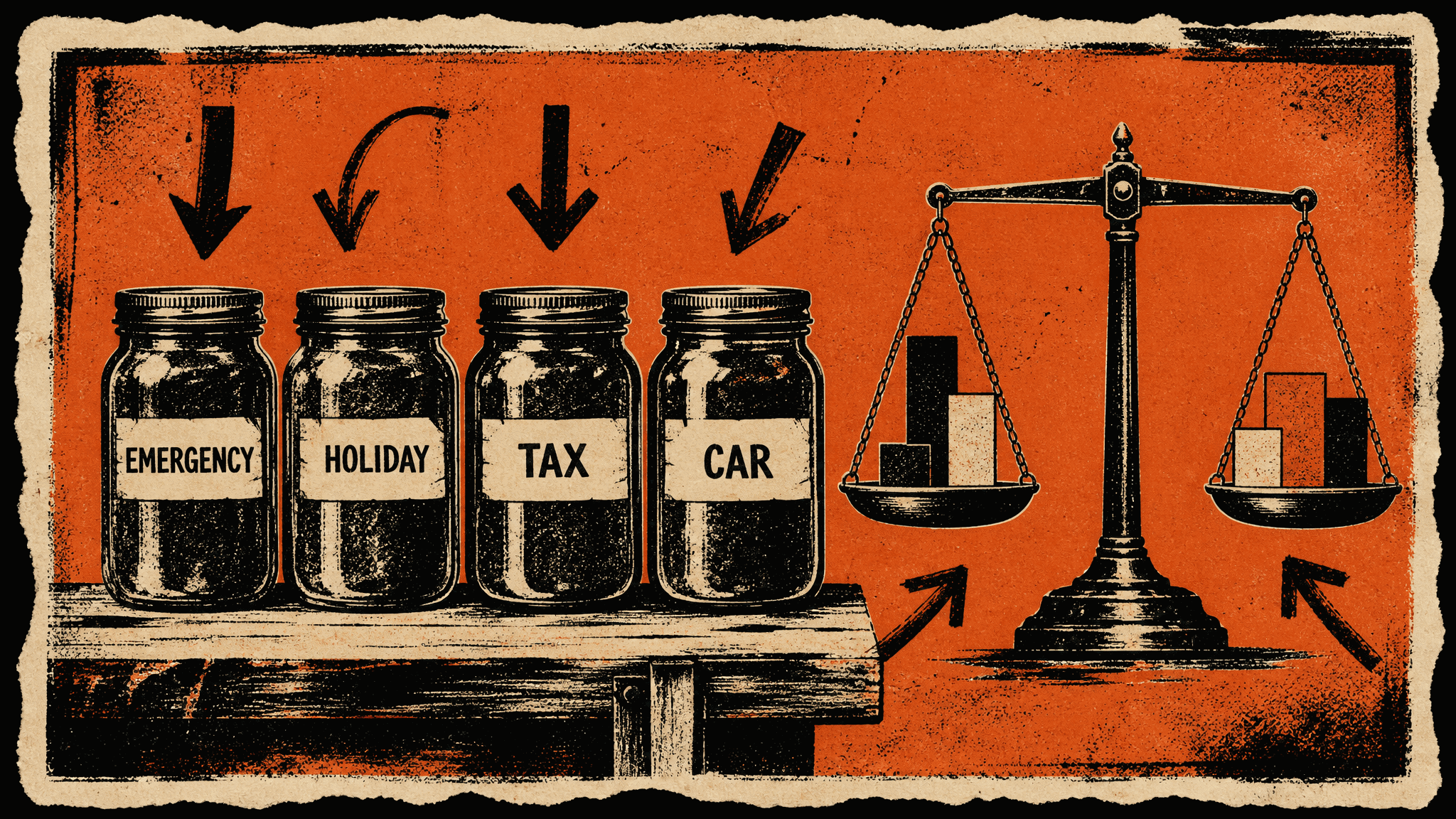
Start with sinking funds. These are the buckets for expenses that are predictable but annoying: holidays, car maintenance, annual insurance, school fees, medical deductibles, pet care, home repairs, travel, and professional dues. Calling them surprises is generous. The holidays arrive every year with the punctuality of a villain.
If you need the full setup, read Sinking Funds Explained: The One Habit That Makes ‘Surprise’ Expenses Disappear. For this reset, keep it simple: list every known irregular expense between now and January 31, estimate the amount, subtract anything already saved, and divide what remains by the number of paychecks left before it hits.
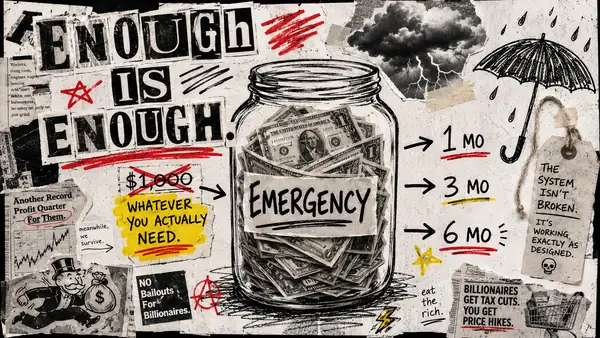
Then top up emergency cash. The Federal Reserve reported in May 2026 that 63% of adults could cover a $400 emergency expense with cash or its equivalent, unchanged from 2024. That number is both better than panic and worse than comfort. A blown tire, urgent care visit, or furnace tantrum does not wait for your next payday because it respects your aesthetic.
Use Emergency Fund Math: How Much Is Actually Enough in 2026? if your target needs more nuance. A dual-income renter with stable jobs may need a different cash buffer than a self-employed homeowner with two kids and a roof making suspicious noises. The rule depends. That is the whole forbidden point.
Last, review investment drift. Do not rebalance because a headline yelled at you. Rebalance because your actual allocation moved away from your target. Vanguard research summarized by AAII found no single perfect rebalancing frequency or threshold, but annual or semiannual monitoring with a 5% threshold was a reasonable balance for many broadly diversified stock and bond portfolios. That is refreshingly unsexy. Finance advice should be more unsexy when real money is involved.
Look across all investment accounts together, not one account at a time. Your 401(k), IRA, taxable brokerage, and HSA investments may be one household portfolio wearing different hats. Check target stock and bond allocation, cash drag, concentrated positions, fees, and whether new contributions can nudge the portfolio back before you sell anything taxable.
Days 8-14 checklist
- Day 8: List irregular expenses due before January 31.
- Day 9: Create or refresh sinking fund targets.
- Day 10: Move cash into the most urgent funds.
- Day 11: Compare emergency cash to your real monthly burn rate.
- Day 12: Schedule one automatic transfer if the fund is light.
- Day 13: Check portfolio allocation against your target.
- Day 14: Rebalance with contributions first, trades second, and taxes considered before clicking anything shiny.
Week 3: Tax Pre-Game
Tax planning in September feels suspiciously adult. That does not make it optional.
For 2026, IRS Publication 505 lists estimated-tax installment dates of April 15, June 15, September 15, and January 15, 2027 for calendar-year taxpayers. The same publication says the final January payment can be skipped if you file your 2026 Form 1040 or 1040-SR by January 31, 2027 and pay the remaining tax due. Please do not interpret that as an invitation to improvise with federal deadlines. The IRS is not known for whimsical leniency.
If you have W-2 income only, Week 3 may be a withholding check. If you freelance, run a business, sell investments, receive rental income, exercise equity comp, or had a lumpy income year, this is where you stop pretending April is a future problem. IRS Publication 505 says most people must pay estimated tax for 2026 if they expect to owe at least $1,000 after withholding and credits and their withholding and credits fall below the safe-harbor tests. That sentence has enough conditions to need a chair, so use the worksheet or a tax pro if your year was weird.
Next: tax-loss harvesting eligibility. This is not a command to sell losers. It is a check. Look for taxable brokerage positions below cost basis, realized gains you may want to offset, and positions you still want exposure to. Then read the wash-sale rule twice before touching anything. IRS Publication 550 says a wash sale occurs when you sell stock or securities at a loss and buy substantially identical stock or securities within 30 days before or after the sale. Accidentally nuking the deduction because you clicked rebuy too fast is a very avoidable facepalm.
Then draft your charitable strategy. In 2026, IRS Publication 505 says non-itemizers may be able to claim a charitable deduction for cash or check contributions up to $1,000, or $2,000 for married filing jointly, subject to limitations. It also says itemized charitable deductions face a 0.5% AGI floor beginning in 2026. Separately, the IRS explains that deductible contributions generally must go to qualified organizations and that contributions have to be paid before the close of the tax year.
The practical version: decide whether you are giving cash, appreciated securities, donor-advised fund contributions, or household goods. Confirm the organization qualifies. Save receipts. If you are bunching gifts, do the math before December 29 when everyone is tired and the printer smells like hot dust.
Days 15-21 checklist
- Day 15: Estimate full-year income, withholding, credits, and tax already paid.
- Day 16: Confirm whether a September or January estimated payment is needed.
- Day 17: Review taxable brokerage gains and losses.
- Day 18: Check wash-sale exposure before selling anything for a loss.
- Day 19: Draft your giving list and confirm qualified organizations.
- Day 20: Gather receipts for gifts already made.
- Day 21: Send the complicated stuff to your tax pro while there is still oxygen in the calendar.
Week 4: Holiday Plan-Ahead
Week 4 is where you admit the holiday season is not a surprise. Thanksgiving does not burst through the wall like an unexpected plumbing bill. It has been on the calendar the whole time, smug as ever.
The National Retail Federation forecast 2025 holiday retail sales of $1.01 trillion to $1.02 trillion, up 3.7% to 4.2% from 2024. Its winter holiday data also showed consumers planned to spend an average of $890.49 on gifts, food, decorations, and other seasonal items. That is the national circus. Your job is not to fund the circus.
Lock the gift list first. Names, rough amounts, gift ideas, shipping deadlines, and whether the person is getting money, an experience, a physical item, or mercy. Group gifts are allowed. Smaller gifts are allowed. No gifts are allowed where the relationship supports it. Adults can survive a card. Some will even pretend to like it.
Then book travel if travel is happening. Flights, trains, hotels, rental cars, pet boarding, parking, checked bags, rideshares, road-trip food, and the airport sandwich that costs like it has a trust fund. Travel budgets fail because people budget the ticket and forget the ecosystem.
Finally, set Black Friday boundaries before the sale emails start multiplying. Decide what you are actually allowed to buy: replacement items, gifts already on the list, planned household purchases, and nothing else. If you need a cooling-off system, The 24-Hour Rule, the 30-Day List, and the $100 Test: Three Anti-Impulse-Buy Frameworks is the anti-chaos menu.
Boundaries are not deprivation. They are pre-decisions. You are making the calm version of you negotiate with the feral version who sees 42% off a countertop appliance and briefly believes soup is a personality.

Days 22-30 checklist
- Day 22: Write the full gift list.
- Day 23: Assign a spending range to each person.
- Day 24: Pick gift ideas before panic shopping starts.
- Day 25: Price travel, lodging, pet care, bags, parking, and food.
- Day 26: Book the travel you already know you need.
- Day 27: Decide which Black Friday categories are allowed.
- Day 28: Create a waiting list for everything else.
- Day 29: Move holiday cash into the right sinking fund.
- Day 30: Review the whole reset and schedule one Q4 check-in.
Into Q4: Start January Before January
The fall reset works because it does not ask you to become a new person. Suspicious request, frankly. It asks you to run a month of maintenance before the loudest spending quarter of the year.
Week 1 gives you visibility. Week 2 gives you buffers. Week 3 reduces tax chaos. Week 4 keeps holiday spending from turning into January debt with ribbon on it.
That is momentum. Not perfection. Not a gold-star budget. Momentum.
People who run a fall reset enter January with facts, fewer leaks, funded priorities, cleaner records, and fewer financial jump scares. People who wait for January 1 are already behind, because by then Q4 has done what Q4 does: hosted travel, gifts, parties, annual renewals, charitable deadlines, tax loose ends, and one mysterious charge from a merchant name that looks like a Wi-Fi password.
Your financial system can be simple or detailed. Zero-based, envelope, pay-yourself-first, values-based, custom, or barely-a-budget-because-automation-is-carrying-the-load. Pick the method that fits your life now. If your life changes, update the method. That is not failure. That is maintenance with better lighting.
The forbidden financial reset is not about earning permission to spend, save, invest, or rest. It is about getting enough information to make decisions before the calendar starts throwing confetti in your eyes.
January 1 is theater. September is the actual ignition.
 Forbidden Finance