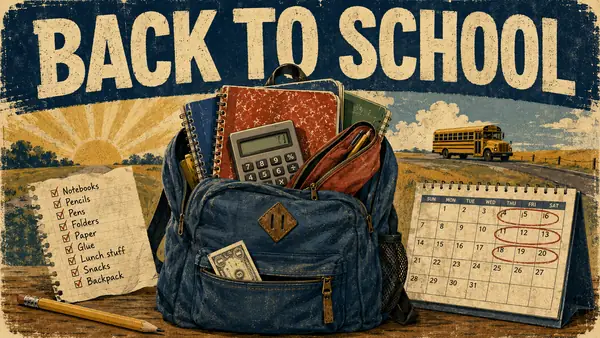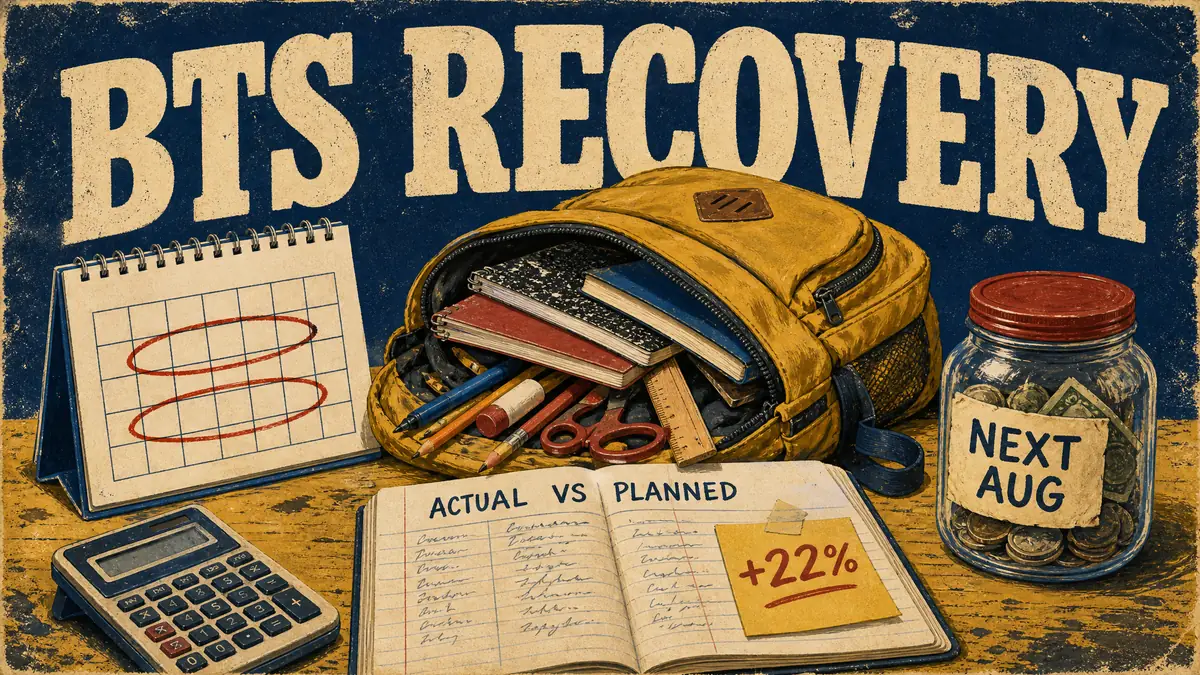
August is the month where a $7 pack of markers somehow becomes a $286 cart, a field-trip fee appears from the mist, and one child announces that last year’s perfectly good backpack is socially illegal.
So if your back-to-school budget blew up, welcome. You did not fail a sacred money test. You met August.
The numbers back up the mess. NRF reported that families with K-12 students planned to spend an average of $863.86 on back-to-school items in 2026, with total K-12 spending expected to hit $43.3 billion. Deloitte put planned 2026 K-12 spending at about $557 per student and found that half of parents planned to cut other expenses to make room.
Translation: this is not you being uniquely chaotic. This is a seasonal cash ambush wearing a glue-stick costume.
The job now is not shame. The job is cleanup. For the next two weeks, you are going to reconcile what happened, fund the gap from the right places, and restart the system for next August before your brain quietly files this under never again and forgets by March.
If you built a plan from Back-to-School Spending Starts in August: A 3-Week Funding Plan, good. If the plan still cracked, also good. Budgets are forecasts, not courtroom evidence.
The Reconcile: Find the Actual School-Supplies Total
Start with the boring part. Sorry. The boring part is where the money is hiding.
Pull every back-to-school transaction from July 1 through the first full week of school. Include school supplies, clothing, shoes, backpacks, electronics, sports fees, classroom contributions, lunch containers, haircut money, parking passes, dorm bits if you have a college student, and the mystery Target run where you bought pencils, shampoo, bananas, and a lamp. August loves a mixed cart.
Your goal is one number: actual back-to-school spend.
Not the number you hoped for. Not the number you vaguely remember telling yourself in the car. The actual total.
Once you have the total, compare it to the plan. If you planned $650 and spent $820, the gap is $170. If you planned $500 and spent $700, that is a 40% overshoot. Painful? Yes. Useful? Also yes. Forbidden finance move: treat the number as data, not a character witness.
Epsilon found that 54% of parents expected to go over budget for back-to-school in 2026. Deloitte also found that among parents whose kid has a specific must-have item, 57% say the child influences them to splurge on it. That is not a parenting defect. That is a human in a store with a kid, fluorescent lighting, and a very specific sneaker request.
| category | planned | actual | where to pull from |
|---|---|---|---|
| Supplies and classroom asks | $120 | $165 | Back-to-school fund, household supplies, weekly flexible money |
| Clothes and first-day outfit | $180 | $260 | Clothing fund, kids fund, delayed adult wardrobe purchase |
| Shoes and sports gear | $150 | $225 | Sports fund, activities fund, next-month recreation money |
| Tech and calculators | $200 | $310 | Tech replacement fund, school fund, short-term pause on upgrades |
| Fees, forms, lunch gear | $75 | $140 | School fees fund, grocery buffer, dining-out reduction |
The Funding Sources: Pull From the Right Buckets
Now cover the gap without raiding the emergency fund unless this has become an actual emergency.
An emergency fund is for job loss, medical bills, urgent car repairs, surprise housing problems, and other expenses with sharp teeth. A backpack that cost more than planned is annoying. It is not a pipe bursting through your ceiling at 11:42 p.m. For the deeper math, see Emergency Fund Math: How Much Is Actually Enough in 2026?.
Use this order instead.
First, pull from any leftover back-to-school money. Obvious, but check it. Sometimes the fund has $38 sitting there like a tiny apology.
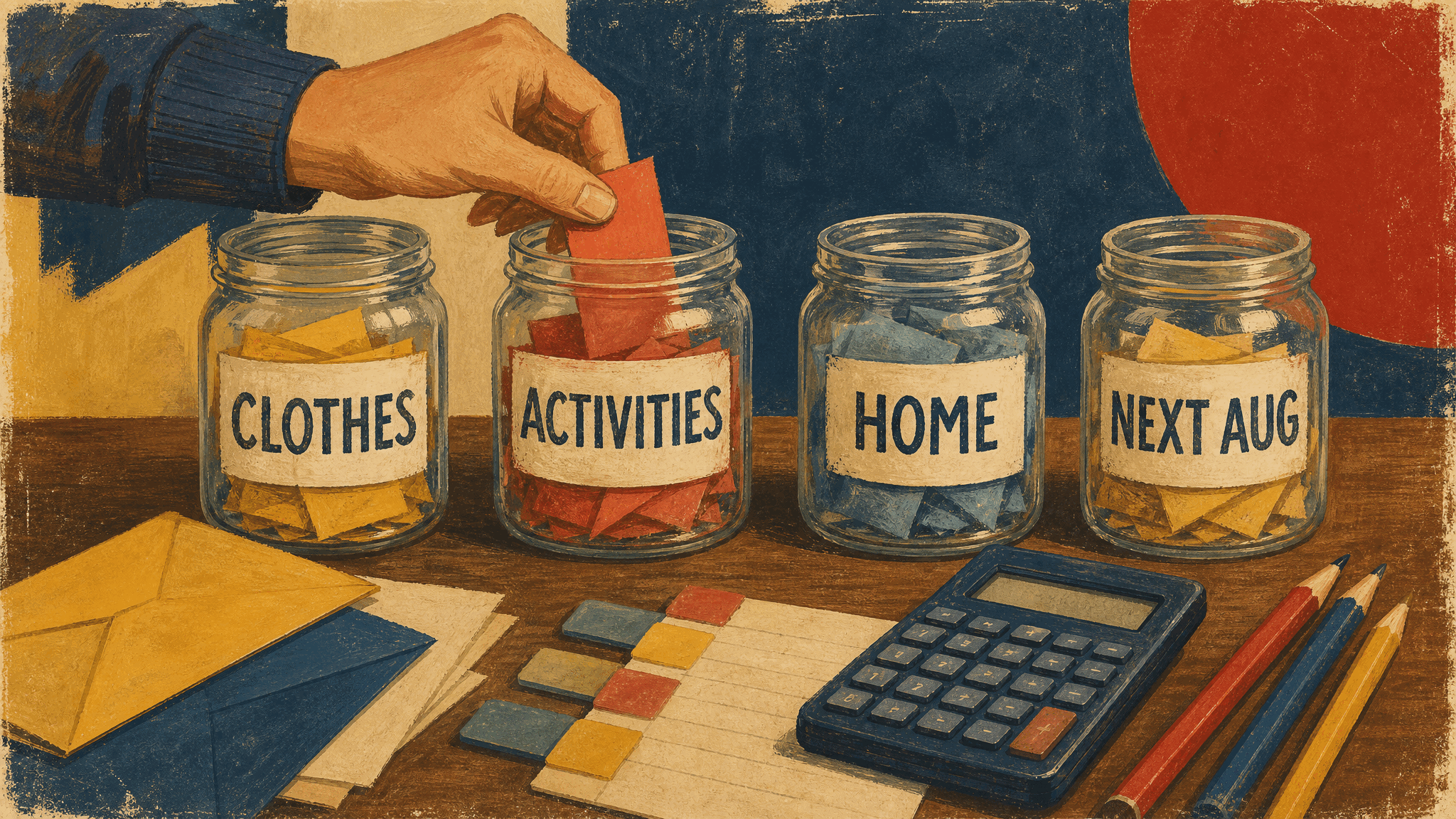
Second, pull from adjacent sinking funds. Clothing overage comes from clothing. Cleats come from sports or activities. Lunch boxes can come from household or groceries. If you need a refresher on setting up those buckets, Sinking Funds Explained: The One Habit That Makes ‘Surprise’ Expenses Disappear is the starting point.
Third, pause a flexible category for one pay cycle. Dining out, entertainment, random Amazon, convenience food, coffee runs, adult fun money. Not forever. Just long enough to stop the August leak. The latte is still not your moral downfall. The $46 emergency pizza night after meet-the-teacher may be the glue holding society together.
Fourth, split the remaining gap across two paychecks. If you are short $180, cover $90 now and $90 next check. This is less dramatic than emptying savings and then trying to refill it while September fees arrive wearing tap shoes.
Only touch the emergency fund if the alternative is missing a required bill, overdrafting, or carrying expensive debt you cannot pay off quickly. Even then, label it clearly: emergency fund used for back-to-school cash-flow shortfall. Then schedule the refill.
Restart for Next Year: Do It Before the Glitter Settles
This is the part everyone skips because September feels like the finish line.
It is not. September is when next August becomes cheaper.
Take this year’s actual total and divide it by the number of months until next August shopping starts for you. If you shop in July, divide by ten or eleven months, not twelve. Be honest about your household rhythm. Some people buy early. Some people panic-buy the night before school starts while muttering about washable markers. Both are lifestyles.
Now decide whether next year’s back-to-school sinking fund needs a 20% increase.
Use the increase if your overshoot was normal stuff: clothes cost more, shoes were outgrown, supply lists expanded, activity fees hit earlier, or you forgot categories that predictably happen every year. That is not a one-off. That is your real number waving from across the room.
Do not automatically increase by 20% if the overage was a true one-time expense, like replacing a laptop, buying a graphing calculator for the first time, or outfitting a kid for a new sport. Put those in their own sinking funds if they are likely to repeat.
This is where the rule depends. Traditional advice loves pretending there is one correct budget shape. There is not. A family with three elementary kids needs a different system than a household with one high schooler, one college freshman, and a grocery bill that acts personally offended by eggs.
Set the first contribution now, even if it is small. $15 this week beats the imaginary $150 you promise Future You will start in January. Future You has orthodontist bills and no patience for our little speeches.
Keep the Data, Drop the Guilt
Here is the two-week recovery plan.
Week one: collect the transactions, separate school spending from ordinary household spending, write down planned versus actual, and identify the gap. Keep the categories simple. Supplies. Clothing. Shoes. Tech. Fees. Activities. Food and lunch gear. Done.
Week two: fund the gap in order. Back-to-school fund first. Adjacent sinking funds second. Flexible spending third. Paycheck split fourth. Emergency fund only if the situation actually deserves the word emergency.
Then restart next year’s fund immediately. Use the actual number, not the aspirational number. If the actual was 20% to 40% higher than planned, do not turn that into a shame spiral. Turn it into a better forecast.
The BLS reported that average annual consumer-unit spending reached $78,535 in 2024, while prices rose faster than nominal spending. Families are not imagining the squeeze. The margins are tighter, and school season shows up with a clipboard.
So give yourself the same grace you would give a friend. You bought the shoes. You paid the fees. You found the weird folder with prongs because apparently the folder infrastructure of America depends on prongs.
You overshot. You’re a parent in August. Now you know.

 Forbidden Finance