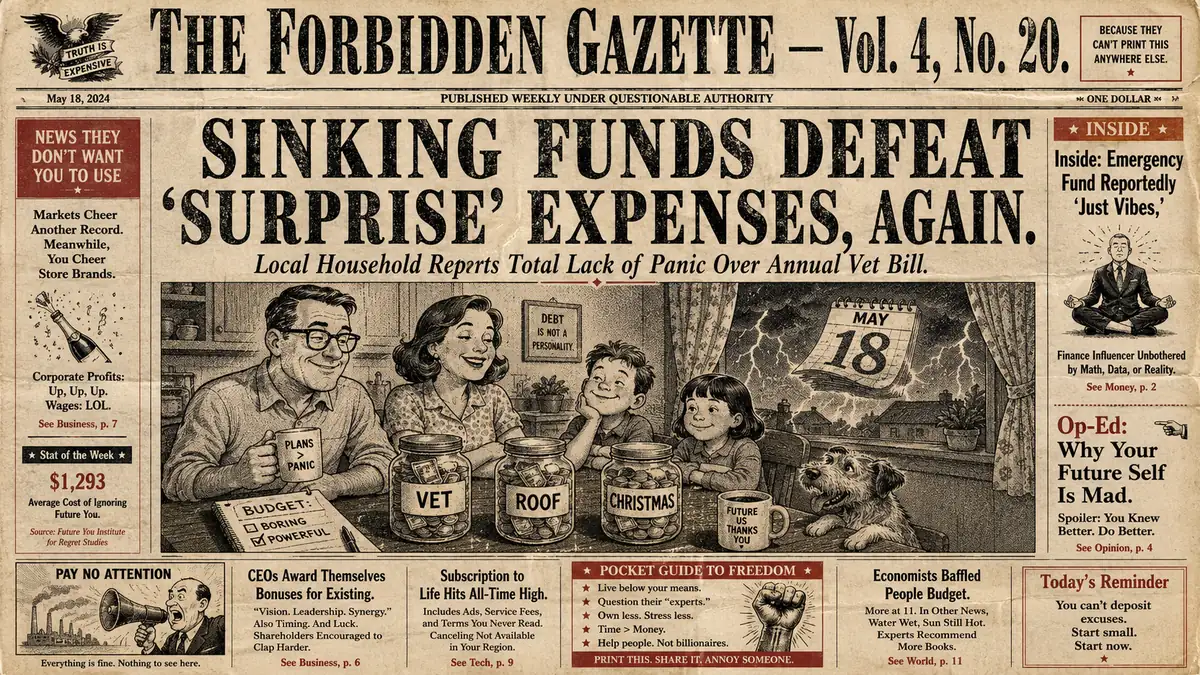
TL;DR: Sinking funds are for expected but irregular expenses. Emergency funds are for unexpected, catastrophic expenses. If the bill has a date, a season, a pattern, or a smug little habit of showing up every year, it belongs in a sinking fund.
The car insurance bill does not kick down your door like a villain in a low-budget thriller. It sends emails. It has a renewal date. It has done this before.
Same with holiday spending, back-to-school chaos, vet visits, annual subscriptions, summer camp deposits, professional licensing, and that appliance making a noise best described as financially threatening.
A sinking fund is the budget move that makes those expenses boring. Not free. Not magical. Boring. And boring is elite.
The Federal Reserve found that 63% of adults in 2024 could cover a $400 emergency expense completely using cash or its equivalent. That means a lot of people are one routine-but-lumpy bill away from calling it an emergency. The forbidden truth: many money emergencies are just predictable expenses that were never given a chair at the budget table.
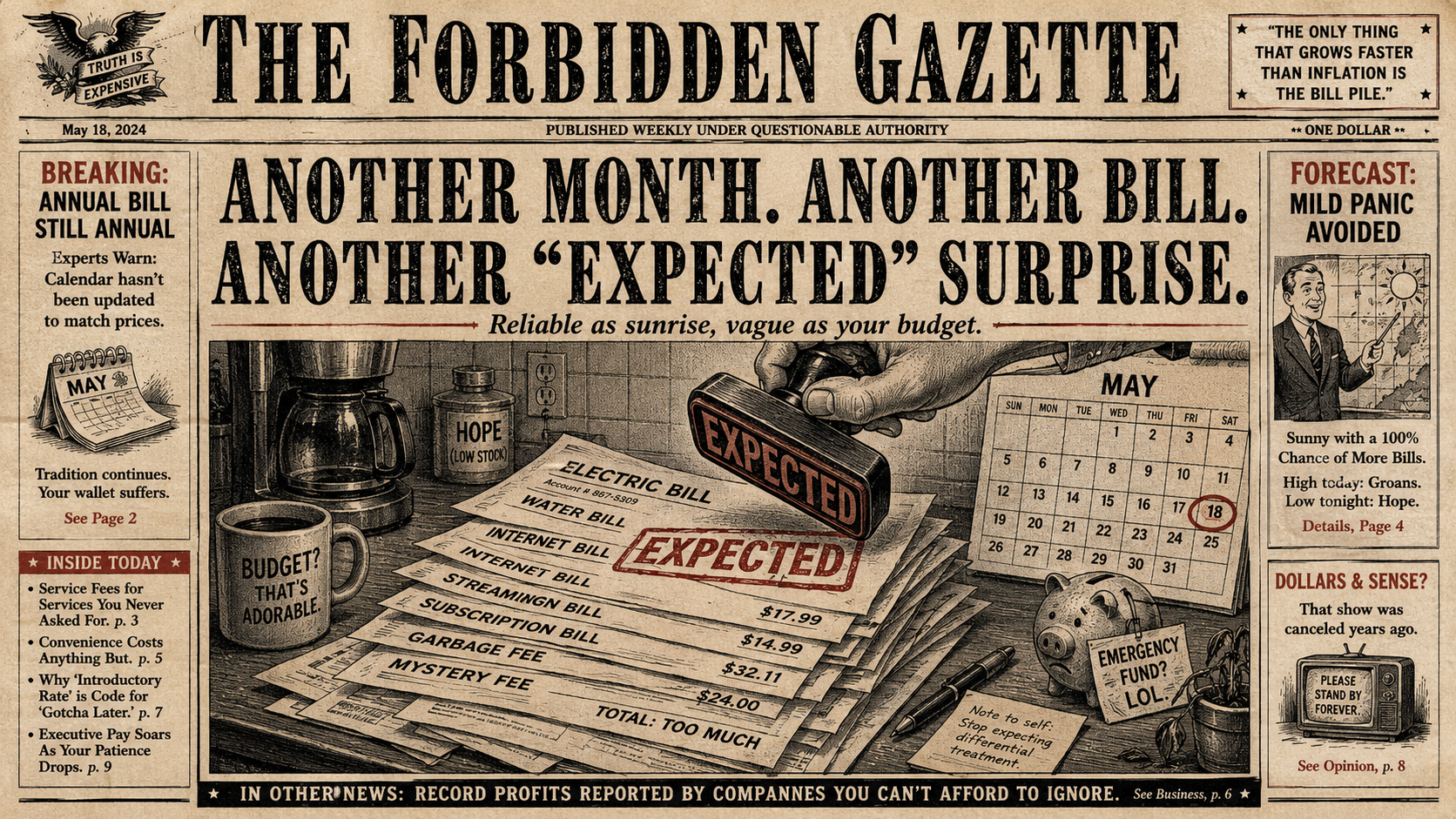
What Is a Sinking Fund?
A sinking fund is money you set aside a little at a time for a specific future expense.
That is the whole spell. No cape. No seminar. No app with 14 tabs and a dashboard that looks like mission control for a toaster.
The expense can be annual, seasonal, occasional, or long-range. The key is that it is expected. You may not know the exact dollar amount, but you know the category exists. Cars need maintenance. Kids have birthdays. Pets develop opinions at the vet. Holidays arrive with glitter, shipping deadlines, and a suspicious number of cheese boards.
The formula is stupidly useful:
Target amount ÷ months until you need it = monthly sinking fund amount.
If you need $1,200 for December and you start in January, you set aside $100 per month. When December shows up wearing a festive sweater and carrying receipts, the money is already there.
A sinking fund is not about being perfect. It is about refusing to act shocked by the calendar. The calendar has one trick. It repeats.
Sinking Fund vs. Emergency Fund
This distinction matters because people keep raiding their emergency fund for expenses that were never emergencies. Then a real emergency happens, and the account is sitting there like an empty snack bag.
Sinking funds are for expected, irregular expenses. They are known categories with uneven timing: annual insurance premiums, car repairs, holiday travel, school costs, medical copays, professional dues, property taxes, appliance replacement.
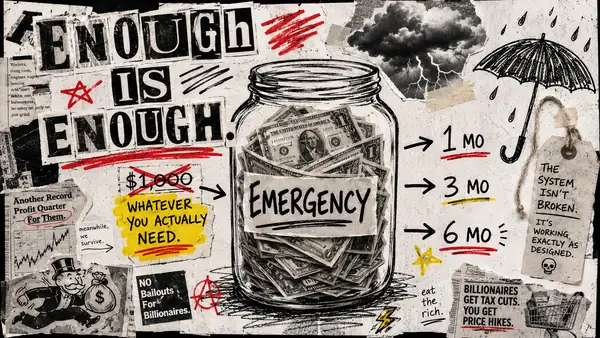
Emergency funds are for unexpected, catastrophic expenses. Job loss. A major medical event. An urgent home repair after a storm. The kind of thing where your first thought is not, 'Ah yes, the annual dishwasher explosion.'
The Federal Reserve frames emergency savings around unexpected expenses and income shocks. That is exactly where your emergency fund should stay: the actual chaos drawer, not the place you go fishing for Prime renewal money.
Here is the clean test:
- If you can name it in advance, it probably needs a sinking fund.
- If it is tied to a renewal date, season, mileage count, tax deadline, or aging object in your house, sinking fund.
- If it would make your household unstable and you could not reasonably plan the timing, emergency fund.
Forbidden finance move: stop using one vague savings pile called 'savings' and then feeling personally attacked every time real life asks for money.
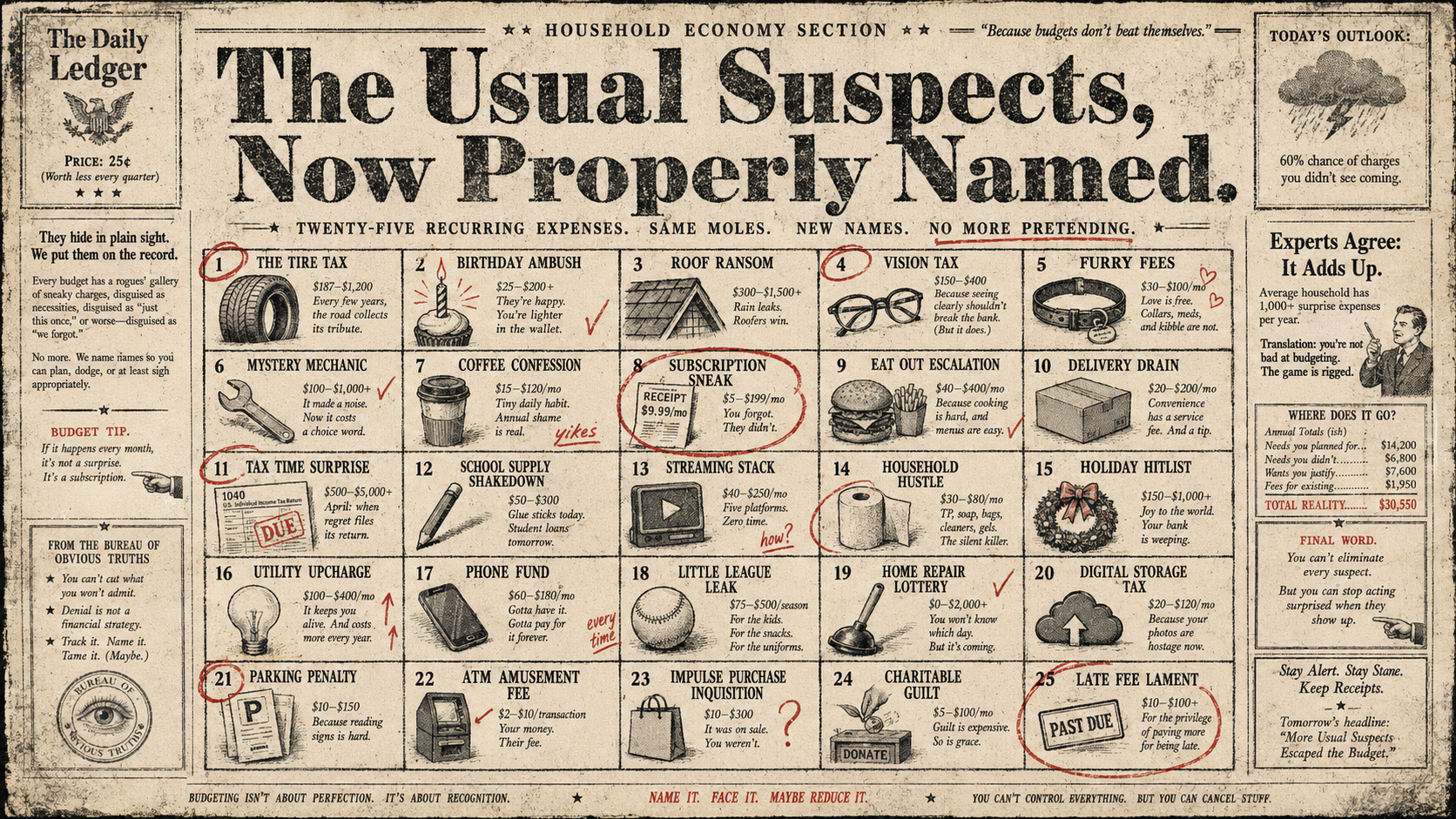
The 25 Categories Worth Naming
Households are expensive in boring, repeated ways. The BLS Consumer Expenditure Survey reported average annual consumer-unit spending of $78,535 in 2024, with transportation, housing, healthcare, entertainment, education, apparel, and insurance all taking meaningful bites. Translation: the budget is not being sabotaged by one latte. It is being nibbled to death by annual renewals, seasonal spending, and objects with motors.
For cars, AAA estimated the 2025 average cost to own and operate a new vehicle at $11,577, including insurance, registration, taxes, maintenance, repairs, and tires. For holidays, NRF said consumers planned to spend $890.49 per person on 2025 winter holiday gifts and seasonal items. For self-employed taxes, the IRS says Form 1040-ES is used to figure and pay estimated tax on income not subject to withholding.
Use the ranges below as starter targets, not commandments from a beige finance temple. Your real numbers win.
| Category | Typical Annual Amount Range | Monthly Equivalent |
|---|---|---|
| Annual car insurance premiums | $1,200-$2,400 | $100-$200 |
| Homeowners or renters insurance premiums | $200-$2,500 | $17-$208 |
| Vet bills and pet meds | $300-$1,500 | $25-$125 |
| Holiday gifts and hosting | $600-$2,000 | $50-$167 |
| Car maintenance and tires | $600-$2,000 | $50-$167 |
| Summer camp or childcare gaps | $500-$5,000 | $42-$417 |
| Costco renewal | $65-$130 | $5-$11 |
| Amazon Prime | $100-$180 | $8-$15 |
| Kids' birthdays | $200-$1,000 | $17-$83 |
| Taxes for the self-employed | Varies by income | Set aside a percentage of each payment |
| Replacement appliances | $300-$2,000 | $25-$167 |
| Eyeglasses or contacts | $150-$900 | $13-$75 |
| Professional licensing and continuing education | $100-$2,000 | $8-$167 |
| Home repairs and roof reserve | $600-$5,000 | $50-$417 |
| Medical copays and deductibles | $300-$3,000 | $25-$250 |
| Dental work | $200-$2,500 | $17-$208 |
| Back-to-school supplies and fees | $200-$1,200 | $17-$100 |
| Seasonal clothing and shoes | $300-$1,500 | $25-$125 |
| Travel and vacations | $600-$6,000 | $50-$500 |
| Weddings, graduations, and gifts | $200-$2,000 | $17-$167 |
| Property taxes | $1,000-$10,000+ | $83-$833+ |
| Vehicle registration and inspection | $100-$800 | $8-$67 |
| Phone or laptop replacement | $300-$2,500 | $25-$208 |
| Furniture or mattress replacement | $300-$3,000 | $25-$250 |
| Annual software, apps, and subscriptions | $100-$1,200 | $8-$100 |
Three Worked Examples
This is where sinking funds go from cute idea to 'oh, I can actually do this.' The math is deliberately plain. If a finance product needs cinematic onboarding to divide by 12, send it outside to think about what it has done.
- $1,800 annual car-insurance premium: $150 per month.
Formula: $1,800 ÷ 12 = $150. You create a category called Car Insurance. Every month, $150 goes in. When the premium hits, you pay it from that category. No drama, no credit card hangover, no pretending the bill appeared from a misty forest. For context, BLS reported average vehicle insurance spending of $1,993 in 2024, so this example is not exotic. - $1,200 holiday season: $100 per month.
Formula: $1,200 ÷ 12 = $100. This can include gifts, food, travel extras, decorations, postage, teacher gifts, office nonsense, and the emergency roll of wrapping paper purchased at a pharmacy for the price of a small lamp. The NRF holiday survey put 2025 planned winter holiday spending at $890.49 per person for gifts and seasonal items, so a household target of $1,200 is extremely believable. - $4,000 roof reserve every five years: about $67 per month.
Formula: five years is 60 months. $4,000 ÷ 60 = $66.67, rounded to $67. This will not buy every roof in America. Obviously. Roofs are basically houses wearing expensive hats. But a reserve means you are not starting from zero when the inspection report starts using words like 'active moisture.'
The tiny monthly number is the point. A $1,800 bill feels like a punch. $150 per month feels like a line item. Same money. Different blood pressure.
How to Set Them Up Without Opening Six Bank Accounts
You do not need a separate savings account for every sinking fund. Please do not turn your banking life into a junk drawer with routing numbers.
The cleaner structure is named budget categories with rolling balances. The money can live in one checking account, one savings account, or wherever your household keeps short-term cash. The budget category tracks the job of the money.
This is the same basic principle behind Zero-Based Budgeting: Give Every Dollar a Job (and Yes, 'Pizza Fund' Counts): every dollar has a name before it wanders off and becomes Target mist.
Example:
- Car Insurance balance: $600
- Vet balance: $220
- Holiday balance: $500
- Roof Reserve balance: $1,340
- Annual Subscriptions balance: $90
Your bank may show one savings balance of $2,750. Your budget shows what that $2,750 is for. That difference is enormous. It stops you from seeing a healthy savings balance and accidentally spending the roof money on patio furniture because the sun came out and you got ideas.
If you like envelopes, this is digital envelope budgeting without the part where you keep cash in paper sleeves and feel like you are running a tiny Victorian bank. See Envelope Budgeting: Your Grandma Was Right (But You Don't Need Actual Envelopes) for the cousin method.
What If Your Budget Is Already Tight?
Then start smaller. This is not a purity contest. Nobody is handing out gold stars for suffering in a spreadsheet.
The Federal Reserve reported that 51% of adults spent less than their income in the month before the 2024 survey, while 19% spent more than their income and 30% spent about the same. Many households do not have a giant cushion waiting around in a linen suit.
So do not start with 25 categories. Start with three.
Pick the expenses most likely to hurt you in the next six months. Usually that means an insurance renewal, a holiday or birthday season, and one car/home/pet category. Fund those first. The rest can wait in the lobby reading old magazines.
If the true monthly amount is too high, you have four options:
- Lower the target.
- Extend the timeline.
- Fund only part of the expense for now.
- Pause a lower-priority category.
For example, maybe the perfect holiday sinking fund is $100 per month, but you can only do $40. Fine. That still gives you $480 by December. Not perfect. Very useful.
This is where the forbidden frame matters. The rule depends. A household with volatile income, three kids, and a car held together by optimism needs a different setup than a single renter with no pets and a bus pass. For broader budget-fit questions, Which Budgeting Method Is Right for You? is the map.
How to Keep Sinking Funds From Turning Into Budget Theater
Budget theater is when the spreadsheet looks noble and your actual account looks like it lost a bar fight.
To avoid that, use a few boring rules.
First, name categories like a human. 'Annual Non-Monthly Obligations' sounds like a committee memo. 'Car Insurance' works. 'Vet' works. 'Christmas/Holidays' works. 'Kid Birthday Mayhem' works if it makes you remember what the money is for.
Second, let balances roll over. If you budget $75 for vet bills and spend $0 this month, next month the category has $150. That is the point. Do not zero it out because an app thinks the month ended and therefore reality reset. Reality did not reset. The dog is still aging.
Third, review once a month. Add what you planned. Adjust what changed. If your insurance premium jumps, update the monthly amount. If your kid ages into a more expensive birthday era involving venues and classmates and tiny paper cups, update it. The budget is a living document, not a stone tablet with subscription fees.
Fourth, audit recurring expenses. Sinking funds should not become a museum for charges you forgot to cancel. Annual subscriptions deserve suspicion. If you need a clean sweep, Your Forgotten Subscriptions Are Bleeding You Dry is the polite intervention with a clipboard.
Fifth, keep the emergency fund sacred. If the holiday category runs short, you reduce holiday spending or move money from another planned category. You do not drain the emergency fund because December had the audacity to arrive again.
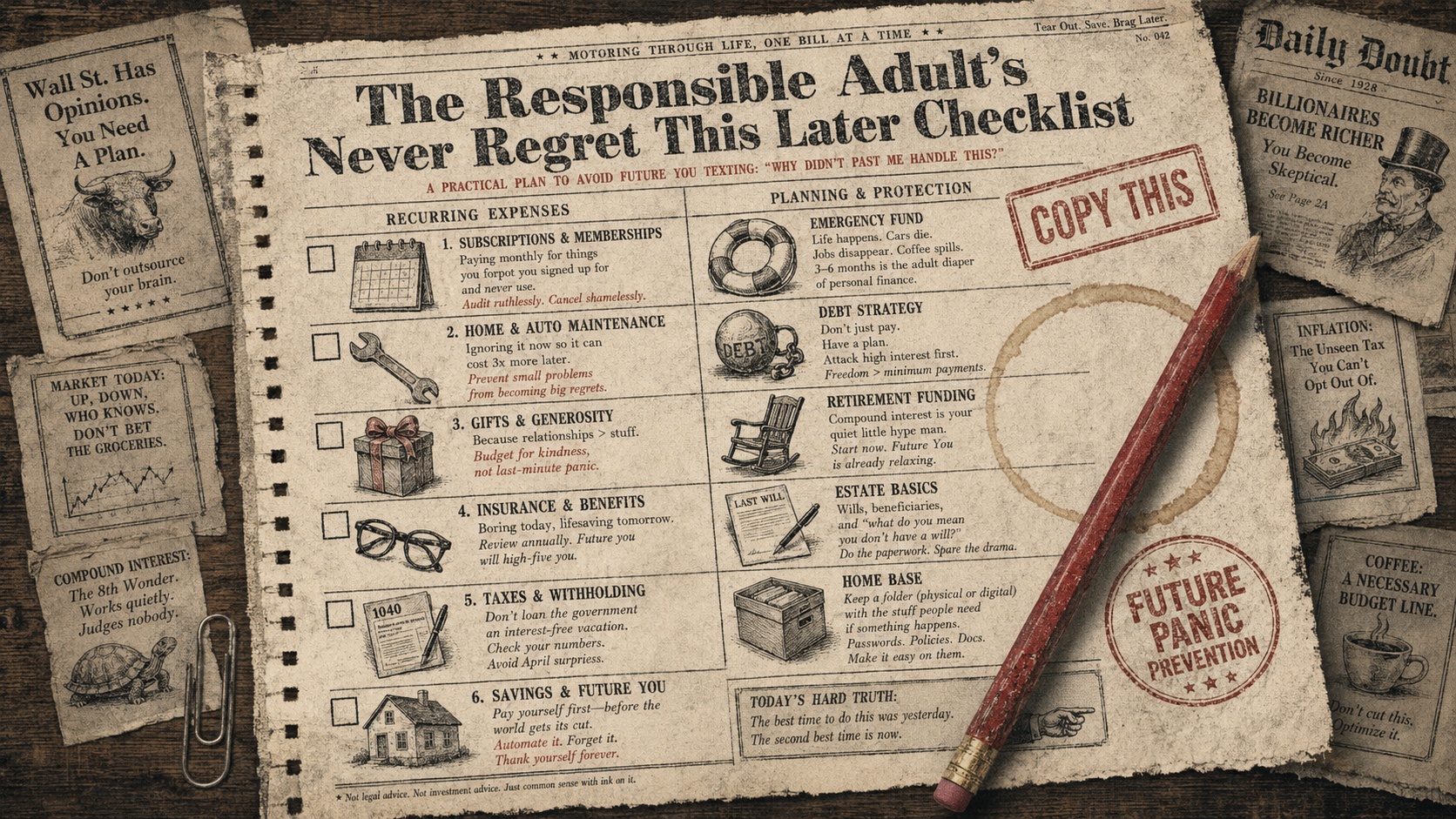
Copy This Starter List
Here is the starter version. Add it to your budget, notes app, spreadsheet, or whatever system you will actually open. Forbidden Finance supports any tool that does not make you feel like a raccoon in a password maze. Wait, no. Let us say: any tool that does not make you hate your life.
- Car insurance: target $____ by ____; monthly $____
- Home or renters insurance: target $____ by ____; monthly $____
- Car maintenance and tires: target $____; monthly $____
- Vet and pet meds: target $____; monthly $____
- Medical, dental, vision: target $____; monthly $____
- Eyeglasses or contacts: target $____ by ____; monthly $____
- Holidays: target $____ by ____; monthly $____
- Kids' birthdays: target $____ by ____; monthly $____
- Back-to-school: target $____ by ____; monthly $____
- Summer camp or childcare gaps: target $____ by ____; monthly $____
- Travel or vacation: target $____ by ____; monthly $____
- Weddings, graduations, and gifts: target $____; monthly $____
- Property taxes: target $____ by ____; monthly $____
- Self-employed taxes: set aside ____% of income
- Professional licensing: target $____ by ____; monthly $____
- Appliance replacement: target $____; monthly $____
- Roof or home repairs: target $____; monthly $____
- Vehicle registration: target $____ by ____; monthly $____
- Phone or laptop replacement: target $____; monthly $____
- Annual subscriptions: target $____; monthly $____
If you use a Pay Yourself First: The Forbidden Art of Not Tracking Every Latte setup, sinking funds can sit right beside your automatic savings. Pay the future bill before the present version of you spends the money on vibes and a mysteriously expensive sandwich.
The shift is simple: stop being surprised by the predictable. Once the predictable stops raiding your month, actual emergencies feel manageable. Still annoying. Still rude. But manageable.
Pick three categories. Set them up tonight. Future you will be deeply confused about why current you was ever stressed.
 Forbidden Finance