The Intro: Impulse Buying Is Not a Character Defect
Your cart has a sweater, a desk lamp, two skincare products, and something called a “travel cable organizer,” which is impressive because you do not travel and your cables currently live in a drawer like uncooked spaghetti.
That is not a moral failure. That is shopping infrastructure doing what shopping infrastructure was built to do: remove every pause between “huh, cute” and “your order is confirmed.”
A 2026 PartnerCentric consumer survey found that 81% of consumers had made at least one impulse purchase so far that year, while 53% said their budget was tighter than the year before. Tiny contradiction? No. Human behavior. You can be careful with money and still be ambushed by a targeted ad at 10:47 p.m. while eating cereal from a mug.
The forbidden move is not “never buy fun things.” Please. Joy is not a budget leak. The move is learning which wants deserve a yes, which deserve a pause, and which were created entirely by lighting, boredom, and a model wearing linen in a kitchen nobody actually cooks in.
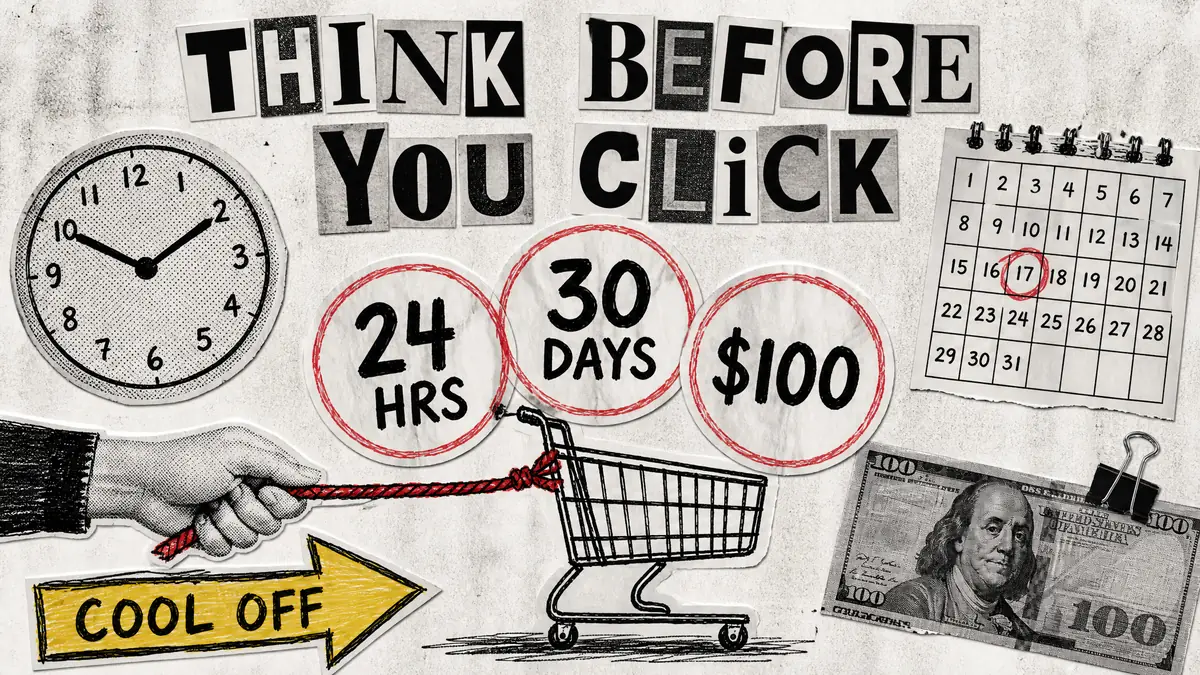
That is where three simple frameworks help: the 24-hour rule, the 30-day list, and the $100 test. They are not personalities. They are tools. Like Which Budgeting Method Is Right for You?, the right answer depends on the purchase, your cash flow, and whether your brain is currently being bullied by a flash sale.
The 24-Hour Rule: Let the Want Cool Off Overnight
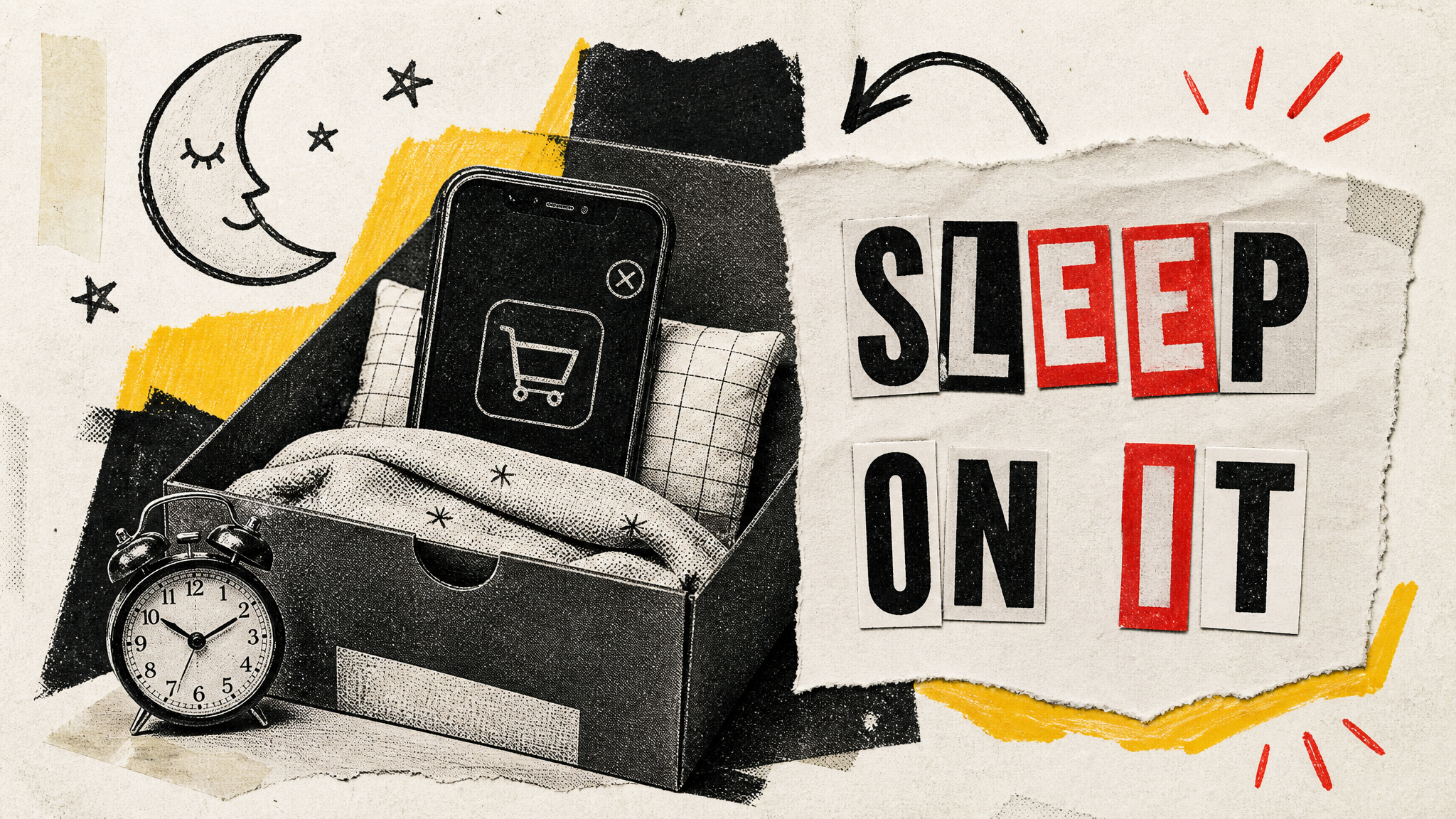
The 24-hour rule is brutally simple: if the purchase is not urgent, wait until tomorrow.
Not “keep the tab open and lovingly revisit it every nine minutes.” Not “watch six review videos until your algorithm decides this is your new religion.” Wait. Close the loop. Go be a person with blood sugar and laundry.
The science is not that sleep makes you virtuous. The science is that immediacy distorts value. A human intertemporal-choice study by Pine and colleagues found that increasing dopamine activity made people more impulsive by changing how they valued sooner versus later rewards. Translation: the “I want it now” signal is not an eternal truth carved into stone. It is a hot little flare. Give it hours and distance, and the flare often becomes, “Why was I about to buy a countertop nugget-ice machine?”
Use the 24-hour rule for social-media finds, late-night carts, limited-time offers, clothing, gadgets, decor, and anything described as “viral.” Viral is not a category. It is a warning label wearing lip gloss.
How to run it
Write down the item, the price, and why you want it. Then leave. If you still want it tomorrow, ask one boring question: where does this money come from?
If the answer is “my fun-money category,” enjoy. If the answer is “from the part of my checking account that was supposed to become groceries,” maybe the lamp can remain a JPEG.
This pairs well with The Real Cost of ‘Convenience’: Auditing Delivery, Subscriptions, and Same-Day Everything because most impulse buying is not about one dramatic mistake. It is a pile of small, frictionless yeses.
How people sabotage it
They keep browsing “just to compare.” They leave the cart open as a shrine. They decide the sale ending tonight is basically a hostage situation. They move from one store to another until the original want has reproduced into six cousins.
The rule only works if the pause is real. No feeding the want after midnight. The algorithm has enough snacks.
The 30-Day List: Make the Want Prove It Has Legs
The 30-day list is for wants that feel meaningful but not urgent. You write the thing down, along with the date and why you want it. Then you revisit it in a month.
Most wants are situational. You saw a beautiful ceramic dish and briefly became the kind of person who serves olives. You watched one home-office video and decided your productivity problem was a monitor light bar, not your inbox. Happens to the best of us. The list creates a little museum of former personalities.
The self-control research behind this is older than the internet’s relationship with “capsule wardrobe,” which is saying something. In Mischel, Shoda, and Rodriguez’s delay-of-gratification work, waiting was not just about white-knuckle willpower. Cognitive and attention strategies mattered. In adult money terms, writing the want down changes the task. You are not wrestling the purchase in the checkout aisle. You are moving it into a cooler room.
This is also why old-school methods like Kakeibo: The 122-Year-Old Budgeting Method That Still Slaps still work for some people. Writing things by hand is annoying in exactly the useful way. The annoyance is the feature. Forbidden, apparently.
When it works best
Use the 30-day list for hobby gear, furniture, wardrobe upgrades, kitchen gadgets, fitness equipment, and anything connected to an identity upgrade. Identity purchases are sneaky because they are not just selling you the item. They are selling you the version of yourself who owns the item, uses it daily, and somehow has matching containers.
If you still want it after 30 days, good data. If you forgot it existed, also good data. The list is not a prison. It is a receipt for your own attention.
How people sabotage it
They treat the list like a reservation system. They add the thing and mentally buy it anyway. They keep checking whether it is still in stock. They follow the brand. They watch unboxing videos. They “research” until desire looks like homework.
The 30-day list works because it starves the situational want. If you keep feeding it, do not act shocked when it gets bigger.
The $100 Test: Make the Money Feel Like Money Again
The $100 test asks one rude question: would you go to an ATM, withdraw $100 in cash, and hand it over for this?
Not tap. Not finance. Not split into four “basically nothing” payments. Not “I had store credit, so it was free,” which is adorable accounting and also false. Would you physically give up the cash?
This works because payment methods change how spending feels. Prelec and Loewenstein described the “pain of paying,” the immediate discomfort people can feel when money leaves them, and noted that cash tightly couples consumption with payment while cards weaken that connection. In normal-person language: cash makes the trade-off visible. Your phone makes it vanish behind a tiny animation and a cheerful ding. Very cute. Financially suspicious.
Use the $100 test for purchases that are easy to rationalize because the checkout is painless: electronics, beauty devices, home upgrades, event tickets, delivery bundles, subscription add-ons, and anything with a monthly payment that hides the full cost like it owes money to three cousins.
How to run it
If the item costs around $100, ask the question literally. If it costs more, ask whether you would hand over the first $100 in cash and still feel calm. If it costs less, ask whether you would rather keep the cash for something you already know matters.
This does not mean cash is morally superior. We are not starting a cult in the Coinstar aisle. It means friction can restore attention. If you use a digital envelope system, the same idea applies: make the money leave a named category before you buy. Envelope Budgeting: Your Grandma Was Right (But You Don’t Need Actual Envelopes) is basically this principle wearing sensible shoes.
How people sabotage it
They convert the price into points. They focus on the monthly payment. They use buy-now-pay-later because “it fits the budget,” while ignoring that four future versions of themselves now have tiny invoices. They say returns are free, as if returning things is not a second unpaid job involving tape, labels, and a printer that smells fear.
The meta-rule for bigger purchases
For purchases over $250, stack two frameworks.
Use the 24-hour rule plus the $100 test for expensive carts. Use the 30-day list plus the $100 test for identity purchases. Use the 24-hour rule plus the 30-day list when the item is not urgent but your brain is acting like civilization depends on linen pants.
Stacking works because each framework catches a different problem. The 24-hour rule cools the spike. The 30-day list tests whether the want survives real life. The $100 test brings back the pain of paying. One pause is useful. Two pauses are harder to sweet-talk.
| Framework | Best for | Why it works | Common sabotage |
|---|---|---|---|
| 24-hour rule | Flash sales, social-media finds, late-night carts, gadgets, clothes | It lets the immediate reward signal cool before you decide | Keeping the tab open, “researching,” treating sale timers as emergencies |
| 30-day list | Hobby gear, furniture, identity purchases, kitchen and fitness upgrades | It separates enduring wants from situational wants | Feeding the want with reviews, brand follows, and cart-checking |
| $100 test | Easy-click purchases, subscriptions, BNPL offers, large-but-rationalized buys | It restores friction and the pain of paying | Focusing on points, monthly payments, store credit, or free returns |
Wanting something now is data, not a verdict.
 Forbidden Finance