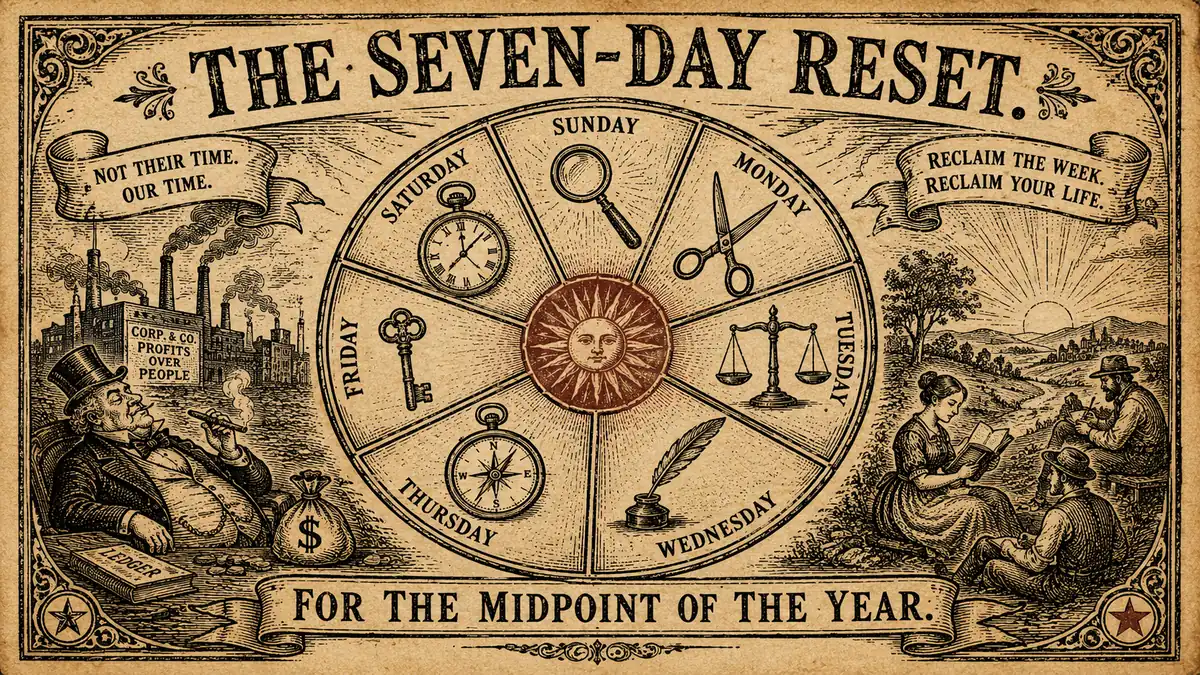
The Mid-Year Money Meeting You Can Actually Finish
July walks in holding your January goals and asking, “So, what happened here?” Rude. Accurate. Very on-brand for the calendar.
Maybe you saved more than expected. Maybe you spent $312 on “small” subscriptions because every app now thinks it deserves a monthly tribute. Maybe your brokerage account drifted into a portfolio that looks less like a plan and more like a group project where nobody read the prompt.
This is not a shame ritual. No candlelit ceremony where you confess that you ordered delivery during a stressful week. Forbidden Finance rules are simpler: look at the numbers, decide what still fits, and stop performing loyalty to systems your life already outgrew.
You need seven days. Thirty minutes a day. Three and a half hours total. That is less time than one airport delay, two bad meetings, or trying to cancel cable by phone.

TL;DR
• Days 1–2: net-worth snapshot, then subscription sweep.
• Days 3–4: review your savings rate, then rebalance investments.
• Days 5–6: check taxes, then re-rank your 2026 goals.
• Day 7: schedule four monthly reviews before life eats the calendar.
Day 1: Take a Net-Worth Snapshot
Start with the scoreboard. Not because your net worth defines you. It does not. Your dog and your favorite bartender do not care. Let’s not lie to ourselves, your kids probably do care. But net worth tells you whether your financial system is building, stalling, or quietly rolling downhill while smiling.
Open your banking, investing, retirement, debt, and cash accounts. Add up what you own. Subtract what you owe. Keep it boring: cash, investments, retirement accounts, home equity if you track it, student loans, credit cards, auto loans, and mortgage balance.
If you want the deeper version, pair this with How to Calculate Your Real Net Worth (and What the Number Actually Tells You). Today is the 30-minute version: enough truth to steer with, not enough detail to ruin your afternoon.
- What to do: Create one line for today’s total assets, one line for total debts, and one final number for net worth.
- What to look for: Big changes since January, debt that has not moved, cash that is too low, or investment growth hiding behind market noise.
- What good looks like: You know your current number, your biggest driver, and one account that needs attention.
Do not turn this into a forensic audit. If your number is approximate, fine. Precision is useful. Pretending a rough number is unknowable is just procrastination in a nicer shirt.
Day 2: Run the Subscription Sweep
Subscriptions are the weeds of personal finance. One day you sign up for a free trial to watch exactly one show. Six months later, your checking account is funding a streaming service, a meditation app you do not open, and software that apparently bills in ancient runes.
Pull the last 90 days of card and bank transactions. Search for monthly, quarterly, and annual charges. Use words like “membership,” “premium,” “renewal,” “app,” “cloud,” “streaming,” and “subscription.” Also search merchant names you barely recognize, because recurring charges enjoy aliases like minor criminals.
The goal is not to become joyless. Keep the things you use. Kill the things surviving on inertia. If you want the full hunt, Sub-Hunting: How to Find $50-$200/Month Hiding in Your Recurring Charges is the longer pass.
- What to do: List every recurring charge, its amount, billing frequency, renewal date, and whether you still use it.
- What to look for: Duplicate tools, annual renewals coming soon, subscriptions tied to old habits, and “cheap” charges that stack into rent-adjacent nonsense.
- What good looks like: You cancel or downgrade at least one thing, confirm the keepers, and note renewal dates before they ambush you.
One forbidden move: keep the subscription that genuinely improves your life, even if a spreadsheet glares at it. The latte is rarely the villain. The 14 forgotten charges are wearing the fake mustache.
Day 3: Review Your Year-to-Date Savings Rate
Your savings rate is the part of the plan that cuts through vibes. Income came in. Some of it stayed yours. How much?
The national backdrop is useful, but only as context. In its April 2026 personal income release, the BEA reported a 2.6% U.S. personal saving rate, with personal saving measured as a share of disposable personal income. That number is not your target. It is a reminder that savings rates are not moral traits. They are math under pressure.
For your own version, calculate year-to-date savings as money sent to retirement accounts, taxable investing, emergency savings, sinking funds, and debt principal above minimums if you count debt payoff. Divide by year-to-date take-home pay, or by gross income if that is how you usually track. Pick one. Use it consistently.
- What to do: Add your 2026 savings so far, divide by your chosen income measure, and write down the percentage.
- What to look for: A gap between your planned rate and actual rate, one-time expenses that distorted the number, or savings happening only when you remember.
- What good looks like: You know whether the January plan still works, and you make one automation or transfer adjustment before closing the tab.
If your rate is lower than planned, do not immediately declare yourself broken. Maybe childcare changed. Maybe rent jumped. Maybe your January plan was written by an optimistic stranger wearing your face. Adjust the system.
Day 4: Rebalance Investments to Your Target Allocation
Investments drift. That is their hobby. Stocks run, bonds lag, international perks up, cash piles up, and suddenly your “balanced” portfolio has the personality of a carnival ride.
Rebalancing is the act of bringing your portfolio back toward your target allocation. The point is not to predict the market. The point is to keep your risk from quietly changing while you are busy living a life, which is rude but common.
Vanguard frames rebalancing as a way to keep portfolio risk aligned with target risk exposure as asset returns diverge. Fidelity describes calendar, threshold, and hybrid approaches, including a threshold example where a position deviates by 5 percentage points or more from target. Translation: boring is allowed. Boring is often the point.
- What to do: Compare your current allocation to your target allocation across stocks, bonds, cash, and any major subcategories you track.
- What to look for: Any asset class more than about 5 percentage points from target, concentrated single-stock risk, idle cash, or accounts that no longer match their job.
- What good looks like: You either rebalance today or write the exact trades, transfers, or future contributions needed to move back toward target.
Use new contributions first if you can. Selling in taxable accounts can create taxes, which is the financial equivalent of finding a fee hiding inside a fee. In retirement accounts, rebalancing is usually cleaner, though your plan menu may still be a tiny museum of odd fund names.

Day 5: Check Taxes and Estimated Payments
Taxes are where a lot of tidy budgets go to be humbled. Especially if you have 1099 income, freelance work, consulting money, creator income, contract gigs, or the occasional “this side project got weirdly real” deposit.
The IRS says estimated tax is generally used to pay tax on income not subject to withholding, including interest, dividends, self-employment income, capital gains, and other sources. The IRS also says individuals generally must make estimated payments if they expect to owe at least $1,000 after subtracting withholding and refundable credits, and withholding plus credits will be less than the smaller of 90% of current-year tax or 100% of prior-year tax.
For the 2026 tax year, the post-July checkpoint you are staring at is September 15, 2026, listed as the third payment due date in the IRS 2026 Form 1040-ES. That is not “future you’s problem.” Future you has already filed a complaint.
Set a 30-minute timer. Estimate your year-to-date income, withholding, deductible expenses, retirement contributions, and self-employment income. If the numbers are messy, rough them in. A rough projection in July beats a perfect panic in April.
- What to do: Estimate total 2026 income, taxes already withheld or paid, and whether you need a September 15 estimated payment.
- What to look for: 1099 income with no tax set-aside, higher-than-expected profits, under-withholding, or deductible expenses you have not recorded.
- What good looks like: You know whether to increase withholding, set aside cash, make an estimated payment, or ask a tax pro before the deadline.
If your summer side income is the culprit, Summer Side-Hustle Money: How to Track It, Tax It, and Not Let It Disappear is the companion piece. The money is real. So is the tax bill. Annoying little pairing.
Day 6: Re-Rank Your 2026 Goals
January goals are made in January conditions. July is a different room. Income may have changed. Your rent may have changed. Your priorities may have changed. You may have discovered that one goal was not a goal at all, just peer pressure with a spreadsheet.
Write down every money goal you named for 2026. Emergency fund. Retirement contributions. Debt payoff. Vacation. House fund. Career move. New baby fund. Business cushion. Whatever made the list.
Now sort each into one of three buckets: still on track, needs adjustment, or drop it. Dropping a goal is not failure if the goal no longer fits. It is editing. People pay professionals to do that.
- What to do: Put each 2026 goal into “on track,” “adjust,” or “drop,” then assign one next action to every goal you keep.
- What to look for: Goals competing for the same dollar, goals you no longer care about, and goals that need a smaller version to stay alive.
- What good looks like: Your active goal list is shorter, clearer, and tied to current reality instead of January cosplay.
This is the forbidden part most finance advice skips. Your plan is allowed to change because your life changed. The system serves the life. Not the other way around.
Day 7: Schedule Four Monthly Money Dates
The final day is not another analysis session. It is calendar defense.
Open your calendar and schedule four monthly reviews: late July, late August, late September, and late October. Thirty minutes each. Same time if possible. Add a short agenda in the event description: net worth, subscriptions, savings rate, investments, taxes, goals.
Money dates sound precious, like something a couple in matching linen would discuss over herbal tea. Ignore the branding. The function is solid. You are creating a recurring checkpoint before the year becomes a holiday blur with receipts.
- What to do: Put the next four monthly reviews on your calendar with reminders and a short agenda.
- What to look for: Times you will actually honor, months with travel or deadlines, and a backup slot if the first one gets steamrolled.
- What good looks like: The next review already exists before motivation has a chance to wander off.
Keep the monthly version lighter than this reset. Ten minutes for net worth. Five for subscriptions. Five for savings. Five for investments. Five for whatever is currently on fire. That is enough to catch drift before it turns into a personality.
Three and a half hours, spread over a week. The half of the year you actually run.

 Forbidden Finance