You have $600 left after bills. Your savings account looks like a tip jar. Your credit card charges interest. Somewhere, someone is yelling that every spare dollar belongs to debt until you achieve financial purity.
Lovely. Does financial purity cover a tow truck?
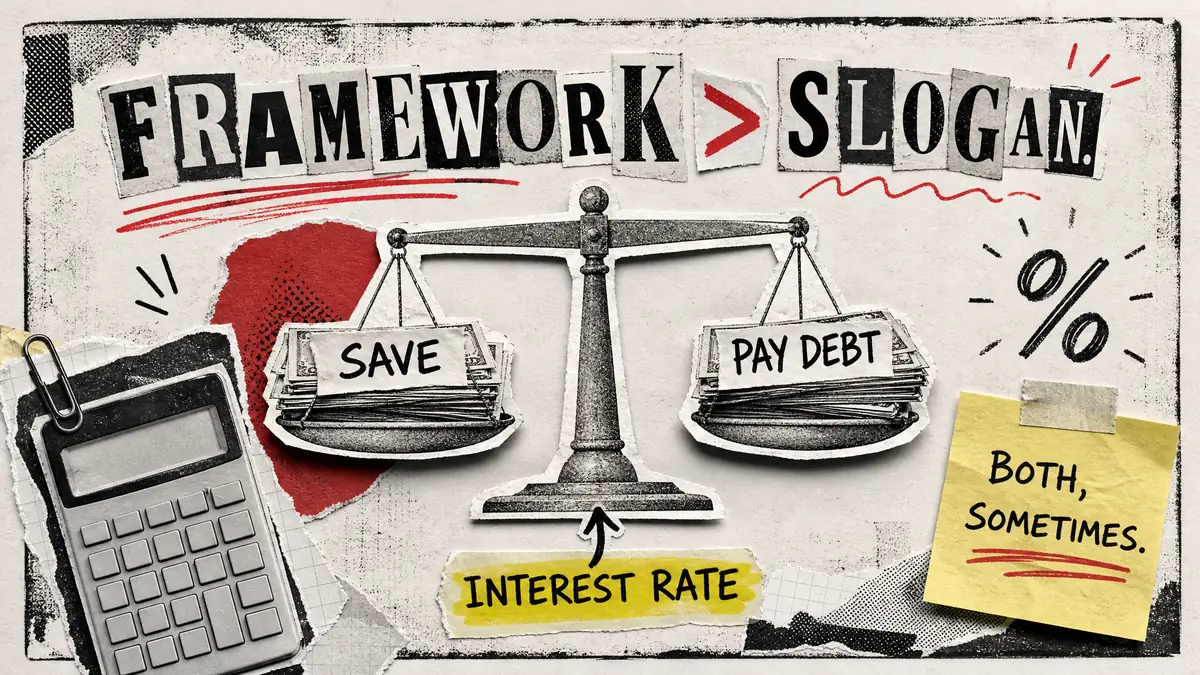
“Always pay debt first” gives you a direction. It skips the map: income, expenses, employer benefits, cash reserves, and which debt you’re actually carrying. Debt-free can be a great destination. Getting there requires a route that survives contact with your car, your paycheck, and your nervous system.

TL;DR
- Audit income, debts, and expenses; sometimes earning more is the first move.
- Capture the full employer match unless essentials and minimums consume everything, then build $1,000–$2,000 cash.
- Clear all bad debt, then build a separate three- to six-month emergency fund.
- Invest beyond the match, then weigh mortgage prepayments against investing and peace of mind.
1. Audit what you’re working with
Before assigning that $600, check that it exists.
List take-home income, every debt’s balance, interest rate, and minimum payment, and your expenses. Include irregular bills: insurance renewals do not become surprises because you’ve successfully ignored the envelope.
Subtract essentials and required payments. That’s the money available for this framework. If the result is zero or negative, the first job is creating breathing room.
Sometimes that means cutting an expense. Sometimes it means asking for a raise, finding a better-paying job, or adding income. There is a limit to what canceling subscriptions can do against a paycheck that doesn’t cover the household.
Repeat the audit periodically and after changes in work, rates, or family needs. Life keeps editing the spreadsheet.
2. Capture the employer match, with one exception
With money available after essentials and minimum payments, capture your full employer 401(k) match first.
Even a 25% match beats a 20%+ credit card on percentage alone. Contribute $100; a 25% match adds $25. That’s compensation you receive through saving. Your credit card offers no comparable employee-appreciation program.
That comparison isn’t an annualized investment return. The match is only yours once it vests. Check eligibility, the matching formula, and the vesting schedule, especially if you expect to leave soon.
Ask whether matching happens each paycheck and whether a year-end “true-up” replaces missed matching amounts. Payroll timing can matter even before you’re ready to invest beyond the match.
The exception: if essentials and minimums swallow your entire paycheck, focus on creating room and getting out of bad debt first. Come back to the match after escaping that squeeze.
No employer match? Move straight to cash.
3. Put $1,000 to $2,000 between you and the next surprise
Build a cash cushion before aggressive payoff. Our minimum is $1,000; aim toward $2,000 if you can.
The traditional $1,000 starter number has been around for about two decades. Inflation has eaten it. Using the BLS consumer price index via FRED, which rose from 182.6 in January 2003 to 336.298 in September 2026, that earlier $1,000 had the buying power of about $1,840 today.
One car repair or medical bill can eat $1,000 quickly. Send your last $800 to a card, then face a $650 repair with no cash, and you may borrow again. Excellent cardio for your checking account. Less excellent progress.
This cushion covers small surprises and timing hiccups. Keep it separate from dollars already promised to bills. If you use it, refill it before resuming aggressive extra payments.
The ‘Cash Cushion’ Most People Don’t Have but Should: 1 Month of Expenses in Checking explains the fuller target. At this stage, cap the cushion at $2,000 so the rest goes to debt. Later, it stays a cushion while you build a separate emergency fund.
4. Clear all bad debt before building the full emergency fund
Our position: pay off all bad debt before building the full emergency fund or investing beyond the match.
Bad debt includes high-interest borrowing and debt on things that lose value. Our payoff list includes credit card balances, car loans, personal loans, buy now pay later, and student loans. A low rate doesn’t automatically move these behind investing.
There is no truly good debt. A mortgage is the one debt we consider acceptable to carry.
Student loans belong on the payoff list, but often have lower rates and several small balances. Those individual loans may offer quick wins. A consolidated balance goes wherever its rate puts it in your chosen order.
Keep minimum payments current on every debt. Check promotional expiration dates, prepayment charges, and any forgiveness terms before accelerating a particular loan.
We support using credit cards and paying the statement balance in full, never carrying a balance. For a qualifying billing dispute, Regulation Z, 12 CFR 1026.13 lets you withhold the disputed amount during investigation, keeping that cash in your account; follow its notice requirements, including written notice within 60 days of the first statement showing the error. With debit, the money has already left checking: under Regulation E, 12 CFR 1005.11, banks generally have 10 business days to investigate, or up to 45 days with provisional credit by day 10, extended to 90 days for some transactions, including point-of-sale debit card purchases. For a family without spare cash, that gap hurts.
5. Choose a payoff order you can keep following
The snowball targets the smallest balance first while you pay minimums elsewhere. Each cleared account gives you a quick win and a payment to roll into the next debt.
The avalanche targets the highest interest rate first. With the same payment budget and terms, it minimizes interest.
Our rule of thumb: when rates sit within roughly five percentage points of each other, the snowball often costs little extra, so take the wins. Balances and payoff time still matter; check the actual comparison.
If a big balance sits roughly 10 or more percentage points above the others, don’t leave it collecting expensive interest behind cheaper debts. Avalanche it.
A hybrid works too: clear anything you can wipe out in one to two months, then avalanche the rest. Whichever method you choose, roll freed payments forward.
Debt Snowball vs. Debt Avalanche: How to Pick the Payoff Method That Fits Your Debts walks through the comparison. The method should keep you paying consistently without giving a very expensive balance an extended vacation.
6. Build the full emergency fund
Bad debt gone? Redirect those payments toward a separate emergency fund covering three to six months of expenses. Also finish bringing your everyday cash cushion toward one month of expenses.
The cushion handles small disruptions. The emergency fund handles bigger trouble, such as losing income. They have different jobs, even if both occasionally get blamed on the car.
Use Emergency Fund Math: How Much Is Actually Enough in 2026? to set the reserve around your household’s income stability, dependents, and essential costs. Keep it accessible.
7. Invest beyond the match, and watch contribution windows
With bad debt cleared and the full emergency fund built, increase investing beyond your employer match.
For 2026, the IRS sets the base employee 401(k) contribution limit at $24,500 and the IRA limit at $7,500. Those are under-50 limits; catch-up provisions can increase them. IRA eligibility and deductibility depend on your circumstances.
For ordinary workplace salary deferrals, Fidelity’s 2026 tax-planning guidance identifies December 31 as the final contribution date for 401(k)s and 403(b)s. Your payroll cutoff can arrive earlier.
The IRS’s 2026 reporting instructions specify April 15, 2027 for traditional and Roth IRA contributions designated for 2026. That’s the ordinary deadline; applicable relief can change it.
Unused room generally can’t be carried forward. Check payroll timing to protect your match throughout the year, then use remaining eligible room at this stage. A closing window doesn’t justify emptying your cushion or skipping ahead while bad debt remains.
For the investing branch, start with Investing 101 for People Who Already Have a Budget.
8. Weigh mortgage math against the relief of fewer obligations
Now the interest-rate spread gets a proper seat at the table: should extra money prepay your mortgage or go toward investing?
The spread compares the debt’s effective interest cost with returns elsewhere, accounting for applicable taxes and fees. Expected investment returns carry uncertainty. Forecasts have been known to embarrass people wearing expensive suits.
The expensive-debt comparison is straightforward. The Federal Reserve’s October 7, 2026 G.19 release puts August’s rate for commercial-bank credit card accounts assessed interest at 22.36%. In a simplified illustration, $1,000 outstanding for a year at 22% costs about $220; $1,000 earning a hypothetical 4% produces $40 before tax. Actual balances and compounding change the totals, without rescuing that spread.
A 4% mortgage presents a different tradeoff. Prepayment produces known interest savings under the loan’s terms. Investing may produce more over a long horizon, but stocks can lose value. Compare cash yields after tax and investment expectations with their risks attached.
Then price the relief. Maybe every mortgage statement makes your shoulders climb toward your ears. You’re allowed to care.
In The Red and the Black, Drazen Prelec and George Loewenstein model how payment obligations and enjoyment interact. Their account of debt aversion offers a useful lens: unpaid balances can carry psychological weight beyond the interest bill.
Choosing to prepay a low-rate mortgage for peace of mind is a values choice. Name the possible opportunity cost: “Fewer obligations help me sleep.” Perfectly legitimate. No need to dress your nervous system in a spreadsheet costume.
Protect your reserves and choose sustainable payments, possibly alongside investing. Values-Based Budgeting: Spend Money on What Actually Matters (Forbidden Concept, We Know) helps make that preference visible.
Your decision tree, with room for being human
Start with the audit, then follow the first applicable row. Keep essentials and minimum payments covered throughout.
| Situation | Do this | Then do this | Then do this |
|---|---|---|---|
| Your numbers are unclear | Audit income, debts, and expenses | Find available cash or income opportunities | Repeat the audit periodically |
| Essentials and minimums consume everything | Create breathing room | Focus on getting out of bad debt | Return to the match after the squeeze |
| Available employer match is missing | Check vesting and payroll rules | Capture the full match | Build the cash cushion |
| Your starter cushion is missing | Save at least $1,000 | Aim toward $2,000 | Direct further surplus to bad debt |
| Bad debt remains | Choose snowball, avalanche, or hybrid | Clear all bad debt | Build full reserves |
| Bad debt is gone | Build three to six months of emergency savings | Finish the everyday cushion | Invest beyond the match |
| Only the mortgage remains, with reserves funded | Review investing and contribution windows | Compare mortgage cost with uncertain returns | Weigh relief and revisit the choice |

Review the choice when your rate, income, family, or stress level changes. The plan can update without a disciplinary hearing.
There is no one right answer. There’s the right answer for your interest rate and your nervous system.
 Forbidden Finance