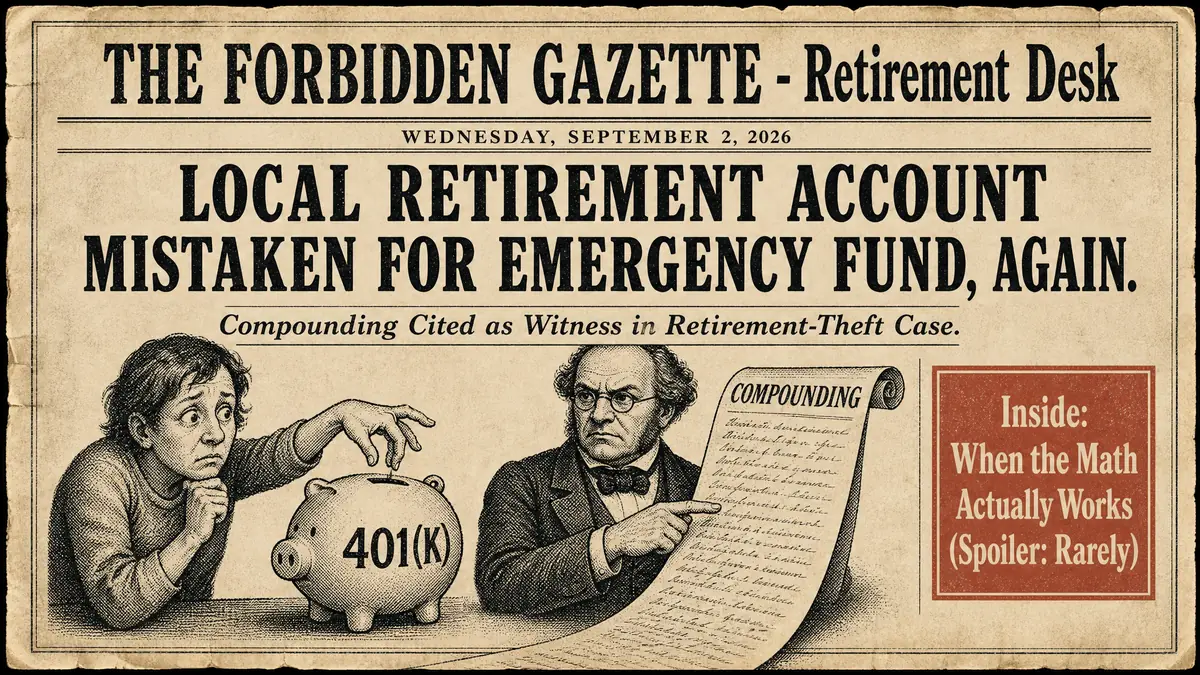
First, the Forbidden Position
The 401(k) loan button is usually sitting there in the benefits portal like a vending machine with better typography. Click, confirm, wait a few days, money appears. Dangerous magic.
And yes, sometimes life is not being cute. A foreclosure notice is not a budgeting lesson. A disability crisis is not a character flaw. A credit card charging 29% interest is not a tiny inconvenience, it is a blender with your paycheck in it.
Still, the rule is blunt: tapping your 401(k) is almost always the wrong move. Not because you are bad if you need money. Because the account is doing one very specific job, and that job is not replacing the transmission, paying the dentist, or covering rent after payroll decided to cosplay as chaos.
For 2026, the IRS set the basic 401(k), 403(b), governmental 457, and TSP employee deferral limit at $24,500, with a general age-50 catch-up limit of $8,000 and a higher age-60-to-63 catch-up of $11,250. That is the front door. Loans and hardship withdrawals are the side door with a flickering light.
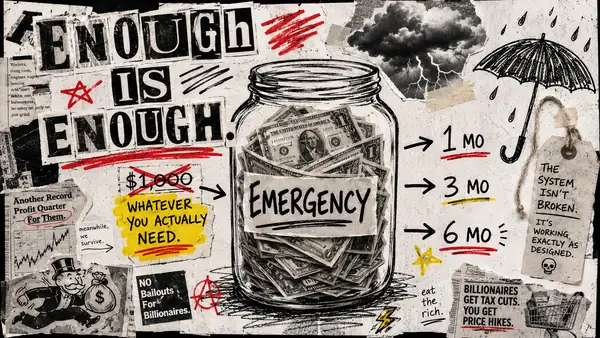
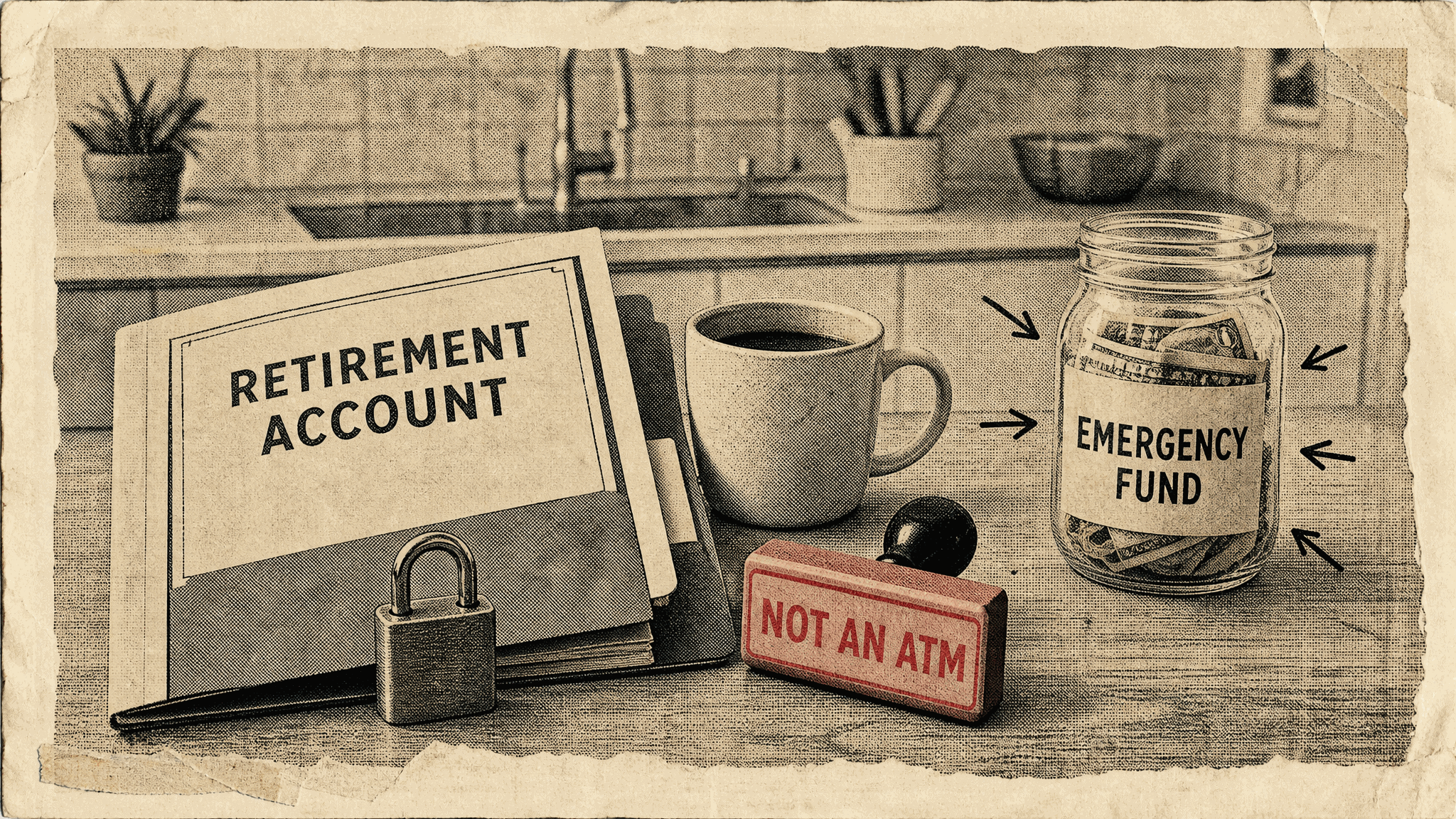
If you are reading this before raiding retirement, read Emergency Fund Math: How Much Is Actually Enough in 2026? next. The least glamorous cash bucket in your life may be the thing that keeps your future self from sending present-you a strongly worded letter.
TL;DR
- A 401(k) loan is not free money; it is future money dragged into the present wearing a fake mustache.
- A hardship withdrawal is worse because the money usually leaves permanently and may trigger tax plus penalties.
- The math can work in rare emergencies, but boring cash beats retirement surgery.
401(k) Loan Mechanics: The Trap Door With Payroll Deduction
A 401(k) loan is exactly what it sounds like: you borrow from your own vested plan balance and repay the plan, usually through payroll deductions. You are not applying to a bank. You are interrupting your retirement account mid-sentence.
The IRS says plans may allow loans, but they do not have to. If your plan allows them, the usual maximum is the lesser of 50% of your vested account balance or $50,000. If 50% of your vested balance is less than $10,000, the plan may allow up to $10,000, but it is not required to be that generous. Benefits departments love optional generosity the way airports love reasonably priced sandwiches.
Most 401(k) loans must be repaid within five years, with payments at least quarterly. There is a longer-period exception for loans used to buy a primary residence. If you leave your job with a loan outstanding, your plan may require faster repayment. If you miss the deadline, the unpaid amount can become a taxable distribution.
That job-change risk matters. The study Borrowing from the Future? 401(k) Plan Loans and Loan Defaults found that while about 90% of loans were repaid overall, 86% of workers who left an employer with a loan outstanding failed to repay the balance. The trap door opens fastest when your paycheck changes buildings.
Also, yes, you pay interest to yourself. This sounds soothing. A little too soothing. The interest does go back into your account, but the borrowed money is out of the market while the loan is outstanding, and the repayments come from your paycheck. If the payment makes you lower new contributions or miss an employer match, congratulations, the loan brought friends.
Before touching the loan button, open your plan documents and fee disclosures. How to Read Your 401(k) Statement (and Spot the Fees Eating Your Retirement) is useful here because loan fees, maintenance charges, and investment options are often hiding in plain sight, wearing beige.
| Dimension | 401(k) loan | Hardship withdrawal |
|---|---|---|
| Must your plan allow it? | Yes | Yes |
| Is it repaid? | Yes, if you follow the schedule | No |
| Typical limit | Usually lesser of 50% vested balance or $50,000 | Limited to the amount needed for the hardship |
| Taxes at the time | Usually not taxable if compliant | Usually taxable if pre-tax money |
| 10% early penalty risk | Usually avoided unless the loan defaults | Often applies before age 59 1/2 unless an exception applies |
| Main danger | Job loss or missed payments can turn it into a taxable distribution | Permanent account reduction plus taxes and possible penalty |
| Emotional marketing name | Borrowing from yourself | Hardship relief |
| More honest name | Future-you invoice | Retirement money leaving the building |
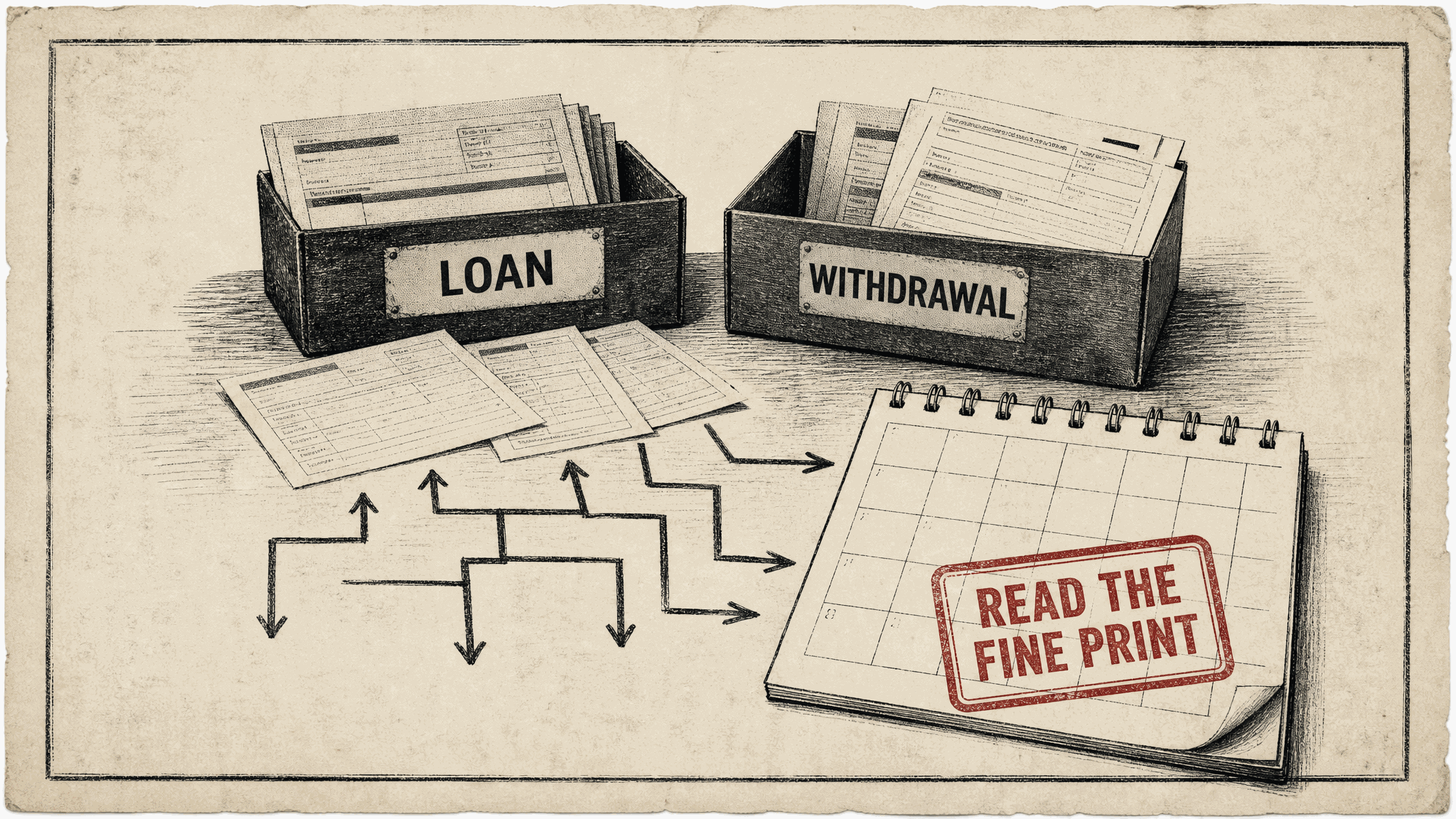
Hardship Withdrawal Mechanics Under SECURE 2.0
A hardship withdrawal is not a loan. It is a withdrawal. The money comes out, gets taxed if it was pre-tax, and generally does not go back in. That is why it deserves a colder stare.
The IRS says a 401(k) hardship distribution must be because of an immediate and heavy financial need and must be limited to the amount necessary to satisfy that need. Safe-harbor categories include certain medical expenses, costs tied to buying a principal residence, tuition and related education costs, payments needed to prevent eviction or foreclosure, funeral expenses, and certain expenses to repair damage to your principal residence.
Read that again. A hardship withdrawal can be allowed for something serious, but allowed does not mean painless. The IRS also says hardship distributions are taxable and are not repaid to the account. The retirement account does not refill itself because you whispered sorry at the login screen.
SECURE 2.0 added more flexibility around certain emergency distributions, but it did not turn your 401(k) into a penalty-free snack drawer. Under IRS Notice 2024-55, an emergency personal expense distribution can be used for unforeseeable or immediate financial needs related to necessary personal or family emergency expenses. The amount treated this way is capped at $1,000 per calendar year, is included in gross income, is not subject to the 10% additional tax, and can generally be repaid within three years.
That $1,000 exception is helpful. It is also small. One emergency room bill can look at $1,000 and laugh with its whole chest.
There are other 10% penalty exceptions too. The IRS lists exceptions for total and permanent disability, death, certain disaster recovery distributions, certain domestic-abuse victim distributions, qualified birth or adoption distributions, and more. Taxes may still apply. The penalty exception is not a magic eraser. It is one fewer bad thing on the invoice.
The Opportunity-Cost Math
This is the part everybody wants to skip because the number is ugly and does not come with a tiny violin.
Say you take a $20,000 401(k) loan at age 35 and repay the principal over five years. A simple planning model says the real damage is not only the loan balance. It is the growth the $20,000 missed while it was out of the market, plus the years of compounding on that missed growth.
Here is the rough version. Assume the borrowed $20,000 would otherwise have stayed invested from age 35 to age 40, then the gap compounds from age 40 to 65. This isolates the opportunity cost of the five-year interruption. It does not count plan loan interest you pay back to yourself, and it does not count extra damage from pausing contributions, losing a match, paying loan fees, or defaulting after a job change. Translation: real life can be nicer or much ruder.
| Assumption | At age 40 if left invested | Principal restored after loan | Gap at age 40 | Gap grown to age 65 |
|---|---|---|---|---|
| 7% annual return | $28,051 | $20,000 | $8,051 | $43,696 |
| 8% annual return | $29,387 | $20,000 | $9,387 | $64,284 |
That is how a $20,000 loan can still cost roughly $44,000 to $64,000 in lost growth by age 65, even when you repay it. The missing growth becomes its own little retirement villain. Polite. Compounded. Annoying.
The broader data explain why this matters. Vanguard’s How America Saves 2026 reported record 86% participation among eligible employees and 69% of participants in professionally managed allocations. The system is getting better at helping people stay invested. A loan interrupts the exact machine built to make inertia useful.
The EBRI/ICI 401(k) database report found that 77% of 401(k) participants were in plans allowing loans at year-end 2023, but only 15% of loan-eligible participants had loans outstanding. That is the good news. Most people are not treating the 401(k) like a debit card with a vesting schedule.
Still, one bad tap can matter. Especially at 35. Time is not garnish in retirement math. Time is the meal.
The Rare Defensible Cases
There are exceptions. Not loopholes. Not vibes. Actual cases where the math or the emergency may justify the move after you compare every other option.
High-interest debt avalanche where the math actually works
If you are paying 28% or 32% credit card interest, and your 401(k) loan rate is far lower, the arithmetic can favor using a loan to kill the debt faster. But the bar is higher than “this feels efficient.”
You need a written payoff plan, no new card spending, continued 401(k) contributions at least up to the match if possible, and a repayment schedule that does not break your cash flow. Otherwise you did not solve the debt problem. You moved it behind a nicer login.
For the grind after the obvious early wins, The ‘Boring Middle’ of Debt Payoff — and How to Stay in the Game is the right companion piece. Debt payoff is not only math. It is also staying with the plan when the plan stops feeling dramatic.
Foreclosure or eviction prevention
If the choice is between preserving a retirement balance and keeping your household housed, the spreadsheet should sit down and use an indoor voice.
The IRS includes payments needed to prevent eviction from, or foreclosure on, a principal residence among hardship safe-harbor needs. That does not mean withdraw automatically. It means this is one of the few cases where retirement-account access may be defensible because the alternative can be financially catastrophic.
Before you do it, ask the mortgage servicer or landlord about payment plans, forbearance, local assistance, and legal timelines. A hardship withdrawal that buys real time can be rational. A withdrawal that delays the same outcome by three weeks may just feed the furnace.
Disability, terminal illness, or severe medical hardship
If disability or serious illness changes your income, expenses, or life expectancy, normal optimization advice can become wildly inappropriate. This is not the moment for a stranger on the internet to yell “never touch retirement.” That would be both useless and tacky.
The IRS lists total and permanent disability as an exception to the 10% additional tax for qualified plans and IRAs, and IRS guidance under SECURE 2.0 also addresses terminally ill individual distributions. You still need tax guidance because penalty-free does not always mean tax-free.
The defensible move here is not “withdraw because hardship exists.” It is “coordinate benefits, insurance, taxes, cash needs, and retirement access in the least destructive order available.” Less catchy. Much better.
Closing: Hands Off Unless the Math Has a Lawyer
The forbidden personal-finance answer is rarely “never.” Never is easy to write and often lazy to live with. Real lives are messier than clean rules, and sometimes the 401(k) is the least terrible option on the menu.
But least terrible is not the same as good.
A 401(k) loan can become a tax bill if your job changes. A hardship withdrawal can permanently shrink the account. SECURE 2.0 emergency access helps at the edges, but $1,000 does not turn retirement savings into a full emergency plan. And the compounding math is merciless because it has no hobbies.
Your first line of defense is cash outside the plan. Your second is a budget system you will actually use. Your third is boring prevention: insurance deductibles funded, sinking funds named, consumer debt attacked, and retirement left to do retirement things. For a bigger view of where your account should be by age, read How Much Should You Have Saved by 30, 40, 50, 60? Honest Benchmarks (and What to Do If You’re Behind).
So yes, there are exceptions: high-interest debt payoff where the numbers truly work, foreclosure prevention where the alternative is worse, and disability or severe hardship where normal advice needs to make room for reality.
For everything else, hands off the 401(k). The money has a job.
Your retirement account is not your emergency fund. That’s why you have an emergency fund.
 Forbidden Finance