Your Bills Have Formed a Small Gang
Your checking balance says $782. Groceries will cost $96. Unfortunately, the electric bill, car payment, insurance, and phone bill have booked the same five-day window. Payday arrives afterward, apparently for dramatic effect.
You can afford your month. You cannot comfortably afford this particular Tuesday.
The fix worth trying: keep one month of expenses visibly in checking, separate from emergency savings. A cash cushion. Money whose entire purpose is so you don’t have to do mental math at the grocery store.
Financial breathing room is hardly universal. In its 2025 household survey, published in May 2026, the Federal Reserve found that 63% of adults would cover a hypothetical $400 emergency exclusively with cash or its equivalent, including a credit card paid off at the next statement. That does not mean everyone else lacks $400.
It does make “just absorb it” feel like rather ambitious household policy.

What a Cash Cushion Actually Does
The cushion absorbs ordinary timing problems: payday after rent, a late-cycle grocery trip, four perfectly predictable bills arriving like an unpleasant barbershop quartet.
It stays in the checking account you use. You see it whenever you check your balance. Its job is access and breathing room.
A September 2026 JPMorgan Chase Institute report notes that checking cash covers about two to three weeks of outflows for the median individual in its Chase customer data. That is useful context, not proof that every household needs the same checking balance.
Aim for one month of expenses, not one month of income.
If you bring home $5,000 and normally spend $3,600, your cushion target is $3,600. Include housing, utilities, groceries, transportation, insurance, debt payments, childcare, and ordinary discretionary spending. Your actual life gets counted, including the coffee that makes other humans tolerable.
Average three representative months. Count card purchases or the payments covering those purchases, never both. Keep separately funded annual expenses out of this calculation.
That $3,600 is extra working cash, beyond money already committed to upcoming spending. Temporarily dipping below it is allowed. Payday replenishes it.
Say your usual pre-payday balance is $80, and $300 of bills arrive before a $2,000 paycheck. Without a cushion, you’re $220 short. Add the $3,600 reserve, and the same sequence leaves $3,380 before payday. The paycheck then arrives and the account recovers. Nothing in your life got cheaper. The calendar simply lost its ability to corner you.
You still check upcoming bills. You just stop asking whether buying chicken today requires an emergency transfer and a small congressional hearing.
What It Isn’t
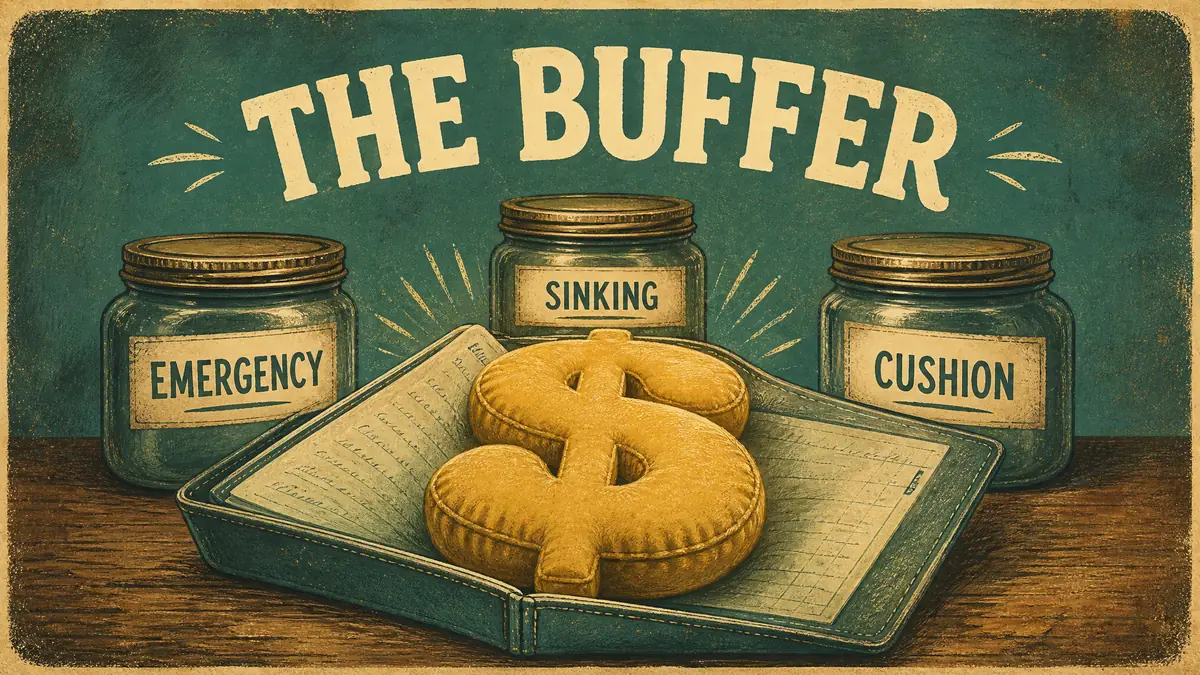
Your emergency fund handles genuine disruptions: job loss, urgent repairs, a medical expense you couldn’t reasonably plan for. Keep that reserve in a high-yield savings account, mentally untouchable during ordinary weeks and available when an emergency actually happens.
Emergency Fund Math: How Much Is Actually Enough in 2026? covers sizing that separate reserve.
A sinking fund has a named future purchase or bill: annual insurance, replacement tires, holiday travel. December does not qualify as a surprise plot twist.
For those buckets, read Sinking Funds Explained: The One Habit That Makes ‘Surprise’ Expenses Disappear.
| Account | Where it lives | When you touch it |
|---|---|---|
| Cash cushion | Your everyday checking account | Ordinary bills and spending land before income; replenish as pay arrives |
| Emergency fund | A separate high-yield savings account | A genuine financial disruption or urgent unexpected expense |
| Sinking fund | A named savings account or savings bucket | The designated purchase or bill comes due |

These are three jobs. The same $1,000 cannot cover all three simultaneously, however enthusiastically your spreadsheet believes in teamwork.
How to Build It in 60–90 Days
1. Week One: Name the Number
Review your statements, calculate your monthly expenses, and write down the target.
Then identify any checking money genuinely left over after upcoming commitments. If $600 is already unassigned, a $3,600 cushion needs another $3,000.
Rent money waiting for the first isn’t unassigned. Neither is the cash covering last week’s card purchases. We are counting money, not auditioning it for two roles.
Set milestones: $250, $500, one week’s expenses, then the full month. Partial breathing room still counts.
2. Pick a Payday Contribution That Exists
Divide the remaining target by the paychecks actually arriving within your chosen window.
For that $3,000 gap:
- Six paychecks require $500 each.
- Four paychecks require $750 each.
Use your calendar, not an imaginary monthly paycheck that never visits.
If the result would leave essentials unpaid, change the timeline. Building a full month’s expenses from scratch in 60–90 days requires substantial spare cash. A household with $150 available each month does not become a $1,000-a-month saver through improved attitude.
Start smaller. Keep going.
3. Leave the Money in Checking
On payday, earmark your contribution as cushion money and leave it there instead of spending it or sweeping it into another account. Add a budget category or account note so the bigger balance doesn’t impersonate disposable income.
Find contributions through temporary changes you choose: pause an optional purchase, redirect a canceled subscription, sell unused gear, or assign part of a bonus. Keep essentials and minimum debt payments covered.
Don’t empty emergency savings merely to complete this exercise. Moving the same reserve between accounts doesn’t create another reserve.
For uneven paychecks, contribute from stronger deposits rather than scheduling a transfer that assumes next Friday will be generous. Building a Budget That Survives an Irregular Income explores that setup.
4. Test the Awkward Weeks
Map the next month’s paydays and bill dates. Watch the lowest projected balance, including pending payments and routine grocery spending.
The Consumer Financial Protection Bureau found in its 2018 bill-payment research that suggesting due-date changes to align bills with income could help some consumers manage cash flow.
Ask billers whether dates can move, and confirm when changes take effect. Less bill congestion helps while you build.
By day 60, review progress. By day 90, check whether the cushion survives your most crowded bill week. If it doesn’t, adjust the amount or timeline. The deadline is a planning tool, not a parole hearing.
Common Mistakes That Eat the Cushion
Treating the balance as spending permission. A $4,800 balance with a $3,600 cushion doesn’t automatically mean $1,200 is free. Subtract upcoming commitments first. The bank app doesn’t know you promised the dentist money.
Refusing to use it. If bill timing temporarily takes your cushion from $3,600 to $2,900, let the next paycheck restore it. This money is allowed to move. Otherwise you’ve given checking money a museum security detail.
Letting every dip become permanent. A cushion handles timing; it cannot indefinitely fund spending above income. If it shrinks across several pay cycles, review expenses, income, and due dates.
Forcing a month because an article said so. One month is a useful starting target. You might begin with $500 or need more for volatile income. Update it when childcare, housing, or your work changes.
If calendar anxiety is your main money problem, this could be the biggest stress reducer you try: groceries stay groceries, bills get paid, and your emergency fund stops receiving routine evacuation orders.
One month of breathing room. The most boring upgrade your nervous system has ever taken delivery of.
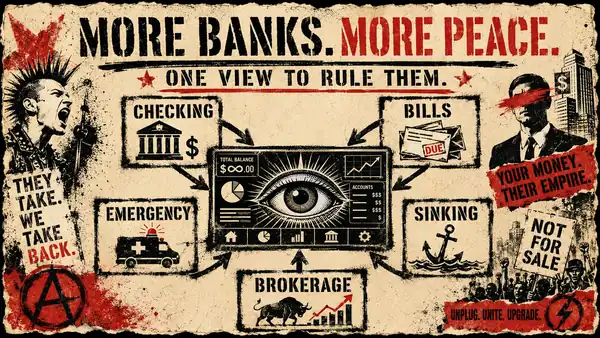
 Forbidden Finance