Three payment reminders light up your phone before you’ve finished your coffee. You have extra money to send somewhere. Which balance gets it?
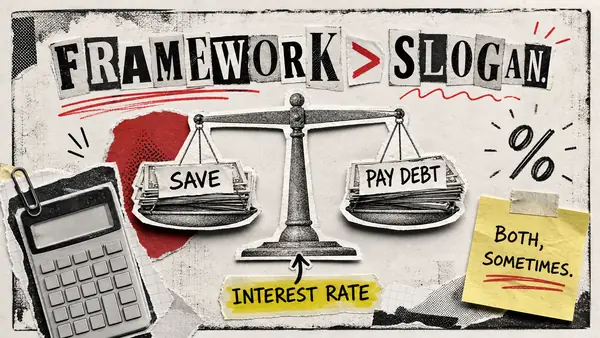
Debt snowball vs. debt avalanche is a choice about order: buy an early win by clearing a small balance, or cut interest by attacking the highest rate. Both deserve a fair hearing. Neither requires joining a financial religion with unusually strong opinions about spreadsheets.

TL;DR
- Snowball clears the smallest balances first, giving you earlier wins and fewer bills.
- Avalanche targets the highest interest rates first, minimizing interest when payments and other terms stay equal.
- Favor snowball for similar rates, avalanche for a large expensive balance, or a hybrid for both.
How the debt snowball works
Snowball puts your debts in order from smallest balance to largest, regardless of interest rate.
To start tomorrow:
- Write down every balance, annual percentage rate (APR), minimum payment, and due date.
- Pay the minimum on every debt.
- Send every extra dollar available for payoff to the smallest balance.
- Once it’s paid off, roll its entire payment into the next-smallest debt, including the minimum you no longer owe.
- Repeat until the list is empty.
Choose the extra payment from money left after essentials and your cash cushion. Put due dates somewhere you’ll actually see them, and schedule the minimums if your cash flow allows. Then make the separate target payment. A beautiful ranking buried in an unopened notebook has the same practical value as a gym membership you only visit by direct debit.
Keep that total monthly payoff budget steady as balances disappear. Otherwise, the snowball melts into takeout. Understandable physics; unhelpful financing.
The appeal is visible progress: early wins, fewer monthly bills, and momentum. A balance actually reaches zero. Your brain gets evidence that this enormous project has an exit.
There’s research behind that appeal. In their 2012 Journal of Marketing Research study, “Can Small Victories Help Win the War? Evidence from Consumer Debt Management”, David Gal and Blakeley McShane found that closing accounts predicted eventual debt elimination in debt-settlement data, regardless of the balances closed. That’s an association, not proof that snowball wins for everyone.
Remi Trudel also addressed repayment allocation in Harvard Business Review in 2016. The underlying Journal of Consumer Research study, by Kettle, Trudel, Blanchard, and Häubl, found that concentrating repayments boosted motivation, especially when focused on the smallest accounts.
The downside: snowball usually costs more interest when it leaves expensive balances waiting. Those early wins can have a price tag.
How the debt avalanche works
Avalanche uses the same mechanics with a different queue: highest interest rate first, then work downward.
Pay every minimum. Put all extra payoff money toward the highest-rate debt. When it’s gone, move its whole payment to the next-highest rate. For equal rates, clearing the smaller balance first gives you a convenient tiebreaker.
With the same payment budget, fixed rates, and ordinary loan terms, avalanche minimizes total interest. Less interest can also mean finishing a little sooner. The Consumer Financial Protection Bureau describes the savings advantage and the motivational trade-off of waiting for a large first balance to disappear.
The rate stakes are substantial. The Federal Reserve’s October 7, 2026, G.19 release reports a 22.36% rate for credit card accounts assessed interest in August 2026.
Use the APR to rank debts, rather than the size of the required payment. A bigger minimum doesn’t automatically mean a more expensive rate. Check the statements again if rates change; your target can change with them. The queue has permission to move.
The drawback arrives when your most expensive debt is also enormous. You make payments, watch the balance shrink, and still have exactly the same number of bills. The spreadsheet doesn’t need confetti. You might.
If you choose avalanche, track progress within the balance as well as completed debts. The ‘Boring Middle’ of Debt Payoff — and How to Stay in the Game helps with the months that feel like stirring cold porridge.
Same debts, both ways
Here are two simplified illustrations supplied by our editors. Each assumes interest accrues monthly, minimums are paid first, then $300/month extra goes to the target debt. Freed-up minimums roll forward.
Example A: rates close together. You owe $1,200 at 19% (minimum $35), $4,500 at 22% (minimum $110), and $9,000 at 24% (minimum $220), plus $300/month extra.
Example B: small cheap loans ahead of an expensive card. You owe $900 at 6% (minimum $40), $3,000 at 6% (minimum $60), and a $10,000 credit card at 27% (minimum $300), plus $300/month extra.
| Example | Method | Months to debt-free | Total interest |
|---|---|---|---|
| A: Rates close together | Snowball | 30 months | About $4,761 |
| A: Rates close together | Avalanche | 29 months | About $4,495 |
| B: Small cheap loans, expensive card | Snowball | 26 months | About $4,119 |
| B: Small cheap loans, expensive card | Avalanche | 25 months | About $3,023 |
| B: Small cheap loans, expensive card | Hybrid: clear $900, then avalanche | 25 months | About $3,245 |

In Example A, snowball costs about $270 more. You might gladly pay that for earlier wins. Fair trade, if it helps you keep going.
Example B is less forgiving. Snowball costs about $1,100 more than avalanche because the expensive card waits behind cheaper loans. The hybrid buys one fast win for about $220 more than pure avalanche. Motivation has a receipt now (metaphorically; please stop collecting actual receipts in your glove compartment).
These figures illustrate the trade-offs. Your results depend on your balances, terms, and payment timing.
The hybrid
Our default hybrid: clear any balance you can wipe out within one to two months of extra payments, then switch to avalanche for everything remaining.
You get a quick finish and then direct the growing payment toward expensive debt. Combining methods is permitted. Nobody confiscates your calculator.
Set the switch before you start. Keep minimums current, finish the qualifying small balance, and immediately reorder the remaining debts by rate. Another tempting small debt doesn’t automatically get to extend the detour.
Example B shows the trade-off for clearing $900 first; our usual one-to-two-month cutoff is tighter. Treat that example as a priced option, rather than a reason to let every cheap loan jump the queue.
Which one should you use
Here’s 403 Finance’s default decision rule:
- Rates within roughly 5 percentage points of each other: choose snowball and take the wins. The extra interest is often a relatively small trade-off.
- A large balance roughly 10 percentage points or more above the others, behind smaller cheaper debts: choose avalanche. The “snowball tax” can become real money.
- You want a quick win and interest savings: use the hybrid, then stick to the switch.
Those cutoffs are our practical guidelines. Balances, time spent waiting, and your extra payment matter too; a rate gap alone cannot tell you the dollar cost. Compare the projected totals before deciding what motivation is worth to you.
If snowball keeps you making payments and avalanche leaves you avoiding the account login, you have permission to choose snowball. Make that choice with the cost visible.
For rates between those rough thresholds, start with avalanche unless you know an early completed balance would help you persist. The method should fit your habits, much like the choices in Which Budgeting Method Is Right for You?.
At each review, ask whether you’re making the planned extra payments, whether the target still makes sense, and whether the budget leaves room for ordinary life. If your income drops, resize the payment before frustration turns into abandoning the plan.
You can change your order later. There is no breakup paperwork.
Where student loans fit
We count student loans as bad debt to clear. That’s our payoff framework, with no verdict attached to your education or your younger self’s signature.
They’re often lower-rate than credit cards and split into several smaller loans, so individual balances frequently land in a hybrid plan’s quick-win bucket. Check each balance and rate separately. A consolidated large balance slots wherever its rate puts it.
One servicer login can hide several loans. Convenient interface; surprise nesting dolls.
Before prepaying aggressively, check the protections. Federal Student Aid explains that federal loans carry benefits private loans typically don’t, including income-based repayment options, eligible payment relief, and forgiveness or discharge pathways.
Eligibility depends on your loans and circumstances. Review your current options with your servicer before sending a large extra payment, especially if you’re pursuing forgiveness. Our preference for clearing debt still leaves room for benefits worth preserving.
Where payoff fits in the bigger plan
Choosing an order helps once you have money available to pay extra. First, find out what your situation can actually support.
Here’s 403 Finance’s sequence:
- Audit your situation. List income, every debt, and expenses. Repeat periodically and after major changes. The Mid-Year Money Reset: A 10-Step Audit to Run Before June Hits gives you a structure you can use in any month. Sometimes the right first move is earning more. You can’t cancel enough streaming services to fix an income gap bigger than the television.
- Capture any employer 401(k) match. Our exception: if you’re living paycheck to paycheck with nothing left over, come back to the match after the bad debt is gone.
- Build a $1,000 to $2,000 cash cushion. How to Build a $1,000 Emergency Fund in 90 Days (Even on a Tight Budget) offers a starting plan. This cushion gives an urgent expense somewhere to land besides a credit card.
- Pay off ALL bad debt. We include high-interest debt plus debt on things that lose value: credit card balances, car loans, personal loans, buy now pay later, and student loans. Student loans remain included under our framework even though education isn’t a depreciating object.
- Then build a full emergency fund covering 3 to 6 months of expenses. Once those payments disappear, redirect the money toward that larger reserve.
A mortgage is the one debt we consider acceptable to carry. Credit cards themselves are fine to use; carrying a balance is the problem.
Keep essential bills and required minimums covered throughout. If the audit shows you can’t cover those, work on cash flow and repayment arrangements first. Choosing a target doesn’t manufacture an extra payment.
This sequence is our clear starting position. Your household gets to account for the actual people, protections, and paychecks involved.
Pick an order you can keep
Tomorrow, gather the statements, write down the rates, protect the minimums, and choose one target. Put a review date on your calendar.
The best payoff method is the one you’re still running in month nine. By then, the novelty has left the group chat. Your plan should still work.
 Forbidden Finance