TL;DR: Month nine of debt payoff is not where discipline goes to die. It is where the novelty is gone, the old life still looks expensive, and the finish line has the audacity to remain distant. The fix is not more shame. It is smaller finish lines, boring automation, and tiny rewards that do not restart the mess.
By month one, you had a spreadsheet. Maybe a color-coded one. Maybe a dramatic debt-free date circled like it was a court summons.
By month nine, the spreadsheet has become a beige little goblet of truth. You open it, sigh, and see that after all that effort, after the canceled subscriptions and the grocery math and the heroic refusal to finance a couch, you are still not done.
That is the boring middle.
It matters because consumer debt is not exactly a rare hobby. In its May 7, 2026 G.19 release, the Federal Reserve reported $1.337 trillion in seasonally adjusted revolving consumer credit outstanding for March 2026. Translation: you are not uniquely bad at money. You are participating in a very popular national group project with terrible snacks.
Debt is a math problem. Month nine is a psychology problem.

The Boring Middle Is Real
The annoying thing about motivation is that it behaves less like a reliable employee and more like a houseplant you forgot to water.
Behavioral research has a name for part of this: goal-gradient theory. In The Goal-Gradient Hypothesis Resurrected, Kivetz, Urminsky, and Zheng found that people tend to increase effort as they get closer to a reward. Coffee-card people bought coffee faster as the free cup got nearer. Internet users worked harder for rewards as the reward got closer.
Great. Lovely. Wonderful for the last 10%.
Month nine is usually not the last 10%. It is the hallway. Fluorescent lights. No windows. Someone keeps saying you are doing amazing, which somehow makes it worse.
There is research for that too. Stuck in the Middle: The Psychophysics of Goal Pursuit argues that motivation can be higher near the beginning and near the end, then sag in the middle. That does not mean your plan failed. It means your brain is having a very normal reaction to delayed payoff.
Personal finance advice loves to pretend you should be equally excited on day 270 as you were on day 1. This is rude and fictional. Month one has novelty. Month twenty-two has glory. Month nine has a $43 interest charge and a freezer full of chicken thighs.
So stop asking month-nine you to feel inspired. Ask month-nine you to stay operational.
Make the Finish Line Closer on Purpose
Your debt-free date may still be a year away. That is too far for your brain to chew. It needs smaller bites. Not fake progress. Real progress, chopped into visible chunks.
This is where micro-milestones earn their rent.
Research on small wins lines up with what snowball fans have been yelling about for years. In Small Victories: Creating Intrinsic Motivation in Savings and Debt Reduction, Brown and Lahey found that breaking unpleasant tasks into smaller parts can create motivational gains, and participants completed unequal task parts faster when arranged from smallest to largest.
That does not mean everyone should abandon the avalanche and tattoo smallest balance first on their forearm. Calm down, internet. It means progress markers matter.
If you chose the snowball, your micro-milestones may be account closures. If you chose the avalanche, they may be interest-rate graduations. If you built a custom mutant system after reading Which Budgeting Method Is Right for You?, fine. Forbidden finance rule: the right system is the one you can keep using after your life gets weird.
- Every $1,000 retired. Track the total principal you have killed, not just what remains. Going from $31,400 to $30,400 is not visually sexy. Going from $0 paid off to $1,000 paid off is a tiny parade.
- Every account closed. Snowball people, this is your confetti cannon. Closing a balance removes a monthly decision, a login, and one more little gremlin from the list.
- Every interest-rate tier graduated. Avalanche people, celebrate when the nastiest APR is gone and your next dollar moves to a lower-rate target. Less interest is not flashy. Neither is plumbing. You still need it.
- Every scary number crossed. Under $20,000. Under $10,000. Under $5,000. These thresholds are arbitrary, yes. So are birthday candles, and nobody complains when cake is involved.
The milestone is not there to impress anyone. It is there to make progress visible before the final victory lap.
Automate the Boring Stuff
Minimum payments are not the strategy. They are the guardrail.
Set the minimum payment to autopay on every card and debt account where it makes sense, preferably from an account that carries a real buffer. The CFPB says automatic payments can help make sure bills are paid on time, while also warning that you still need enough money in the account to avoid overdraft or nonsufficient-funds fees. So yes, automate. Also look at your bank balance. Two things can be true.
The point is not to let autopay run your whole life while you stare into the middle distance. The point is to stop spending willpower on remembering minimums so you can spend attention on the payments that actually shorten the timeline: your avalanche payment, snowball payment, or whatever extra principal attack your plan uses.
Minimums keep you current. Extra payments move the date.
That distinction matters because interest is still doing push-ups in the background. In the same current G.19 release, the Federal Reserve listed the average rate on credit card accounts assessed interest at 21.52% for Q1 2026. At that kind of rate, an extra $78 is not cute. It is a tiny jailbreak.
If automation is your style, this overlaps with the logic in Pay Yourself First: The Forbidden Art of Not Tracking Every Latte. Automate the parts that should happen no matter how tired you are. Keep the manual energy for the choices that need judgment.
Use Snowflakes When They Fall
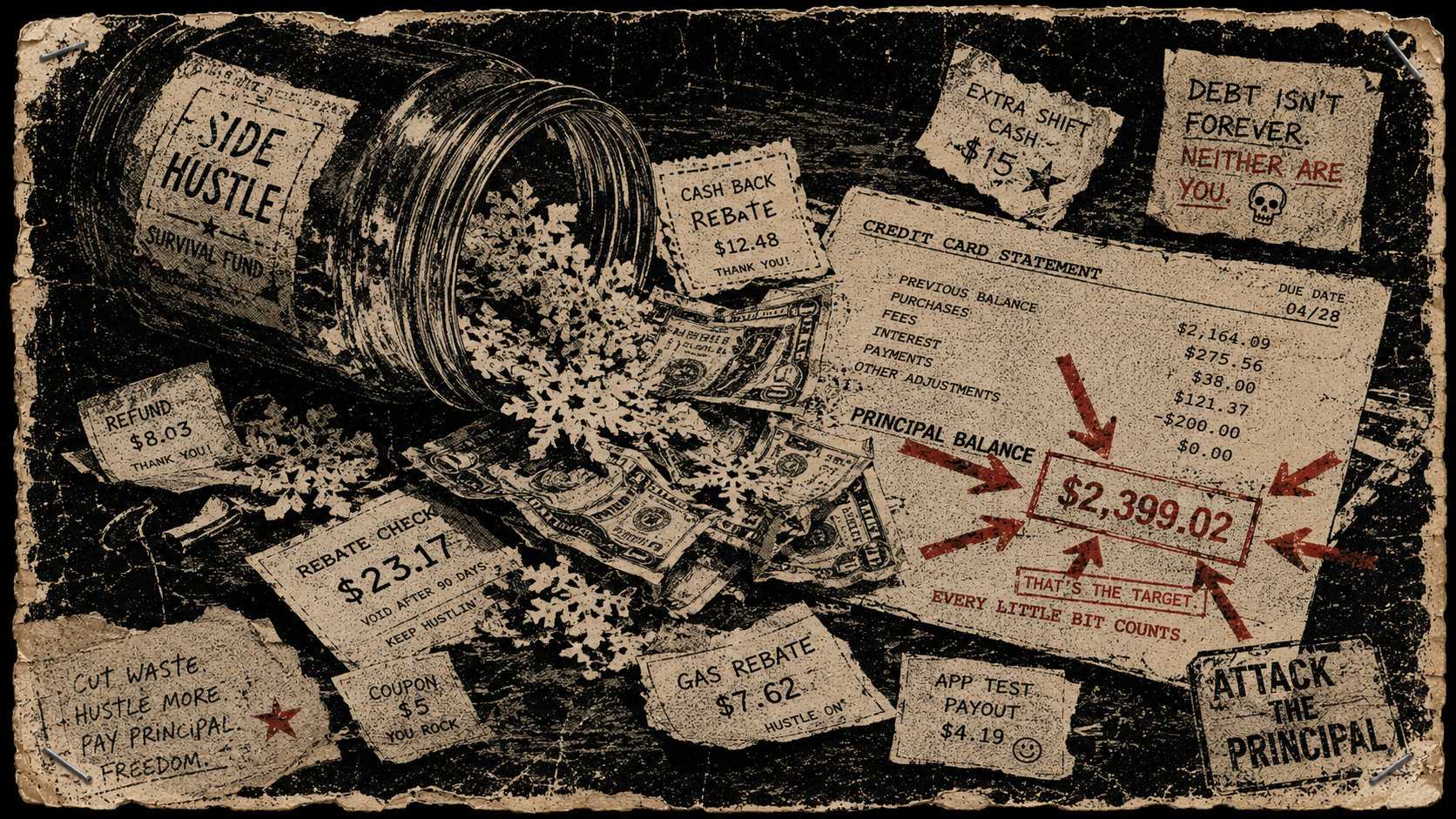
A debt snowflake is a small, one-off amount thrown straight at principal before it melts into takeout, shipping fees, or the little aisle at Target where your cart becomes legally feral.
Snowflakes are not your main plan. They are not a substitute for the monthly extra payment. They are a way to turn found money into timeline compression.
The CFPB’s 2025 Consumer Credit Card Market report reviews the cost and availability of credit in the card market, which is a polite government way of reminding everyone that revolving balances are not a neutral storage container for inconvenience. The longer principal hangs around, the more rent it charges.
Good snowflakes are boring and immediate:
- Cash-back rewards redeemed as a statement credit or payment.
- A utility refund, insurance refund, or random overpayment check.
- A side-hustle bonus after taxes and true expenses.
- A rebate you forgot you submitted in February because hope is a dangerous administrative process.
- A canceled subscription amount redirected the same day, before it becomes miscellaneous fog.
The rule is simple: if the money was not part of your normal spending plan, give it a job before your brain gives it vibes.
This is not deprivation theater. If the $40 refund needs to buy groceries because the week got ugly, buy groceries. Debt payoff does not outrank food, medicine, rent, childcare, or keeping your car from making the expensive noise.
But when the money is truly extra, send it. The payment may look tiny. The behavior is the win.
Celebrate Without Reopening the Trapdoor
You are allowed to celebrate progress. In fact, you probably should.
Traditional advice gets weird here. It acts like joy is a leak in the system. Forbidden Finance disagrees. A plan with no joy is just a punishment schedule with math.
The trick is to celebrate in a way that reinforces the system instead of chewing through it.
Milestone rule of thumb: spend $5 to $20 per milestone, never on credit, and never in a way that creates a new bill.
Examples: a fancy coffee, a used book, a movie rental, a bakery thing with too much frosting, a cheap bouquet, a long walk with an excellent podcast and no attempt to monetize your soul.
Not examples: a weekend trip you cannot cash-flow, a new card because the bonus looked good, or a celebratory cart that starts with socks and ends with a countertop ice machine. We have all seen the internet. It knows what it did.
Celebration should say, I noticed. It should not say, please enjoy this invoice in six weeks.
You can also make some milestones free. Rename the paid-off account in your tracker. Move the old card to a closed section. Screenshot the balance, then delete the app if the app makes you itchy. Put a big red X on a paper chain if you are the craft type. We support glitter only when supervised.
The important part is that progress gets witnessed. Month nine needs evidence.
The Month-Nine Script
Here is the boring-middle operating system.
Once a week, open the spreadsheet or app. Not every hour. Not during dinner. Not at 12:18 a.m. when your brain is auditioning for a disaster documentary.
Look at three numbers: total remaining, total paid off, and next milestone. That is it.
Confirm the minimums are scheduled. Make the planned extra payment. If a snowflake appeared, send it before it gets emotionally absorbed into the household economy. Then close the tab.
Do not recalculate the entire debt-free date every time gas goes up twelve cents. Do not compare your pace to someone online who paid off $80,000 in seven months because they sold a boat, moved into their uncle’s duplex, and forgot to mention the signing bonus. Data without context is just gossip in a blazer.
If your method still fits, keep going. If your life changed, update the method. Snowball, avalanche, hybrid, custom, slower for a season, faster after a raise, paused for a medical bill. That is not failure. That is a system responding to reality.
Month nine is where you stop relying on the emotional high of starting and build the quieter skill of continuing.
Very annoying. Very effective.
You are closer than the sweat says you are. Open the spreadsheet. Look at the number. Then close it again.
 Forbidden Finance