Your budget has started leaving a little money behind.
Not mansion money. Not finance-influencer-standing-in-front-of-a-rented-car money. More like $150 here, $400 there, a tax refund, a bonus, or the suspiciously clean number left after bills, groceries, rent, and life have all taken their turns at the buffet.
That is the moment most investing advice gets weird. Suddenly everybody has a chart, a hot take, and a cousin who made 900% on a stock with a ticker that sounds like a Wi-Fi password. Helpful. Very normal.
You do not need that. If your budget is working, the next job is to move from tracking money to owning assets. The U.S. personal saving rate was 3.0% in May 2026, according to the Bureau of Economic Analysis, so having any investable surplus already puts you in a practical minority. No shame confetti required. Just a system.

TL;DR
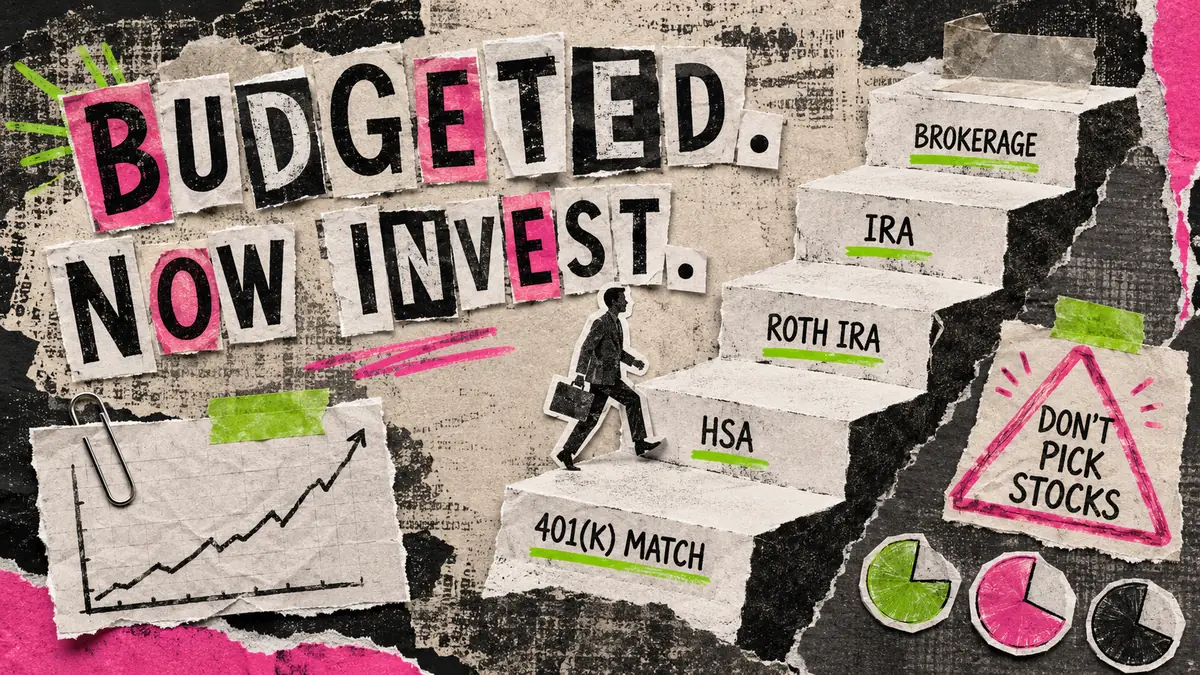
- Start with the 401(k) match, then HSA, Roth IRA, traditional IRA, and taxable brokerage.
- A simple three-fund portfolio can be enough: U.S. stocks, international stocks, and bonds.
- The forbidden move is boring consistency, because boring is what survives your group chat.
You Have a Budget. Now Give the Surplus a Job
A budget answers one question: where should your cash go this month?
Investing answers a different question: what should your money become over the next decade, or three?
Those are related, but they are not the same job. Your rent money should not be cosplaying as retirement money. Your emergency fund should not be in a stock fund where a bad week can turn a car repair into a spiritual event. If you still need cash reserves, start with Emergency Fund Math: How Much Is Actually Enough in 2026? and park that money somewhere boring on purpose, as covered in Where to Park Cash in 2026: HYSA vs. Money Market vs. T-Bills vs. CDs.
Once the short-term cash is handled, investing is the machine that gives long-term money a chance to outrun inflation. The SEC’s Investor.gov introduction to investing puts the basic formula plainly: regular investments plus time are the engine. No velvet rope. No secret handshake. No blazer required.
This is where the Forbidden Finance rule applies: the best system is the one you will actually run. If automation keeps you consistent, automate. If a monthly calendar reminder works better because your income changes, do that. If you need to start with $25 because life is expensive and apparently eggs went to private school, start there.
Account Priority Order for 2026
The account order below is a practical default, not a commandment carved into a stone tablet by someone with a podcast microphone. The IRS 2026 retirement limits announcement confirms the 2026 401(k) employee deferral limit of $24,500 and the IRA limit of $7,500. For HSAs, IRS Rev. Proc. 2025-19 confirms the 2026 HSA limits of $4,400 for self-only coverage and $8,750 for family coverage, and IRS Publication 969 confirms the extra $1,000 HSA catch-up for eligible people age 55 or older.
| Account | Why this priority | 2026 contribution limit |
|---|---|---|
| 401(k) up to the employer match | Employer match is part of your compensation. Skipping it is leaving money on the table, then politely pushing the table into traffic. | Contribute enough to get the full match. The employee deferral limit is $24,500, with catch-up rules for eligible older workers. |
| HSA, if you are eligible | HSAs can be unusually tax-friendly: deductible or pre-tax contributions, potential tax-free growth, and tax-free qualified medical withdrawals. | $4,400 self-only or $8,750 family. Eligible people age 55 or older can add $1,000. |
| Roth IRA | You contribute after-tax dollars, then qualified withdrawals can be tax-free later. Nice if your current tax rate is lower than future-you's tax rate, which future-you may discuss dramatically over dinner. | $7,500 total across traditional and Roth IRAs, or $8,600 if age 50 or older. Roth income phase-outs apply. |
| Traditional IRA | Can give you more tax-deferred space, and deductible contributions may help current-year taxes if you qualify. | Same shared IRA limit: $7,500 total, or $8,600 if age 50 or older. Deductibility depends on income and workplace-plan coverage. |
| Taxable brokerage | Flexible, no retirement-account contribution cap, no early-withdrawal penalty structure, and useful after tax-advantaged space is full. | No IRS contribution cap, but taxes apply to dividends, interest, and realized gains. |
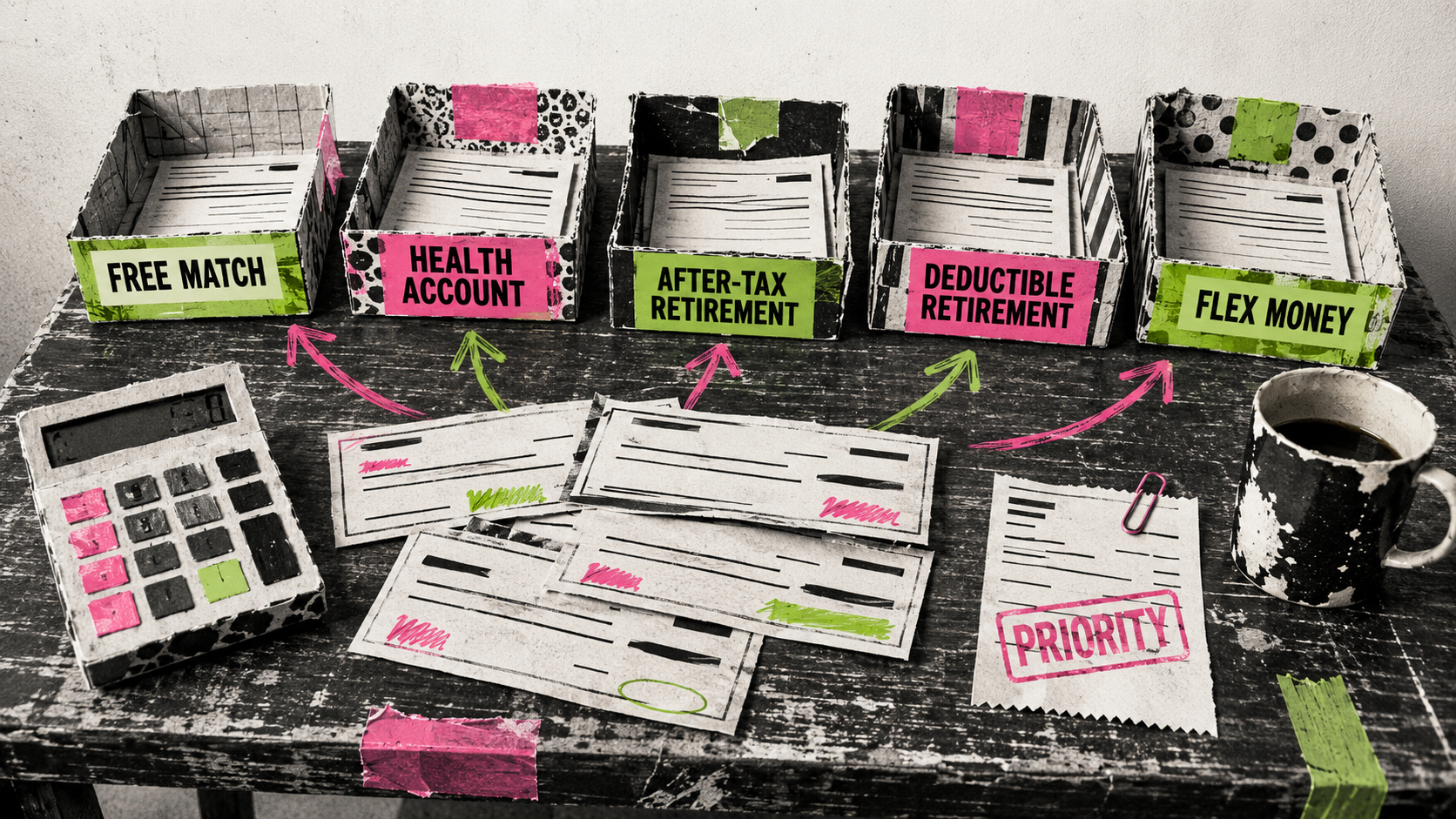
This order assumes you already have the bills under control. If your budget is still being held together by tape, vibes, and one heroic checking account, Pay Yourself First: The Forbidden Art of Not Tracking Every Latte may be the better next step.
Also: an HSA only belongs this high if you are eligible and can avoid using every dollar immediately. If medical costs are current and loud, use the account for medical costs. Investing is not more virtuous than staying functional. Teeth count.
What You Actually Buy: Index Funds, ETFs, and Target-Date Funds
Once the account exists, you still have to buy something inside it. Opening an IRA and leaving the cash uninvested is common beginner folklore. The money is technically in the room, but it is standing by the wall at the dance.
Start with the wrappers and products:
Index funds try to track a market index instead of paying managers to pick winners. The Investor.gov glossary describes an index fund as a mutual fund, ETF, or unit investment trust that follows a passive strategy designed to approximate an index before fees. Translation: you buy the haystack instead of paying someone in a vest to identify the needle.
ETFs are funds that trade on an exchange during the day. Many index funds are ETFs. Many are mutual funds. The difference is usually less important than cost, diversification, and whether the fund matches your goal. This is less spicy than debating it online, which is why it works.
Target-date funds are all-in-one funds that change their mix over time. A fund with 2065 in the name is usually built for someone expecting to retire around that year. The SEC’s target-date fund bulletin says these funds hold a mix of investments and adjust asset allocation over time to make retirement investing more convenient.
The forbidden answer is that all three can be fine. A target-date fund is often the best starter choice inside a 401(k) if you want one fund and no tinkering. A custom index-fund portfolio gives more control if you are willing to maintain it. ETFs can be convenient in taxable accounts. None of these require you to know which semiconductor company will dominate 2031. You are allowed to retire without becoming a part-time analyst in cargo shorts.
The Three-Fund Portfolio Template
A three-fund portfolio is the investing equivalent of a good weeknight dinner: protein, vegetable, carb, done. Not glamorous. Extremely useful.
The classic version uses one broad U.S. stock fund, one broad international stock fund, and one broad bond fund. The SEC’s asset allocation and diversification guide explains that spreading money across asset classes and within asset classes can reduce concentration risk, though diversification cannot promise gains or prevent losses. Annoying disclaimer. Correct disclaimer.
| Fund type | % allocation | Example tickers - keep generic |
|---|---|---|
| Total U.S. stock market index | 50% | VTI, ITOT, SCHB, or a similar total-market mutual fund |
| Total international stock market index | 30% | VXUS, IXUS, or a similar broad international fund |
| Total U.S. bond market index | 20% | BND, AGG, SCHZ, or a similar total bond fund |
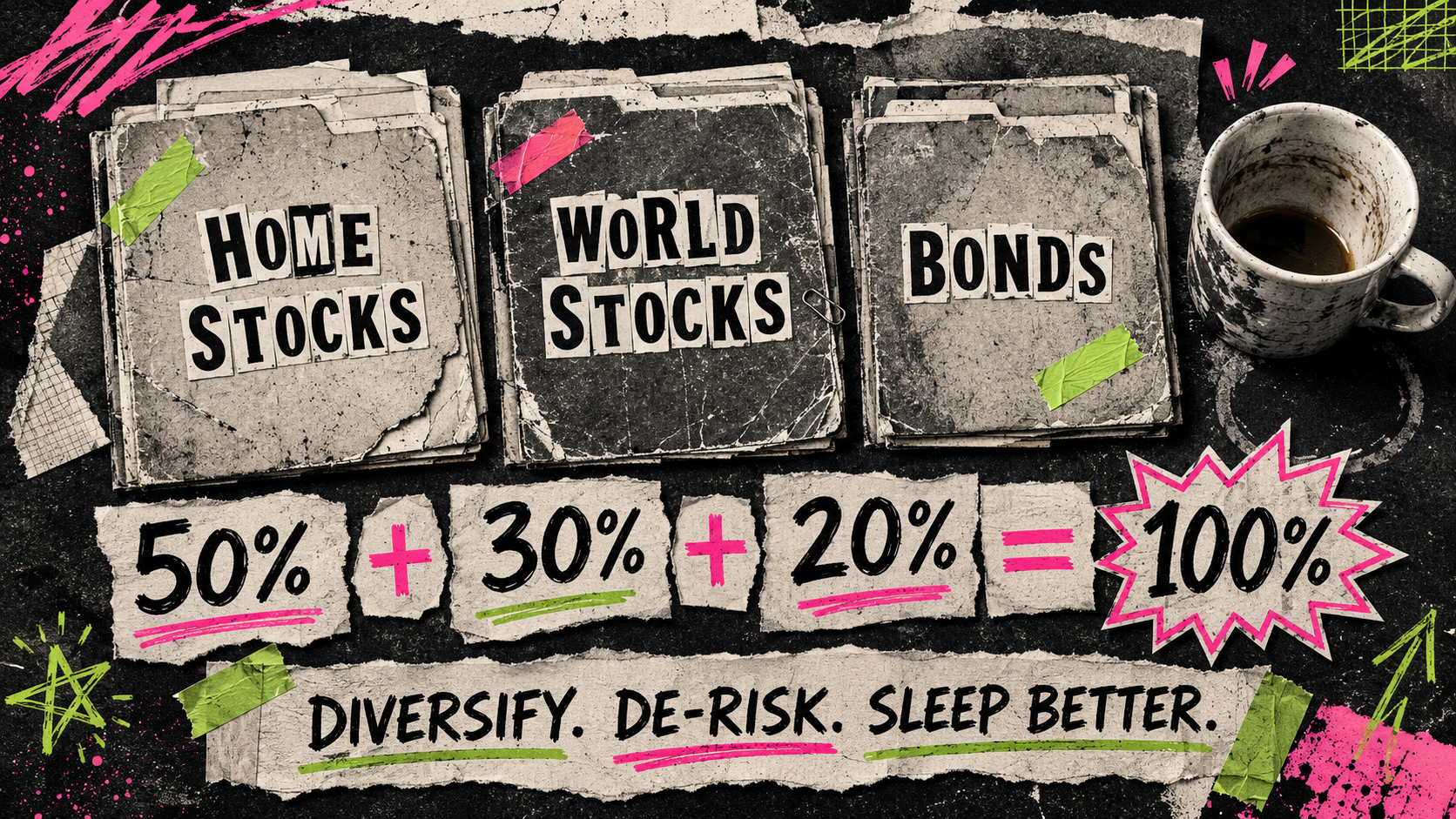
Those percentages are a template, not your legal identity. If you are 28 and can watch a market drop without panic-refreshing your account at 2:13 a.m., you might hold fewer bonds. If a 20% drop would make you sell everything and take up indoor gardening, you might hold more bonds. The right allocation is not the one that sounds smartest. It is the one you can hold.
If you are tracking your balance sheet already, your investment mix should eventually show up in your net worth view too. How to Calculate Your Real Net Worth (and What the Number Actually Tells You) is the companion piece for that bigger picture.
Rebalancing Is Maintenance, Not a Personality
Rebalancing means bringing your portfolio back to its target mix after markets move. If your plan is 80% stocks and 20% bonds, a long stock rally might turn it into 87% stocks and 13% bonds. Congratulations, you now own more risk than you ordered. Very artisanal.
Vanguard’s rebalancing guidance describes calendar-based reviews, threshold-based triggers, and a combination of the two. It also notes that optimal methods are neither too frequent nor too infrequent. For most people, an annual review is fine. Add a 5-percentage-point drift rule if you want a little more structure.
A simple annual routine:
- Pick a target allocation.
- Once a year, compare your actual allocation to the target.
- If an asset class is off by about 5 percentage points, redirect new contributions or rebalance inside tax-advantaged accounts first.
- In taxable accounts, be careful about selling winners because taxes may show up with a clipboard.
Rebalancing is not about predicting next year. It is about keeping the risk level you chose while your account tries to wander off unsupervised.
Multiple Brokerages Are Normal. Chaos Is Optional.
Real life rarely fits inside one tidy account. You might have an old 401(k), a current 401(k), a Roth IRA, an HSA with investments, and a taxable brokerage. Maybe your spouse has their own stack. Maybe an account from 2019 is still sitting there because the login requires a phone number you had three apartments ago.
That is normal. The problem is not multiple institutions. The problem is trying to rebalance by looking at each account separately, like judging a family photo one forehead at a time.
This matters because your 401(k) might be heavy in U.S. stocks while your IRA holds international funds and your HSA holds bonds. Each account can look strange alone. Together, they might be perfectly reasonable. Or not. You need the full map before you start moving pieces.
This is the same reason salary alone is such a weak signal. Your Salary Is Not Your Net Worth (And That’s the Forbidden Truth) covers that broader problem: income is the river, but assets are the reservoir. Nice salary. Show us the lake.
The Behavioral Traps That Eat Returns
Most investing failure does not come from picking the wrong broad index fund by 0.03% in expense ratio. It comes from getting scared, clever, bored, or all three before lunch.
Vanguard’s Advisor’s Alpha research puts behavioral coaching at the center of investor value because helping people stick with a long-term plan can matter more than expert security selection. Fidelity’s analysis of whether to sell stocks says market timing can weigh on returns and shows that missing only the five best S&P 500 days from 1988 through 2025 would have reduced a hypothetical $10,000 investment’s gains by 38%, according to Fidelity and Bloomberg data. DALBAR’s 2026 QAIB press release reported that the average equity investor earned 17.16% in 2025 versus 17.88% for the S&P 500, a 72-basis-point gap, after a much larger gap in 2024.
Here are the usual suspects:
-
Panic-selling. The market drops, your account turns red, and your brain says, sell now so the pain stops. Understandable. Expensive. Selling turns volatility into a locked-in decision.
-
Waiting for the dip. You keep cash ready for the perfect entry point. Then the market rises, you wait harder, and somehow waiting becomes your hobby. The dip is not a bus schedule.
-
Stock-picking compulsion. You have broad funds, but one headline whispers that a single company is the future. Fine, if you need a tiny sandbox, keep it tiny. Do not let entertainment money hijack retirement money.
-
Performance-chasing. Last year’s winner looks obvious after it already won. This is how portfolios become museums of recently popular things, which is a very specific kind of clutter.
-
Confusing activity with control. More trades can feel like more intelligence. Sometimes it is just fidgeting with tax consequences.
The fix is not becoming emotionless. You are a person, not a spreadsheet with shoes. The fix is building a process you can follow while annoyed, tired, busy, or staring at a headline written to raise your blood pressure.
The Math: Starting Late vs. Starting Now
Starting now matters because time is the one investment input you cannot make more of. You can increase contributions. You can reduce fees. You can work longer. You cannot go back and tell 24-year-old you to stop buying novelty kitchen appliances and buy an index fund instead. Tragic, because that waffle maker was mid.
The Investor.gov investing guide gives a clean example using a 7% average annual return assumption: to reach $1 million by age 65, someone starting at 25 would need about $418 per month, while someone starting at 35 would need about $883 per month, and someone starting at 45 would need about $2,033 per month. Same destination. Very different monthly pain.
That does not mean starting late is hopeless. It means the math gets louder. If you are 42 and just starting, the move is not shame. Shame has a terrible return profile. The move is a higher savings rate, tax-advantaged accounts where available, a realistic allocation, and fewer years spent debating whether this is the perfect moment.
If you are wondering whether you are behind, use benchmarks as information, not a sentencing hearing. How Much Should You Have Saved by 30, 40, 50, 60? Honest Benchmarks (and What to Do If You’re Behind) is built for that exact question.
The market does not require you to have started at the ideal age. It does require you to stop letting the ideal age be an excuse.
Your First $10K Invested: A One-Page Decision Tree
This is a practical path for your first $10,000 invested. It assumes your budget works, your high-interest debt is not on fire, and your short-term cash needs are covered. If any of those assumptions are false, adjust. The rule depends. Forbidden, apparently.
1. Do you have an employer match?
If yes, put enough into the workplace plan to capture the full match first. The IRS 2026 retirement limits page says the 2026 employee deferral limit for 401(k), 403(b), governmental 457 plans, and the federal Thrift Savings Plan is $24,500, but your first target is the match, not necessarily the full limit.
If no match exists, continue.
2. Are you HSA-eligible?
If yes, decide whether you can invest some HSA money without risking current medical bills. IRS Rev. Proc. 2025-19 sets 2026 HSA contribution limits at $4,400 for self-only HDHP coverage and $8,750 for family HDHP coverage. If your healthcare life is noisy, use the HSA for healthcare. That is not a failure. That is the noun in the account name.
3. Are you eligible for a Roth IRA contribution?
If yes, a Roth IRA is often a strong next home for beginner retirement dollars. The IRS 2026 announcement lists the 2026 IRA contribution limit at $7,500, with a $1,100 catch-up for people age 50 or older, and it lists Roth income phase-out ranges.
If your income is over the Roth range, check whether a traditional IRA or workplace plan makes more sense for your tax situation. Tax advice on the internet should not pretend your W-2, household, state, and future tax rate are all wearing name tags.
4. Pick either one target-date fund or a three-fund mix.
If you want maximum simplicity, choose a low-cost target-date fund close to your expected retirement year. The SEC’s target-date fund bulletin says these funds are designed to diversify and change the investment mix over time.
If you want more control, use the three-fund template above. Keep costs low. Keep holdings broad. Keep your urge to optimize in a small box where it can mutter to itself.
5. Automate the next contribution.
The first $10,000 is partly financial and partly psychological. You are proving that money can move from budget surplus into assets without a monthly debate. A recurring transfer is boring in the best possible way, like a dishwasher that actually dries the cups.
6. Write down your sell rules before the market drops.
A sell rule might be: rebalance annually, sell only if my goals changed, or sell only to reduce a concentrated position. Fidelity’s selling guidance stresses strategy over emotion, which is easy to agree with on a calm day and much harder when the chart looks like it fell down stairs.
7. Review once a year.
Put it on your calendar. Check contribution rates, asset allocation, fees, beneficiaries, and whether old accounts need to be rolled over or simply tracked better. If you also run periodic budget reviews, fold investing into that rhythm; The Mid-Year Money Reset: A 10-Step Audit to Run Before June Hits is a good template for that kind of financial housekeeping.

Final Thought
Investing after budgeting is not a personality upgrade. You do not need to become a market person. You need an account order, a simple fund choice, a contribution habit, and a plan for the day the market gets rude.
That is the forbidden version: fewer commandments, more fit. Use the account order if it fits. Use a target-date fund if you want simplicity. Use three funds if you want control. Rebalance annually unless your life or allocation clearly says otherwise. Track everything in one view so your portfolio is a portfolio, not a scavenger hunt.
The best time to invest was 20 years ago. The second-best time is whatever Tuesday this is.
 Forbidden Finance