The paycheck that was supposed to land Friday arrives Tuesday. The client who was definitely going to pay this week has discovered silence as an accounting system. Meanwhile, rent remains aggressively monthly.
This is why “set a fixed monthly budget” is such hilarious advice for freelancers, contractors, commission earners, gig workers, and seasonal-business owners. Fixed on what, exactly? The invoice that aged into a historical artifact? The commission check that could buy tires or a yacht, depending on the moon? A salary-style budget assumes your income behaves. Yours does not. So stop budgeting as if it does.

TL;DR
- Build the budget from your three worst income months, not your fantasy average month.
- Split every deposit by percentages so big checks fund taxes, buffers, bills, and breathing room automatically.
- Zero-based budgeting gets twitchy with irregular income; custom priority tiers behave better.
- Two months of cash is boring, rude, and necessary.
Your Paycheck Is Not a Calendar
Irregular income is not a personality flaw. It is a cash-flow pattern. The budget needs to respect that pattern, preferably before your bank account starts doing interpretive dance.
The latest public BLS Contingent Work Supplement release, covering July 2023 and published in November 2024, counted 11.9 million independent contractors on their sole or main job, equal to 7.4% of total employment. That category includes independent contractors, consultants, and freelance workers. Translation: plenty of people are not living inside the neat little paycheck box.
The most recent dedicated Pew Research Center gig-platform survey found that 16% of U.S. adults had ever earned money through an online gig platform, and 9% had done so in the prior year. Among current or recent gig workers, 52% said covering gaps or changes in income was a major reason they did the work. So yes, the whole point is volatility. Anyone telling you to “just average it out” has perhaps never waited on a client approval chain that includes seven people and one mysteriously unavailable approver named Brad.
Bank-transaction research from the JPMorgan Chase Institute found that 55% of people had more than a 30% month-to-month change in total income, and median-income individuals saw nearly $500 in monthly labor-income fluctuations. That is the polite institutional way of saying: your budget cannot be built around “normal” if normal keeps changing outfits.
Start With the Lowest-Month Baseline
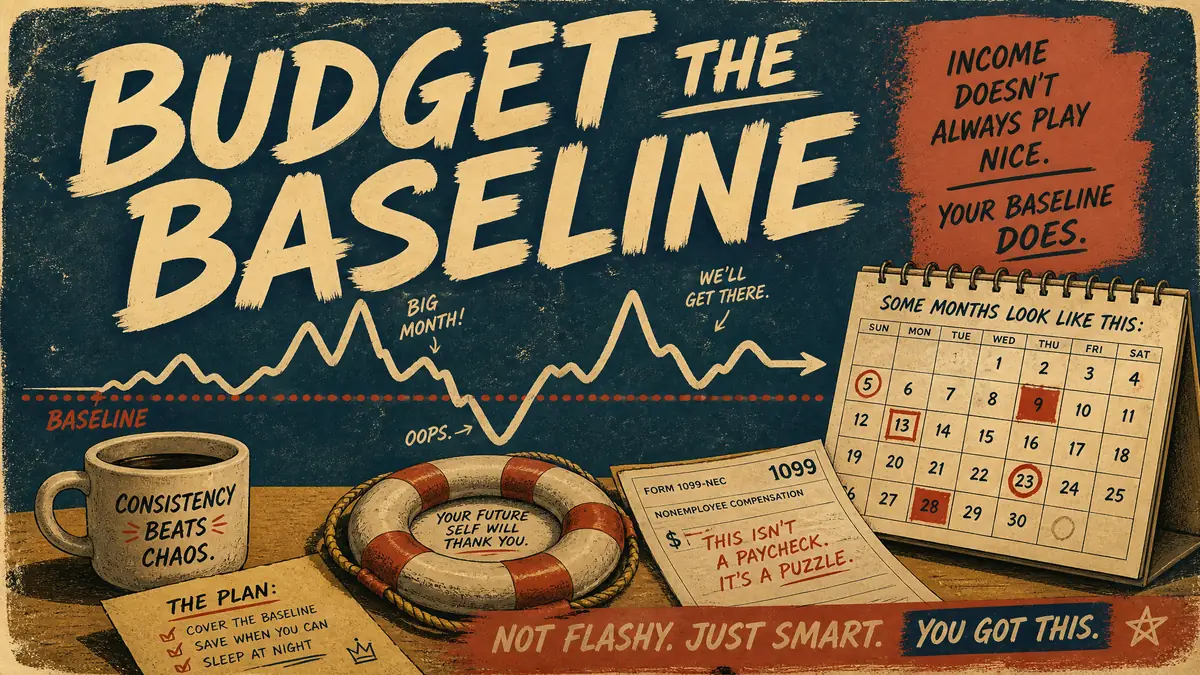
The forbidden move is this: stop building your budget around your average month. Average income is a seductive little liar.
If you earned $9,000 in March, $6,500 in April, and $2,400 in May, the average says you make about $5,967 per month. Lovely. Very cute. Completely useless when June shows up wearing the $2,400 costume and your bills do not accept vibes.
Instead, use the lowest-month baseline.
Pull your last 12 months of income after refunds, chargebacks, platform fees, and business expenses you pay before money becomes household money. Find the three lowest months. Average those three. That number becomes the base income your household budget is allowed to trust.
If your worst three months were $2,400, $2,900, and $3,100, your baseline is $2,800. That is the income your must-pay life needs to fit inside. Not your best month. Not your best month plus optimism. Not the month where a client paid three invoices at once and you briefly became a duchess.
The baseline does three useful things:
- It tells you whether your fixed expenses are too heavy for the business you actually have.
- It stops high-income months from pretending they are the new normal.
- It gives extra income a job before it wanders into same-day delivery and flowers that begin dying immediately.
This does not mean you live like every month is terrible. It means the core budget survives if the month is terrible. Anything above baseline gets allocated by rule, not mood.
Split Every Deposit Before It Gets Ideas
A salary budget usually starts with the month. An irregular-income budget starts with the deposit.
Every time money lands, split it the same way. The check can be $400, $4,000, or “why is my bank calling me?” The percentages stay boring. Boring is the point.
| Deposit | Tax bucket 30% | Business buffer 10% | Cash buffer 10% | Must-pay bills 45% | Discretionary 5% |
|---|---|---|---|---|---|
| $900 | $270 | $90 | $90 | $405 | $45 |
| $2,800 | $840 | $280 | $280 | $1,260 | $140 |
| $5,400 | $1,620 | $540 | $540 | $2,430 | $270 |
Those percentages are an example, not a tattoo. Your numbers might be 25% taxes, 5% business, 15% buffer, 50% household, 5% joy. The magic is not the exact split. The magic is that every deposit gets processed before your brain starts saying, “We deserve sushi because Q2 was emotionally violent.”
If you already like automation, pair this with Pay Yourself First: The Forbidden Art of Not Tracking Every Latte. The irregular-income version is not a fixed auto-transfer that detonates your checking account during a slow week. It is a fixed percentage skim from each deposit.
Pick the Budget Method That Matches Volatility
Some budget methods are great. Some are great for someone else. Personal finance advice gets weird when it treats methods like moral rankings. Calm down, spreadsheet clergy.
Here is how the common methods behave with uneven income.
| Method | How it handles irregular income | Best use | Problem area | Verdict |
|---|---|---|---|---|
| Pay-yourself-first | Works if transfers are percentage-based per deposit | Building savings without tracking every category | Fixed monthly transfers can overdraft slow months | Strong add-on |
| Percentage-based | Scales with each payment size | Taxes, savings, buffers, and flexible spending | Needs occasional recalibration | Core engine |
| Zero-based | Needs either predictable income or a full prior-month buffer | Stable paychecks, debt payoff sprints, tight control | Future income guesses become fiction with formatting | Less useful here |
| Envelope budgeting | Good for variable spending guardrails | Groceries, gas, eating out, personal spending | Underfunded envelopes pile up during low-income stretches | Useful layer |
| Custom tiered budget | Separates categories by priority and funds them in order | Freelancers, contractors, seasonal earners, commission workers | Takes more setup at the beginning | Best fit |

Zero-based budgeting has a real place. We have a whole post on Zero-Based Budgeting: Give Every Dollar a Job (and Yes, “Pizza Fund” Counts) because the method can be excellent when the money is already sitting there. But if you are assigning dollars you have not received yet, zero-based budgeting starts asking you to forecast the future with the confidence of a weather app in spring.
For irregular income, the better default is custom and tiered. Read Custom Budgeting: For People Who Read All 7 Methods and Said “Nah” if you want the bigger philosophy. The short version: build a system from primitives, not commandments.
Build Priority Tiers, Not Perfect Categories
Categories matter less than funding order. “Dining out” versus “restaurants” is not the breakthrough. The breakthrough is knowing which categories get money first when the check is small.
Use three priority tiers.
- Must-pay: rent or mortgage, utilities, minimum debt payments, insurance, groceries, transportation, taxes, essential childcare, required business tools.
- Should-pay: emergency fund, business buffer, sinking funds, extra debt payments, health costs, annual subscriptions you actually use, home maintenance, professional development.
- Discretionary: restaurants, travel, gifts, hobbies, upgrades, entertainment, clothes beyond replacement, the little treat that keeps you from becoming a haunted filing cabinet.
Must-pay categories are funded from your lowest-month baseline. Should-pay categories are funded from ordinary surplus. Discretionary categories are funded from actual extra money, not “future me will invoice harder.”
This is also where a lot of popular budget advice gets rude. The latte is not your problem. Your rent is your problem. Your taxes are your problem. Your slow-season cash gap is your problem. If a $5 coffee is the small joy that keeps you sane while chasing three overdue invoices, the budget can hold a $5 coffee. It just cannot pretend that coffee belongs above insurance.
The Two-Month Buffer Is Not Dramatic
For salaried households, a classic emergency fund is often framed as three to six months of expenses. For irregular earners, the first milestone is different: build a two-month operating buffer.
That means two months of must-pay expenses, in cash, separate from tax money and separate from business money. Not invested. Not “available on a credit card.” Not trapped in an account with withdrawal rules written by a committee that hates weekends.
Why two months? Because one bad month is normal. Two bad months is where the budget starts making haunted noises.
The JPMorgan Chase Institute estimated that families needed roughly 6.2 weeks of take-home income in liquid assets to weather a simultaneous income dip and spending spike, and 65% lacked that sufficient buffer. That finding is for families broadly, not only freelancers. If your income is structurally uneven and your taxes are not withheld, rounding up to two months is not paranoia. It is basic plumbing.
The 2026 Federal Reserve household survey appendix reported that 55% of adults had emergency or rainy-day funds covering three months of expenses, while among people asked whether they could cover three months after losing their main income source by borrowing, using savings, or selling assets, only 34% said yes. That gap is the whole movie. Cash matters most right when income decides to be theatrical.
For where to park that cash, see Emergency Fund Math: How Much Is Actually Enough in 2026?. The short version: boring, liquid, boring again.
Quarterly Taxes Are a Cash-Flow System
Quarterly taxes are not a surprise. They are a recurring bill wearing a fake mustache.
For tax year 2026, IRS Publication 505 lists estimated-tax due dates for calendar-year filers as April 15, 2026; June 15, 2026; September 15, 2026; and January 15, 2027. As of this post’s August 2026 timing, the first two have already passed for most filers. The remaining federal dates are September 15, 2026 and January 15, 2027.
The same IRS Publication 505 says most individuals must pay estimated tax for 2026 if they expect to owe at least $1,000 after withholding and credits, and withholding plus credits will be less than the smaller of 90% of 2026 tax or 100% of 2025 tax. Higher-income taxpayers generally substitute 110% for 100% if 2025 AGI was above $150,000, or $75,000 for married filing separately.
If your income is uneven, do not blindly divide the year by four and call it finance. The IRS explicitly points irregular earners toward the annualized income installment method, which can reduce required payments for periods before the income actually arrives. That sentence is less exciting than finding money in an old coat, but it can save you from paying as if January knew what August would do.
Then there is self-employment tax. The IRS says you usually must pay self-employment tax if net earnings from self-employment are $400 or more, and the rate consists of 12.4% for Social Security plus 2.9% for Medicare. Your tax bucket is not optional confetti. It is rent for your future April self.
A workable routine:
- Send your tax percentage to a separate tax account on every deposit.
- Recalculate quarterly using year-to-date profit, not gross deposits.
- Track deductible business expenses before money enters the household budget.
- Keep state and local taxes in the plan if they apply where you live.
- Ask a tax pro about safe harbor and annualized payments if your income swings hard.
Run the Budget Like a Seasonal Business
A seasonal-business owner knows July money might need to pay February bills. Freelancers should think the same way. Your high month is not a shopping event. It is a reservoir.
Run a monthly close. Nothing fancy. Look at income received, taxes set aside, must-pay categories funded, buffer progress, business expenses, and discretionary spending. Then ask one useful question: did this month beat the baseline?
If yes, sweep the surplus in this order: taxes if underfunded, two-month buffer, overdue must-pay categories, sinking funds, debt goals, investing, discretionary upgrades. If no, fund must-pay categories first and stop pretending every line item deserves equal dignity. The streaming service will survive its demotion. It has had a good run.
This system also lets your budget evolve. A brand-new freelancer may need blunt categories and weekly check-ins. A contractor three years in may need detailed tax, business, and household buckets. A commission earner with a huge buffer may only need quarterly reviews. That is not inconsistency. That is the budget graduating with you.

The goal is not to make irregular income feel regular. That is how you end up with a fake budget and a real overdraft fee. The goal is to build a system that assumes the dips are coming, catches the spikes before they evaporate, and gives you permission to spend only after the boring parts have been handled.
The salary-budget worldview was always going to fail you. Build for the income you actually have.

 Forbidden Finance