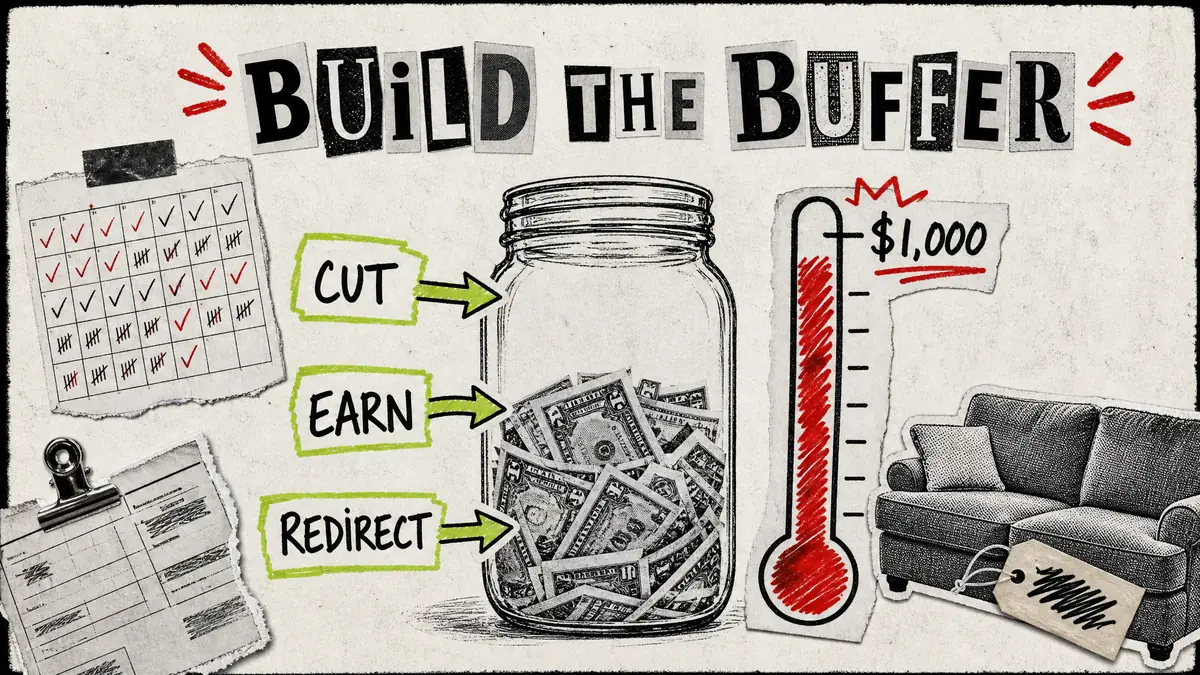
The $1,000 Emergency Fund Starter Line
A $1,000 emergency fund will not fix every emergency. It will not repair a transmission, replace a roof, cover three months of rent, or make your health insurance deductible stop behaving like a haunted vending machine.
But it can stop a small disaster from becoming a credit-card disaster.
The latest Federal Reserve SHED report says 63% of adults in 2025 could cover a $400 emergency with cash, savings, or a credit card paid off at the next statement. That sounds decent until you remember the other 37% are left juggling debt, selling something, borrowing, or being unable to cover it.
Bankrate’s 2026 emergency savings survey puts the bigger picture in sharper focus: only 47% of Americans said they had enough liquidity or access to funds to cover a $1,000 emergency expense, and 24% had no emergency savings at all. So if you are starting from $0, you are not uniquely bad at money. You are living in the same math as a lot of people. Welcome to the least exclusive club in America.
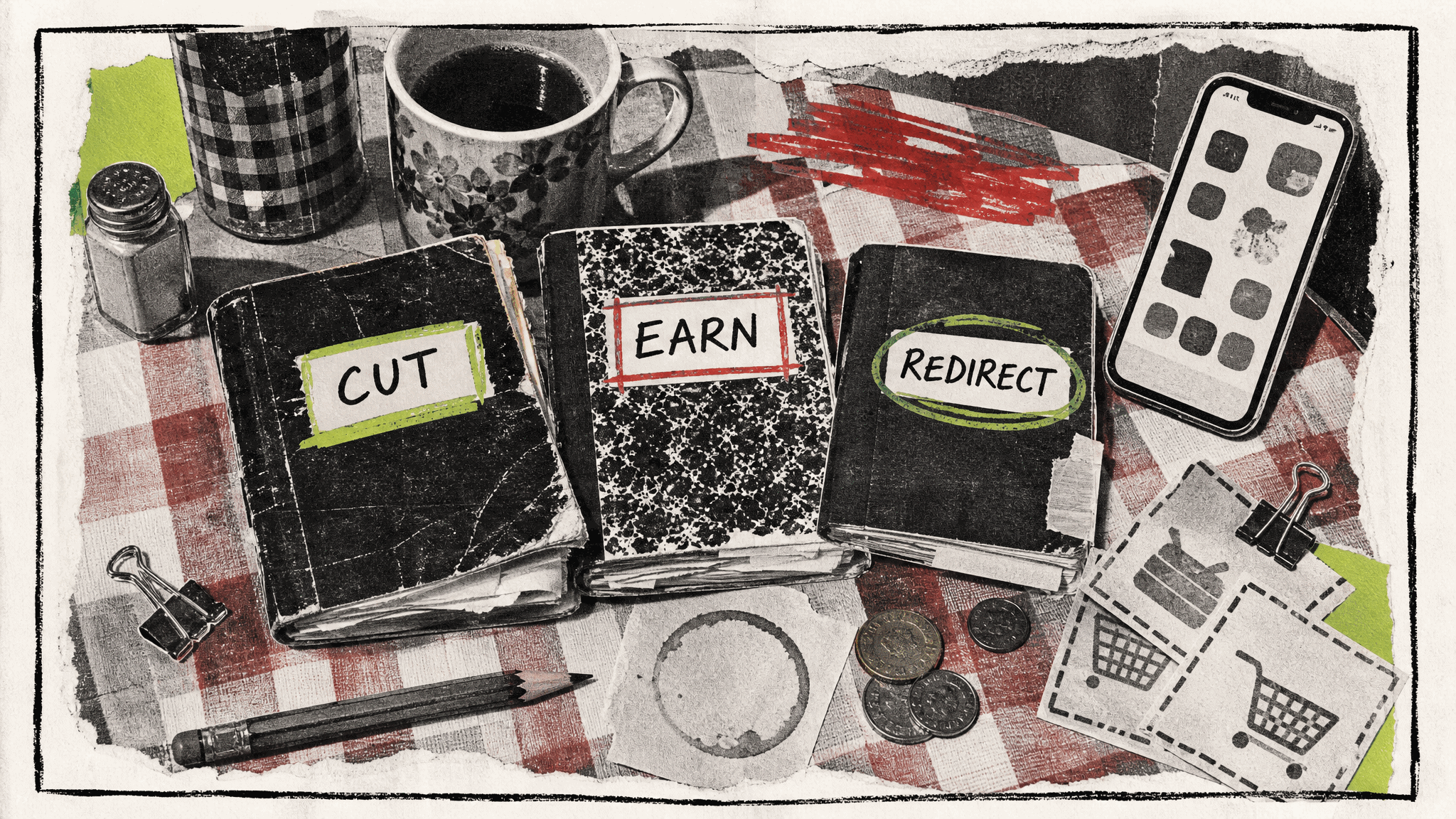
This plan gives you three lanes: cut, earn, and redirect. You do not need to use all 15 moves. Pick the ones that fit your actual life, not the imaginary life where you meal-prep lentils in silence and never need joy again.
For deeper sizing beyond this starter buffer, bookmark Emergency Fund Math: How Much Is Actually Enough in 2026?. This article is about the first sprint: building $1,000 in 90 days without turning your budget into a punishment spreadsheet.
TL;DR
- $1,000 in 90 days means about $333 per month or $77 per week.
- Use three lanes: cut expenses, earn short-term cash, and redirect money already coming your way.
- If 90 days is too tight, aim for $500 in six months and keep your dignity intact.
| Lane | Move | Typical dollar value |
|---|---|---|
| Cut | Subscription audit | $15-$75 per month |
| Cut | Grocery brand swaps | $40-$100 per month |
| Cut | Cable downgrade | $25-$90 per month |
| Cut | Bill negotiation | $10-$50 per month |
| Cut | Dining-out cap | $50-$150 per month |
| Earn | One-time gigs | $75-$250 once |
| Earn | Selling unused stuff | $100-$400 once |
| Earn | Asking for the raise that's overdue | $50-$300 per month after taxes |
| Earn | Bonus deferral | $100-$500 once |
| Earn | Overtime | $80-$300 per paycheck |
| Redirect | Tax refund | $250-$1,000+ once |
| Redirect | Rebates | $10-$75 once |
| Redirect | Cashback | $10-$50 per month |
| Redirect | Found money | $20-$200 once |
| Redirect | Paycheck round-up | $10-$40 per paycheck |
The Cut Lane: Find the Leaks Without Declaring War on Your Life
Cutting expenses gets mocked because it can drift into nonsense fast. The latte is not your problem. Your rent is your problem. Still, small leaks matter when the goal is short and specific.
Start with subscriptions. Pull 90 days of checking and credit-card transactions. Cancel anything you forgot, downgraded emotionally, or only keep because cancellation requires a password reset and a small act of courage. A clean subscription audit can free $15 to $75 per month. For a deeper sweep, use Your Forgotten Subscriptions Are Bleeding You Dry as your search party.
Next, grocery brand swaps. The BLS reported that households spent an average of $6,224 on food at home in 2024, so even a modest 5% to 10% improvement on grocery habits can move real money. Swap store-brand staples, frozen produce, basic pantry items, and cheaper proteins first. Do not start with the one cereal your kid will riot over. Nobody needs that kind of Tuesday.
Then downgrade cable or streaming. If you still have a cable bundle, trim channels, cancel equipment rentals where possible, or move to a lower tier. If you use streaming, rotate instead of stacking. One month gets the dragon show. Another month gets the murder documentaries. Everyone survives.
Bill negotiation is next. Internet, phone, insurance, and gym bills often have room, especially if a promo expired. Use How to Negotiate Your Bills (Cable, Phone, Insurance) Without the Anxiety before you call, because companies invented hold music to make you surrender.
Finally, set a dining-out cap. The BLS says households spent an average of $3,945 on food away from home in 2024. You do not need a restaurant ban. Pick a 90-day cap: maybe two takeout meals per week, or $40 for Friday food because Friday food is load-bearing. Savings target: $50 to $150 per month.
The Earn Lane: Add Cash Without Building a Whole New Personality
Earning extra money is often faster than cutting, especially if your budget is already thin. There is only so much to cancel before you are staring at the electric bill like it personally betrayed you.
First, one-time gigs. Think babysitting, pet sitting, lawn help, tutoring, moving help, event staffing, delivery blocks, or cleaning out a garage. One decent weekend can bring in $75 to $250. Keep it boring. Boring pays.
Second, sell unused stuff. Your closet may contain a small emergency fund wearing old denim. List electronics, small appliances, kids’ gear, furniture, tools, instruments, and hobby equipment you have not touched in a year. Price it to move. The goal is not to win Marketplace. The goal is cash.
Third, ask for the raise that’s overdue. This is slower if your workplace runs on review cycles and calendar rituals, but it belongs in the plan because the payoff can outlive the 90 days. Ask with specifics: current responsibilities, measurable wins, market range, and the number you want. If you get $100 extra per month after taxes, that is not dramatic. It is useful, which is better.
Fourth, redirect bonuses before they dissolve into normal spending. If you receive a quarterly bonus, referral bonus, retention payment, commission catch-up, or small work stipend, decide the emergency-fund amount before it hits checking. Money without a job becomes vibes. Vibes buy takeout and phone chargers.
Fifth, use overtime if it is available and safe. The Department of Labor says covered, nonexempt workers generally must receive overtime pay at not less than one and one-half times their regular rate after 40 hours in a workweek. If your job offers overtime, even one extra shift per pay period can do heavy lifting. If overtime wrecks your health, childcare, commute, or sanity, skip it. The emergency fund is supposed to reduce emergencies, not create a fresh one with fluorescent lighting.
The Redirect Lane: Catch Money Before It Escapes
Redirecting is the least glamorous lane, which is why it works. You are not becoming a different person. You are catching dollars already moving through your life and pointing them at the buffer.
Tax refunds are the obvious example. The IRS reported an average refund amount of $3,276 for the 2026 filing season through May 8, 2026. Your refund may be $0, and that is fine. But if one arrives, sending the first $250, $500, or $1,000 to savings before it mixes with regular checking is a clean move.
Rebates count too. Utility rebates, insurance refunds, price-adjustment credits, returned deposits, healthcare reimbursements, and class-action checks that show up like financial confetti all belong here. Put them in savings the day they arrive. Waiting turns them into groceries, gas, and the mysterious household category known as “Target happened.”
Cashback is another quiet redirect. If you use rewards cards responsibly and pay the balance in full, cash out rewards monthly and send them straight to the emergency fund. If cards tempt you into spending more, skip this move. Forbidden finance rule: the trick only counts if it actually helps.
Found money is the junk drawer of savings. Old Venmo balances, payment-app cash, uncashed checks, refund credits, gift-card balances, and forgotten savings pockets can add $20 to $200. Annoying? Yes. Worth it? Also yes.
Finally, try paycheck round-ups. Every payday, round your checking balance down to the nearest $10, $25, or $50 and move the difference. Or auto-transfer $10 to $40 per paycheck. This pairs well with The Reverse Budget: Pay Yourself First, Then Spend the Rest Guilt-Free because the whole point is saving before the money gets absorbed into daily life.
The Timeline Math: $333 a Month or $77 a Week
The clean version is simple: $1,000 divided by 90 days is about $11.11 per day. More usefully, it is $333 per month or $77 per week.
Do not run this as 90 tiny daily decisions. Daily willpower is a terrible financial operating system. It crashes when you are tired, hungry, underpaid, over-scheduled, or standing near good fries.
Run it weekly instead.
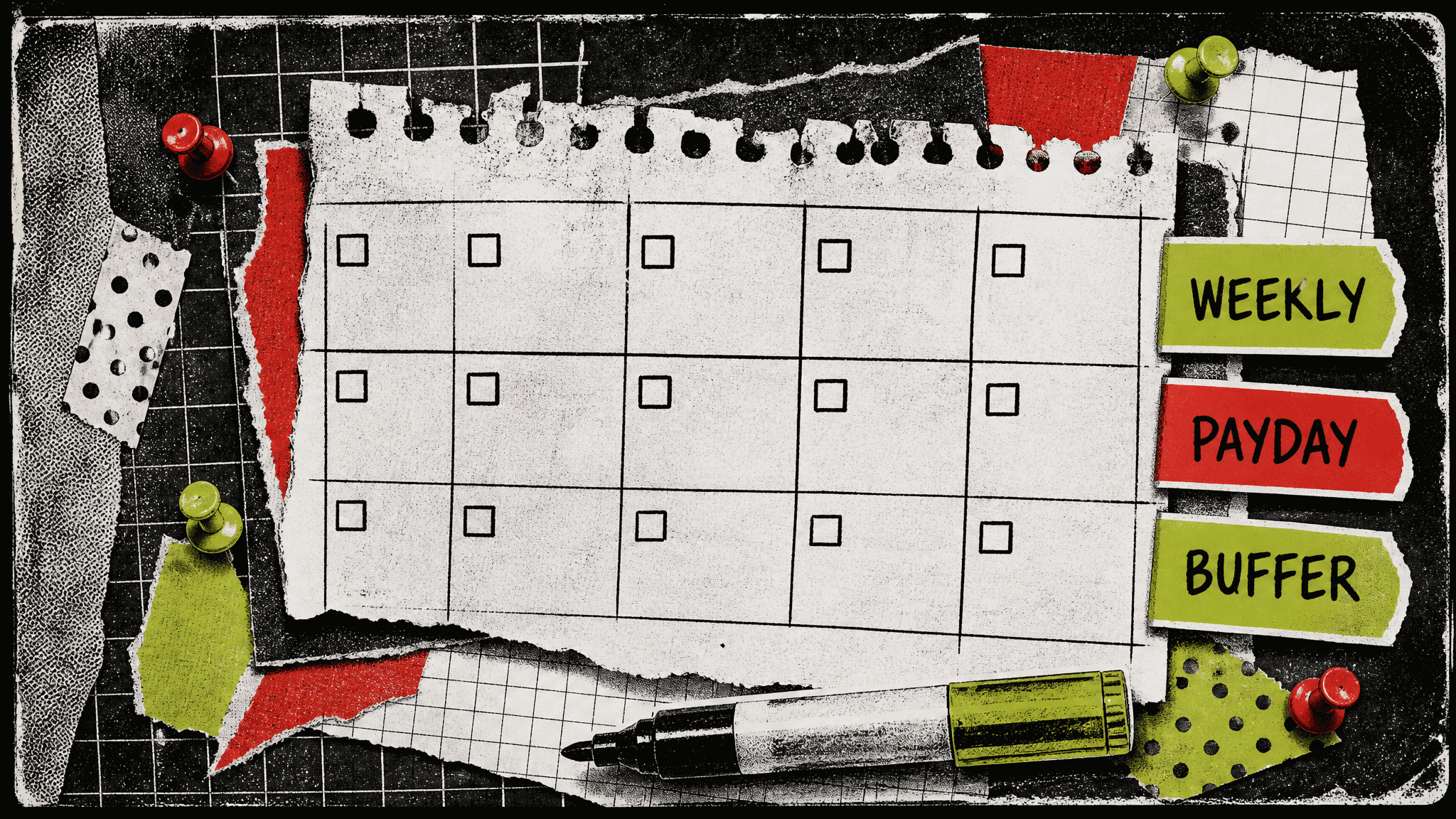
Week 1: open a separate savings account or bucket and move the first $25 to $100. The point is friction. Emergency money should not sit in checking wearing a fake mustache.
Weeks 2 through 4: use the cut lane. Cancel two subscriptions, make grocery swaps, cap restaurants, and negotiate one bill. Target $200 to $300 total by the end of month one.
Weeks 5 through 8: use the earn lane. Sell three to five items, take one paid gig, ask about overtime, or start the raise conversation. Target another $300 to $400.
Weeks 9 through 13: use the redirect lane. Sweep cashback, refunds, rebates, found money, and paycheck round-ups. Fill the remaining gap.
Here is a realistic mix: $40 from subscriptions, $75 from grocery swaps, $80 from dining-out limits, $120 from one gig, $250 from selling unused stuff, $150 from overtime, $50 from cashback and rebates, and $235 from a refund, bonus, or paycheck transfers. That totals $1,000 without pretending your budget has a secret yacht category.
If your income is irregular, build the weekly target around paydays instead of calendar weeks. Save more in paid weeks and less in dry weeks. Same destination, less drama.
The Alternative Pace: $500 in Six Months Is Still a Win
Now the honest part: $1,000 in 90 days is not possible for everyone.
If your rent jumped, childcare costs are eating the room, hours got cut, groceries are doing stunt pricing, or debt minimums already have their boots on your neck, forcing a 90-day sprint may backfire. You are not failing the plan. The plan may be too aggressive for this season.
Use the $500 in six months version instead.
That is about $83 per month, or about $19 per week. It is slower. It is also real. And real beats heroic for exactly as long as heroic lasts, which is usually until the first unexpected car noise.
The Federal Reserve found that 12% of all adults in 2025 said they would be unable to pay a $400 emergency expense by any means. Bankrate also found nearly a quarter of Americans had no emergency savings. So no, this is not the moment for shame confetti.
Start with $100. Then $250. Then $500. A smaller fund still changes behavior. It gives you options. It lets you pay the urgent bill without turning every other bill into a knife fight. It gives your nervous system one less tab open.
Once you hit $500, keep the account open and keep the habit running. Maybe the next target is $1,000. Maybe it is one month of rent. Maybe it is a named sinking fund for car repairs because your dashboard light has entered its performance-art era.
The forbidden move is choosing the pace that keeps you in the game.
$1,000 in 90 days is a goal. The first $100 is a pivot.
 Forbidden Finance