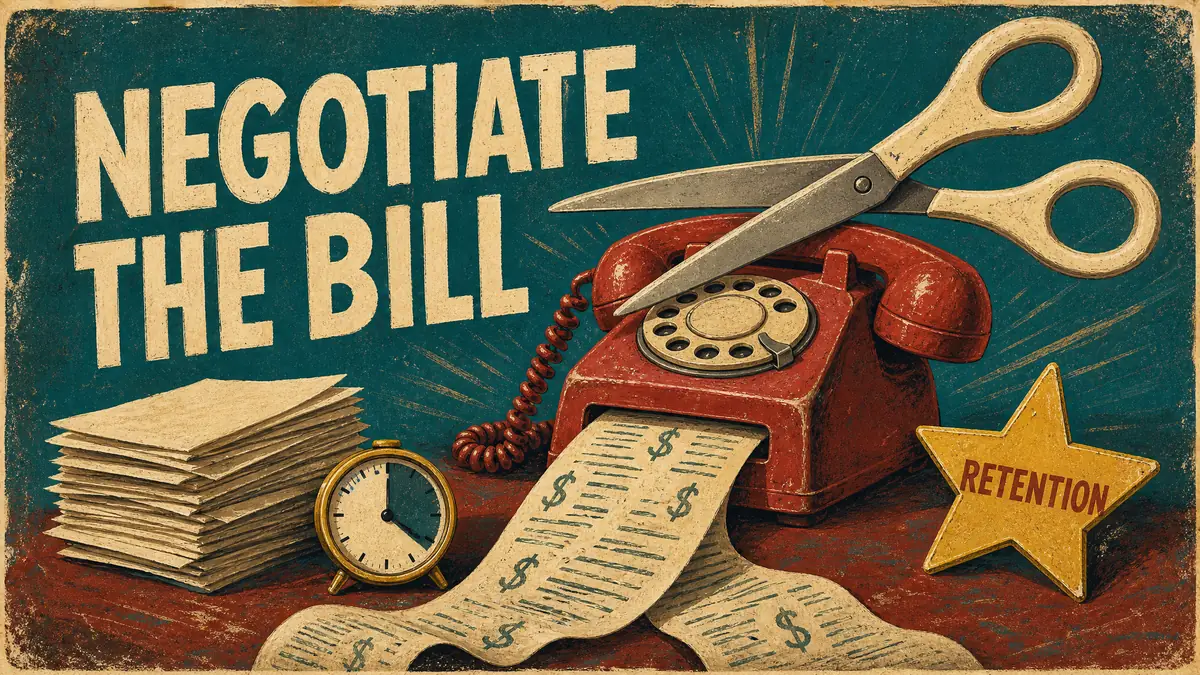
The bill is too high, the hold music sounds like a dental drill, and somehow you are supposed to calmly ask a stranger for money back from a company that invented the phrase “broadcast surcharge.” Charming little afternoon.
Still, this is one of the rare money tasks where the payoff can show up immediately. Not spiritually. Not “future you will thank you.” Actually on the next bill. Bankrate found in 2025 that 43% of U.S. adults say money negatively affects their mental health at least occasionally, so if calling your internet provider makes your soul leave your body, you are not being dramatic. You are being statistically normal.
And the bills are not exactly behaving. Reviews.org reported in its 2026 Consumer Trust Survey that 73% of consumers saw their internet bills rise in the prior year, and 66% contacted customer support about a bill. Apparently “please explain this fee” is now a national hobby.
TL;DR
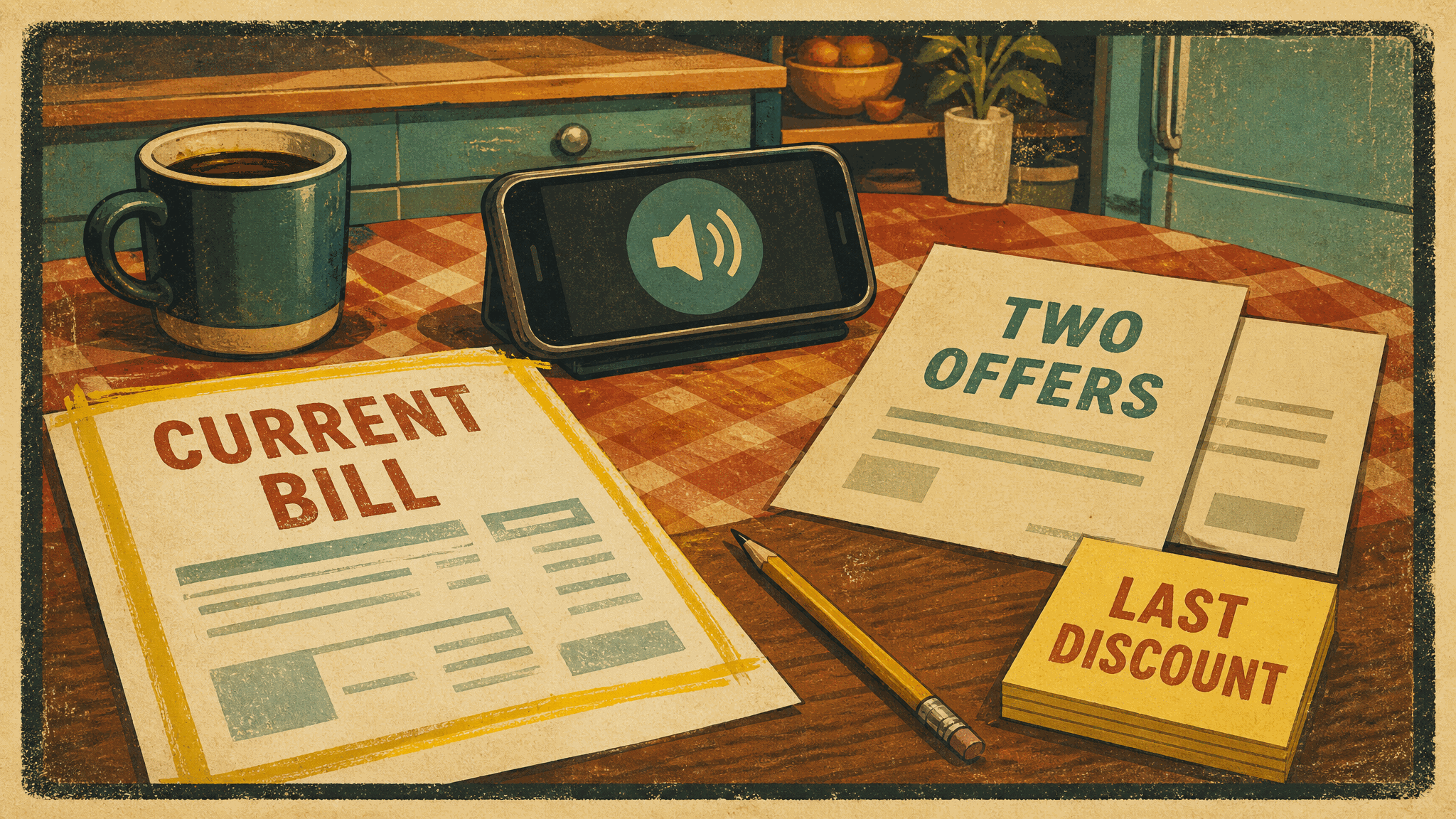
- Pull your current bill, two competing offers, and your discount history before calling.
- Start with retention language, then escalate only if the first answer is weak.
- Track the annualized savings so this becomes a habit, not a once-a-year panic ritual.
Pull the Paper Trail Before You Call
Do not call with vibes. Vibes get you a “valued customer” speech and a $3 courtesy credit. Cute. Useless.
Before you dial, collect three things.
First, pull your current bill. Circle the base rate, equipment fees, taxes, service fees, discounts, promo expiration dates, and mystery items that sound like they were named by a committee hiding in a printer closet. For cable and satellite TV, the Federal Communications Commission adopted an all-in pricing rule requiring cable and satellite providers to show the aggregate video programming price clearly in promotional materials and on bills, which is useful because “surprise, the real price is higher” is not a personality trait.
Second, pull two competitor offers. Do not name-drop companies in your notes if it makes you freeze up. Label them Offer A and Offer B. What matters is the price, speed, coverage, deductible, contract length, fees, and whether the advertised deal turns into a pumpkin after 12 months.
Third, know your retention-tier history. That means your last discount, when it started, when it expired, and what you were paying before the bill crept upward like a houseplant with bad intentions. If you received a loyalty credit last August, say so. If your promo expired in May, say so. The forbidden pricing usually lives in the gap between “published price” and “please do not leave us.”
Use this exact opener:
“I’m a customer of X years and reviewing whether to stay.”
Then stop talking. Let them fill the silence. Silence is free, which is suspiciously rare in personal finance.
What Each Bill Is Worth Fighting For
These are target ranges, not a blood oath from the billing department. A 30% cut is easier on a bloated cable package than on a state-regulated insurance policy. The point is to know where the juice might be worth the phone call.
| Bill type | Typical % off | Negotiation difficulty 1-5 |
|---|---|---|
| Cable/internet | 10%-30% | 3 |
| Mobile phone | 5%-25% | 3 |
| Auto insurance | 5%-20% | 4 |
| Home insurance | 5%-15% | 4 |
| Gym membership | 10%-50% | 2 |
| Service contracts | 10%-30% | 2 |

A bill audit fits naturally beside a subscription sweep. If your account history is full of tiny monthly charges wearing fake mustaches, read Your Forgotten Subscriptions Are Bleeding You Dry next.
Use the Three Escalation Tiers
Your goal is not to win a courtroom drama. Your goal is to reach the person whose screen contains the better buttons.
- Front-line agent. Ask for a lower rate, loyalty discount, fee removal, or plan review. Be calm. Be specific. Assume they have a small toolbox.
- Retention department. If the offer is weak, say: “I appreciate you checking. Is there a retention or loyalty team that can review cancellation-prevention options?” This is where the interesting coupons live.
- Cancellation department. Use this only if you are willing to leave or downgrade. Say: “Before I cancel, I want to confirm whether there is a final offer that matches my usage and current market pricing.”
If the issue turns into billing trouble rather than negotiation, the FCC Consumer Complaints Center accepts phone, internet, and TV complaints involving billing, equipment, coverage, speed, service, and related issues. You are not threatening anyone with paperwork. You are simply remembering that paperwork exists. A subtle power move. Very beige. Very effective.
Scripts You Can Steal
Cable and internet
“I’m a customer of X years and reviewing whether to stay. My current bill is higher than comparable offers I found, and I want to lower the monthly cost without adding services. Can you check loyalty, retention, or current promotional pricing for my account?”
If they offer a bundle: “Please price that with all monthly fees included, and compare it to my current plan. I do not want a lower base price that becomes a higher real bill.”
If they say no: “I understand. Please transfer me to the retention team so I can review cancellation options.”
Mobile phone
“I’m reviewing our phone bill because the monthly total has drifted up. Can you check whether our plan is still the best fit for our actual usage, including autopay discounts, loyalty credits, older-line discounts, and device protection we may not need?”
Then ask: “What would the bill be if we kept the same number of lines but changed data tiers?”
The phone company loves selling you “unlimited” everything. You may not need unlimited everything. You may need unlimited patience, but they do not sell that yet.
Auto insurance
“I’m comparing auto insurance rates and want to see whether my current policy can be repriced before renewal. Please review discounts, mileage, driver details, deductibles, bundling, telematics options, and whether any coverages no longer fit the car’s value.”
The Insurance Information Institute recommends comparing policies from at least three insurers and matching coverage levels so you are comparing apples to apples. Not apples to “this one has a cute app icon.”
Home insurance
“I’m reviewing my homeowners policy before renewal. Can you check replacement cost assumptions, deductible options, protective-device discounts, bundle discounts, claim-free discounts, and any rating changes that affected my premium?”
A recent NerdWallet survey found that 66% of Americans who shopped for homeowners insurance in the prior 12 months used multiple shopping methods. That is the move. Get quotes online, call insurers, ask an independent agent, and make your current insurer compete for the privilege of billing you.
Gym membership
“I want to keep the membership, but the current rate is higher than I want to pay. Are there loyalty rates, off-peak plans, annual-pay discounts, waived fees, or pause options available?”
If you are actually willing to cancel: “Please tell me the cancellation process and final billing date before we continue.”
Gyms often negotiate because unused memberships are basically their business model wearing sneakers.
Service contracts
“I’m reviewing this service contract before renewal. I need the renewal price, what is actually covered, what is excluded, the deductible or service-call fee, and whether there is a lower plan that matches my usage.”
Then ask: “If I cancel today, what happens to coverage and billing?”
That question is boring. Boring questions save money. Glamour is how you end up paying monthly for a printer warranty from the Stone Age.
Keep the Call Calm While You Ask for More
The trick is not aggression. It is repetition with receipts.
Use the same sentence three ways:
“I need the monthly total lower.”
“That still leaves the bill higher than comparable offers.”
“What is the best available option if I remove services or move to cancellation?”
Do not over-explain your life. You do not need to present a dramatic monologue about groceries, rent, and the emotional violence of modem rental fees. You are a customer reviewing price. That is enough.
Also, do not accept the first shiny object. A free premium channel, bonus data, or upgraded roadside widget is not savings unless you wanted it and would have paid for it. Otherwise it is clutter wearing a party hat.
If the call is going badly, say: “Thanks for checking. I am going to pause and compare this against my other options. Please note the offer and confirmation number on my account.”
Then hang up like a person with blood pressure.
Document the Savings Like a Tiny Audit
Negotiation only counts when the bill changes.
Write down the date, agent name or ID, department, confirmation number, old price, new price, promo end date, contract term, cancellation fee, and when the new rate should appear. Ask for written confirmation by email or account message. Screenshot the chat if you used chat. Screenshot everything. Future you deserves evidence, not folklore.
Here is the “$340 in 45 minutes” math:
Cable/internet call: $20 per month lower for 12 months = $240.
Mobile call: $100 one-time loyalty credit = $100.
Total documented savings = $340.
Time spent = 45 minutes.
Hourly rate = $453.33.
That is not a lifestyle transformation. It is one mildly annoying administrative errand that paid like a highly specialized consultant with a headset and trust issues.
This is also why bill negotiation belongs inside a wider money reset. The Mid-Year Money Reset: A 10-Step Audit to Run Before June Hits is the same idea at household scale: find the leaks, fix the obvious ones, refuse to make it a personality crisis.
And yes, the money matters. Bankrate’s 2026 Annual Emergency Savings Report found that only 47% of Americans said they had enough liquidity or access to funds to cover a $1,000 emergency expense. A few hundred dollars is not cute spreadsheet confetti. It is margin.
Make It a Calendar Habit, Not a One-Off Hero Moment
The worst version of bill negotiation is waiting until you are furious, calling six companies in one afternoon, then never doing it again because the experience made you want to live inside a cave with fiber internet.
Make it boring instead.
Set a quarterly “recurring bill review” appointment. Pull the last 90 days of transactions. Sort by merchant. Flag anything monthly, quarterly, or annual. Then pick only two calls. Two. This is not a hostage negotiation marathon.
If you want to get more aggressive, pair this with Sub-Hunting: How to Find $50-$200/Month Hiding in Your Recurring Charges. Same muscle. Different target.
The forbidden rule is that there is no single correct cadence. Monthly is great if your bills are volatile. Quarterly is enough for most households. Twice a year works if your life is already held together by autopay and good records. Personal finance advice loves pretending everyone needs the same system. Everyone does not. Pick the one you will actually run.
Before the next call, reopen your notes and use the same opener: “I’m a customer of X years and reviewing whether to stay.”
Then ask. Pause. Escalate. Document. Put the follow-up date on the calendar.
45 minutes. Sometimes $340. The forbidden thing is they were always going to give it to you.

 Forbidden Finance