Start With The Next Ten Years
Ten years from retirement is when your portfolio stops being a scoreboard and starts becoming plumbing. Less exciting, yes. Also harder to ignore when water is dripping through the ceiling.
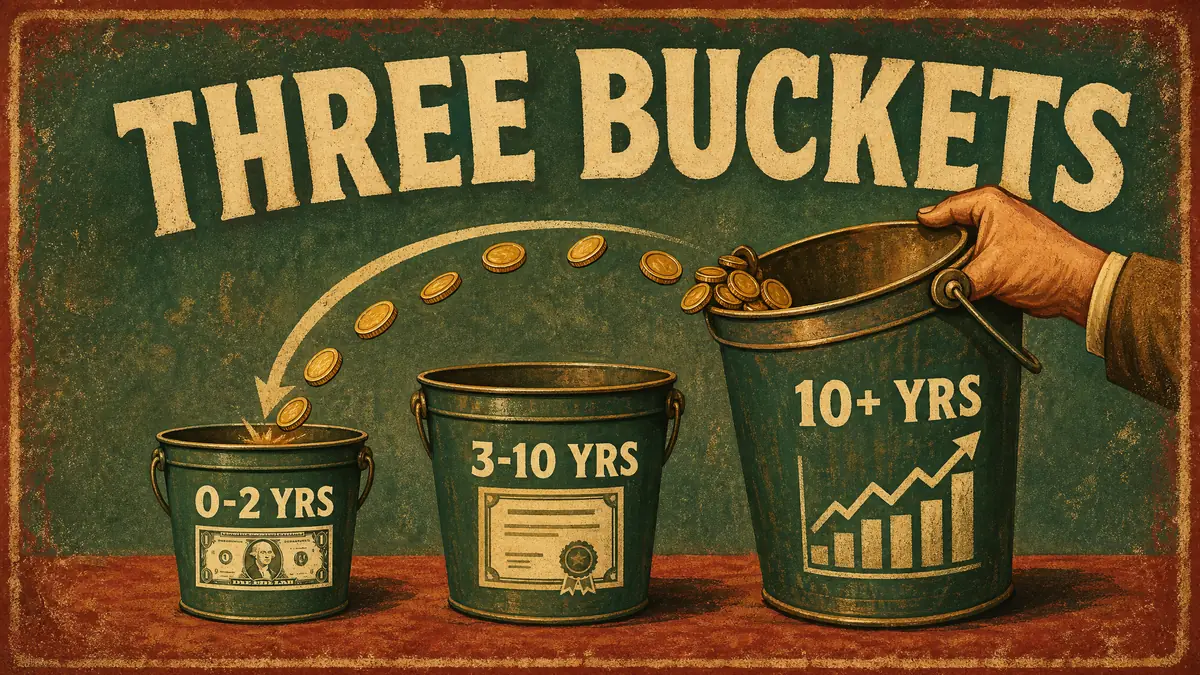
The three-bucket strategy is a simple way to organize retirement money by time: cash for soon, bonds for next, stocks for later. It is not a personality test. It is not a purity pledge. It is just a way to avoid selling beaten-up stocks to pay the electric bill, which is the financial equivalent of using a wedding dress as a shop towel.
Vanguard frames retirement income planning as a decision framework, not one holy withdrawal doctrine handed down from a spreadsheet-shaped mountain. That matters here. Buckets are useful because your life has timing. Bills arrive monthly. Markets do not politely recover on schedule.

TL;DR
- Bucket 1 holds roughly two years of withdrawals in cash or short Treasuries.
- At a 4% withdrawal rate, that means about 8% in Bucket 1 and roughly 30% in Bucket 2.
- The point is not perfect math. It is avoiding forced selling when markets are rude.
The Three Buckets Explained
Bucket 1 is the boring one. Good. Boring is underrated. This is money for the next 0-2 years of planned portfolio withdrawals, usually held in cash, high-yield savings, money market funds, Treasury bills, or short Treasury funds. The job is not growth. The job is showing up.
Bucket 2 covers years 3-10. Think high-quality bonds, short-to-intermediate bond funds, Treasury ladders, CDs, or a conservative balanced fund. This bucket should have some return potential, but it is still wearing sensible shoes. It exists so Bucket 1 does not become a lonely little puddle after the first market tantrum.
Bucket 3 is the long-term growth engine: diversified stock funds and other assets you do not expect to touch for a decade or more. If Bucket 1 is groceries and Bucket 2 is the pantry, Bucket 3 is the farm. You do not dig up the farm because tomatoes are on sale.
This is also why the strategy works for late-career readers, not just retirees. If retirement is eight years away, you are already close enough for timing to matter. Your 401(k), IRA, Roth IRA, taxable brokerage, HSA, and that rollover account from the job where everyone used Slack like it was oxygen are all part of the same future paycheck.
Why Sequence Risk Is Different Near Retirement
A 30% market drop at age 40 is annoying. Painful, sure. Emotionally, it can feel like opening your statement and finding a raccoon has been day-trading in there. But structurally, you are probably still buying. Your paycheck is still refilling the machine. Lower prices can even help future contributions.
A 30% market drop in your first retirement year is a different animal. You are no longer adding shares. You are selling them. If you sell stocks after they fall, then those shares are gone before they can participate in the recovery. Same market return. Different order. Very different outcome.
That is the core of sequence-of-returns risk. William Bengen showed in his 1994 withdrawal-rate work that averages can mislead retirees because year-by-year returns and inflation matter. Kitces makes the point even sharper: the first decade of real returns tends to drive the danger more than the first month or the first scary headline.
Buckets do not repeal sequence risk. Forbidden, but not magical. They give you a pre-decided order of operations so you are not inventing a plan while CNBC is hyperventilating in the background.
How Big Each Bucket Should Be
Start with spending, not vibes. First, calculate how much you expect to pull from investments each year after Social Security, pensions, part-time work, rental income, or any other income floor. If you do not know that number, start with The ‘Ugly Number’: How to Calculate What You Actually Spend in a Year. The ugly number is rude, but useful. Like a smoke alarm.
Then translate your withdrawal rate into bucket sizes. A 4% withdrawal rate means you plan to withdraw 4% of the portfolio in year one. Two years of withdrawals equals about 8% in Bucket 1. Years 3-10 equals roughly eight more years of withdrawals, so Bucket 2 lands around 32%, which people often round to about 30%. Bucket 3 gets the rest.
The 4% idea comes from historical withdrawal research, not from a finance influencer carving it into a granite countertop. Bengen’s 1994 paper tested inflation-adjusted withdrawals against historical U.S. stock, bond, and inflation data. The later AAII study commonly called the Trinity study emphasized that no single withdrawal rate fits every investor and that mid-course corrections may be needed. Translation: the rule depends. Forbidden Finance remains undefeated.
| Starting Withdrawal Rate | Bucket 1: 0-2 Years | Bucket 2: 3-10 Years | Bucket 3: 10+ Years |
|---|---|---|---|
| 3% | About 6% of portfolio | About 24% of portfolio | About 70% of portfolio |
| 4% | About 8% of portfolio | About 32% of portfolio | About 60% of portfolio |
| 5% | About 10% of portfolio | About 40% of portfolio | About 50% of portfolio |

These are planning weights, not commandments. If you have a pension covering most fixed expenses, Bucket 1 can be smaller. If you are retiring before Medicare, supporting family, or carrying lumpy expenses, Bucket 1 may need more room. Life does not read allocation textbooks. Rude, but consistent.
The Annual Refill Ritual
Once a year, check the buckets. Not daily. Daily checking is how a reasonable adult becomes a candle-chart goblin. Annual is enough for most households.
The basic refill order is simple. Spend from Bucket 1. If Bucket 2 had a decent year, refill Bucket 1 from Bucket 2. If Bucket 3 had a strong year, refill Bucket 2 from Bucket 3. In good markets, growth replenishes stability. In bad markets, the cash and bond buckets buy time so you are not selling stocks after a drop.
T. Rowe Price modeled cash-buffer and bucketing approaches that use near-term reserves first when market returns are negative, then move through lower-risk assets before tapping higher-risk assets. That is the behavioral magic of the bucket system. It gives panic a checklist.
One caution: do not worship the buckets so hard that you ignore total allocation. Buckets are a way to organize the portfolio, not a loophole in math. Morningstar found that bucket strategies can offer behavioral benefits, but design and refill rules matter because cash reserves and rigid structures can carry opportunity costs. A plan that keeps you calm is valuable. A plan that quietly starves growth for 25 years is just anxiety in a cardigan.
Useful Before You Retire, Not After You Panic
The best time to build buckets is before retirement starts. Five to ten years out, you can still adjust contributions, risk level, savings rate, account location, cash reserves, and retirement date. After retirement starts, the plan has fewer knobs and more feelings.
This is where late-career planning gets practical. Read How to Read Your 401(k) Statement (and Spot the Fees Eating Your Retirement) so you know what you actually own. Then decide where Bucket 1 cash belongs using Where to Park Cash in 2026: HYSA vs. Money Market vs. T-Bills vs. CDs. Cash location is not glamorous, but neither is discovering your emergency money is trapped behind settlement delays and three customer-service menus.
Pre-retirement buckets also help you notice whether the portfolio you think you own matches the portfolio you actually own. Many people are aggressive in one account, conservative in another, and accidentally weird in aggregate. That is not a moral failure. That is account sprawl wearing a fake mustache.
Aggregation Sidebar: One Portfolio Wearing Five Hats
Buckets only work if you can see the whole household portfolio at once. A 401(k) is not Bucket 3 by default. A Roth IRA is not magically growth money just because it has better tax treatment. A taxable brokerage is not automatically short-term money because you can access it. Account type and bucket role are related, but they are not identical.
Vanguard notes that consolidating or coordinating accounts can make it easier to see where you stand and reduce administrative clutter. Vanguard also points out that retirees may have multiple retirement accounts beyond what any one recordkeeper can observe. Which is a polite institutional way of saying: your money may be scattered across enough logins to qualify as a scavenger hunt.
The practical move is to assign every holding a job. Cash for near withdrawals. Conservative fixed income for the next layer. Stocks for later. Then check whether those jobs add up across the household, including a spouse or partner if you manage money together. The market will still be moody. At least your map will not be.
Final Thought
The three-bucket strategy is not the One Correct Way. That is the whole point. Some people need a strict bucket system because it keeps them from selling low. Some people prefer a total-return portfolio with a simple rebalancing rule. Some people need a pension bridge, a part-time-work bridge, or a smaller house with fewer stairs and fewer mysterious attic boxes.
The forbidden move is giving yourself permission to choose the structure that fits your actual retirement risk, not the one that sounds most impressive at dinner.
Your money does not need drama. It needs time, liquidity, and a plan for ugly years.
You don’t outlive your money. You outlive bad sequencing.
 Forbidden Finance