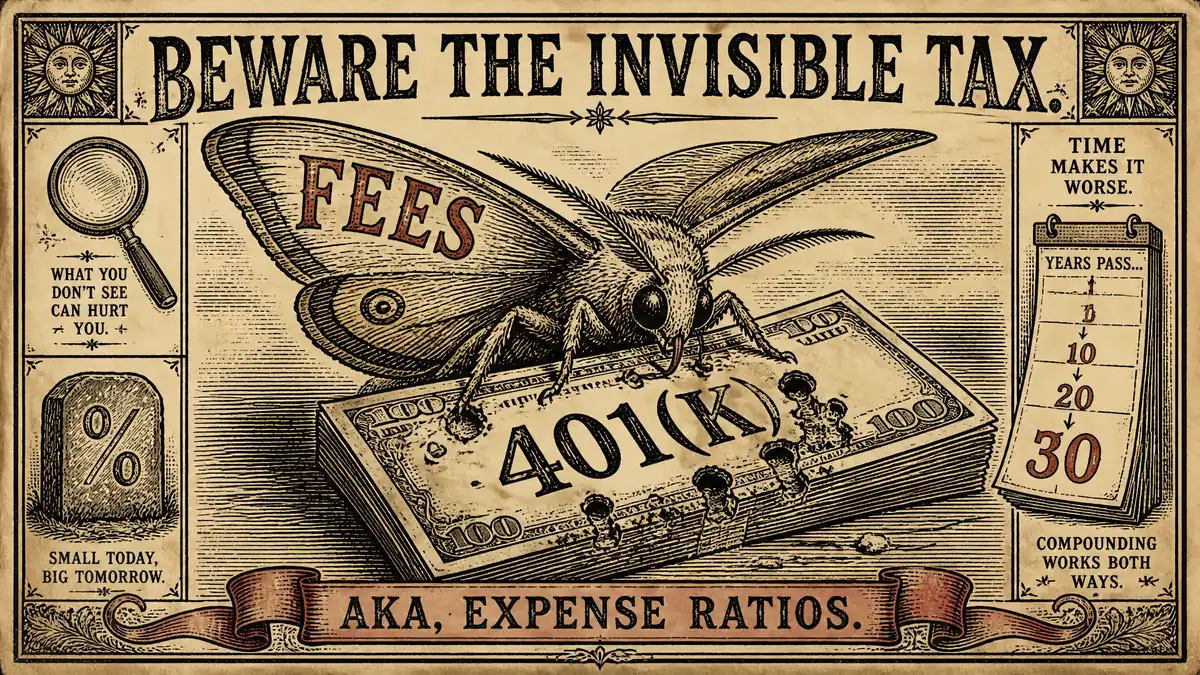
Your 401(k) statement is not trying to be readable. It is trying to be legally sufficient, which is finance-speak for “technically present, emotionally unavailable.” Somewhere inside the account balance, the pie chart, and the 19-page disclosure packet written by someone allergic to verbs, your fees are sitting there with a tiny fork.
The good news: you do not need to become a retirement-plan attorney. You need to find three things: the expense ratio on each fund, the administrative fees charged to your account, and whether your plan hides recordkeeping costs inside revenue-sharing arrangements. Fun little treasure hunt. The treasure is your own money.

TL;DR
- Find each fund’s expense ratio first; anything over 0.5% deserves a hard look.
- Administrative fees and revenue sharing can hide outside the fund list.
- A 0.75% annual fee gap can cost about $156,000 over 30 years.
- Your move is not shame, it is comparison shopping.
First, Know What the Statement Is Required to Show
Your 401(k) statement usually arrives quarterly. Your fee disclosure usually arrives annually. They are related, but they are not the same document, because apparently one confusing retirement document was not enough.
Under the DoL’s 404(a)(5) rule, participant-directed plans have to give you plan and investment fee information, including a comparative chart for the plan’s investment options. That chart is the part you want. It should show each fund’s name, category, performance, benchmark, total annual operating expenses as a percentage, and the cost per $1,000 invested.
The same rule also requires quarterly statements showing administrative or individual fees actually charged to your account. Translation: if the plan deducted $18 for recordkeeping, it should not require a séance to find it.
There is a second rule working in the background. The DoL’s 408(b)(2) rule requires covered service providers to disclose compensation to the plan fiduciary, including direct and indirect compensation. That is the grown-up table where recordkeepers, fund companies, consultants, and other well-dressed fee collectors explain how they get paid.
You, as a participant, mostly see the 404(a)(5) disclosure. HR or the plan committee should have access to the 408(b)(2) materials. Keep that in mind for the script later.
Walk Through the Statement Like a Fee Detective
Open the statement and ignore the big balance for 30 seconds. Yes, it is the fun number. No, it is not the first number.
1. Find the Expense Ratio
Look for columns named “expense ratio,” “gross expense ratio,” “net expense ratio,” “total annual operating expenses,” or “annual operating expense.” A plan may also show cost per $1,000. If the fund costs $4.00 per $1,000, that is 0.40%. If it costs $12.50 per $1,000, that is 1.25%. The math is boring. The result is not.
On a real-style statement, you might see something like this:
- Big U.S. Equity Index Fund: expense ratio 0.03%. Good.
- Total Bond Index Fund: expense ratio 0.05%. Good.
- Target Date 2055 Index Fund: expense ratio 0.08%. Good.
- International Index Fund: expense ratio 0.10%. Fine.
- Large Cap Growth Active Fund: expense ratio 0.64%. Examine.
- Global Opportunities Fund: expense ratio 1.12%. Probably bad unless it is doing something very specific and very useful, which it probably is not.
The Investment Company Institute found that 401(k) participants investing in equity mutual funds paid an average expense ratio of 0.27% in 2025, down from 0.76% in 2000. That does not mean your plan is magically cheap. It means if your core stock fund costs 1.12%, the burden of proof has entered the chat wearing boots.
2. Compare Each Fund to the Plan’s Index Options
Do not compare your expensive fund to vibes. Compare it to the cheapest broad index fund in the same category.
Large-cap active fund? Compare it to the plan’s S&P 500 or total U.S. stock index option. Target-date fund? Compare it to the plan’s index target-date series, if one exists. International active fund? Compare it to the plan’s international index fund.
This is where Investing 101 for People Who Already Have a Budget becomes useful: the point is not to chase the cheapest fund blindly. The point is to ask whether the expensive fund is buying you anything you actually need.
3. Check Your Allocation
A cheap fund can still be wrong for the job. A money market fund with a tiny fee is not a retirement plan if you are 31 and saving for 35 more years. It is a waiting room with fluorescent lights.
Vanguard’s How America Saves reported that 69% of participants were in professionally managed allocations at year-end 2025, including target-date funds, balanced funds, and advice services. That is not a command to use one. It is a reminder that your allocation should be intentional, not whatever the enrollment website auto-clicked while you were trying to finish benefits paperwork before lunch.
The Fee Tiers: Green, Yellow, Red
Here is the quick read. These are rules of thumb, not holy tablets carried down from Mount Spreadsheet.
| Fee level | Annotation | What to do |
|---|---|---|
| 0.00% to 0.20% | Excellent for broad index funds and many institutional options. | Keep if the fund fits your allocation. |
| 0.21% to 0.50% | Reasonable for many target-date, bond, international, or specialty options. | Compare against the closest index fund before changing. |
| 0.51% to 1.00% | Examine. This is where the fee starts asking for rent. | Look for a cheaper fund in the same asset class and compare performance, risk, and role. |
| Over 1.00% | Probably bad for a core retirement holding. | Demand a reason, then check whether an index option can do the job for less. |
Why the hard side-eye over 1%? Because fees compound backward. Every year, the fund takes its slice before your future self gets dessert.
The Department of Labor gives a classic example: a 1% fee difference over 35 years can reduce an account balance by 28%, assuming a $25,000 starting balance, 7% average returns, and no additional contributions. Different assumptions change the number. The lesson survives.
Also, do not confuse “expensive” with “sophisticated.” Sometimes complex investments are useful. Sometimes they are just a fee lasagna.
The Sneaky Part: Administrative Fees and Revenue Sharing
Expense ratios are the obvious villain. Administrative fees are the side character who was in the room the whole time.
Look for quarterly line items like:
- Recordkeeping fee
- Plan administration fee
- Advisory fee
- Managed account fee
- Loan maintenance fee
- Distribution processing fee
- Qualified domestic relations order fee
- Brokerage window fee
Some of these are normal. Somebody has to keep the plan records, process payroll contributions, file required reports, and answer the phone when someone forgets their password for the ninth time. The issue is not that fees exist. The issue is whether they are reasonable, visible, and avoidable.
The trickier version is revenue sharing. Under the DoL’s 404(a)(5) rule, your quarterly statement may explain that some administrative expenses were paid from the operating expenses of one or more investment options, including revenue sharing, Rule 12b-1 fees, or sub-transfer agent fees.
In plain English: instead of charging everyone a clear $40 annual recordkeeping fee, the plan may use higher fund expense ratios to pay the recordkeeper indirectly. The fee is still yours. It just arrives wearing a fake mustache.
The Investment Company Institute describes how mutual fund shareholder-service payments to recordkeepers can offset the cost of plan recordkeeping, and those payments are included in the fund expense ratio. That is not automatically evil. It is automatically worth understanding.
If your plan has both high expense ratios and separate admin fees, congratulations, you may have discovered fee layering. Put that in the HR script with a tiny skull drawn in the margin. Actually, do not draw the skull. HR gets nervous.
The Compounding Cost: Small Percent, Large Bite
Let’s run the math the way fees actually hurt: slowly, politely, and then all at once.
Assumptions: you start with $200,000, earn a 5% gross annual return before fees, make no additional contributions, and compare a low-fee portfolio at 0.25% per year against a higher-fee portfolio at 1.00% per year. That is a 0.75% fee differential.
| Year | Low-fee portfolio: 0.25% annual fee | Higher-fee portfolio: 1.00% annual fee | Cost of the fee gap |
|---|---|---|---|
| 0 | $200,000 | $200,000 | $0 |
| 10 | $318,105 | $296,049 | $22,056 |
| 20 | $505,954 | $438,225 | $67,729 |
| 30 | $804,731 | $648,680 | $156,052 |
That $156,052 is not a line item you get to angrily dispute with customer service. It is the missing growth on the money that left every year. Very tidy. Very rude.
This is why 401(k) fees belong in the same mental folder as forgotten subscriptions. Not because they are the same size, but because they are recurring, quiet, and weirdly easy to ignore until you run the annual damage report. If you enjoy finding recurring charges hiding under couch cushions, Sub-Hunting: How to Find $50-$200/Month Hiding in Your Recurring Charges is the same energy, smaller decimal places.

Ask HR These Three Questions
You do not need to accuse anyone of stealing your retirement in the subject line. Tempting, but no.
Use this script:
“Hi, I’m reviewing my 401(k) fees and investment options. Could you help me understand three things?”
1. “Can you send me the most recent participant fee disclosure and investment comparative chart?”
This is the 404(a)(5) disclosure. Ask for the version that shows each investment option, benchmark, performance, expense ratio, and shareholder-type fees. If someone sends you a login page and a shrug, ask where inside the portal the annual fee disclosure lives.
2. “Are plan administrative and recordkeeping costs charged directly to participants, paid by the employer, or paid through revenue sharing?”
This forces the fee structure into daylight. You are not being difficult. You are asking whether the bill is itemized, hidden in fund expenses, or split like a restaurant check where one person ordered lobster.
3. “Does the plan offer lower-cost index options or institutional share classes for the same asset categories?”
This is the money question. If your current fund is a U.S. stock fund at 0.78%, and the plan offers a broad U.S. index fund at 0.04%, you have a comparison. If the plan does not offer a cheaper option, ask when the investment menu is reviewed and whether participant feedback goes to the plan committee.
You can also ask whether the plan uses a managed account service and what it costs. Some advice services are helpful. Some are expensive autopilot with a nicer font.
Stay and Optimize, or Roll Over After a Job Change
If you still work there, your best move is usually to optimize inside the plan first: capture the employer match, choose the lowest-cost funds that fit your allocation, avoid unnecessary managed-account add-ons, and keep administrative fees on your radar.
If you have left the job, the decision changes. The IRS says you generally have four options for an old workplace plan: leave the money in the old plan, roll it into a new employer’s plan, roll it into an IRA, or withdraw it. Withdrawing is usually the chaos option because taxes and possible penalties can show up with steel-toed shoes.
Staying can make sense if the old plan has excellent institutional funds, low administrative fees, strong creditor protections, or access to investment options you cannot easily buy in an IRA. Rolling over can make sense if the old plan is expensive, limited, annoying to manage, or likely to be forgotten behind three old email addresses and a benefits portal that looks like it was assembled during a thunderstorm.
Before rolling over, compare all-in costs. Some IRAs offer cheap index funds and no account fee. Some rollovers get nudged into expensive managed products because the word “retirement” makes everyone lower their guard. Forbidden, but common.
This is also where your broader plan matters. If you are checking whether retirement is on track, How Much Should You Have Saved by 30, 40, 50, 60? Honest Benchmarks (and What to Do If You’re Behind) gives you the bigger map. Fees are one lever. Savings rate, allocation, time, and tax location matter too.
The forbidden move is not “always roll over” or “never roll over.” The rule is that the rule depends. If the old 401(k) is cheap and clean, stay and optimize. If it is expensive and cluttered, roll it somewhere better after checking tax treatment, investment options, and account fees.
You can’t out-earn a 1.5% expense ratio. You can only out-fix it.
 Forbidden Finance