The health savings account has terrible branding. It sounds like a little medical piggy bank. Aspirin money. Copay confetti. The place your employer tells you to stash enough for orthodontics and then never mentions again.
That is adorable. Also, incomplete.
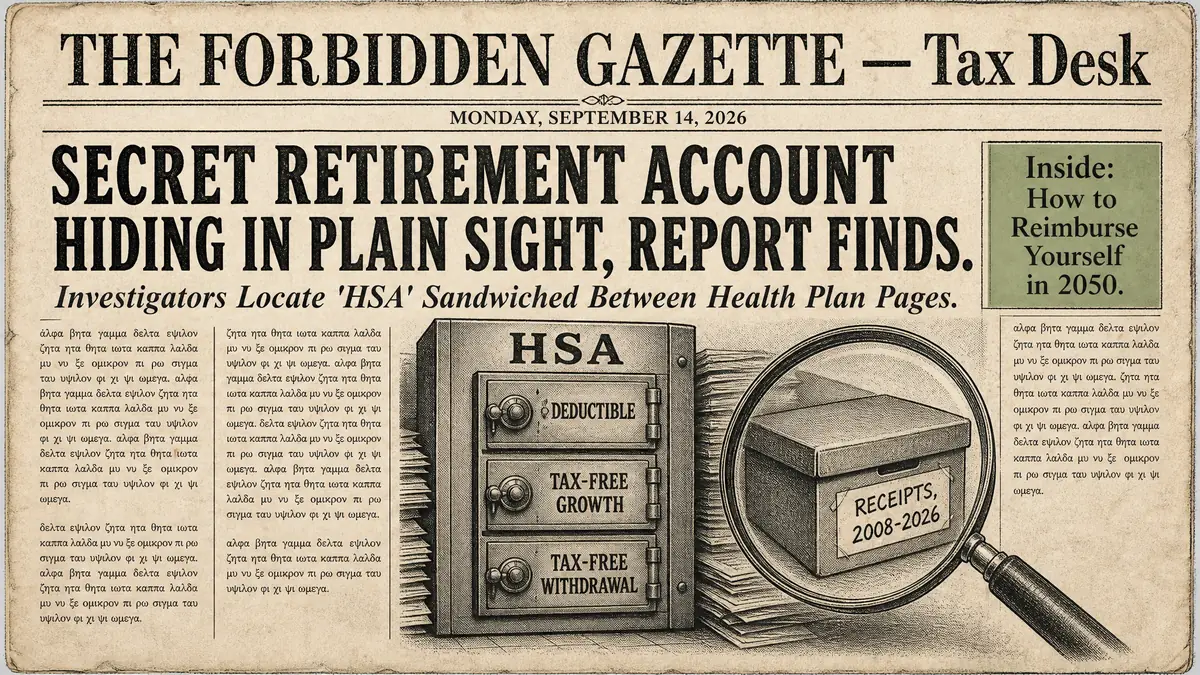
An HSA is one of the strangest accounts in American finance because it can behave like a tax deduction, an investment account, a medical emergency fund, and a retirement account wearing a fake mustache. The tax code gave it three separate advantages, then buried it inside health insurance paperwork like a cursed side quest.

TL;DR
- For 2026, the HSA contribution limit is $4,400 for self-only HDHP coverage and $8,750 for family coverage.
- The forbidden move is paying medical bills out of pocket, saving receipts, and reimbursing yourself years later.
- If you can invest it, an HSA can outrank a Roth IRA in the savings order.
What an HSA Actually Is
A health savings account is a tax-advantaged account tied to an eligible high-deductible health plan. The boring official version, from IRS Publication 969, is that an HSA is a tax-exempt trust or custodial account you set up with a qualified trustee to pay or reimburse certain medical expenses.
Translation: if you qualify, you can put money in, potentially invest it, and later use it for qualified medical expenses without paying federal income tax on the way out.
The catch is eligibility. To contribute, IRS Publication 969 says you generally need HDHP coverage on the first day of the month, no disqualifying other health coverage, no Medicare enrollment, and no one claiming you as a dependent. Health insurance, as usual, brought a clipboard to a knife fight.
This matters because HSAs are not flexible spending accounts. FSAs often come with use-it-or-lose-it rules. HSAs roll over. The money stays yours if you change jobs. The account is portable. You do not have to spend it by December because someone in benefits decided your dentist needs a year-end bonus.
That portability is why the HSA belongs in the same mental folder as your 401(k), IRA, and taxable brokerage account. If you are building your money system around automation, this sits naturally next to Pay Yourself First: The Forbidden Art of Not Tracking Every Latte. You are not trying to become a receipt monk. You are trying to route dollars to the best container for the job.
The Triple Tax Advantage Is Not Marketing Fluff
Most retirement accounts make you pick a tax flavor. Traditional 401(k): possible deduction now, taxes later. Roth IRA: taxes now, qualified withdrawals later. Taxable brokerage: no special entry ticket, then taxes on dividends, interest, and realized gains.
The HSA looks at this menu and says, rudely, “I’ll take all three.”
| Tax stage | How HSA works | vs. 401(k) | vs. Roth |
|---|---|---|---|
| Money goes in | Contributions can be deductible, and employer contributions can be excluded from income, according to IRS Publication 969. | Similar to traditional pre-tax treatment. | Better, because Roth contributions are after-tax. |
| Money grows | Earnings inside the HSA are not included in income while held in the account. | Similar tax deferral while invested. | Similar tax-free internal growth. |
| Money comes out | Distributions used for qualified medical expenses can be tax-free. | Better for medical costs, because 401(k) withdrawals are generally taxable. | Similar tax-free exit, but only if HSA withdrawals are for qualified medical expenses. |

Run the simple federal-income-tax math. A $4,400 HSA contribution in 2026 saves $528 if you are in the 12% bracket, $968 if you are in the 22% bracket, and $1,056 if you are in the 24% bracket. A family max contribution of $8,750 saves $1,050 at 12%, $1,925 at 22%, and $2,100 at 24%. State taxes and payroll-tax treatment can change the real answer, because the tax code enjoys making you earn your spreadsheet.
This is why an HSA is bigger than next year’s copays. It is a tax shelter with a first-aid sticker on the lid.
The 2026 HSA Numbers
For calendar year 2026, IRS Revenue Procedure 2025-19 sets the HSA contribution limit at $4,400 for self-only HDHP coverage and $8,750 for family HDHP coverage. The same IRS guidance defines a 2026 HDHP as having a deductible of at least $1,700 for self-only coverage or $3,400 for family coverage, with annual out-of-pocket expenses capped at $8,500 and $17,000, respectively.
If you are 55 or older, IRS Publication 969 describes an additional HSA catch-up contribution. That catch-up is $1,000. Married couples do not get one giant shared HSA, by the way. Each spouse who wants to make a catch-up contribution needs their own HSA. Romance is alive, and it has separate custodial accounts.
These limits are not trivia. They tell you the maximum amount you can move into the account during the year, but they also tell you something about risk. A family HDHP can expose you to a 2026 out-of-pocket ceiling of $17,000. That is not a rounding error. That is a used car with paperwork.
The broader market is large enough that this is not some niche trick for tax nerds hiding under fluorescent lights. Devenir’s 2025 Year-End HSA Research Report found nearly $174 billion in HSA assets across 41.7 million accounts at the end of 2025. Investment assets reached nearly $85 billion, and about 4.2 million accounts held invested dollars.
Still, access is uneven. The Bureau of Labor Statistics reported that HSA access among private industry workers rose from 24% in March 2015 to 39% in March 2024, while HDHP availability among private industry workers participating in medical care plans reached 50% in 2024. In plain English: lots of people see these plans during open enrollment, but not everyone gets the same menu.
That is why the best HSA decision starts with the plan, not the tax hack. If the HDHP premium savings are tiny and the deductible jump is huge, pause. Open enrollment is not the time to cosplay as a spreadsheet hero. Use the same sober lens you would bring to Open Enrollment Is Coming: A 5-Step Prep Guide Before You Click ‘Re-Elect’: premium, deductible, out-of-pocket max, employer HSA contribution, prescriptions, expected care, and cash buffer.
The Receipts Game: Reimburse Future You
Here is the forbidden play.
You pay a qualified medical bill with normal cash. You save the receipt. You leave the HSA invested. Years later, you reimburse yourself from the HSA for that old qualified expense.
No, you do not need to do it in the same year. IRS Publication 969 says you can take an HSA distribution at any time, but only amounts used exclusively to pay qualified medical expenses are tax-free. The recordkeeping section says you must keep records showing the expense was qualified, was not previously reimbursed, and was not taken as an itemized deduction.
That is the entire game: the receipt becomes a future tax-free withdrawal ticket. A tiny paper rectangle, suddenly promoted to executive leadership.
| Step | What you do | Why it matters | What can ruin it |
|---|---|---|---|
| 1. Get eligible | Open and fund an HSA after you are covered by an eligible HDHP. | Medical expenses generally need to happen after the HSA exists to support later reimbursement. | Trying to reimburse expenses from before the HSA was established. |
| 2. Pay out of pocket | Use checking, savings, or a credit card for the medical bill. | The HSA balance stays invested instead of getting drained for every copay. | Doing this without enough cash cushion. |
| 3. Save proof | Keep the bill, receipt, explanation of benefits, and proof you paid. | The IRS recordkeeping burden is on you. | One blurry photo named IMG_4472 and a dream. |
| 4. Reimburse later | Take an HSA distribution in a future year for the old qualified expense. | You can create tax-free cash flow after years of potential compounding. | Reimbursing the same expense twice or deducting it elsewhere. |
A quick example: you have a $2,000 qualified medical bill this year. If you pay it from the HSA immediately, the account loses $2,000. If you pay it from cash, keep documentation, and let that $2,000 remain invested for 30 years at a hypothetical 7% annual return, it grows to about $15,225. Later, you could reimburse yourself $2,000 tax-free using the old receipt and still have roughly $13,225 left in the account, before considering fees or actual market performance.
That return is not promised. The market has opinions. But the structure is real.
The qualified-expense definition matters too. IRS Publication 502 defines medical expenses as costs for diagnosis, cure, mitigation, treatment, or prevention of disease, plus costs affecting a body part or function. It also makes clear that general health purchases, like vitamins or vacations, do not magically become medical care because you whispered “wellness” near them.
When the HSA Beats the Roth IRA
The Roth IRA is excellent. We are not here to throw tomatoes at good accounts. For 2026, the IRS IRA contribution limit is $7,500, or $8,600 if you are 50 or older, subject to taxable compensation and income rules.
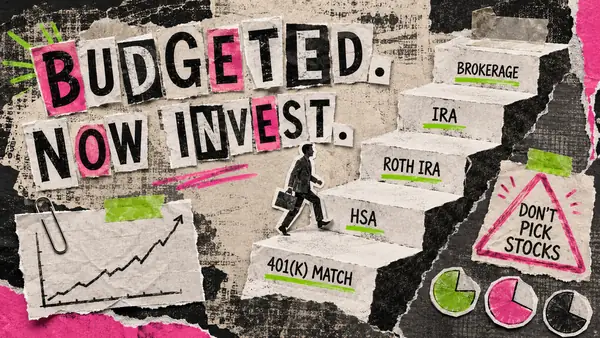
But if you are eligible for an HSA, have enough cash to avoid using it as a bill-paying turnstile, and can invest the balance, the HSA often deserves to come before Roth IRA dollars after you capture any employer match in your workplace plan.
A practical order looks like this:
- Get the full employer 401(k) match if available. Free money remains undefeated.
- Build a cash buffer large enough to survive the HDHP deductible without panic.
- Contribute to the HSA, especially if your employer adds money.
- Invest HSA dollars you do not need soon.
- Then fund Roth IRA, extra 401(k), taxable brokerage, or other goals based on your actual life.
This is not a universal commandment carved into a beige cubicle wall. If you have expensive recurring care, unstable income, or thin emergency savings, using the HSA for current medical bills may be the correct move. The forbidden rule is that the rule depends.
If you are already past the basics and trying to decide where investable dollars belong, pair this with Investing 101 for People Who Already Have a Budget. The HSA is not a replacement for asset allocation. It is a location decision. Same investments, better wrapper, if your situation fits.
What Changes at 65
At 65, the HSA gets weirder in a useful way.
Before age 65, non-qualified withdrawals are generally included in income and may face an extra 20% tax, according to IRS Publication 969. After you reach 65, that additional 20% tax no longer applies. Non-medical withdrawals are still taxable as income, but the penalty is gone.
That means an HSA starts acting IRA-like for non-medical withdrawals after 65. Not identical. Do not tell your CPA that a blog with jokes said they are literally the same account. But functionally, if you use the money for non-medical retirement spending after 65, the tax result can resemble a traditional IRA distribution.
For qualified medical expenses, the best feature survives. Withdrawals can still be tax-free when used properly. That matters because health costs in retirement are not a tiny line item hiding under “miscellaneous.” EBRI estimated in 2026 that a 65-year-old couple with Medigap Plan G and average premiums would need $267,000 for a 50% chance of covering retirement medical expenditures, and $405,000 for a 90% chance. In an extreme high-prescription-drug scenario, the estimate rose to $469,000.
Medicare also changes contribution eligibility. IRS Publication 969 says you cannot contribute to an HSA once enrolled in Medicare. Existing HSA dollars can still be used. The faucet turns off; the bucket does not evaporate.
This is where HSAs fit into net worth tracking. They are not merely medical cash. They are a retirement-health-care asset, and possibly a backup traditional-style retirement account if medical costs come in lower than expected. That is a much more useful mental category than “card I use at the pharmacy while looking mildly confused.”
Common HSA Mistakes
The first mistake is raiding it for every current expense when you do not have to. EBRI’s 2024 HSA Database report found that 56% of HSAs in its database had a distribution in 2024, with an average distribution of $1,870. Sometimes that is necessary. Sometimes it is just the debit card doing what debit cards do: making money leave quietly.
The second mistake is never investing. EBRI found that only 18% of accountholders invested HSA funds in assets other than cash in 2024. Devenir’s 2025 Year-End HSA Research Report tells the same story from a market angle: about 10% of all HSAs held invested dollars, but HSA investment accounts had an average total balance of $24,252, about 9.7 times the average funded non-investment account balance.
That does not mean everyone should invest every HSA dollar. If you might need the money for next month’s MRI, cash is not a character flaw. But if your HSA provider requires a $1,000 or $2,000 cash threshold before investing, and you have years before needing the money, leaving everything idle can turn a retirement account into a sad checking account with better tax paperwork.
The third mistake is losing receipts. The deferred reimbursement strategy only works if you can prove the expense. Create a folder. Scan documents. Save PDFs from your insurer. Back them up. Name files like an adult with future enemies: provider, date, person, expense type. Your future self does not want to audit a folder called “stuff.”
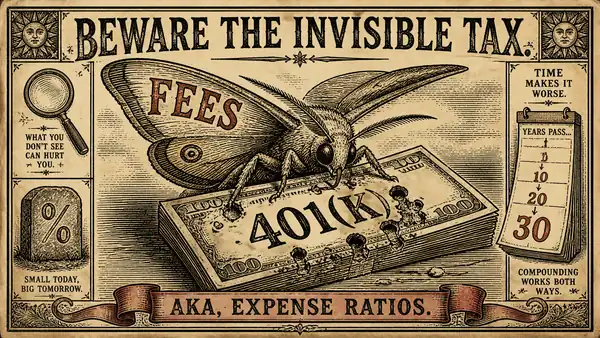
The fourth mistake is ignoring fees and investment menus. Some HSAs are great spending accounts and mediocre investing accounts. Others offer low-cost index funds and reasonable cash rules. Read the fee schedule with the same suspicion you bring to How to Read Your 401(k) Statement (and Spot the Fees Eating Your Retirement). Fees are not dramatic. That is how they get away with it.
The fifth mistake is maxing the HSA while having no emergency fund. Yes, the HSA can be powerful. No, it should not turn a $1,700 deductible into a household jump scare. Pair the HSA with plain old liquidity. Boring cash is allowed to be useful.

The Forbidden Takeaway
The HSA is misunderstood because the name points you at the wrong use case. Health savings account sounds temporary. It sounds like a parking spot for this year’s deductible. It sounds like something you open because HR used a cheerful font.
The better version is more interesting. If you qualify, if the HDHP makes sense, if you have enough cash to avoid raiding the account, and if your provider lets you invest without nonsense fees, the HSA can become one of the highest-priority accounts in your financial stack.
Use it for current medical bills when life requires that. Save receipts and reimburse later when you can. Invest the portion that has a long timeline. At 65, let the account keep doing what it does best: paying medical costs tax-free, while giving you IRA-like flexibility for non-medical spending if needed.
No shame. No one-size-fits-all commandment. Just a weird little account with a better job than its name admits.
The HSA is the only account that lies to you about its job. The job is retirement.
 Forbidden Finance