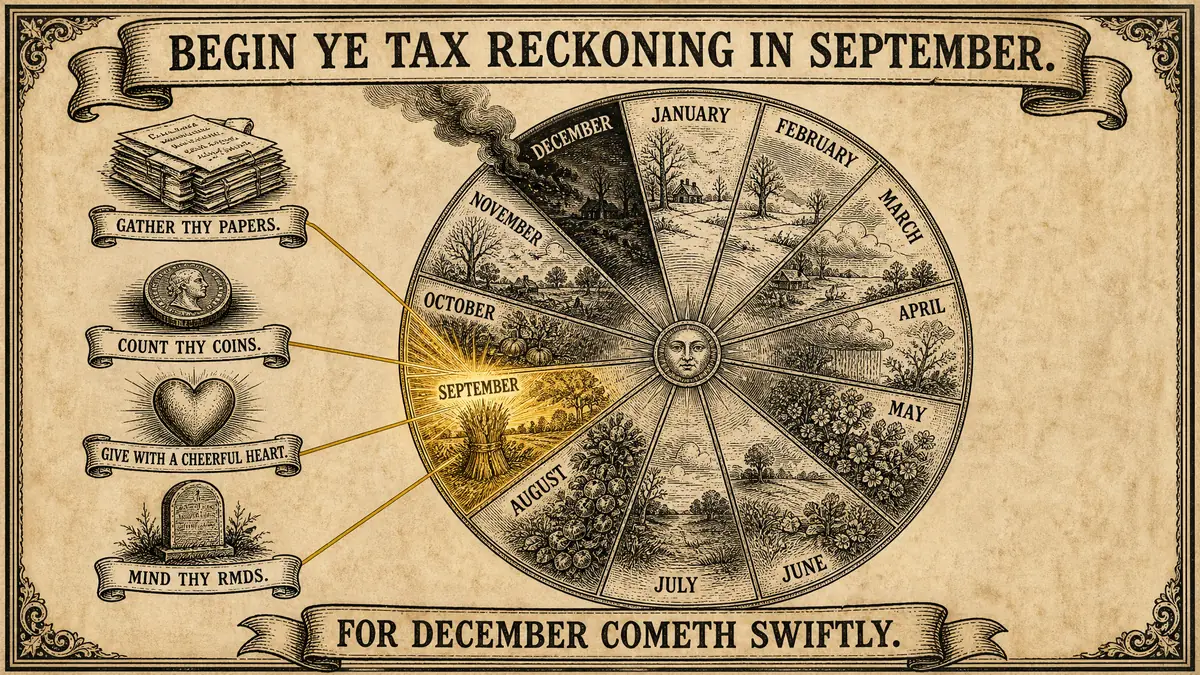
December tax planning has the same energy as buying holiday gifts at 8:42 p.m. on December 24. Technically possible. Spiritually expensive. None of this is tax advice, and I am not your CPA or EA, which is exactly why September is a beautiful month to talk to one.
The tax-planning industrial complex wants you to believe December is the dramatic finale. Candles. Spreadsheets. Mild panic. A portal password you definitely saved somewhere. But most useful year-end tax moves need lead time, especially if they involve investments, charitable gifts, retirement distributions, state rules, or anything that requires another human being to answer an email.
Q4 is when CPAs are still reachable. December is when they are triaging the clients who just discovered capital gains exist. Be kinder to everyone involved, including future you.

TL;DR
- September gives you time to model, transfer, sell, replace, donate, and document without begging a CPA for a miracle.
- Wash-sale windows, Roth conversion taxes, inherited IRA RMDs, and state 529 deadlines all punish lazy timing.
- December planning is mostly regret wearing a festive sweater.
The Deadline Calendar: What Actually Needs a Head Start
The deadline is rarely the hard part. The problem is everything that must happen before the deadline: gathering tax lots, estimating income, moving cash, getting charity paperwork, or finding the beneficiary date on an inherited IRA while your custodian website loads like it is powered by wet cardboard.
The major federal rules below come from the Internal Revenue Service on investment losses and wash sales, IRS Publication 590-A on Roth conversions, IRS Publication 526 on charitable contributions, IRS Publication 590-B on inherited IRA distributions, and IRS Publication 505 on estimated tax payments.
| Move | Real deadline | Ideal start date |
|---|---|---|
| Tax-loss harvesting setup | Sales must happen by December 31 for the tax year, with wash-sale monitoring before and after the trade | Early September |
| Roth conversion modeling | Conversion generally must be completed by December 31 to count for that tax year | September, once income is forecastable |
| Donor-advised fund contribution | Gift must be completed by December 31 for the current-year charitable deduction | September or October, especially for appreciated securities |
| Bunching itemized deductions | Most deductible payments must be made by December 31, subject to category limits | September, before cash gets socially booked by the holidays |
| Inherited IRA RMD planning | Annual RMDs, if required, are generally due by December 31; the 10-year cleanout deadline is also a December 31 deadline | September, because custodians love processing queues |
| 529 state deduction contribution | Often December 31, but several states allow tax-filing-deadline contributions for the prior year | September, then verify your state |
| Estimated-payment trueup | Q3 payment is due September 15, 2026; Q4 is due January 15, 2027 | Now, because math ages poorly in a drawer |

The point is not to do all of this. The forbidden move is choosing the few that fit your actual life. A person with taxable brokerage gains has a different September checklist than a person who inherited an IRA, which is different from a parent trying to grab a state 529 deduction before the window closes.
Personal finance that pretends everyone has the same checklist is just cosplay with a calculator.
Tax-Loss Harvesting: Build the Watchlist Before the Sale
Tax-loss harvesting sounds fancier than it is. You sell an investment in a taxable account at a loss, use that loss to offset capital gains, and possibly deduct up to $3,000 of excess net capital loss against ordinary income, with unused losses carried forward. The Internal Revenue Service explains the capital-loss limit, carryforward treatment, and wash-sale rules in Publication 550.
The useful part happens before the sale. In September, pull your taxable brokerage holdings and sort them into three buckets: positions with unrealized losses, positions with realized gains already booked this year, and positions you still want exposure to even if you sell the loser.
That last bucket matters because the wash-sale rule is where casual harvesting goes to faceplant. The IRS says a wash sale can occur if you sell stock or securities at a loss and buy substantially identical stock or securities within 30 days before or after the sale. So the window is not just the month after you sell. It looks backward too. Rude, but legally committed.
September gives you time to pick replacement exposure that is not substantially identical, turn off automatic reinvestment where needed, check spouse accounts, check IRAs, and avoid selling a fund only to have a dividend reinvestment quietly buy it back like a tiny tax gremlin. Fine. A tiny tax mistake.
If you are new to taxable investing, read Investing 101 for People Who Already Have a Budget first. Harvesting losses is not a personality. It is a maintenance task.
Roth Conversions: Your Future Bracket Is the Bossy Main Character
A Roth conversion is not free money. It is taxable income now in exchange for the possibility of tax-free qualified Roth withdrawals later. IRS Publication 590-A says amounts converted from a traditional IRA to a Roth IRA are generally included in gross income for the year of conversion.
That is why September matters. You are not asking, should I convert? You are asking, how much can I convert before the next dollar starts behaving badly?
For 2026, the Internal Revenue Service lists the standard deduction at $16,100 for single filers, $32,200 for married filing jointly, and $24,150 for heads of household. It also lists the 2026 marginal brackets, which matter because conversion income stacks on top of wages, interest, business income, pensions, taxable Social Security, and whatever else your year brought home in a wrinkled tote bag.
The math depends on next year’s marginal-rate forecast too. If next year is likely to be lower income, maybe because you retire, sell fewer assets, pause consulting, or finally stop monetizing every hobby like the internet told you to, converting this year may be less attractive. If this year is unusually low and next year looks higher, a partial conversion might be worth modeling.
Do not model only federal tax. Look at state tax, Affordable Care Act premium credits if relevant, Medicare IRMAA if you are close, education credits, child credits, and estimated-payment needs. A $20,000 conversion can be elegant or annoying depending on what it bumps into. Taxes are a group project where one person did not read the assignment.
Charitable Giving and Bunching: Make the Deduction Earn Its Keep
Charitable-giving stacking means you intentionally concentrate multiple years of giving into one tax year, often through a donor-advised fund, so your itemized deductions clear the standard deduction by enough to matter. You still grant money to charities over time, but the deduction may land upfront when you contribute to the DAF.
IRS Publication 526 explains that charitable deductions are subject to AGI limits, including the familiar 60% of AGI limit for many cash gifts and lower limits for some property gifts. It also says a donor-advised fund deduction requires proper acknowledgment from the sponsoring organization confirming its legal control over the assets.
Translation: the receipt is not decorative. Keep it.
Bunching got more interesting for 2026 because IRS Publication 505 describes a new charitable contribution deduction floor for itemizers: deductible charitable contributions generally must exceed 0.5% of AGI. It also notes a cash charitable deduction for non-itemizers of up to $1,000, or $2,000 for married filing jointly, subject to limitations.
So September is when you run the itemized-versus-standard comparison, not December 29 while eating leftover pie directly from the dish. Add up mortgage interest, state and local taxes, charitable gifts, medical deductions if unusually high, and any other Schedule A items. For 2026, IRS Publication 505 says the SALT deduction limit is $40,400, or $20,200 if married filing separately, subject to income phase-down rules.
If you are not going to itemize, fine. The budget police are not coming. But if you are close, stacking gifts, accelerating deductible payments, or using appreciated securities may turn a scattered set of nice gestures into an actual tax plan.
This is the same basic mindset as The Fall Financial Reset: 30 Days to Q4-Ready Finances: fewer heroic December gestures, more boring systems that quietly do the job.
Inherited IRA RMD Planning: The 10-Year Rule Is Not a Vibe
Inherited IRA rules are where casual confidence goes to die. The phrase 10-year rule sounds simple, which is how it gets you.
IRS Publication 590-B says the 10-year rule generally requires the inherited IRA to be fully distributed by December 31 of the year containing the 10th anniversary of the original owner’s death. For many nonspouse designated beneficiaries, that is the big endpoint.
But the annual-distribution question depends on facts. If the original owner died before their required beginning date and the 10-year rule applies, IRS Publication 590-B says no distribution is required before the 10th year. If the owner died on or after the required beginning date, designated beneficiaries may need annual RMDs during the 10-year period.
That is why September is not early. September is civilized.
You need the year of death, whether the original owner had reached the required beginning date, beneficiary type, account type, prior distributions, and custodian records. If multiple beneficiaries or a trust are involved, congratulations, you have entered paperwork theatre. Get professional help before the third act.
Do not wait until late December to request an inherited IRA distribution. Custodians have processing deadlines, holidays exist, and login codes love to expire at the exact moment you become emotionally vulnerable.
529 Contributions: State Deadlines Are Weird Because Of Course They Are
There is no federal deduction for 529 contributions. The federal benefit is generally tax-free growth and tax-free qualified withdrawals. The Internal Revenue Service also notes that 529 funds can be rolled to a beneficiary’s Roth IRA under SECURE 2.0-era rules if strict requirements are met, including a $35,000 lifetime limit, annual Roth IRA contribution limits, a 15-year account requirement, and a direct trustee-to-trustee transfer.
The state deduction or credit is where the calendar gets spicy. Saving for College tracks 529 contribution deadlines nationally and notes that most states use December 31, while some allow April deadlines for prior-year state benefits. For the selected states below, the deadline notes come from primary state tax or state-plan sources: Bright Start, NY529 Advisor, CollegeInvest, PA 529, Virginia Tax, Ohio 529, Georgia Path2College, and the Iowa Department of Revenue.
| State | Selected 529 deduction deadline for 2026 planning | Planning note |
|---|---|---|
| Illinois | December 31 | Bright Start says the contribution deadline for Illinois state income tax deduction purposes is December 31. |
| New York | December 31 | NY529 Advisor says electronic bank transfers can be made until 11:59 p.m. on December 31, with checks postmarked by December 31. |
| Colorado | December 31 | CollegeInvest says contributions must be made by December 31 of the calendar year to be deductible for that year. |
| Pennsylvania | December 31 | PA 529 frames the state deduction around contributions made during the tax year; use year-end as the practical planning cutoff. |
| Virginia | December 31 | Virginia Tax allows the deduction for amounts contributed during the taxable year, with carryforward rules for excess amounts. |
| Ohio | December 31 | Ohio 529 states year-end contributions must be received in good order by its posted December 31 processing cutoff for that tax year. |
| Georgia | April 15 of the following year | Path2College says taxpayers generally have until tax day to apply contributions to the prior year. |
| Iowa | Generally April 30 | The Iowa Department of Revenue says taxpayers generally have until the Iowa individual income tax return deadline to contribute for that year. |
This is a selection, not a 50-state promise carved into stone tablets. Check your own state before transferring money. Also check whether your state requires its own plan, allows any state’s plan, limits the benefit to account owners, allows carryforward, or recaptures deductions after certain rollovers.
If education costs are part of your household plan, this belongs next to cash-flow planning, not in a random browser tab called taxes maybe. The same discipline behind Sinking Funds Explained: The One Habit That Makes Surprise Expenses Disappear works here too: name the future cost before it starts throwing chairs.
Estimated-Payment Trueup: Stop Letting January Ambush You
Estimated taxes are not a moral test. They are a timing system, and the timing system has teeth.
IRS Publication 505 says the 2026 estimated tax due dates are April 15, June 15, September 15, 2026, and January 15, 2027. It also lays out the general safe-harbor idea: many taxpayers avoid penalties if withholding and credits cover at least 90% of current-year tax or 100% of prior-year tax, with 110% substituted for higher-income taxpayers whose prior-year AGI exceeds the threshold.
September is the trueup month because you still have time to adjust. If you are W-2, you may be able to increase withholding for the rest of the year. If you are self-employed, freelancing, consulting, or selling things online under a username that seemed fun in 2017, you may need to update your payment plan.
This is where side-hustle income gets people. The money arrives in cheerful little deposits. The tax bill arrives as one large adult. If that sentence stung, read Summer Side-Hustle Money: How to Track It, Tax It, and Not Let It Disappear.
Also remember that tax withholding is often treated differently from estimated payments for penalty purposes. If you can fix a shortfall through payroll or retirement-account withholding, ask your CPA or EA whether that helps your specific situation. Again, not tax advice. Just a polite nudge away from January theatrics.

Final Thought: September Is the Strategy
The point of starting in September is not to become a tax hobbyist. Nobody needs you cornering guests at dinner to explain basis tracking while the potatoes get cold.
The point is to give yourself options. You can harvest losses without tripping wash-sale rules. You can model Roth conversions before the custodian deadline panic. You can stack charitable gifts with intention instead of vibes. You can check inherited IRA distribution rules while professionals still have calendar space. You can grab state 529 benefits before your state does something deeply state-like. You can true up estimated payments before January starts clearing its throat.
Good planning is rarely glamorous. It looks like one boring spreadsheet, two emails, and a calendar reminder that saves you from doing tax math beside a dying poinsettia.
Still not tax advice, still worth taking to a CPA or EA who knows your full situation. December tax planning is a regret. September tax planning is a strategy.
 Forbidden Finance