The allowance debate is where parenting forums go to start fires. Pay for chores? Never pay for chores? Pay for extra chores but not normal chores? Tie it to grades? Tie it to vibes? Somewhere, a spreadsheet is crying.
The missing point is simpler: kids do not learn money by hearing your final answer. They learn money by making small, low-stakes choices over and over, then seeing what happened.
That matters because the grown-up scoreboard is not exactly glorious. The Council for Economic Education reported that as of March 2026, 39 states required a personal finance course for high school graduation, up from 12 in 2022. Good. Also late. The FINRA Foundation found in its 2024 National Financial Capability Study that only 46% of U.S. adults had set aside enough money to cover three months of living expenses. So yes, the system could use a few more practice reps before age 18.

TL;DR
- Stop trying to win the chore-pay argument and start designing money reps by age.
- Young kids need visible money; teens need real budgets, earned income, and supervised credit practice.
- The goal is not a perfect child investor. It is a kid who has already made cheap mistakes.
The Allowance Debate Is Missing the Point
The chore question is not useless. It just is not the main event.
If allowance is only framed as compensation, kids learn one idea: work equals money. Useful, but narrow. If allowance is only framed as a family entitlement, kids learn another idea: money appears on schedule. Also useful in one tiny way, but please do not let the entire curriculum be “Friday magic.”
The better question is: what financial action can your kid practice this year?
A 5-year-old does not need a lecture about index funds. They need to see three quarters disappear into a clear container and understand that the container is now heavier. A 10-year-old needs the pain of choosing between slime kit now and skateboard fund later. A 14-year-old needs to watch a hypothetical stock drop 8% without panic-buying a second identity. A 17-year-old needs to budget for a real expense, then discover that taxes are not a rumor adults invented to ruin paychecks.
This is why the one-right-way personal finance script falls apart. Parenting does too. The method depends on the kid, the household, the cash flow, and the thing you are actually trying to teach. That is the same reason we keep saying there is no sacred budget template in Which Budgeting Method Is Right for You?. The right system is the one that gets used after Tuesday becomes Tuesday.
The Real Lesson: Practice Beats Position Papers
The Consumer Financial Protection Bureau breaks youth financial capability into building blocks: executive function, financial habits and norms, and financial knowledge and decision-making. That sounds formal because government PDFs are legally required to wear sensible shoes. In parent language, it means kids need practice planning, waiting, choosing, and reviewing.
The T. Rowe Price Parents, Kids & Money Survey found that many parents say money conversations matter, but only 22% reported discussing money with kids at least weekly. That gap is the lesson. You do not need a weekly family finance summit with pastries and minutes. You need tiny rituals.
A good money lesson has four parts:
- A visible amount of money.
- A real choice.
- A delay.
- A short review after the choice plays out.
That is it. No podium. No shame. No “when I was your age” speech unless you are prepared for immediate eye contact avoidance.
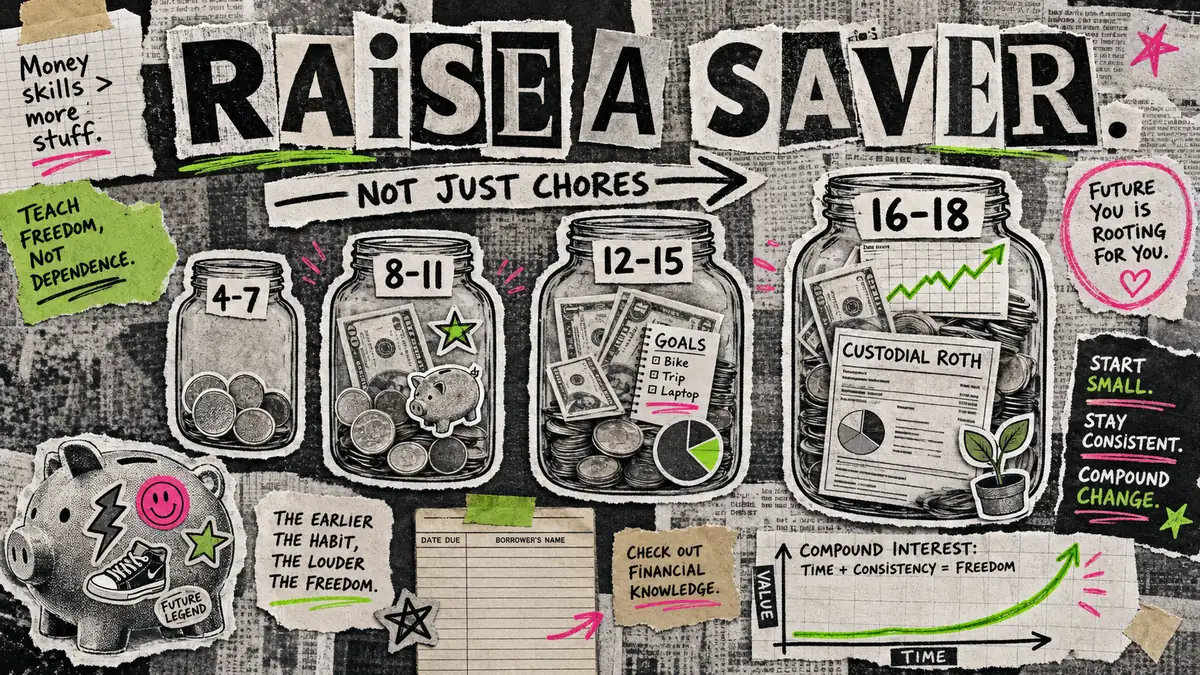
Ages 4-7: Make Money Visible
For ages 4 to 7, the core skill is not budgeting. It is object permanence, but for dollars.
The CFPB says early childhood is when kids begin forming basic values around financial concepts and the math skills needed for financial life. The FDIC Money Smart for Young People PreK-2 curriculum leans into hands-on concepts like counting coins, needs versus wants, saving, spending, and creating a savings jar or piggy bank.
That is the level. Coins. Jars. Counting. Waiting.
Use three clear containers: save, spend, give. Real jars work because kids can see the money pile up. Digital pots can work too if you make the balance visible together, but at this age, plastic dinosaurs and coins have a better user interface than most fintech apps. Forbidden truth: sometimes the jar wins.
Activity: The Three-Jar Store
- Put 10 coins or 10 play dollars on the table.
- Let your kid split the money into save, spend, and give jars any way they want.
- Create a tiny “store” with three options: one cheap treat, one bigger goal card, and one give option.
- Ask one question only: “What changes if you move one coin?”
- Let the choice stand, even if the save jar gets absolutely disrespected.
The mistake to avoid: correcting every split. If they put 9 coins in spend and 1 in save, that is data. Not a crisis. Nobody is refinancing a house here.
Ages 8-11: Let the Jars Become Real
Ages 8 to 11 are where the jars stop being props and start becoming tiny consequences.
Middle childhood is when the CFPB says financial habits and norms really start taking shape. The FDIC Money Smart for Young People grades 3-5 material expands into budgeting, payment options, saving goals, charitable giving, and even an introduction to investing.
This is the age for first real decisions. Not huge decisions. Not “choose the family health insurance plan, Connor.” More like: birthday money, book fair money, sports snack money, a monthly allowance pot.
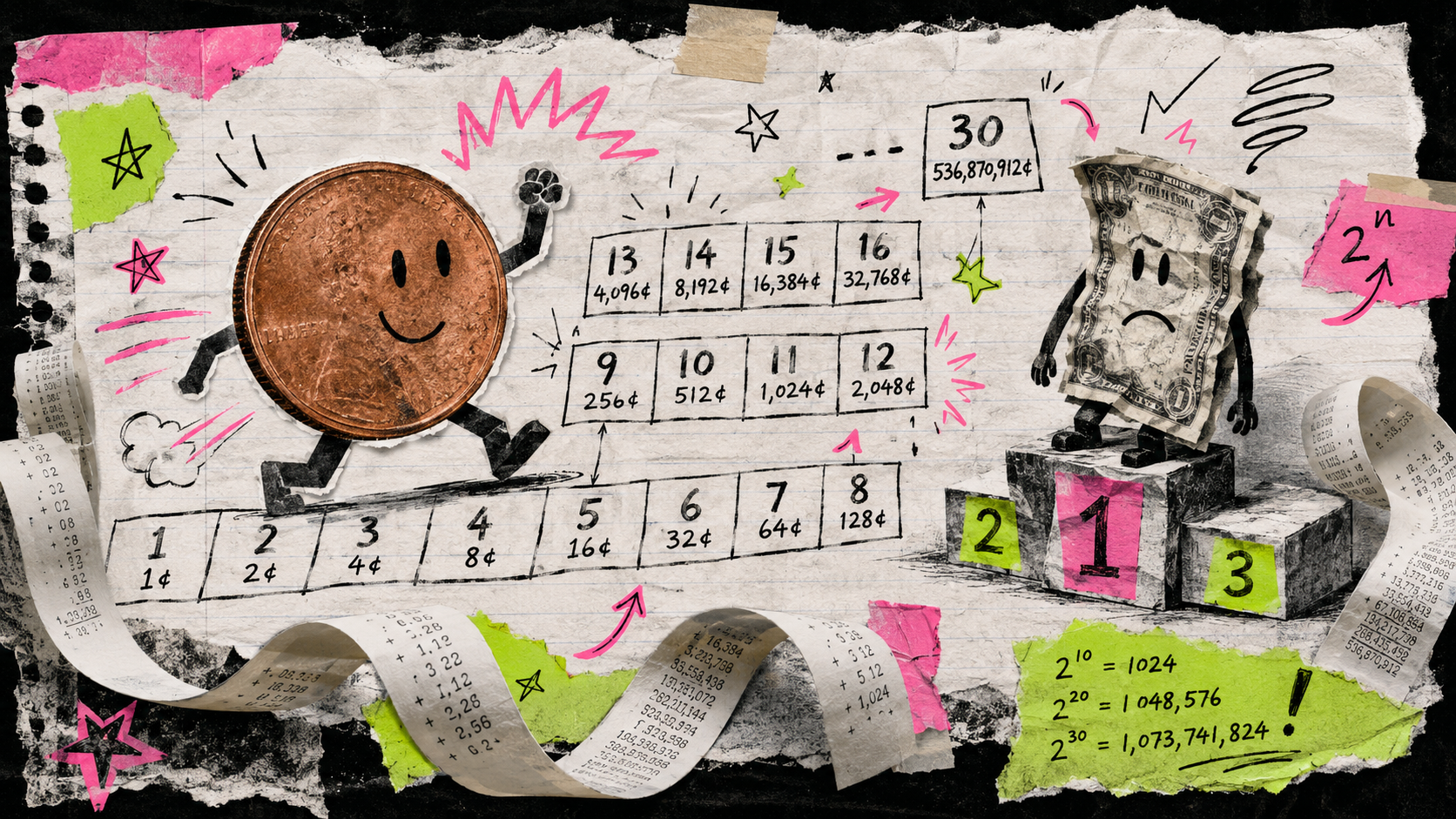
You can also introduce compound interest as a magic trick with math hiding inside. The Investor.gov teacher resource explains compound interest as earning interest on interest. For a kid, start with the ridiculous version: one doubled dollar becomes $2. A penny doubled every day for 30 days, counting day 1 as one cent, becomes $5,368,709.12.
Is that a realistic bank return? Absolutely not. If your bank offers that, the bank is either fictional or wanted by several agencies. But the point lands: small numbers plus repetition can become shocking numbers.
Activity: The 30-Day Penny Shock
- Write days 1 through 30 on a sheet of paper.
- Start day 1 with $0.01.
- Let your kid double the amount each day with a calculator.
- Stop on day 10, day 20, and day 30 to guess the next milestone.
- After the reveal, compare it with saving a flat $1 per day for 30 days.
Then bring it back to real life. If they save $4 a week, what happens after 10 weeks? If they spend the whole allowance on Monday, what happens on Friday? This is where a digital allowance pot can help because the history is visible. Shared visibility turns “I have no money” into “you spent $11.73 on gems shaped like dragons.” Useful, if spiritually tiring.
This is also a natural place to explain envelope-style thinking without requiring actual envelopes, which is why Envelope Budgeting: Your Grandma Was Right (But You Don’t Need Actual Envelopes) pairs nicely with kid money jars. Same mechanic. Smaller stakes. Fewer utility bills.
The mistake to avoid: rescuing every regret. A $6 regret at age 9 is tuition. Cheap tuition.
Ages 12-15: Add Investing Without Turning Dinner Into CNBC
At 12 to 15, kids can handle abstraction. Not unlimited abstraction. Try explaining expense ratios for 40 minutes and you will watch a human leave their body. But they can understand ownership, risk, time, and tracking.
The Investor.gov investing guide defines investing as putting money into assets such as stocks or bonds with the expectation of return over time, while warning that all investments involve risk. That is enough to start. You do not need hot takes. You need a watchlist.
This is also a good age for a first debit card, if your household is ready. Debit is not credit. It is a spending rail. The CFPB tells students to compare bank account fees, minimum balance requirements, ATM access, and overdraft rules before choosing an account. Translate that for teens: the card is not the lesson. The transaction history is the lesson.
Activity: The Fake $100 Portfolio
- Give your teen a fake $100 portfolio, no real money required.
- Let them pick five investments to track: broad market fund, company stock, bond fund, cash, and one wild-card company they actually know.
- Record the starting price once a week for eight weeks.
- Add one sentence each week: “Why did this move?”
- At the end, ask what felt boring, what felt risky, and what they would change.
Do not make the goal “beat the market.” That is how adults become comment-section prophets. The goal is learning that prices move, headlines are loud, and diversification exists because your favorite company can have a weird Tuesday.
If they are ready for more, send them to Investing 101 for People Who Already Have a Budget and let them see the grown-up version. Then ask them to explain one idea back to you. If they say “buy low, sell high,” accept it and do not assign homework. This is parenting, not a licensing exam.
The mistake to avoid: letting investing become gambling with better fonts. No options. No crypto rabbit holes. No “Dad, I found a coin with a frog wearing sunglasses.” Hard pass.
Ages 16-18: Put Real Money Near Real Consequences
By 16 to 18, the practice needs to get real. Not harsh. Real.
Pick one known expense: car insurance, a laptop, prom, senior trip, application fees, summer travel, work clothes, or the terrifying snack budget of a teen with a job. Build a budget around that expense. If the goal is $600 in 12 weeks, the math is $50 a week. Suddenly budgeting is not a moral philosophy. It is arithmetic with a deadline.
This is where Sinking Funds Explained: The One Habit That Makes ‘Surprise’ Expenses Disappear becomes useful. A teen saving for a known expense is running a sinking fund. They do not need the vocabulary first. They need the envelope, pot, or account.
If they have earned income, you can also introduce a Roth IRA. The IRS announced that the 2026 IRA contribution limit is $7,500, with income phaseouts for Roth IRA eligibility. For a teen, the more important rule is from IRS Publication 590-A: Roth IRA contributions are generally limited to the lesser of the annual limit or taxable compensation. Translation: babysitting cash with no records is messy. W-2 job income is clean. Self-employment income can count, but documentation matters. Tax paperwork, the confetti nobody asked for.
Also introduce credit-building carefully. The CFPB says on-time payments reported to the three nationwide credit reporting companies can help build credit history, and points to secured cards and credit-builder loans as possible starter tools. For minors, the CFPB notes that children under 18 generally do not have credit reports unless there is an error, identity theft, or they are an authorized user or joint account holder.
Activity: The Known-Expense Budget
- Pick one real expense due in the next 8 to 16 weeks.
- Write the total, deadline, and weekly savings target.
- Choose where the money sits: separate savings account, labeled pot, or tracked cash envelope.
- Review once a week for five minutes.
- After the purchase, compare the plan with reality and name one adjustment for next time.
If they have a job, add one more step: read the pay stub. Gross pay, taxes, net pay. The first time a teen sees the difference, they understand why adults stare silently at payroll portals. How to Read a Pay Stub Like You Mean It is the next lesson after the first paycheck lands.
The mistake to avoid: handing them adult products without adult guardrails. A debit card needs balance alerts. A Roth IRA needs earned income records. Credit needs autopay, limits, and supervision. Freedom without feedback is just chaos with a PIN.
A Parent’s Note: You Are Building Reps, Not a Tiny CFO
Your job is not to produce an 11-year-old who says “asset allocation” at a birthday party. Frankly, do not invite that child near cake.
Your job is to build reps: counting, choosing, waiting, tracking, earning, saving, giving, investing, budgeting, reading, comparing, correcting, trying again. Fourteen years gives you room. You do not need one perfect talk. You need a hundred tiny experiments.
Some families will pay for chores. Some will separate chores from allowance. Some will use cash jars. Some will use digital pots. Some will use both because the coins are satisfying and the app remembers what happened when everyone else conveniently forgot.
That is the forbidden part: the method can change. A 6-year-old needs visible money. A 10-year-old needs choices. A 14-year-old needs tracking. A 17-year-old needs real deadlines. The system updates because the kid updates.
Money literacy isn’t a lecture. It’s 14 small experiments over 14 years.
| Age band | Core skill | One activity | The one mistake to avoid |
|---|---|---|---|
| 4-7 | Visualizing money through counting, jars, and save/spend/give buckets | The Three-Jar Store | Correcting every split before the kid can learn from it |
| 8-11 | Making first real choices and seeing delayed consequences | The 30-Day Penny Shock | Rescuing every small regret |
| 12-15 | Understanding risk, return, debit spending, and basic tracking | The Fake $100 Portfolio | Treating investing like gambling with nicer charts |
| 16-18 | Budgeting for real expenses, earned income, Roth IRA basics, and credit-building | The Known-Expense Budget | Giving adult tools without guardrails |

 Forbidden Finance