Envelope budgeting is the financial equivalent of your grandparents side-eyeing your contactless card and saying, “Maybe stop pretending the money is infinite.” Annoyingly, they had a point.
What envelope budgeting actually is
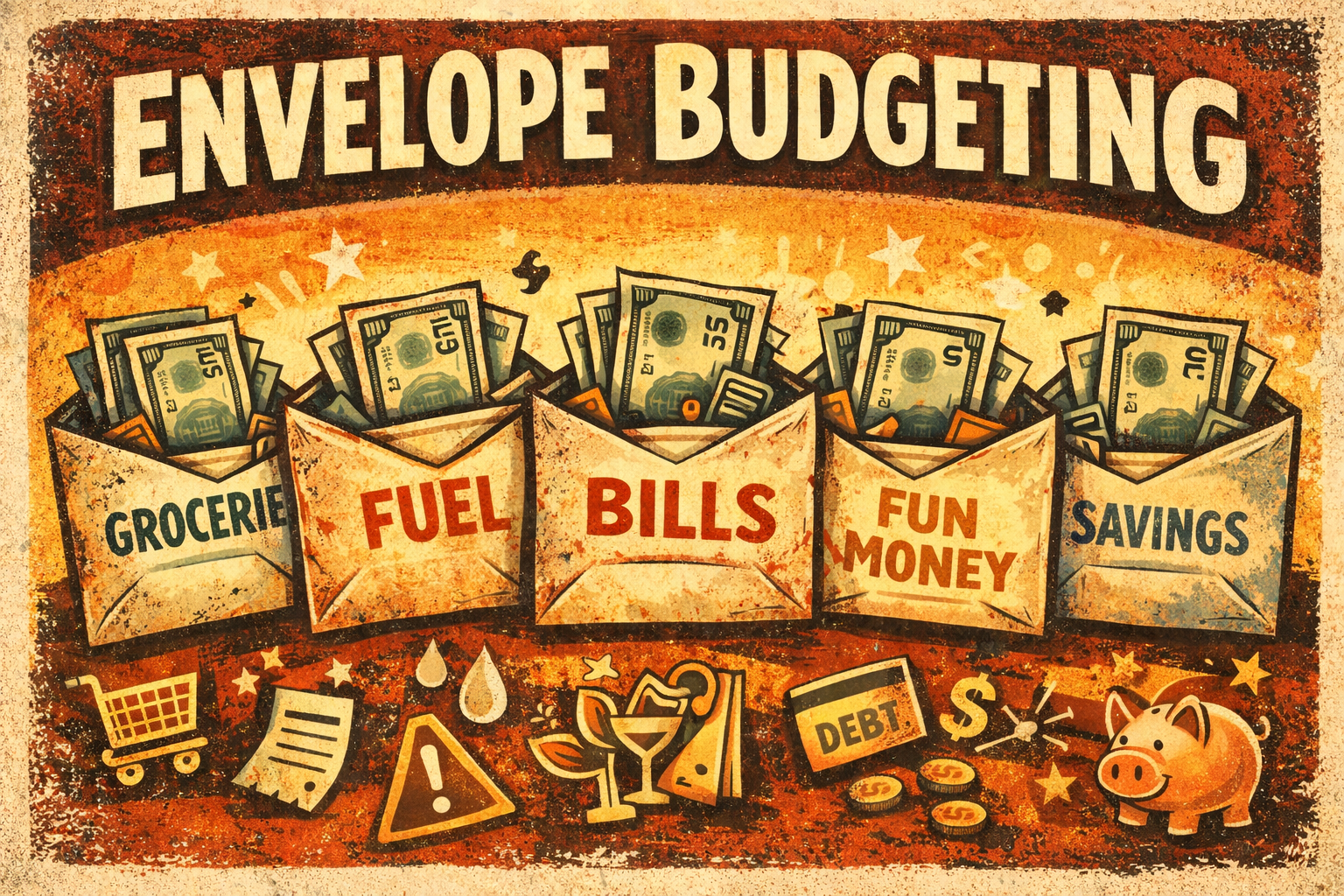
The envelope system is simple: you give each spending category its own limit. Traditionally, that meant literal cash in literal envelopes labeled things like groceries, fuel, or going-out money. When an envelope was empty, spending in that category stopped until the next refill. That old-school system never really disappeared; it just got rebranded for the internet as “cash stuffing” and then dragged into the app era.
And yes, this really is the kind of thing previous generations used because daily life ran on cash. Before every purchase became a tap, swipe, autofill, or “I’ll deal with it later” problem, separating money physically was one of the easiest ways to stop this month’s grocery money from mysteriously becoming this week’s takeaway budget.
Why it worked so well
Envelope budgeting worked for the same reason putting biscuits on the top shelf works: friction matters. Research on payment behavior consistently finds that cash feels more tangible than cards, and that lower “pain of paying” is associated with higher spending. In plain English: handing over physical money feels real, while tapping a card can feel like playing a depressing mobile game with bad rewards.
That’s the secret sauce. The envelope system creates visible limits. You are not guessing whether you are “probably still fine.” You can literally see that the restaurant envelope has two sad notes left in it and that maybe tonight is a pasta-at-home situation.
What happens when an envelope runs out mid-month?
This is the whole point of the method, and also the part people magically hope won’t apply to them.
In the classic version, when an envelope is empty, you stop spending in that category. That is the rule. Not “just this once.” Not “technically it’s self-care.” Empty means empty. Some people do choose to move money from another envelope, but the method only works if that tradeoff is intentional and visible.
That’s why envelope budgeting can be so effective for variable spending like groceries, eating out, fun money, petrol, or personal spending. It turns vague guilt into an actual boundary. Finance apps love calling this “mindful spending,” which is a very polished way of saying “you can’t pretend not to notice anymore.”
Envelope budgeting vs. zero-based budgeting
These two methods are cousins, not twins.
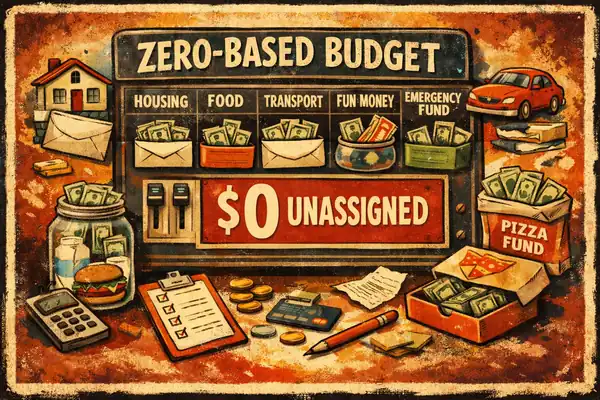
Zero-based budgeting says every dollar should have a job. If your income is $3,000, the full $3,000 gets assigned across bills, spending, savings, and debt payoff until there is nothing left unassigned. Envelope budgeting is more about setting category limits and honoring them. In practice, many people combine the two, but zero-based budgeting is stricter about accounting for every cent.
| Budgeting method | Main rule | Best at | Can feel annoying when… |
|---|---|---|---|
| Envelope budgeting | Each category gets a limit. When it’s gone, it’s gone. | Controlling variable spending and impulse purchases | You want flexibility after the month has already started |
| Zero-based budgeting | Every dollar is assigned somewhere until nothing is left unplanned | Total visibility and intentional planning | You do not want to budget with accountant energy every month |
Neither system is morally superior. They just solve slightly different problems. If zero-based budgeting is “give every dollar a job,” envelope budgeting is “give the chaos a fence.”
How the envelope method evolved for real life in 2026
The original system assumed two things: that you used cash for most daily spending, and that nobody expected you to split a dinner bill, pay a streaming service, and order cat food online before lunch.
That world is gone. In the UK, the Bank of England says cash use for payments has fallen from 55% of transactions to 14% over the past decade. At the same time, digital tools now adapt the envelope method into virtual spaces, categories, or app-based envelopes so people can keep the structure without carrying around a paper wallet that looks like a 1987 utility drawer.
That digital shift matters because the method still works even when the envelopes stop being physical. The core idea has always been the same: pre-decide what each pile of money is for, track what’s left, and don’t let your “fun” spending mug your “rent” money in a dark alley.
How to do envelope budgeting today
Start with the categories most likely to go off the rails. For most people, that’s groceries, eating out, entertainment, fuel, shopping, and personal spending. Your mortgage is not the problem child here. Your “I was just browsing” spending usually is.
Set a fixed amount for each category for the month. As you spend, subtract from that envelope. If there’s money left at month-end, you can roll it forward, move it, or save it. If there isn’t, you either stop or make a conscious tradeoff from another category. No mystery. No drama. Well, less drama.
How Forbidden Finance handles envelope budgeting
This is where envelope budgeting stops being charmingly retro and starts being actually useful.
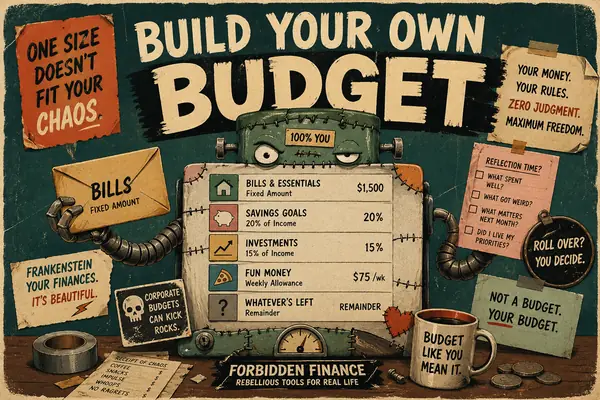
In Forbidden Finance, envelope budgeting keeps the category-based structure people like, but it does not require your allocations to sum to total income the way zero-based budgeting does. Each envelope just gets a fixed dollar amount. You do not have to assign every last cent a sacred purpose and hold a spreadsheet séance over the remainder.
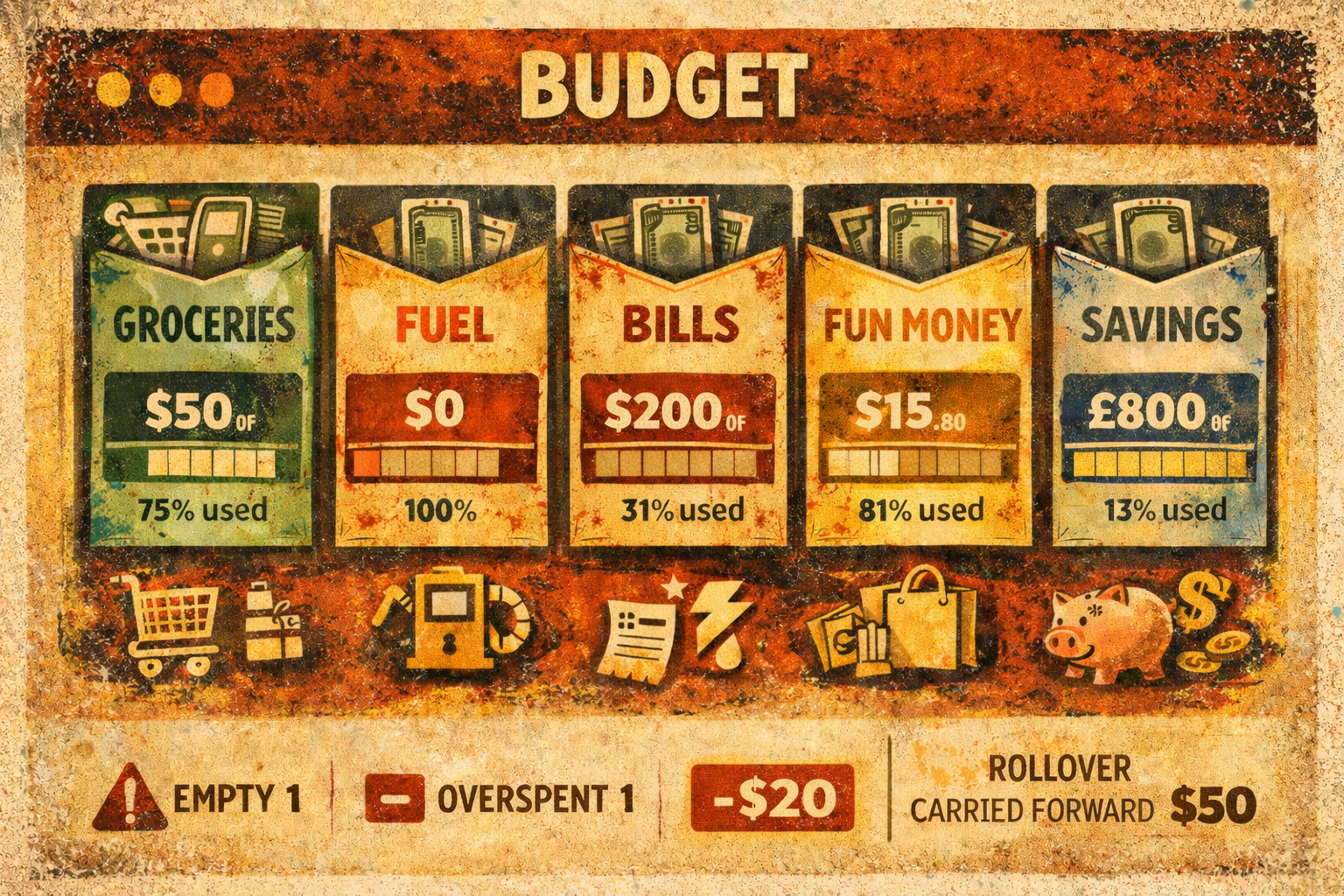
It also supports rollover, which is exactly how the physical version behaved when you didn’t spend everything in an envelope. Unspent money carries into the next month, so your “car maintenance” or “holiday spending” envelope can build over time instead of resetting like a game show penalty.
For overspending, you get to choose the behavior. You can set it to deduct from next month, so overspending reduces that envelope’s next starting allocation. Or you can set it to ignore, so the overspend is logged without changing future months. Your budget, your rules, your consequences.
The dashboard shows the stuff that actually matters: remaining per envelope, percentage used, and which envelopes are empty or overspent. The remaining balance is calculated as:
allocated + rollover - spent
That means you can see the real number, not some motivational fiction invented by a shiny fintech app trying to protect your feelings.
The coaching text in the app says it exactly right:
“Think of each group as a real envelope of cash. Once it's empty, that's it. Unspent money rolls over.”
And yes, envelope budgeting is available starting at the Starter tier ($4.99/month). This is due to connecting to accounts is expensive.
Who envelope budgeting is best for
Envelope budgeting is excellent for people who overspend in specific categories, hate vague budgets, or need clear boundaries around day-to-day spending. It is especially good for the classic “Where did all my money go?” problem, which is somehow still a mystery even when your banking app has been trying to tell you for weeks.
It is less magical for people with highly irregular income, lots of shared household spending without coordination, or zero interest in checking category balances. It can still work there, but it usually needs either a digital tool or a stronger routine than “I will simply remember.” History suggests you will not.
The bottom line
Envelope budgeting has survived this long for a reason. It is simple, visual, and brutally honest in a way modern money often is not.
Your grandma probably didn’t call it behavioral finance. She just knew that if the grocery envelope was empty, the grocery envelope was empty. Rude. Effective. Iconic.
 Forbidden Finance