Money Talks Are a Habit, Not an Assembly
At some point, your child will hold up a plastic thing with glitter on it and ask if you can buy it. Congratulations. You are now teaching economics in aisle seven.
The goal is not to produce a tiny CFO. It is to give your kid words for tradeoffs before money turns into mystery, shame, or the weird adult habit of pretending brunch math does not exist. The Council for Economic Education 2026 Survey of the States shows personal finance is making progress in schools, with 26 states requiring a standalone course and 13 more requiring personal finance folded into another required course. Good. Also, your kid is still watching you tap the card at the grocery store.
A T. Rowe Price Parents, Kids & Money Survey found that 57% of parents had at least some reluctance discussing money with their kids, even though kids ages 8 to 10 and 11 to 14 named parents as their most trusted source for investing information. So the bar isn’t “be perfect.” The bar is “say something true”, out loud, before social media does interpretive dance with compound interest.
TL;DR
- Young kids need visible choices, not a family finance sermon.
- Tweens can handle goals, allowance mechanics, and silly compound-interest math.
- Teens need the big budget categories, debt math, and supervised practice with real costs.
- Shared visibility teaches faster than lectures when you choose what is age-appropriate.
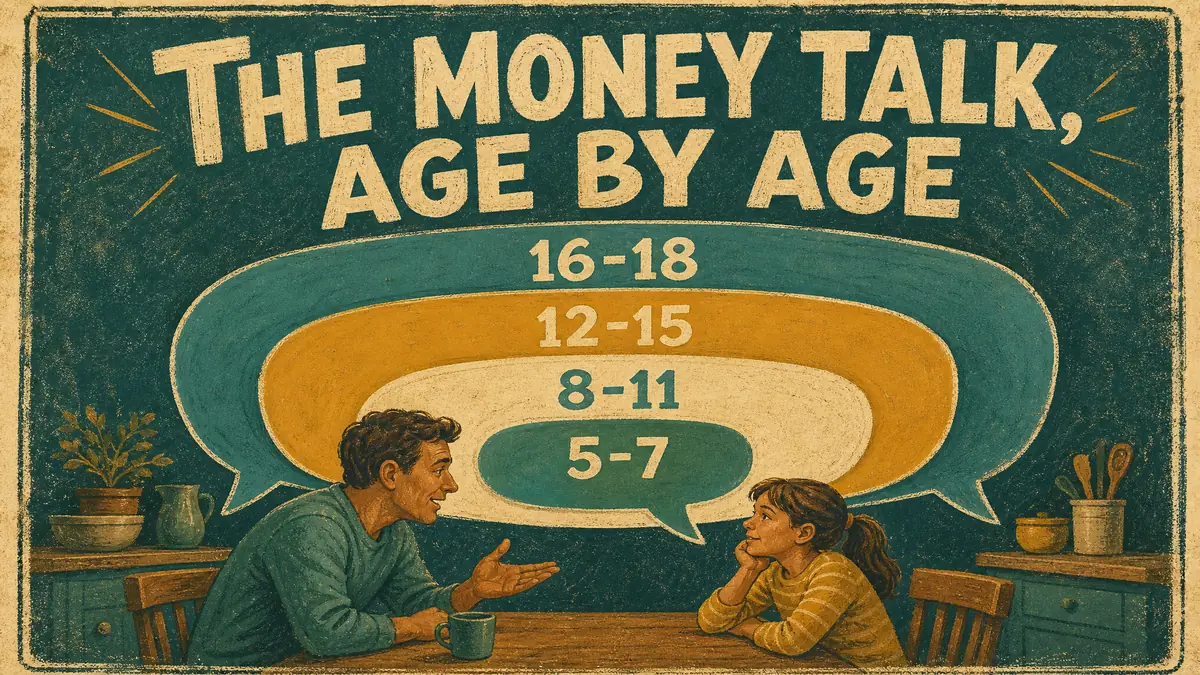
Ages 5-7: Needs, Wants, and the Forbidden Truth About Affording Things
For ages 5 to 7, money is still concrete. They understand cookies, coins, and the emotional collapse of being denied a checkout-lane toy shaped like a dinosaur with legal problems.
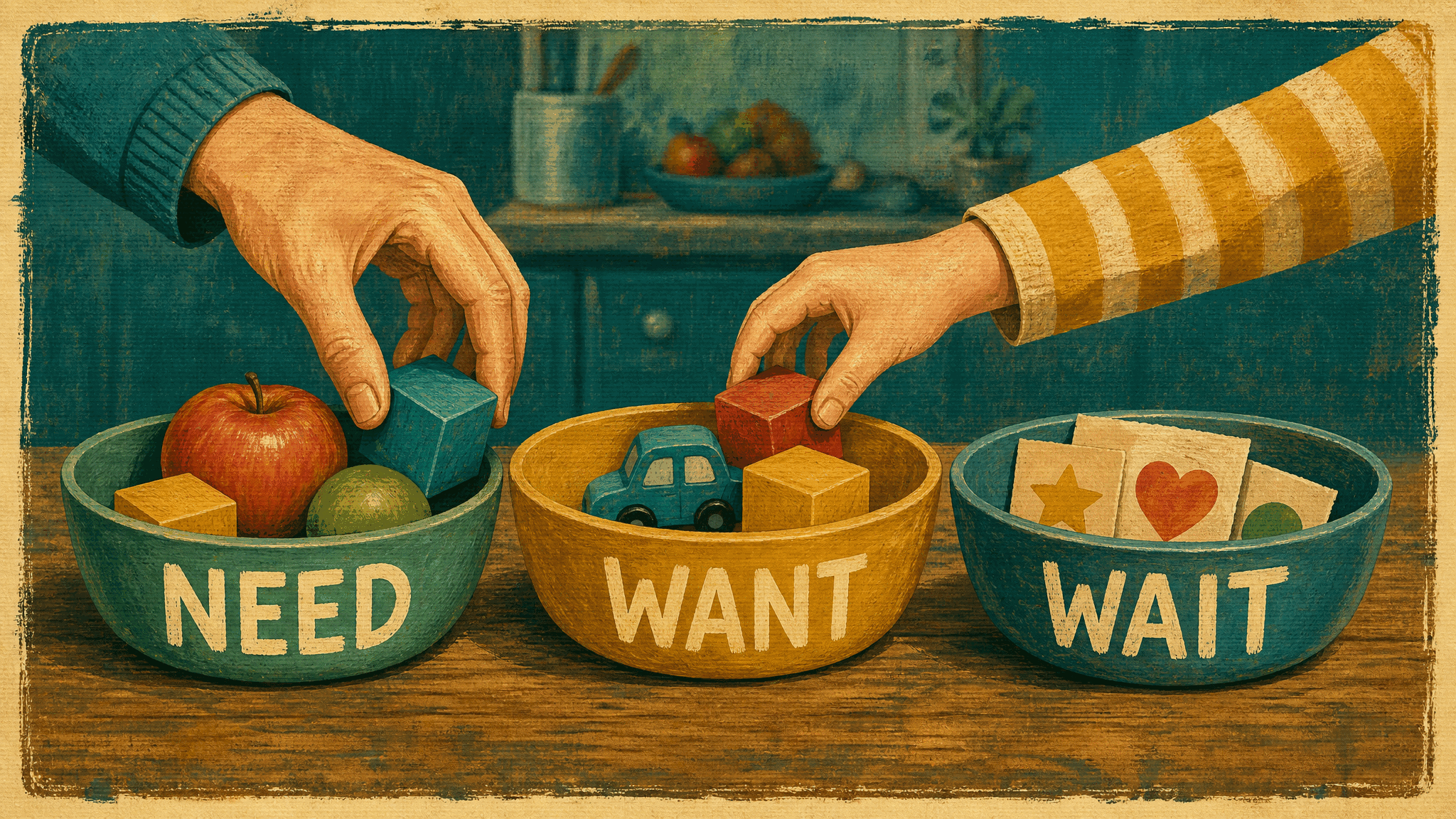
Start with needs and wants. Needs keep the household working: food, housing, medicine, school shoes. Wants make life nicer: stickers, restaurant fries, the mystery slime kit that will somehow migrate to the carpet.
Skip “we can’t afford it” if that isn’t true. Kids can smell that one by age six. Try “we’re not choosing that today,” or “I don’t know if that fits our plan yet.” It is honest without making money sound like a trapdoor.
Parent Scripts
- We can afford some things, but not all things at the same time.
- This is a want, not a need. Wants are allowed, but they have to wait their turn.
- I don’t know if this fits our plan today. Let’s check before we say yes.
- We are choosing groceries and gas first. That doesn’t mean the toy is bad. It means the toy is not first.
Make the conversation visible. Point to two or three items in the cart. Ask: “Need, want, or wait?” Do not grade them like a tiny auditor. Let them practice sorting.
This is also a good age to let them see small balances: the cash in a jar, the balance in a spend bucket, the birthday money left after one purchase. Age-appropriate visibility beats a lecture because the number doesn’t sigh, over-explain, or say “because I said so.”
Common parent mistake: turning every no into a morality play. The lesson is priority, not shame. If a $4 sticker book is not happening today, nobody needs a sermon about fiscal discipline between the bananas and the cereal.
Ages 8-11: Saving Goals, Allowance Mechanics, and the Penny That Gets Weird Fast
By ages 8 to 11, kids can connect today with later. This is the sweet spot for allowance mechanics, goal jars, and the thrilling discovery that spending all your money on Monday can make Saturday feel personally attacked.
A 2025 Greenlight allowance analysis reported an average weekly allowance of $13.15 across kids ages 5 to 19 in Greenlight families, with amounts rising by age. Use that as context, not a commandment. Your allowance system should fit your cash flow, your kid, and your tolerance for chore negotiations conducted by someone wearing pajamas at noon.
If you want a deeper allowance framework, pair this with Teaching Kids About Money: The Allowance Debate Is Missing the Point. The short version: allowance is practice money. It is not a referendum on your parenting philosophy.
Parent Scripts
- You can spend this now, or you can save it toward the skateboard. Both are real choices.
- Allowance is not magic money. It is practice money, and practice means you get to make small mistakes.
- If your goal costs more than one week of allowance, we can divide it into weekly steps.
- I won’t replace the money you spent, but I’ll help you figure out what happened.
Then bring in compound interest. Use the doubled-penny example because it is ridiculous in the correct direction. A penny doubled every day for 30 days, where day 1 is $0.01 and day N equals $0.01 x 2^(N-1), becomes exactly $5,368,709.12 on day 30.
No bank is paying that. If one is, please check whether the branch is painted on a tunnel wall. The lesson is not investment returns. The lesson is that repeated growth can start boring and end loud.
For saving goals, use three buckets: spend soon, save for goal, give or share. For kids who like visuals, jars work. For kids who lose cash inside sofa cushions like it is a retirement strategy, a shared app view may work better.
This is where Sinking Funds Explained: The One Habit That Makes Surprise Expenses Disappear starts making sense in kid form. A goal bucket is just a tiny sinking fund with fewer insurance premiums and more skateboard stickers.
Common parent mistake: rescuing every regret. A $7 mistake at age nine is tuition. Cheap tuition.
Ages 12-15: Show the Budget Without Handing Over the Bank Login
Ages 12 to 15 can handle the family budget at a high level. Not line items. Not your mortgage statement, medical bills, or the exact amount spent on emergency pizza during soccer season. Give them the map, not the vault.
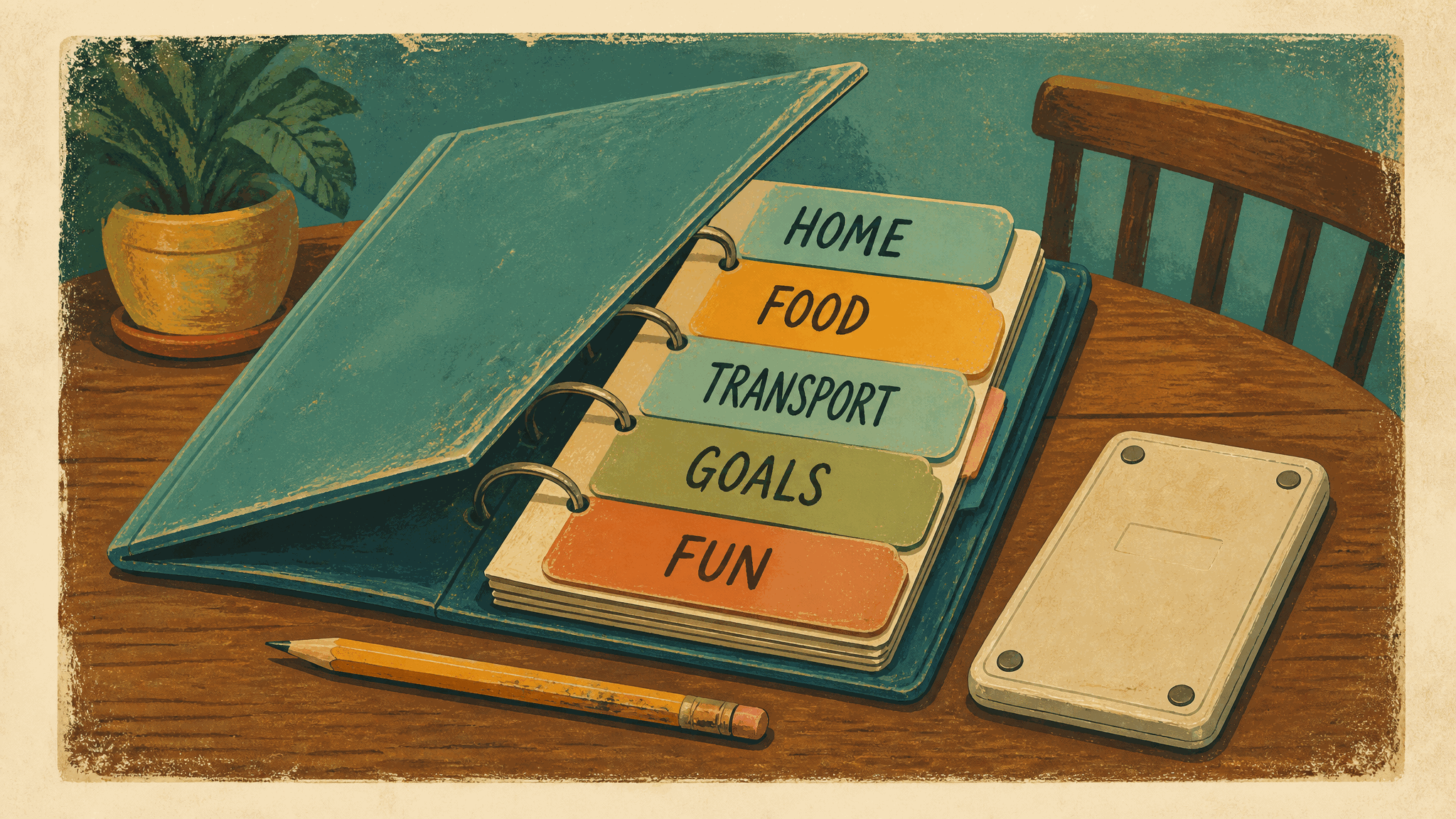
Use five categories: home, food and household, transportation, goals and debt, fun and giving. That is enough. Show how money flows in, gets assigned, and runs out if every category tries to be the favorite child.
The forbidden rule here is that your budget method does not have to look like anyone else’s. Some households need zero-based detail. Some need broad buckets. Some need automation plus a monthly glance. The right method is the one your family will actually run after Wednesday does what Wednesday does.
Parent Scripts
- This is the family money map. We’re not going through every line, but you can see the big categories.
- Housing gets paid before fun because the couch needs a room to live in.
- Debt is money we already used and still have to pay back.
- Interest can help you when you save, but it can work against you when you borrow.
Now introduce debt without making it a horror movie. Debt is borrowing future money for something now. Sometimes it is strategic, like a reasonable car loan or education that has been compared against cost and career path. Sometimes it is just past-you sending present-you a bill with attitude.
The Consumer Financial Protection Bureau reported that in 2024 the average APR reached 25.2% for general-purpose credit cards. Here is the clean math: if someone carried a $500 balance for 12 months at 24% APR compounded monthly and made no payments, the balance would become $634.12. That is $134.12 of interest for buying the thing before having the money.
Use the example, then stop. Teens can absorb math. They cannot absorb a 40-minute monologue delivered while they are trying to locate a hoodie.
Common parent mistake: hiding everything, then expecting wisdom to appear at 18. Visibility is not the same as burden. You can show the budget categories without handing a 13-year-old the emotional weight of the electric bill.
Ages 16-18: Cars, College, Credit, and Other Expensive Plot Twists
At 16 to 18, the conversations need real numbers. Not scary numbers for sport. Useful numbers, attached to choices they are actually about to make.
Start with cars. The newest car is rarely the cheapest car to own, and the monthly payment is only one ingredient. AAA estimated the average annual cost to own and operate a new vehicle at $12,863, or $1,071.92 per month, in its latest Your Driving Costs analysis. That includes costs people conveniently forget while staring at shiny paint.
College deserves the same treatment. The College Board reported 2025-26 average published tuition and fees of $11,950 for public four-year in-state students, $31,880 for public four-year out-of-state students, and $45,000 for private nonprofit four-year students. Value is not the logo on the sweatshirt. Value is cost, aid, debt, completion odds, major, location, and the life your teen may want after the dorm posters come down.
Parent Scripts
- A car budget is not a payment. It is payment, insurance, gas, maintenance, registration, parking, and repairs.
- College value is not the most impressive name. It is what the school costs after aid and what it helps you do next.
- Your first credit card is a tool, not a personality test.
- If you can’t pay the card in full, the reward points are confetti at a very expensive parade.
For credit cards, keep it boring on purpose. The CFPB credit-score guide says paying on time, paying the balance in full, and keeping balances low can help build and protect credit. Translation for teens: one card, one small recurring bill, autopay, full payoff, no chaos.
Then connect it to Your Credit Score Is Built on Six Things — Here’s How to Move Each One so they see the machine behind the number. Credit is not a moral grade. It is a scoring system with levers. Some levers matter more than others. None require buying a jacket you hate at a store card APR that should come with a warning siren.
Common parent mistake: handing over adult tools without adult context. A debit card, credit card, car, student loan, or job paycheck needs a conversation attached. Not a lecture. A conversation.
For the final stretch, ask better questions:
- What is the total cost, not just the monthly cost?
- What happens if income is lower than expected?
- What is the backup plan if the first plan gets weird?
- What part of this decision is math, and what part is values?
Money literacy isn’t a lecture. It’s the way you talk while making dinner.
| Age band | Core skill | Common parent mistake |
|---|---|---|
| 5-7 | Sorting needs, wants, and waiting without shame. | Saying "we can't afford it" when the truer answer is "we're choosing something else first." |
| 8-11 | Saving toward goals and seeing small consequences. | Rescuing every regret before the lesson has time to land. |
| 12-15 | Understanding big budget categories and how debt interest works. | Hiding all money details, then expecting instant maturity later. |
| 16-18 | Comparing real costs for cars, college, and credit. | Focusing on approval for the purchase instead of the full cost of owning the decision. |
 Forbidden Finance