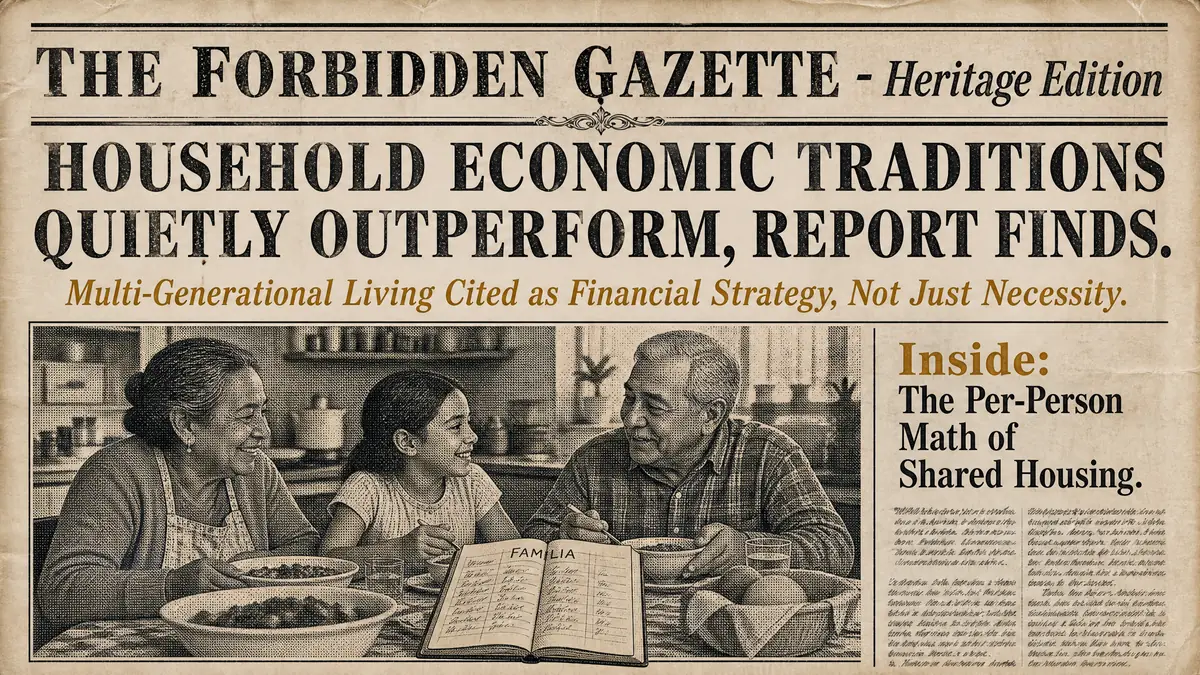
The Context: Hispanic Heritage Month, Without Turning Households Into Symbols
A mortgage payment does not care whether a household looks like a personal-finance textbook.
That is a useful place to start during Hispanic Heritage Month, which runs from September 15 through October 15. This is not an article claiming to speak for Hispanic families, Latino households, immigrant households, or any other family structure with more history than a budgeting app onboarding flow. It is an observation about money systems that already exist, often because life required them, and sometimes because they work.
The data is clear that multigenerational living is not some fringe arrangement. Pew Research Center’s 2024 household data shows 30% of the Hispanic population and 30% of Asian Americans lived in multigenerational households, compared with 29% of Black Americans and 16% of White Americans. Different histories. Similar math.
The usual finance script assumes one household equals one couple, maybe children, one roof, one budget meeting, one heroic spreadsheet. Cute. Also incomplete. Many families manage money through pooled housing, rotating support, remittances, adult children helping parents, parents helping adult children, grandparents watching kids, siblings sharing bills, and cousins becoming emergency funds with opinions.
That does not make multigenerational living automatically better. It can be chosen. It can be forced. It can be warm, crowded, generous, tense, efficient, unfair, protective, or all of those before lunch. The lesson is not “copy someone else’s culture.” The lesson is simpler: household structure is a financial tool.

Shared Housing Economics
Housing is the line item that eats the budget first and asks questions never. So shared housing changes the math before anyone clips a coupon.
If two adults split a fixed housing cost and a third adult joins without changing the rent or mortgage, the per-person share drops by one-third. Add real life, higher utilities, more groceries, a bigger internet plan, a second fridge humming in the garage, and the planning range often lands closer to 30% to 40% savings on fixed per-person costs. This is arithmetic, not magic. Annoyingly, arithmetic remains one of personal finance’s better tricks.
NCRC’s Latino housing analysis notes that Latino households are 3.5 times more likely to be multigenerational than non-Latino households, and that pooled income or savings can contribute to mortgage readiness and home title structures. That point matters because housing is not just shelter. It is also the place where credit rules, underwriting, down payments, closing costs, and family liquidity all meet in one very expensive room.
The trade-off is that shared savings are not free savings. Privacy has value. Quiet has value. Clear expectations have value. Nobody should have to discover after move-in that “helping with bills” meant one person pays the electric bill forever while everyone else contributes spiritually.
| dimension | benefit | cost |
|---|---|---|
| Housing payment | Rent, mortgage, insurance, internet, and utilities can be spread across more adults. | More people may require more space, repairs, parking, or household management. |
| Emergency capacity | More earners can make one job loss less catastrophic for the whole home. | One person's emergency can quickly become everyone's cash-flow problem. |
| Childcare and eldercare | Family presence can reduce paid care needs and keep support close. | Unpaid labor can become invisible, especially for women and older relatives. |
| Credit access | Pooled savings can help with down payments, deposits, or avoiding high-interest debt. | Informal obligations can strain relationships when terms are vague. |
| Autonomy | Shared living can create breathing room for school, career changes, caregiving, or debt payoff. | Adults may feel delayed, monitored, or stuck if there is no exit plan. |

If the budget system is shared, the recordkeeping needs to be shared too. A household with three adult contributors may need separate accounts, one bill account, one grocery card, one reimbursement ritual, or some other boring mechanism that prevents memory from becoming accounting. The less glamorous version of this idea shows up in The Two-Account Rule: Why Most Households Need at Least Two Banks (and Sometimes Five). Glamour is not the point. The light bill getting paid is the point.
Caregiving as Financial Strategy
Caregiving is where money turns into time, and time turns into presence. It is also where many budgets lie to themselves.
The Federal Reserve’s 2025 SHED report found that one-fourth of parents with children under 13 used paid childcare, while 44% used some unpaid childcare. It also reported median monthly childcare payments of $1,083 among families paying for care and housing, compared with a median housing payment of $1,900. Translation: childcare is not a side quest. It is a second rent payment with snack rules.
The same Federal Reserve report found that 18% of adults regularly provided unpaid care for an adult relative or friend because of aging, disability, or illness. Hispanic adults were among the groups more likely than White adults to provide unpaid adult care. Again, that is not a cultural greeting card. It is labor. It has value even when no invoice exists.
This is where multigenerational households can create financial resilience that a single-family budget misses. A grandparent watching a child after school may save cash. An adult child driving a parent to appointments may prevent paid transportation or missed care. A sibling moving in during a recovery period may turn an emergency into a schedule problem instead of a bankruptcy problem.
But unpaid care should not mean uncounted care. If one person provides twenty hours a week of childcare, eldercare, cooking, translation help, transportation, or medication management, the household should treat that as a contribution. Not a favor floating in the air. Not “what family does” until one person burns out quietly in the laundry room.
A better family budget names the non-cash work. It asks who is saving whom money. It notices that care is not free just because no one wrote a check.
Family-Loan Mechanics
Family loans are where generosity meets paperwork and everyone suddenly wishes they were discussing literally anything else.
Still, the mechanics matter. The Federal Reserve’s 2025 household survey found that 23% of adults received help from someone outside their household to pay an expense in the prior year, and 47% of adults ages 18 to 29 did. Cell phone bills, general expenses, and housing costs were the most common forms of help.
That help can be a gift. It can be a loan. It can be a regular remittance. It can be a one-time rescue. The label matters because resentment loves ambiguity.
The CFPB’s family lending guidance recommends writing out what everyone agreed to, including who provides what, how much, how often, when repayment happens, when the arrangement ends, and what happens if circumstances change. This is not cold. This is how affection survives the third awkward reminder text.
Documented family loans can also beat retail credit when the alternative is revolving debt. The Federal Reserve’s September 2026 G.19 release listed credit card accounts assessed interest at 22.15% in May 2026. A family loan at a lower rate, or a no-interest repayment plan that everyone can actually afford, may save hundreds of dollars and keep the borrower out of the penalty-fee swamp.
Remittances deserve the same practical treatment. The World Bank’s Remittance Prices Worldwide report reported that sending $200 from the United States cost 5.04% on average in Q3 2025, while costs varied by provider and corridor. For families sending money regularly, the fee is not background noise. It is part of the budget. A $10 fee repeated every month is not dramatic. That is how it gets away with things.
The useful structure is not complicated: name the purpose, write the amount, set the repayment or sending schedule, choose the transfer method, and decide what happens if income drops. If a loan is really a gift, call it a gift. If support is recurring, budget it like rent. If repayment depends on a bonus, tax refund, or seasonal work, write that down too.
This is the same permission-giving idea behind Values-Based Budgeting: Spend Money on What Actually Matters (Forbidden Concept, We Know): the right system is the one that reflects the real obligation, not the one that looks cleanest on paper.
What Nuclear-Household Readers Can Adopt
You do not need three generations under one roof to borrow the better parts of multigenerational finance.
Start with shared fixed costs. Could you share childcare pickup with another family? Split a warehouse membership with a sibling? Move an adult child home for six months with an actual savings target and an exit date? Rent the basement to a relative under a written agreement? The personal-finance internet often treats independence as the only respectable goal. Fine. But independence that requires everyone to buy their own ladder, printer, guest bed, emergency drill, and Costco-sized olive oil is not always sophistication. Sometimes it is just duplicate spending in nicer packaging.
Next, make care visible. If your household relies on unpaid labor, track it for one month. School pickups. Meal prep. Medical calls. Translation help. Bill management. The invisible work may explain why the budget “works,” which is rude of it, but useful.
Then formalize family money without making it weird. A written family-loan note can be gentler than a vague promise. A shared bill account can reduce monthly confusion. A scheduled money conversation can prevent the festive holiday ambush, a classic genre nobody asked to renew. For households teaching children how money actually moves through a family, Teaching Kids About Money: The Allowance Debate Is Missing the Point pairs well with this broader approach.
Finally, stop assuming the nuclear household is the default setting for financial adulthood. It is one model. Sometimes a good one. Sometimes expensive theater.
Multigenerational households show that a budget can be built around people, proximity, obligation, and mutual aid, not only income categories and subscription audits. The structure has costs. So does every structure. The question is whether the trade-off is named clearly enough for people to choose it, adjust it, or leave it without shame.
The nuclear-family budget was always a relatively recent invention. The other models still work.
 Forbidden Finance