TL;DR: Your FICO score is mostly boring behavior: pay on time, keep reported card balances low, let accounts age, avoid opening a tiny parade of new credit, and do not borrow money just to "improve your mix." The forbidden move is not obsessing over the number. It is knowing which levers actually move it.
Your Score Is Not a Tiny Judge in a Suit
A credit score is a risk score, not a character witness.
It does not know that you are generous, funny, emotionally available, or that you once returned a shopping cart in heavy rain. It knows what got reported to the credit bureaus. That is both annoying and useful.
As of 2026, myFICO still explains the classic FICO formula in five weighted categories: payment history, amounts owed, length of credit history, credit mix, and new credit. FICO also says the exact impact varies by person, because your file is not a spreadsheet wearing one-size-fits-all pants.
Credit matters because borrowing is expensive right now. The Federal Reserve reports consumer credit data monthly, including revolving credit. The CFPB reported in its 2025 credit card market report that credit card debt exceeded $1.2 trillion at the end of 2024. So yes, this number can affect real costs.
It still does not get to become your personality.
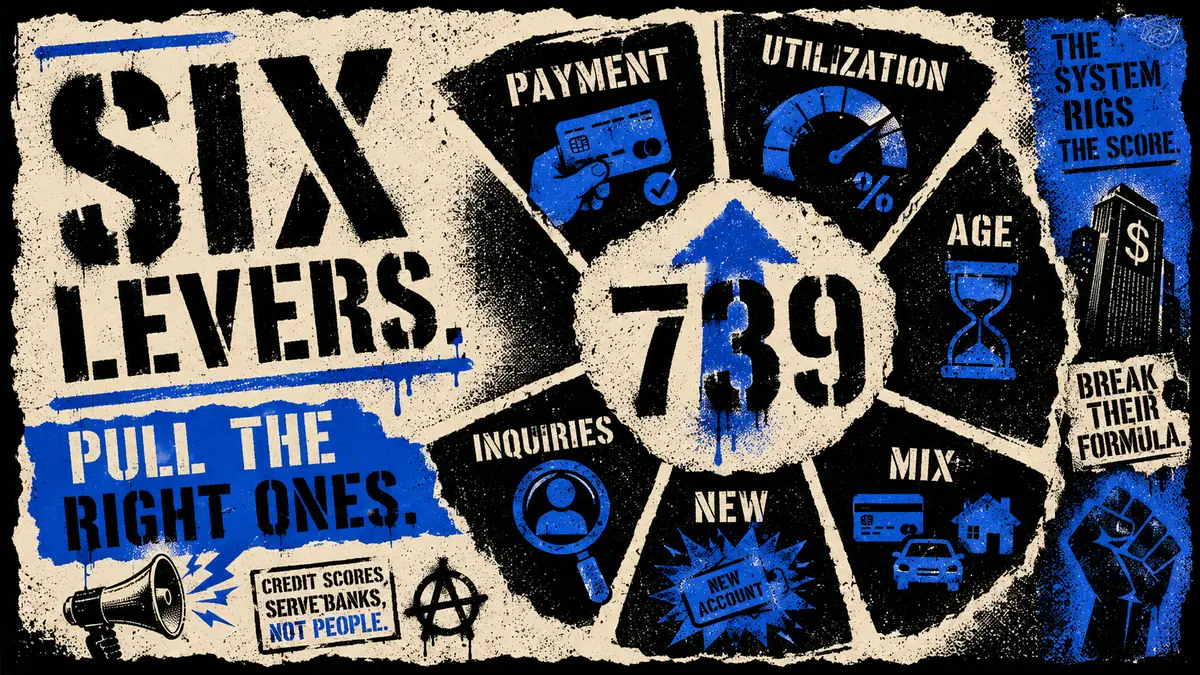
FICO has five official weighted categories, but for real-world action, it helps to split "new credit" into two beginner levers: new accounts and hard inquiries. Same 10% bucket. Less confusion. Very forbidden. Very sensible.
| Component | % Weight | 30-Day Action | 12-Month Action |
|---|---|---|---|
| Payment history | 35% | Put every debt payment on autopay for at least the minimum. | Build a 12-month streak of zero late payments. |
| Credit utilization | 30% | Pay cards before the statement closing date to lower the reported balance. | Keep reported utilization comfortably below 30%, and lower if you are preparing for a major loan. |
| Credit age | 15% | Do not close your oldest no-fee card out of boredom. | Let accounts age and avoid unnecessary account churn. |
| Credit mix | 10% | List what types of credit you already have before adding anything. | Only add a new type of credit if you actually need it. |
| New accounts | Part of new credit, 10% | Pause nonessential applications for 30 days. | Space applications around real needs, not score anxiety. |
| Hard inquiries | Part of new credit, 10% | Rate-shop mortgages, auto loans, or student loans in a tight window. | Keep a simple application calendar so surprises do not pile up. |
Payment History (35%): Pay Like a Boring Legend
Payment history is the biggest FICO category at 35%. This is the "did you pay as agreed?" section. Not glamorous. Not aesthetic. Very powerful.
The beginner mistake is thinking this means "pay in full or you failed." No. Paying in full avoids interest, which is excellent. But for payment history, the minimum payment by the due date is the line between "fine" and "oh no, the machine noticed."
30-day action: Set autopay for at least the minimum on every credit card, loan, and line of credit. Then set a reminder three days before each due date so you can check cash flow like an adult with trust issues.
12-month action: Build a clean streak. No missed payments. No "I thought that card was cancelled." No annual-fee zombie account biting your score from a drawer.
If recurring bills are where your payments go to disappear, read Your Forgotten Subscriptions Are Bleeding You Dry. Subscription creep is funny until it causes a failed payment. Then it is just a raccoon in your checking account.
Utilization (30%): The Statement-Date Trick Nobody Explains
Utilization is the part people misunderstand most confidently.
FICO calls this category "amounts owed," and myFICO says revolving utilization is an important part of it. In plain English: if your card limit is $10,000 and your reported balance is $3,000, your utilization is 30%.
Here is the trick: the balance that matters for utilization is usually the balance reported around your statement closing date, not the balance after your minimum-payment due date.
Read that again, because the credit goblins hid the useful part in the furniture.
Your payment due date protects payment history. Your statement closing date often determines what balance gets reported. The CFPB defines the periodic statement as showing the closing date of the billing cycle and the account balance outstanding on that date. FICO also notes that the balance on your latest monthly statement is typically what shows on your credit report.
So if your card closes on the 12th with a $2,900 balance, then you pay it to $0 on the 20th, your report may still show $2,900 until the next cycle. You did nothing "wrong." The timing was just rude.
30-day action: Find the statement closing date for each card. Pay the balance down before that date, especially if you are about to apply for a loan. Then still pay anything remaining by the due date to avoid interest.
12-month action: Keep reported utilization under 30% as a general beginner target. Lower is often better before a mortgage or auto loan, but do not turn this into a cult. A $47 balance is not a personality flaw.
Credit Age (15%): Let the Old Accounts Be Old
Credit age is 15% of the classic FICO score. It looks at things like your oldest account, newest account, average age, and how long specific accounts have been used.
This is where impatience loses money wearing a fake mustache.
Opening new accounts can lower your average age. Closing old accounts can eventually reduce the age and available credit in your file, especially if the card had no fee and was quietly helping in the background like a financially responsible houseplant.
30-day action: Identify your oldest open account. If it has no annual fee and is not causing spending chaos, consider keeping it open. Put one tiny recurring charge on it if needed, then autopay it. The card does not need a rich inner life. It just needs to stay alive.
12-month action: Stop churning accounts unless there is a real strategy. New cards can be useful. Rewards can be useful. But if you are new to credit, stability is doing more work than another shiny approval screen.
This is the same philosophy behind Custom Budgeting: For People Who Read All 7 Methods and Said "Nah". The best system is the one that fits your actual life. Credit is not different.
Credit Mix (10%): Variety Helps, Debt Cosplay Does Not
Credit mix is 10%. FICO considers whether you have experience with different types of credit, like credit cards, retail accounts, installment loans, and mortgages. FICO also says you do not need one of each.
Please tattoo that on the part of your brain that wants to take out a loan "for the score."
Do not pay interest for vibes.
A credit card you use lightly and pay on time can build history. A student loan, auto loan, mortgage, or personal loan can add installment history if you already needed it. But borrowing money just to impress an algorithm is like buying flowers for a printer. It will not love you back.
30-day action: List your current credit types. Revolving credit? Installment loan? Mortgage? None yet? Fine. You are gathering facts, not auditioning for a lender's approval-themed talent show.
12-month action: Only add a new credit type when it serves a real purpose. If you are building from scratch, a secured card or beginner card may make sense. If you already have cards and loans, your mix is probably not the emergency.
New Credit and Inquiries (10%): Apply Like You Have a Calendar
New credit is 10%, but it causes 90% of the panic because hard inquiries are visible and people love visible things to fear.
myFICO says inquiries remain on your credit report for two years, but FICO Scores only consider inquiries from the last 12 months. It also says opening several new accounts in a short time can signal higher risk, especially if your file is young.
That does not mean "never apply." It means apply like someone who owns a calendar.
30-day action: Pause nonessential applications. If you are not applying for a mortgage, car, student loan, or card you actually need, let the dust settle.
12-month action: Plan applications around real life. Need a car loan in September? Maybe do not open three store cards in August because a cashier offered you 15% off a sweater that will pill immediately.
For rate shopping, the rules are less scary than the folklore. myFICO says FICO Scores ignore mortgage, auto, and student-loan inquiries made in the 30 days before scoring, and may count multiple inquiries in a short shopping period as one. Shop intentionally. Do not stretch it across an entire season like a prestige TV drama.
Also, checking your own credit report does not hurt your score. The CFPB says pulling your own report is not a new-credit inquiry, because apparently the system can tell the difference between "I'm checking my file" and "please finance this suspiciously large couch." By law, you're entitled to one free credit report every 12 months from each of the three major bureaus, but the FTC says Equifax, Experian, and TransUnion have permanently extended free weekly online credit reports through AnnualCreditReport.com, the official site. If you request by mail, CFPB says that still works on the once-every-12-months schedule. Also separate: Equifax offers additional free reports through December 2026. Translation: use the official site, skip the paid monitoring shrine, and check the actual report for errors before the errors start cosplaying as your financial choices.
If you want a money system that does not make you inspect every latte like a crime scene, Pay Yourself First: The Forbidden Art of Not Tracking Every Latte is the spiritual cousin of this advice. Automate the important stuff. Stop worshipping tiny noise.
The Panic Counter: 720 Is Not a Moral Failure, and 800 Is Not a Crown
A 720 FICO and an 800 FICO often live in the same practical universe for everyday credit decisions: you are likely in the "good enough to get serious offers" zone, and the exact lender, income, debt-to-income ratio, collateral, and product matter too. The main place the 800-club fantasy can still matter is mortgage pricing, and even there the tiers are not magic. The current Fannie Mae loan-level price adjustment matrix uses credit-score bands, with many purchase-money pricing tiers topping out at 780 and above, not a secret velvet rope at 800. So yes, improving from 620 to 720 can be huge. Improving from 720 to 800 can help in certain mortgage scenarios and with some lenders, but it is not a spiritual awakening. Do not let a three-digit number cosplay as your net worth, your discipline, or your worth as a human with snacks in the pantry.
Your credit score is a number. Don't let it become a personality.
 Forbidden Finance