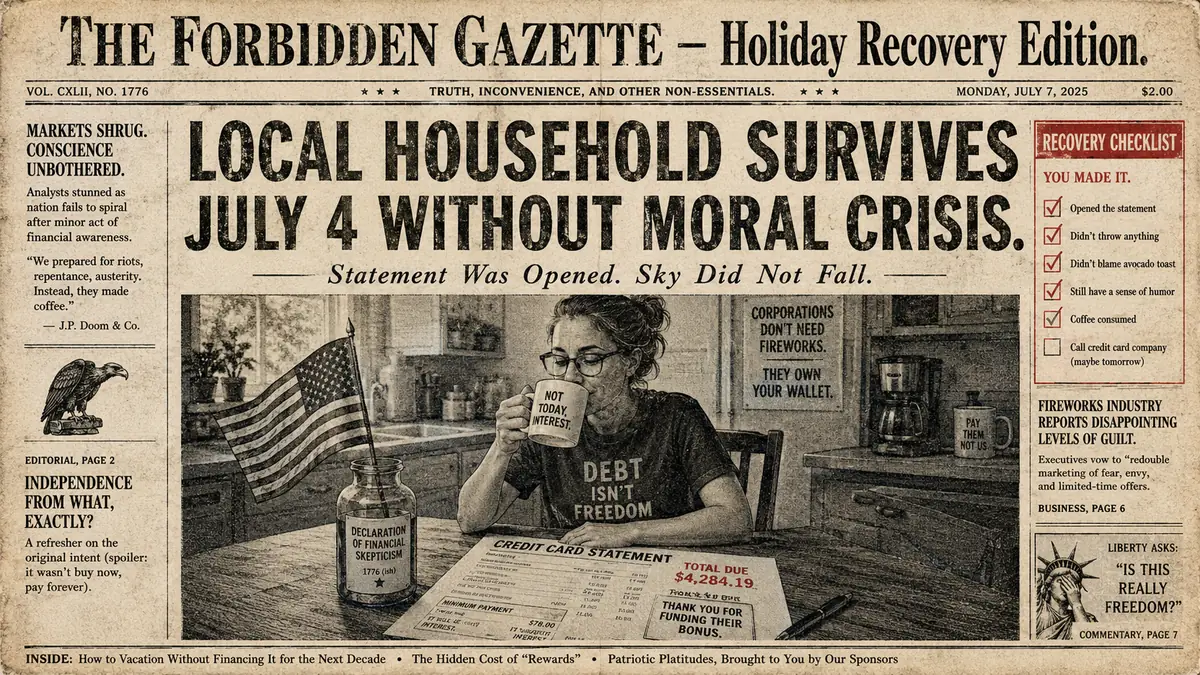
The grill cooled down. The cooler smells faintly like lime and regret. Somewhere, a card charge for “quick snacks” has revealed itself to be $143 because apparently buns, berries, sunscreen, and one emergency folding chair now cost pirate ransom money.
That does not mean July is ruined. According to the National Retail Federation, 86% of consumers planned to celebrate the Fourth of July in 2025, with average food spending at $92.44. Translation: holiday spending is common. Your budget did not uniquely betray civilization.
This is a recovery plan. No lecturing. No financial confessional booth. Just three moves to keep one loud weekend from turning into a month-long shrug.
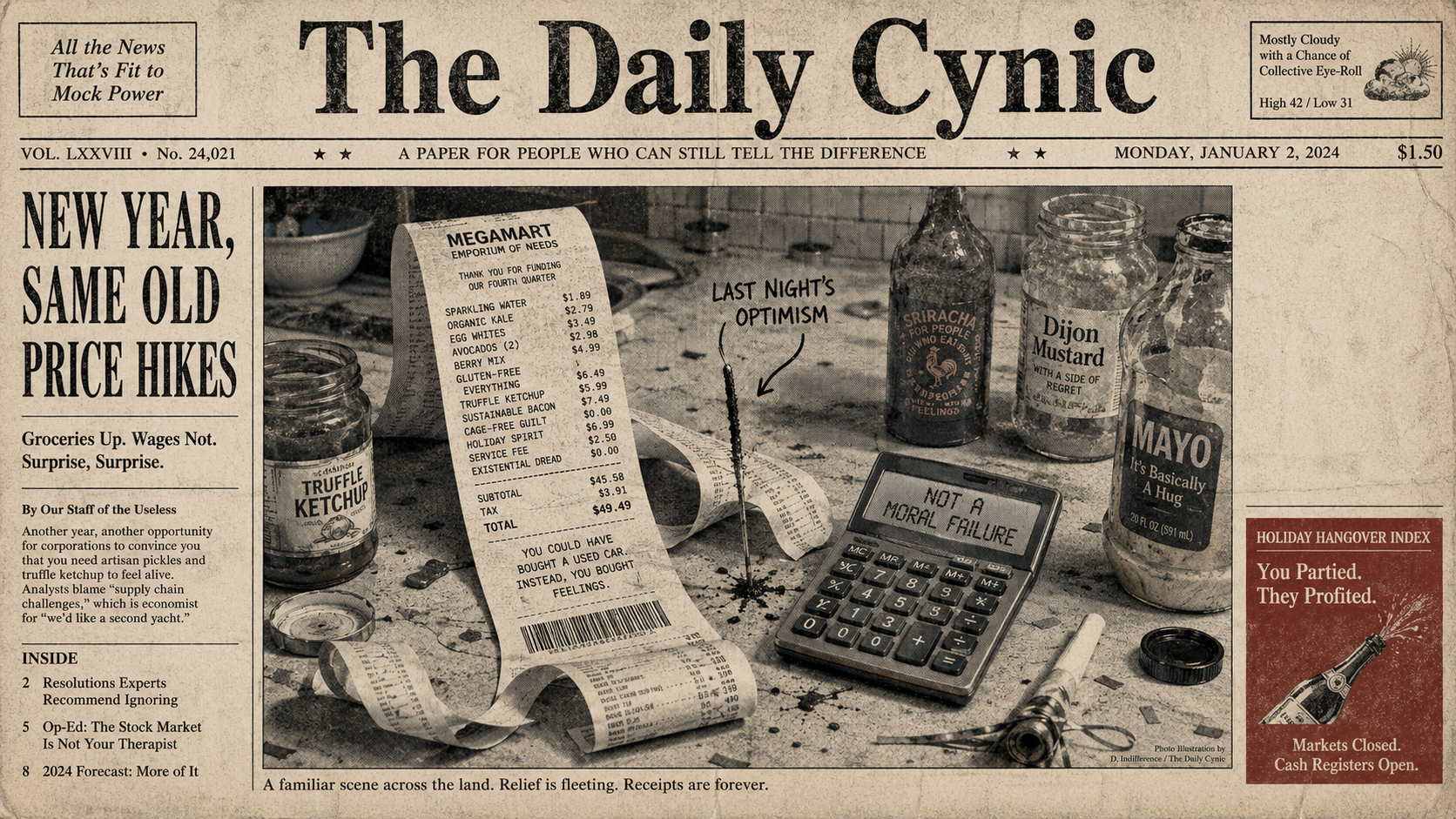
1. Stop and Assess Before Your Brain Starts Writing Fiction
Open the credit card statement Monday morning.
Not “sometime this week.” Not “after I emotionally prepare.” Monday morning. Coffee first if needed. Hydration if the weekend involved patriotic beverages. Then open it.
Avoidance feels protective for about six minutes. After that, your brain starts doing unpaid screenwriting. The damage becomes either “probably fine” or “we now live in a van,” neither of which is useful. Numbers are boring, but boring is exactly the medicine here.
Write down the holiday charges by merchant and category. Groceries. Gas. Restaurants. Travel. Party supplies. Random pharmacy run because someone forgot bug spray (the true national anthem). Do not decide anything yet. Just gather.
This is where the forbidden rule applies: assessment is not punishment. It is inventory. You are not opening the statement so you can feel bad enough to become a better person. You are opening it so the problem stops being a foggy monster and becomes, say, $78 in extra groceries and $46 in takeout.
If your budget already felt shaky before the weekend, this step matters even more. A holiday can expose a weak plan, but it does not automatically prove you are bad at money. For the longer version of why budgets wobble after the honeymoon phase, read Why Most Budgets Fail in Month Three (and How to Build One That Doesn't).
Open it. Name it. No courtroom drama required.
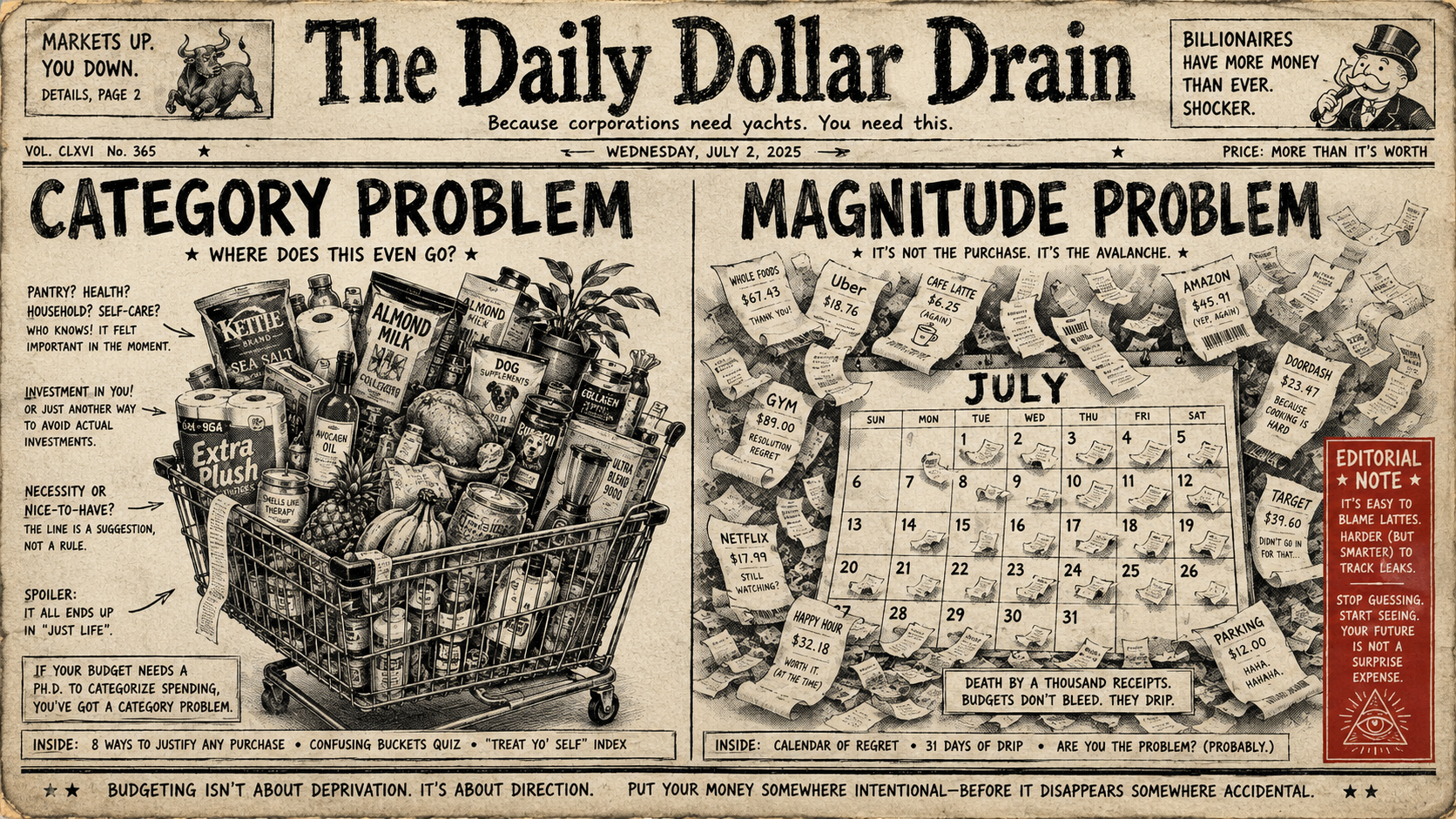
2. Figure Out Whether It Was a Category Problem or a Magnitude Problem
Once you have the numbers, sort the mess. There are two very different problems hiding under the same “oops.”
A category problem means one area blew up. Groceries went feral. Gas spiked because you drove to three barbecues and a fireworks stand. Restaurants got weird because everyone was tired and the fridge contained only mustard and one heroic pickle.
A magnitude problem means everything blew up. Groceries, gas, dining, decorations, shopping, and “miscellaneous,” which is budget language for “we do not speak of this drawer.”
The fix depends on which one you have. If it was one category, patch that category. Move money from a flexible line, pause one nice-to-have, or let July groceries run tighter for a week without turning meals into sadness pellets. If it was everything, stop pretending a $25 tweak will cover it. You need a broader reset: lower discretionary spending for the next two weeks, delay a purchase, or spread the correction across July and August.
This distinction matters because shame loves vague labels. “I overspent” becomes “I’m irresponsible,” and now we are doing amateur theater instead of math.
Janet Polivy and C. Peter Herman describe the “what the hell effect” in restrained eating: once a personal rule feels broken, people may abandon the rule for the short term. Money has its own version. You go $80 over, decide the budget is dead, then order $62 of delivery because apparently the funeral needed catering.
3. Adjust July’s Plan Instead of Abandoning It
Now comes the part traditional money advice often makes unnecessarily dramatic. You do not need to “start over.” You need to revise July.
A budget is not a porcelain figurine. It can be touched. It can be moved. It can survive one weekend of grilled meat, fireworks, and somebody saying, “Should we just grab brunch?” with the confidence of a person not holding the statement.
Think on a 12-month rolling basis. January is not the only legal entrance to responsible adulthood. July 7 counts. So does July 18. So does some random Thursday when you finally admit the patio-furniture purchase was not “basically free” because it was on sale.
Pick one recovery lane. If the overage is small, absorb it inside July. If it is medium, split it between July and August. If it is large, update the annual plan: reduce one future category, delay a savings goal by a paycheck, or build a holiday sinking fund for next year so Future You is less surprised by hot dogs having a line item.
This is also where independence gets less slogan-y. The point is not to obey a perfect spreadsheet. It is to keep choosing a money system that fits the life you are actually living. For that angle, Independence Day Money: 14 Habits That Buy You More Financial Freedom (Not Just More Stuff) pairs nicely with this reset.
G. Alan Marlatt and Judith R. Gordon framed lapses as something to learn from, not proof that the whole effort has collapsed. That is the move here. Treat the weekend as data. Adjust the plan. Keep going.
You didn't fail. You had a weekend. The budget can hold both.
 Forbidden Finance