The Honest Version of Savings by Age
A retirement benchmark can feel like stepping on a scale at the doctor while wearing winter boots, holding your keys, and emotionally carrying the last decade of rent increases.
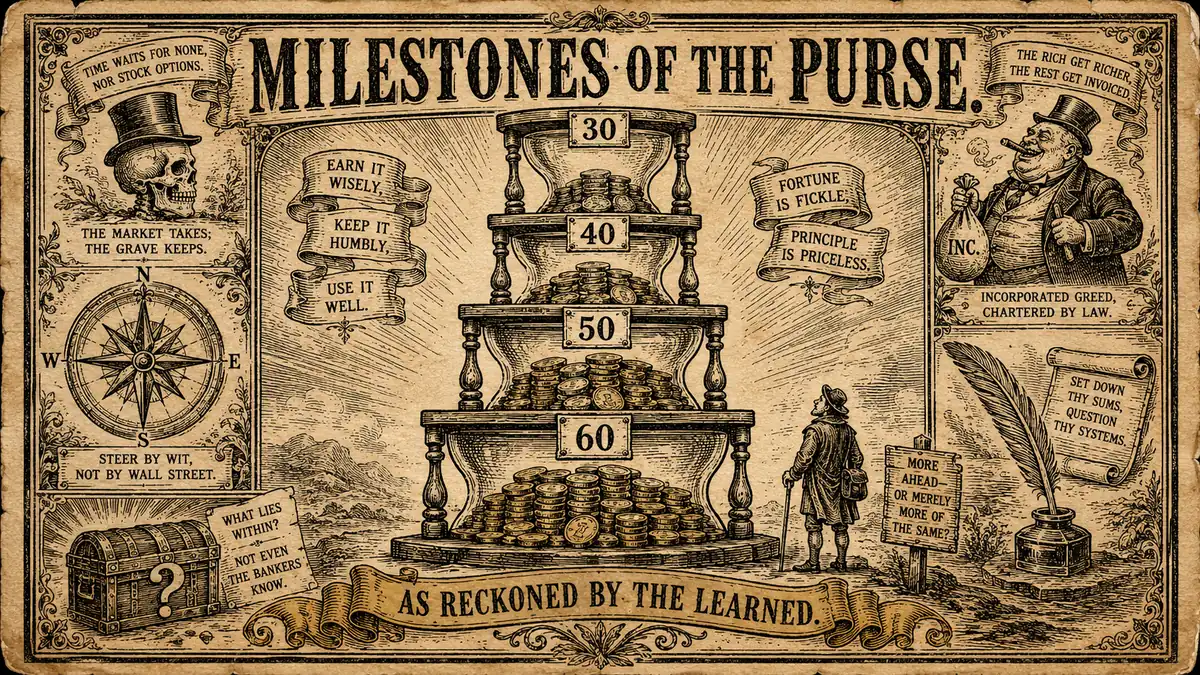
The classic guideline is simple: about 1x your salary saved by 30, 3x by 40, 6x by 50, 8x by 60, and 10x by 67. Fidelity's retirement guideline uses that exact ladder, assuming a 15% savings rate including employer match, a long investing runway, and retirement around 67. T. Rowe Price uses ranges instead, which is more honest because life is not a spreadsheet with a gym membership.
Also, actual humans are not all at the benchmark. The Federal Reserve Survey of Consumer Finances shows median retirement account balances by age that are often far below the tidy rules. Meanwhile, the Bureau of Labor Statistics reported average annual consumer expenditures of $78,535 in 2024. So yes, saving is hard. The rent noticed.

TL;DR
• The standard retirement benchmark is 1x salary by 30, 3x by 40, 6x by 50, 8x by 60, and 10x by 67.
• Count invested retirement assets, not emergency cash, cars, or home equity.
• Your savings rate matters more than your current multiple, because the next dollar still gets a vote.
The Benchmark Table
Use this as a dashboard light, not a moral verdict. A dashboard light says check the engine. It does not call you a disappointment in front of your children.
| Age | Multiple of salary | What counts | Common trap |
|---|---|---|---|
| 30 | 1x | 401(k), 403(b), IRA, Roth IRA, vested match, invested HSA, taxable brokerage earmarked for retirement | Waiting until life feels settled |
| 40 | 3x | All invested retirement accounts, old employer plans, rollover IRAs, taxable long-term investments | Lifestyle creep wearing a respectable blazer |
| 50 | 6x | Same accounts, plus catch-up contributions if eligible | Paying for everyone else's future before yours |
| 60 | 8x | Retirement accounts, brokerage assets, vested employer money, invested HSA balances | Confusing retirement readiness with account size alone |
| 67 | 10x | Portfolio assets meant to fund retirement spending | Ignoring taxes, health care, and withdrawal timing |
Fidelity uses the 10x by 67 framework. T. Rowe Price gives wider ranges, including 3.5x to 5.5x by 50 and 6x to 10.5x by 60. Translation: the benchmark is a map. It is not the law. Forbidden concept, apparently.
By 30: Build the Automatic Part
What counts toward the number
At 30, count money that is actually working for future you: employer 401(k) or 403(b) balances, Roth IRA money, traditional IRA money, vested employer match, taxable brokerage investments you are not planning to raid for a couch, and the invested portion of an HSA.
The Internal Revenue Service set the 2026 employee contribution limit for 401(k), 403(b), governmental 457 plans, and the federal TSP at $24,500. The IRA limit is $7,500. You do not need to hit those limits to be a real adult. You need a repeatable system.
What does not count
Do not count emergency fund cash, home equity, vehicles, wedding gifts you swear you will invest later, or the imaginary resale value of furniture you assembled with a tiny hex key and rage.
Common traps
The big trap is waiting. Waiting for the better job. Waiting for student loans to disappear. Waiting until your apartment has matching chairs. The other trap is building a perfect budget that lasts 19 days because it requires more admin than your actual job.
If you need a low-friction setup, start with automation. Pay Yourself First: The Forbidden Art of Not Tracking Every Latte is the method for people who would rather move the money before they can negotiate with it.
Five-step catch-up plan
- Find the employer match and contribute enough to get it if your cash flow allows.
- Set an automatic retirement contribution, even if it starts at 3%.
- Increase the contribution by 1 percentage point every raise, job change, or January.
- Open an IRA if you do not have a workplace plan or want a second bucket.
- Pick one spending leak to redirect, not twelve, because twelve turns into performance art.
By 40: Fight Lifestyle Creep
What counts toward the number
By 40, the benchmark says roughly 3x salary. Count all invested retirement money: current workplace plan, old 401(k)s, rollover IRAs, Roth and traditional IRAs, vested employer contributions, taxable brokerage assets earmarked for retirement, and invested HSA dollars.
This is also the decade when old accounts start hiding in the financial couch cushions. If you have changed jobs, your total may be less depressing than it looks once you include every plan.
What does not count
Do not count your house, emergency fund, checking balance, car, collectibles, or money already assigned to a near-term goal. A down payment fund is not retirement money. It is a down payment fund wearing sensible shoes.
Common traps
The 40s trap is lifestyle creep with manners. The raise becomes the nicer rental, the second streaming bundle, the car payment that seems normal because everyone else has one, and the vacation you definitely deserve. You may deserve it. The math still gets a vote.
The Bureau of Labor Statistics data is useful here because it reminds you that housing, transportation, food, insurance, and health care are the big gears. The latte is not your problem. Your fixed costs may be your problem.
Five-step catch-up plan
- Calculate your real retirement total across every account before deciding you are doomed.
- Raise your savings rate before upgrading lifestyle after your next pay increase.
- Audit the large recurring costs first: housing, transportation, insurance, debt payments.
- Use a budget style that matches your life, not one that makes you cosplay as an accountant.
- Route at least half of every raise to investing until your savings rate is healthy.
If your budget keeps failing, the issue might be fit, not character. Which Budgeting Method Is Right for You? is a better question than why can't I become a different person by Tuesday?
By 50: Catch-Up Gets Real
What counts toward the number
By 50, the classic target is 6x salary. Count the same invested assets: workplace plans, IRAs, Roth accounts, vested match, taxable brokerage assets, and invested HSA money. If your HSA is just cash for near-term medical expenses, treat that portion as health-care cash, not retirement savings.
The IRS increased the 2026 catch-up contribution limit for most 401(k), 403(b), governmental 457, and TSP participants age 50 and older to $8,000, making the total $32,500. IRA catch-up for age 50 and older is $1,100 in 2026. Useful. Not magic. Still useful.
What does not count
Home equity can support retirement planning if you downsize, relocate, or borrow against it, but it is not the same as liquid retirement savings. Your house cannot buy groceries unless you sell part of it, which neighbors tend to notice.
Common traps
The 50s trap is funding every emergency in the family except your own future. Kids' college. Aging parents. Adult children. Weddings. Medical bills. The emotional invoice can get crowded.
This is where net worth clarity helps. How to Calculate Your Real Net Worth (and What the Number Actually Tells You) separates retirement assets, home equity, cash, and debt so you are not staring at one giant number like it owes you an apology.
Five-step catch-up plan
- Use catch-up contributions if you have the cash flow and the plan allows it.
- Recheck investment allocation so fear has not quietly moved everything to cash.
- Set boundaries around family support so your retirement does not become the emergency fund.
- Run a debt payoff plan for high-interest balances before retirement income gets closer.
- Estimate retirement spending now, using real bills instead of vibes and optimism.
By 60: Make the Number Useful
What counts toward the number
By 60, the benchmark says about 8x salary, with 10x by 67 as the full classic target. Count the invested retirement assets that can realistically fund retirement: workplace plans, IRAs, Roth accounts, brokerage investments, vested match, and invested HSA assets.
For HSAs, the Internal Revenue Service set 2026 limits at $4,400 for self-only HDHP coverage and $8,750 for family coverage. If you are eligible and can invest part of the HSA, it can become a flexible retirement health-care bucket. If you need it for this year's deductible, that is also allowed. Knees are expensive.
What does not count
Do not count money already needed for near-term taxes, medical bills, home repairs, or cash reserves. Also be careful with home equity. It matters. It is wealth. It is just not the same as a portfolio you can withdraw from next month without selling the roof.
Common traps
The 60s trap is thinking the multiple is the whole plan. It is not. Timing matters. Taxes matter. Social Security claiming matters. Health care matters. Sequence risk matters, which is finance-speak for bad market timing showing up like an uninvited guest with muddy shoes.
The Federal Reserve found that retirement accounts were held by 54.3% of families in 2022, and the conditional median value among families with those accounts was $86,900. That number is not a target. It is a reminder that many households are working from imperfect starting points.
Five-step catch-up plan
- Map guaranteed income: Social Security, pensions, annuities, and any rental income.
- Estimate essential spending separately from nice-to-have spending.
- Build a tax-aware withdrawal order before retirement starts.
- Decide whether working longer, part-time work, or phased retirement changes the gap.
- Keep enough cash for short-term needs without accidentally parking the whole future there.
The Math That Matters More Than Benchmarks
Your current savings rate matters more than your current multiple because it is the part you can still change. Benchmarks describe where a tidy hypothetical saver might be. They do not prescribe your worth, your future, or whether you are allowed to enjoy tacos.
Here is the forbidden math: a 30-year-old at 0x salary who saves 25% of income can plausibly reach about 3x salary by 40, assuming steady income and a reasonable long-term market return around 5% to 6% per year. Add employer match or faster income growth, and the path changes again. Remove market returns, and it changes again. This is why the rule depends.
The T. Rowe Price framework points to 15% of income, including employer contributions, as a baseline for many people. Fidelity also builds its guideline around saving 15% starting at 25. If you are behind, the answer is not panic. The answer is usually one of three levers: save more, invest consistently, or give the money more time.
Benchmarks are descriptive, not prescriptive. They tell you what a model says. They do not know your divorce, disability, layoff, caregiving years, medical bills, or the year rent decided to become a luxury good.
If your salary is high but your wealth is not, read Your Salary Is Not Your Net Worth (And That's the Forbidden Truth). Income is the faucet. Wealth is what stays in the tub. Some tubs have leaks.

Sidebar: Put Every Retirement Account in One View
Most people are not only behind. Some are disorganized, because modern working life hands you a new retirement account every time you change jobs and then acts shocked when you forget one.
The Department of Labor has been building a Retirement Savings Lost and Found database because plans and participants lose track of each other after job changes, mergers, bad addresses, and old employers disappearing into corporate fog. The Government Accountability Office has also reported that U.S. 401(k) participants face challenges tracking and consolidating accounts after changing jobs, and that two-thirds of surveyed participants would find a comprehensive pension dashboard useful.
Seeing all retirement accounts together changes the tone. Instead of I have $42,000 and I am doomed, it may become I have $42,000 here, $18,000 in an old 401(k), $9,000 in a Roth IRA, and $3,500 invested in an HSA. Still work to do. Less doom.
The next step is not to worship the benchmark. It is to gather the accounts, count the right assets, ignore the wrong ones, and raise the savings rate you can actually sustain. Maybe that is 5% this year. Maybe it is 18%. Maybe it is 25% because you live below your means with suspicious competence.
You're not behind. You're where you are. The next dollar matters more than the last one didn't.
 Forbidden Finance