June is where FIRE math stops being cute.
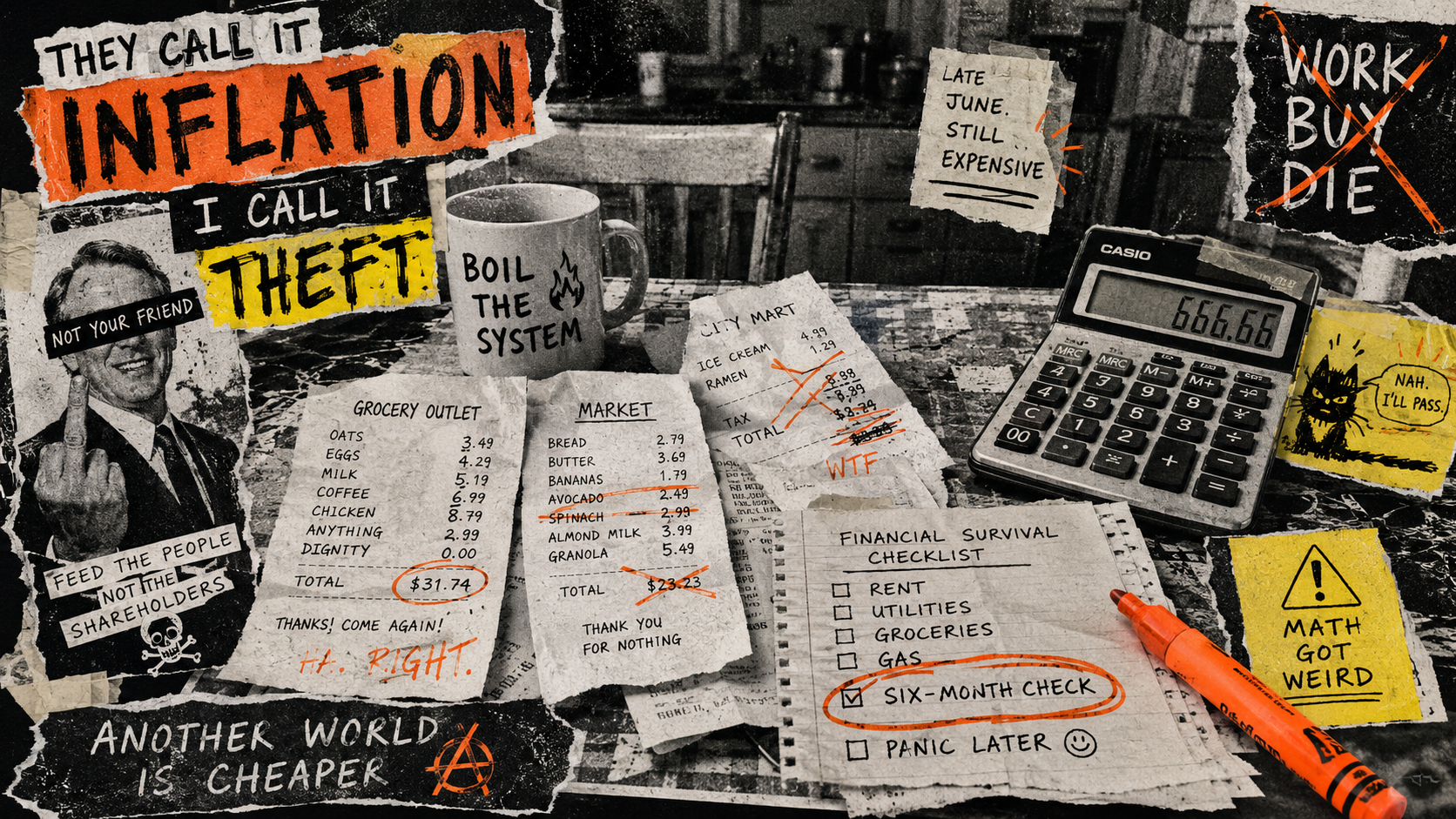
January-you made a plan. Very noble. Very spreadsheet-forward. Six months later, rent may be up, groceries may be doing interpretive dance, your portfolio may have drifted, and your savings rate may be less heroic than the number you remember bragging about to exactly one patient friend.
That does not mean the plan failed. It means the plan is alive. Annoying, but alive.
If you are working toward financial independence, the mid-year check-in is not a motivational ceremony. No candles. No vision board. Just the forbidden act of updating the math before stale assumptions start wearing a tiny fake mustache and calling themselves strategy. If you want the broader setup, start with FIRE Budgeting: The Forbidden Path to Telling Your Boss Goodbye, then come back here and check whether the current year is still behaving.
TL;DR
• Has your real annual spending changed enough to update your FIRE number?
• Is your YTD savings rate savings divided by gross income, not vibes divided by hope?
• Has your portfolio drifted away from your target allocation?
• Are you still aiming for lean, regular, coast, or fat FIRE?
Why The Mid-Year Check Matters
The FIRE number is not a tattoo. It is a calculation. If the inputs change, the output changes. Radical concept. Someone alert the beige budgeting police.
At the national level, the pressure is visible. The BEA reported that the U.S. personal saving rate was 2.6% in April 2026, with personal saving measured as a share of disposable personal income. Meanwhile, the BLS 2024 Consumer Expenditure Survey put average annual expenditures at $78,535 for all consumer units. National averages are not your life, obviously. They include people with three cars, four kids, one suspicious boat, and a grocery bill that looks like a clerical error. But they are useful because they remind you that spending moves.
Your own spending probably moved too. Insurance renewed. Summer travel appeared. A child needed shoes, then immediately outgrew them as a personal attack. Maybe you got a raise. Maybe your bonus did not show up. Maybe your mortgage payment is stable but everything around it has been quietly replaced by a more expensive version wearing the same shirt.
That is why a six-month check-in belongs next to your broader The Mid-Year Money Reset: A 10-Step Audit to Run Before June Hits. FIRE is long-term, but the inputs are embarrassingly current.
Here is the working rule: if a number affects your target, and that number has changed since January, you do not get to keep using the January version because it has nicer hair.
1. Recompute Your FIRE Number
The popular FIRE shortcut is simple:
Annual expenses x 25 = approximate FIRE number.
That 25x rule is the inverse of a 4% withdrawal rate. If you plan to spend $50,000 per year, 25x says your target is $1.25 million. If your real annual spending is now $58,000, the target is $1.45 million. Same rule. Different reality. The latte did not do this. Rent, health insurance, daycare, taxes, car repairs, and the mysterious $17.99 monthly charge from an app you used once in 2021 probably helped.
The 4% idea traces back to withdrawal-rate research from William Bengen and the later AAII Journal paper commonly called the Trinity Study. The short version: historical stock and bond return data were used to test how different withdrawal rates survived across retirement periods. The longer version: the rule is a planning shortcut, not a blood oath.
Current research still treats the withdrawal rate as a moving assumption, not divine scripture. Morningstar estimated a 3.9% safe starting withdrawal rate for 2026 retirees seeking steady inflation-adjusted spending over a 30-year horizon with a 90% probability of having funds remaining. That is not a command to use 3.9%. It is a reminder that 4% is a model, and models have assumptions hiding under the couch.
So recompute your number using your current spending. Do not annualize one freak month. Your cousin's wedding, four hotel nights, and flowers that began dying immediately are not your normal life. Use your last six months, remove true one-offs, add back recurring costs that are likely to continue, then estimate a realistic annual expense number.
Quick formula:
Adjusted six-month spending x 2 = current annual expenses.
Current annual expenses x 25 = baseline FIRE number.
If you want a more conservative number, use 28x, 30x, or a lower withdrawal rate. If you expect part-time income, rental income, a pension, or Social Security later, model it separately. Do not bury it in the expense number like a forbidden little spreadsheet crime.
2. Calculate Your YTD Savings Rate Correctly
Your YTD savings rate is the cleanest mid-year truth serum.
Use this version:
YTD savings rate = YTD savings ÷ YTD gross income.
Gross income means before taxes, insurance, retirement deductions, and payroll weirdness. Savings means money that increased your net worth: 401(k), IRA, HSA if invested or retained, taxable brokerage, cash savings, debt principal payments if you count debt payoff as wealth-building, and employer match if you choose to include it consistently.
The IRS raised the 2026 employee contribution limit for 401(k), 403(b), most 457 plans, and the federal Thrift Savings Plan to $24,500, with IRA contributions rising to $7,500. Those limits matter because your back-half savings plan may literally have more room than last year's plan did. Fun, in the way tax-code fun is basically a beige cracker.
Example:
You earned $72,000 gross through June. You contributed $10,000 to your 401(k), saved $4,000 in cash, invested $3,000 in a taxable brokerage account, and paid $2,000 of student-loan principal above the required interest.
Here is where the definition fork shows up. The same person gets two different savings rates depending on one decision: does debt payoff count?
Model A, count debt payoff (the net-worth view): paying down $2,000 of principal raised your net worth by $2,000, exactly like investing it would have. Assets up or liabilities down, the line moves the same distance. So savings is $10,000 + $4,000 + $3,000 + $2,000 = $19,000.
$19,000 ÷ $72,000 = 26.4% YTD savings rate.
Model B, do not count debt payoff (the invested-assets view): you only count money that flowed into savings and investments, and you track the loan payoff separately. So savings is $10,000 + $4,000 + $3,000 = $17,000.
$17,000 ÷ $72,000 = 23.6% YTD savings rate.
Neither model is cheating. Model A rewards getting out of debt, which is fair, because a killed loan is a real financial gain and your future self is not making those payments anymore. Model B keeps the rate tied strictly to money working in the market, which some FIRE purists prefer. Pick one, write down which one, and use the same version every quarter. A savings rate is only useful when you compare it to your own past self, not to a stranger running different rules.
That number is useful because FIRE timelines are brutally sensitive to savings rate. A 10% savings rate and a 40% savings rate are not two flavors of the same cookie. They are different vehicles. One is a bus. One is a suspiciously fast e-bike.
Sidebar: The Savings-Rate Definition Wars
People fight about savings-rate definitions because personal finance needed one more internet trench.
Some calculate savings divided by take-home pay. Some use gross income. Some include employer match. Some include mortgage principal. Some include debt payoff. Some exclude cash because it is not invested. Some include HSA money only if it stays invested. Everybody has a spreadsheet. Everybody thinks theirs has cheekbones.
For FIRE check-ins, gross income is the clean denominator because it keeps taxes and paycheck deductions from muddying the comparison. Include or exclude employer match however you want, but do it the same way every quarter. Consistency beats purity. Purity is usually where useful spreadsheets go to become unusable.
If you are using an anti-budget or reverse-budget setup, this section pairs well with Pay Yourself First: The Forbidden Art of Not Tracking Every Latte. The point is not to watch every coffee like it owes you money. The point is to know whether the big automated flows are still doing the job.
3. Check Allocation Drift Before It Rewrites Your Risk
Your target allocation is the risk level you chose while calm. Your current allocation is what the market did while you were busy having a life.
If your target is 80% stocks and 20% bonds, but a strong equity run pushed you to 88% stocks, you did not become more aggressive on purpose. Your portfolio just grabbed the steering wheel. Rude, but common.
Vanguard describes rebalancing as a way to keep portfolio risk aligned with a target risk exposure, because allocations drift when underlying assets earn different returns. The Investor.gov rebalancing example is deliberately simple: an 80/20 stock-bond portfolio becomes 85/15 after market moves, then the investor considers selling stocks or buying bonds to get back to target, while checking fees and tax consequences.
Your mid-year check is not a command to trade. It is a command to look.
Write down four numbers:
Current stock percentage.
Current bond percentage.
Current cash percentage.
Target percentages.
Then ask: is the drift large enough to matter? Some people rebalance on a calendar, such as annually or semiannually. Some use bands, such as 5 percentage points away from target. Some do it with new contributions instead of selling appreciated assets, because taxable brokerage accounts love turning simple decisions into paperwork confetti.
The forbidden move here is boring: rebalance according to the policy you already chose. Not because the market is about to crash. Not because a chart on the internet looked haunted. Because your allocation is supposed to match your plan, and the market is not your plan.
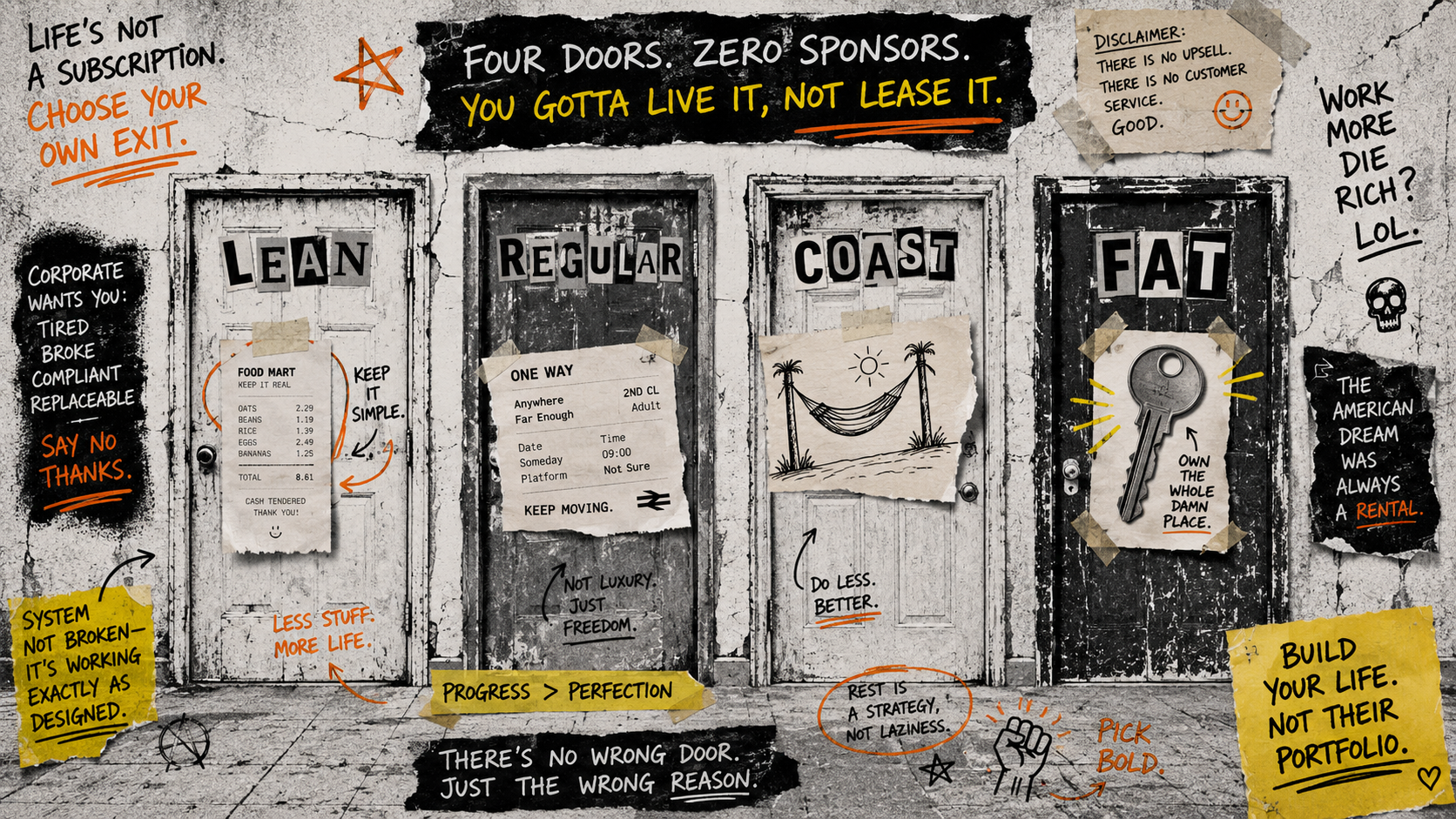
4. Re-Evaluate Lean, Regular, Coast, And Fat FIRE
FIRE tiers are not moral ranks. Lean FIRE is not holier. Fat FIRE is not greedier. Coast FIRE is not lazy. These are planning shapes. Pick the one that fits your actual life, not the one that gets the most approving nods from strangers with usernames like DividendLaser9000.
If your expenses changed in the first half of the year, your tier might have changed too. A new child, a city move, a health expense, a paid-off loan, a raise, or a business that suddenly works can all shift the target. That is not failure. That is the system updating after life dropped a new patch.
Use the table as a quick reset, not a personality quiz.
| FIRE tier | Target multiple of expenses | Withdrawal rate assumption | Profile |
|---|---|---|---|
| Lean FIRE | Often 25x lean annual expenses, sometimes 28x-33x for more cushion | Usually 3%-4% | Low fixed costs, high flexibility, fewer expensive preferences. Great if you actually like the life, miserable if you are pretending. |
| Regular FIRE | About 25x current annual expenses | Usually around 4%, adjusted for risk and horizon | The default FIRE lane: current lifestyle funded without full-time work, assuming the expense number is honest. |
| Coast FIRE | Discounted version of the full FIRE target based on years until traditional retirement | Final target often uses 3%-4%; coast number uses expected real return | You have enough invested that compound growth may carry retirement from here, even if you only cover current bills going forward. |
| Fat FIRE | Often 25x-33x higher annual expenses | Often 3%-4%, sometimes lower for long horizons or high fixed costs | More travel, higher housing costs, private health coverage, family help, or simply wanting more margin. Champagne optional. Spreadsheet required. |
The current withdrawal-rate conversation is not one-size-fits-all either. Morningstar treats safe starting withdrawals as dependent on asset allocation, inflation assumptions, time horizon, and flexibility. That matters because a 38-year-old leaving work may be planning for 50 years, not the 30-year horizon most classic research tested. Longer runway, more sequence risk, more years for health care to invent expensive surprises. Very thoughtful of it.
This is also where net worth clarity helps. If you are mixing home equity, retirement accounts, taxable investments, and cash into one big number, revisit Your Salary Is Not Your Net Worth (And That's the Forbidden Truth). FIRE depends less on the number that makes you feel rich and more on the assets that can actually fund spending.
Coast FIRE Math, Because Time Is Doing Part Of The Job
Coast FIRE deserves its own check because the math is backward. Regular FIRE asks, how much do I need at the end? Coast FIRE asks, how much must already be invested today so it can grow into that end number without more retirement contributions?
The formula:
Coast FIRE number = Full FIRE number ÷ (1 + real return)years until retirement
That little raised number is an exponent. It just means you compound the real return once for every year between now and retirement: 30 years to go means you divide by (1 + real return) thirty times over.
Real return means after inflation. If you use a nominal return and also use today's expense number, you are double-counting optimism. A charming habit. Also dangerous.
The basic engine is compound growth, the same principle behind the Investor.gov compound interest tools: money can grow over time as returns earn returns. Coast FIRE simply solves the equation backward.
Worked example:
Assume annual expenses of $60,000, a 4% withdrawal-rate target, and a full FIRE number of $1,500,000. Assume a 5% real annual return and traditional retirement at age 65.
| Current age | Years until 65 | Full FIRE number | Assumed real return | Coast FIRE number today |
|---|---|---|---|---|
| 28 | 37 | $1,500,000 | 5% | $246,653 |
| 35 | 30 | $1,500,000 | 5% | $347,066 |
| 45 | 20 | $1,500,000 | 5% | $565,334 |
Same destination. Different starting line. Time is not magic, but it does have excellent table manners when you give it decades to sit and compound.
The trap is assuming Coast FIRE means you can stop caring. No. It means you may be able to stop adding to retirement accounts and redirect future cash flow toward current life, a lower-stress job, childcare, debt payoff, a business, or the noble human goal of not answering Slack messages after 6 p.m.
But if your expenses rise, your full FIRE number rises. If your expected real return falls, your Coast number rises. If you move the retirement age closer, your Coast number rises. Coast FIRE is sensitive because it is powered by assumptions. Tiny input changes can become large output changes, which is exactly why mid-year is a good time to rerun it.
5. Update The Back-Half Plan In Writing

Do not leave the check-in as a thought. Thoughts are slippery. They put on socks and vanish.
Write answers to these three questions:
1. What changed in the first six months?
Name the actual change. Not a mood. Not a vague financial fog. Did annual spending rise by $6,000? Did gross income rise by $12,000? Did daycare end? Did rent jump? Did your portfolio drift from 70/30 to 78/22? Did you discover that your car has opinions?
Numbers first. Feelings second. Both count, but only one belongs in the formula.
2. What number changes now?
Pick the input that needs updating: annual expenses, savings rate, retirement age, target allocation, withdrawal-rate assumption, Coast FIRE return assumption, or the FIRE tier itself.
If your 2026 retirement-account plan changed, check the current IRS limits before you decide you are maxed out. Contribution limits are annual tax-year numbers, not ancient wisdom carved into a gym locker.
Also decide whether the change is permanent or seasonal. Summer camp is seasonal. A higher mortgage is probably permanent. A one-time medical bill is real but may not belong in the baseline FIRE number forever. Context is allowed. Forbidden, apparently, but allowed.
3. What one back-half move has the highest impact?
Choose one. Not seven. Seven is how a plan becomes a decorative guilt bouquet.
Examples:
Increase 401(k) contributions by 2 percentage points.
Redirect the finished car payment into brokerage.
Rebalance using new contributions for the rest of the year.
Cut one recurring expense that no longer earns its place.
Move from lean FIRE fantasy to regular FIRE math because you like heat, dental care, and occasionally ordering fries.
Negotiate compensation before year-end instead of trying to save your way out of an income problem with heroic coupon energy.
The right move is the one that changes the trajectory without requiring you to become a different species by Monday.
The Soft Landing
A mid-year FIRE check-in is not about catching yourself being bad with money. That framing can go sit in the penalty box.
The point is simpler: your plan should fit your life as it is now. Not your January life. Not the version of you who thought grocery inflation was done being dramatic. Not the version who forgot property taxes existed because the escrow account was hiding them with professional confidence.
Recompute the FIRE number. Calculate the YTD savings rate correctly. Check whether allocation drift moved your risk. Revisit the tier. Then write the back-half move that actually matters.
That is enough.
The Number isn't a finish line. It's a permission slip.
 Forbidden Finance