Your gift list needs money, too
The candle is $40. The matching candle snuffer is $18. Apparently extinguishing a small fire now requires accessories.
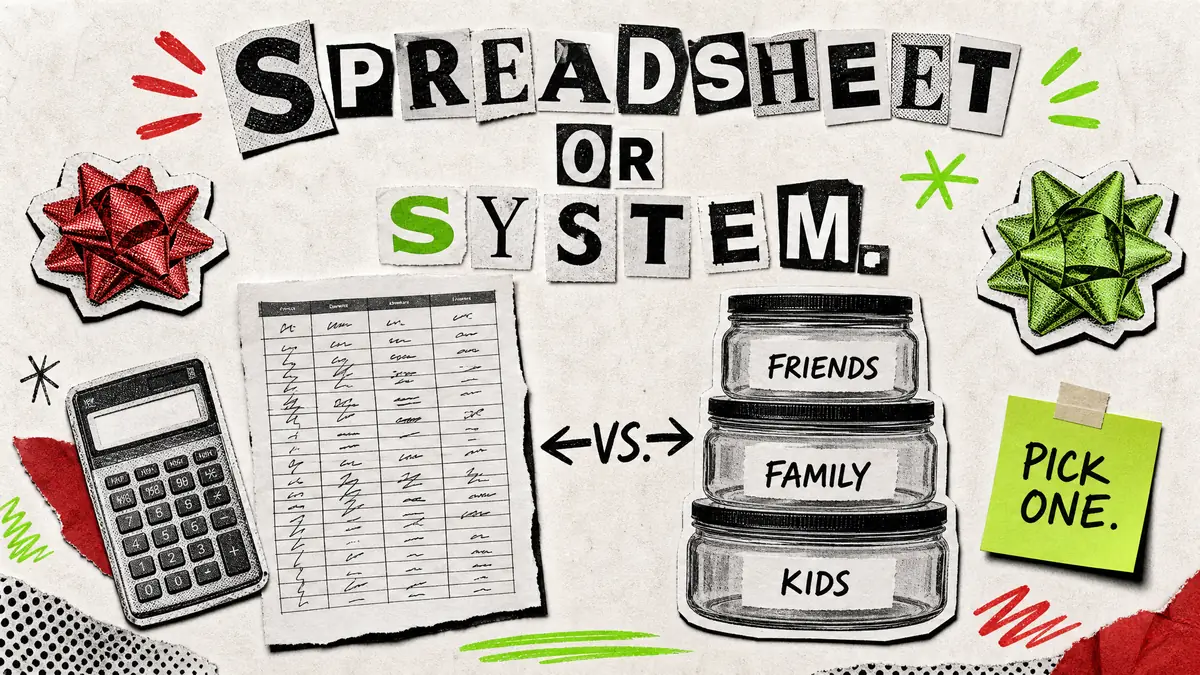
You have twelve people to shop for, a finite amount of money, and two reasonable ways to organize the damage: assign every recipient a budget, or use one holiday gift fund with spending tiers.
Neither method earns you a financial maturity badge. The useful question is how much individual planning your household actually needs.
For context, the National Retail Federation found that consumers planned to spend $890.49 on holiday items in 2025, including $627.93 on gifts for family and friends. Deloitte’s 2026 Holiday Retail Survey puts average planned seasonal spending at $1,654, including retail goods and holiday activities. Different surveys, different baskets. Neither number is your assignment.
Your assignment is choosing a workable plan and putting actual money behind it.

TL;DR
- Use a spreadsheet when individual gift budgets vary widely.
- Use one fund with recipient tiers when repeated rules save you useful planning time.
- Either method needs a funded holiday sinking fund, an overall ceiling, and a way to track purchases.
The spreadsheet method: give every name a number
List every recipient. Assign each a dollar amount. Sum the column. Adjust until the total fits money you can set aside. Then shop within each line.
Keep the sheet useful: recipient, planned amount, actual spending, gift idea, purchased. Add delivery status if packages regularly enter your house and disappear into a closet dimension.
The strength is deliberate variation. Your mother-in-law might get a $150 gift because you agreed to contribute toward something substantial. Your nephew might get $25 because his requested dinosaur costs $19 and makes a noise nobody needed.
Those differences stay visible instead of getting flattened into a universal family allowance.
For each person, treat the amount as a checkout ceiling, including applicable tax and delivery. A $75 item with extra charges does not fit a $75 line. Arithmetic remains annoyingly literal.
If one gift comes in under budget, you can leave the difference unspent. If another needs more, change the allocations before buying and preserve the total. The cells can move. The money still has to exist.
For shared shopping, agree on the amounts together. The Forbidden Conversation: How to Talk About Money Without Starting a Fight helps with the conversation behind the cells, especially when each side of the family has different expectations.
The cost is maintenance. Someone updates purchases, checks remaining allowances, and notices that you both bought Uncle Martin socks.
The system method: fund one pot, shop by tiers
Here, you keep one holiday gift sinking fund and a short rule card. For example:
- All friends: up to $40 each.
- Immediate family: $75–$150, with a chosen default cap.
- Kids: up to $100 each.
- Partner: discretion within an agreed reserve and the overall fund.
These are example household choices, not researched standards of generosity. Change every number if your life calls for it.
Make the family range operational. Choose $100 as your default; discuss exceptions up to $150 before purchasing. Otherwise, a range is an invitation for every appealing sweater to qualify for the maximum.
“Partner discretion” also needs a boundary. You can keep the gift secret while agreeing how much money is available. Romance survives a ceiling. The surprise can be the present.
Count recipients by tier, calculate the maximum allocation, and check it against your fund. Three friends at $40 need $120. Four kids at $100 need $400. Rules without headcounts are decorative.
During shopping, check three things: the recipient’s cap, what you have already spent on them, and the uncommitted fund balance. Caps cover all their gifts combined, including checkout costs.
You still need a shared purchased list to prevent duplicates. You can skip twelve bespoke spending decisions when the same few rules already fit.
If you find something excellent below the cap, stop there. Nobody is conducting a forensic audit of your affection through the retail value of a scarf.
Side by side: the same twelve people
The spreadsheet buys precision with planning time. The system reduces repeated decisions by accepting broader allocations.
| Dimension | Spreadsheet | System | Winner |
|---|---|---|---|
| Very different recipient budgets | Sets an individual amount for everyone | Needs exceptions to its tiers | Spreadsheet |
| Similar spending across recipients | Repeats similar decisions across rows | Reuses a few caps | System |
| Planning overhead | More individual setup and updates | Fewer allocation decisions | System |
| Visibility into individual tradeoffs | Shows each allocation and actual amount | Requires checking purchases against caps | Spreadsheet |
| Duplicate purchases | Purchase status can catch them | A shared purchased list can catch them | Tie |
| Actually paying for gifts | Needs money behind the total | Needs money behind the total | Funded sinking fund |
Here is an illustrative twelve-recipient household under both methods. Each column allocates $1,000, including gift checkout costs. The system uses a $100 family default and an $80 partner reserve.
The system column expands the rules for comparison; you would not need this table to run it.
| Recipient | Spreadsheet allocation | System cap or reserve |
|---|---|---|
| Friend Alex | $30 | $40 |
| Friend Sam | $40 | $40 |
| Friend Jo | $50 | $40 |
| Your mother | $75 | $100 |
| Your father | $75 | $100 |
| Mother-in-law | $150 | $100 |
| Father-in-law | $150 | $100 |
| Your older child | $150 | $100 |
| Your younger child | $100 | $100 |
| Niece | $25 | $100 |
| Nephew | $25 | $100 |
| Partner | $130 | $80 |
| Total gift allocation | $1,000 | $1,000 |
Same total. Different fit.
The spreadsheet accommodates bigger in-law gifts and small gifts for the niece and nephew. The system leaves more room for those children while squeezing the in-laws and partner.
Those caps are permissions, not spending targets. You can still buy the $25 dinosaur under a $100 cap. But if those differences recur across your list, individual allocations may describe your plans more honestly.
Neither column measures love. Otherwise, the clearance aisle would constitute a family scandal.

Who each method fits
Choose the spreadsheet when your household has meaningful differences between recipients: big gifts on one side, stocking stuffers on the other, a shared contribution for one parent, books for another.
It also fits when you enjoy detailed planning or want to see exactly what increasing one person’s allowance takes from elsewhere. You are allowed to like spreadsheets. Conditional formatting has its people.
Choose the system when most recipients naturally fall into a few spending bands and another planning task would cost more attention than it saves.
Maybe every friend gets a small gift, every child gets roughly the same allowance, and the adults have agreed on modest exchanges. Twelve separate budget negotiations would add little.
Ask yourself: would individual amounts materially change what you buy? Then ask who will maintain them during a busy week.
If the detail helps, use it. If you keep abandoning the sheet while faithfully following three caps, that is useful evidence about your needs.
You can also keep tiers for friends and kids while individually budgeting two unusual gifts. Nobody revokes your budgeting license. Which Budgeting Method Is Right for You? applies the same question to the rest of your money: what fits your life now?
Fund the plan before the wrapping starts
Both methods require a holiday sinking fund to turn the plan into paid-for gifts. That is money deliberately set aside for the coming expense, whether you track it in a separate savings pot or as an earmarked balance.
For the example, add a $100 reserve for wrapping supplies and agreed additions to the list. Your funding target becomes $1,100. The reserve does not automatically increase anyone’s cap.
Ten deposits of $110, January through October, would fund that target before November shopping. Sinking Funds Explained: The One Habit That Makes ‘Surprise’ Expenses Disappear walks through setting up the habit.
Starting now? Subtract what you already have, then divide the gap by the paychecks arriving before your purchase dates. With $700 saved and two paychecks remaining, the $400 gap needs $200 from each.
If that does not fit, reduce the list or allowances. A funding gap is information you can act on before checkout.
Use your shopping dates as deadlines. Looking back at 2025, Bank of America Institute reported strong holiday-item spending in October and November, followed by a slowdown around Black Friday and Cyber Monday. Your gifts may need funding well before December’s paycheck arrives wearing a Santa hat.
As you buy, record spending and reduce the available fund balance. If you pay by card, earmark the corresponding cash for payment. The purchase has already used that money, even while the bank balance looks festive.
Next year, keep what worked and change what became a chore. A new baby, different income, or smaller gift exchange can justify a different method.
Pick the method you’ll actually run. The other method is fan-fiction.

 Forbidden Finance