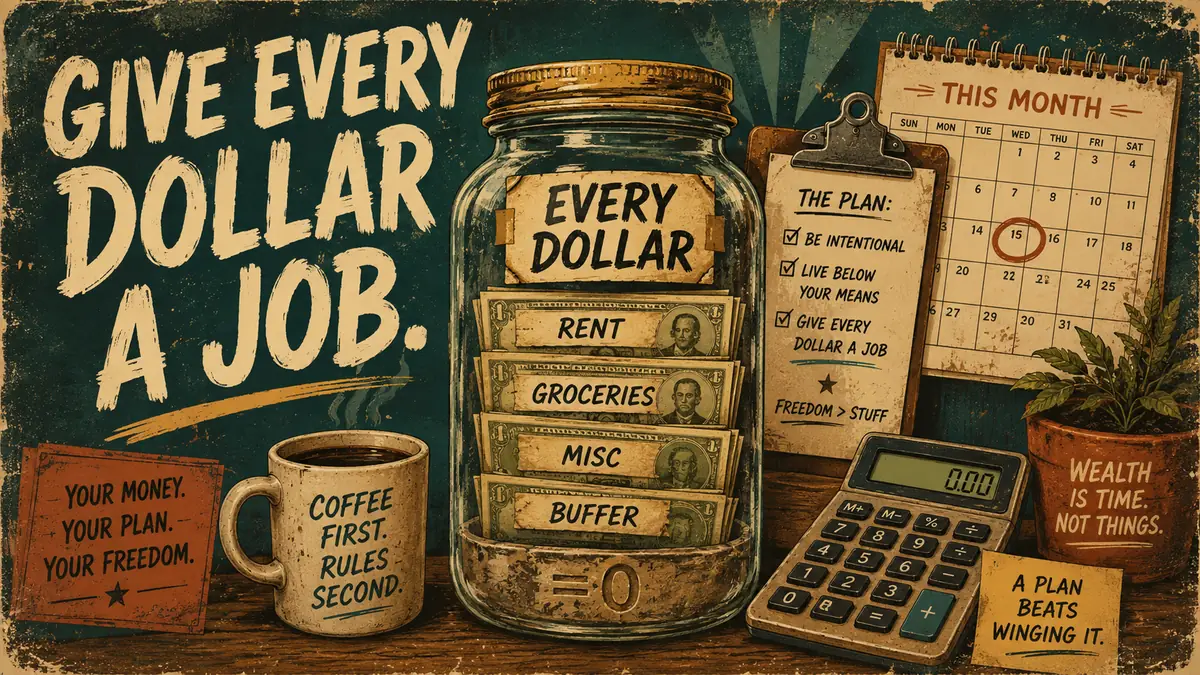
$4 over on groceries should not make you feel like you failed at adulthood.
That is the tiny horror movie version of zero-based budgeting: you buy spinach, chicken, and the crackers you swear are for the kids, then the grocery category goes red by less than the price of parking. Suddenly the budget looks accused, you feel accused, and some finance monk on the internet is spiritually ringing a bell at you.
Forbidden take: the budget is not a moral court. It is a plan. Plans need margins, because humans need food, cars make noises, and shampoo runs out on the same day as printer ink. The calmer version of zero-based budgeting still gives every dollar a job. It just allows one of those jobs to be "stand here and catch nonsense."
Self Financial found in its February 2025 household budgeting survey that 62.3% of respondents said budgeting caused or increased stress, and 51.1% said it caused or increased anxiety. So if zero-based budgeting makes your shoulders climb toward your ears, you are not defective. You may just be running it like a weekly audit instead of a monthly operating system.
TL;DR
• Zero-based budgeting means income minus assigned dollars equals 0, calmly, before the month begins.
• Monthly ZBB works better for most people than weekly budget interrogation.
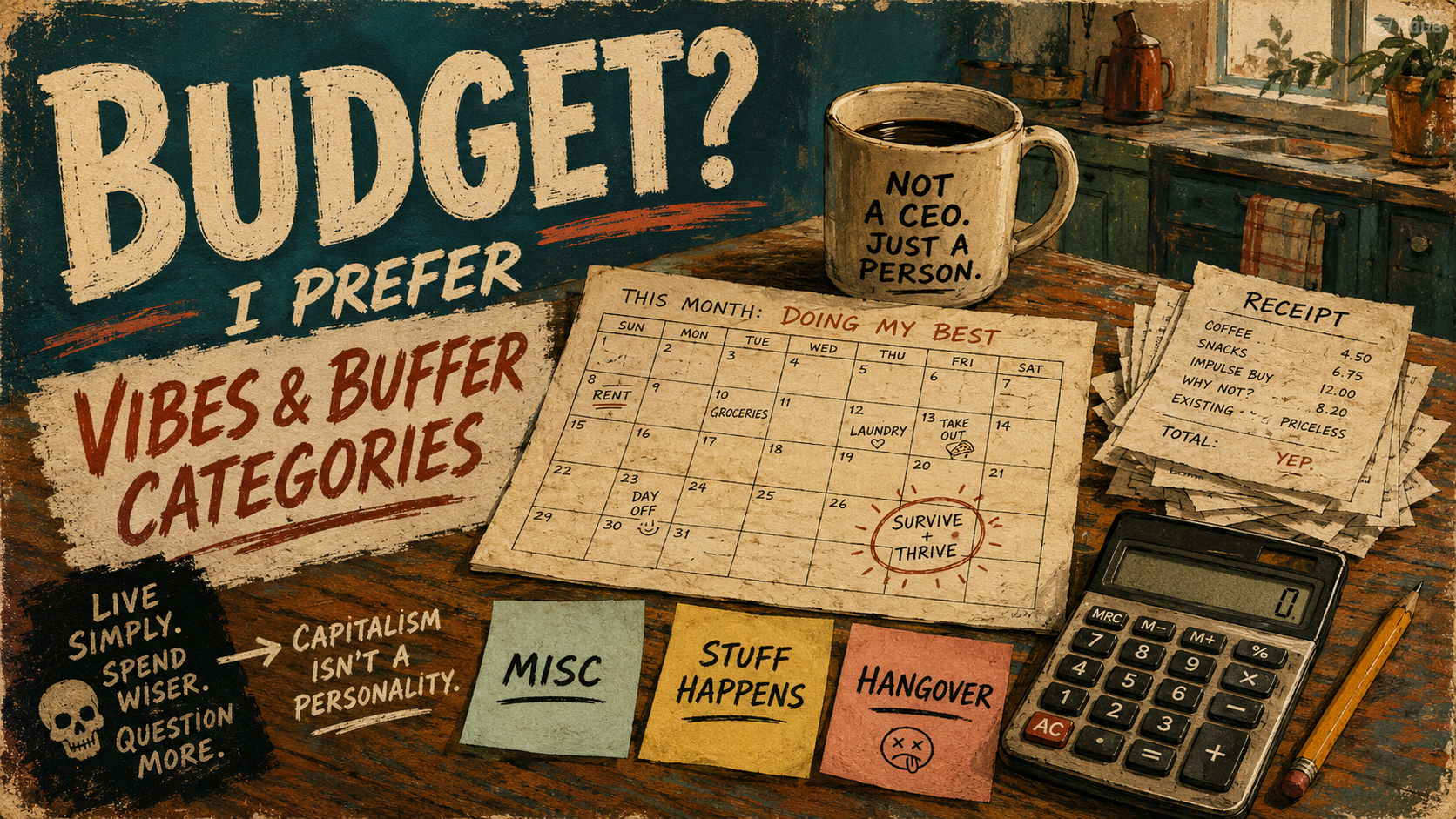
• Buffers and rollovers are not cheating. They are the forbidden little shock absorbers.
The Calm Version of Zero-Based Budgeting
The core mechanic is boring, which is good. Boring is underrated. Boring pays the electric bill.
Zero-based budgeting means:
Income - assigned dollars = 0.
If you bring home $4,800 this month, you assign all $4,800 before the month starts. Rent gets a job. Groceries get a job. Savings gets a job. Debt payoff gets a job. Fun money gets a job. Buffer money gets a job. Nothing floats around unnamed like a mysterious charge from a streaming service you thought you canceled in 2022.
The mistake is thinking "assigned" means "spent." It does not. Assigning $300 to car insurance savings is not spending $300. Assigning $100 to a buffer is not wasting $100. It is giving the money a job you will be glad exists when the school fundraiser, oil change, and sad desk lunch all happen in the same week.
This is why zero-based budgeting lives close to behavioral economics. Richard Thaler described mental accounting as the way people organize, evaluate, and track financial activity, including grouping spending into categories. In plain English: your brain already creates little money buckets. ZBB just labels them before chaos labels them for you.
Also, the categories are not imaginary in the real world. The BLS Consumer Expenditure Survey reported that average annual expenditures for U.S. consumer units were $78,535 in 2024, with housing at 33.4%, transportation at 17.0%, and food at 12.9% of total spending. Your budget is not dramatic for having big fixed costs. It is accurately noticing that rent has been eating protein powder.
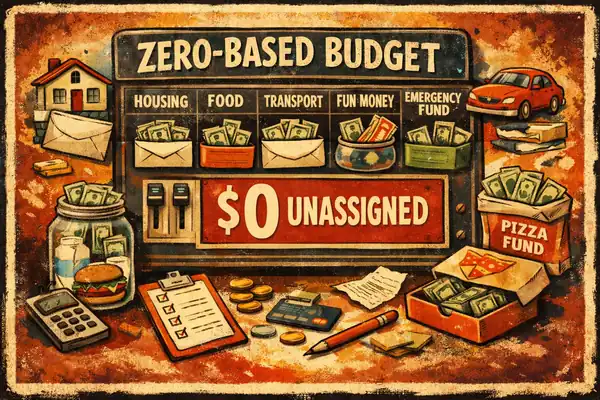
If you want the traditional version first, start with Zero-Based Budgeting: Give Every Dollar a Job (and Yes, "Pizza Fund" Counts). This post is the softer sequel: fewer purity tests, more survivable mechanics.
Run It Monthly, Not Like a Weekly Interrogation
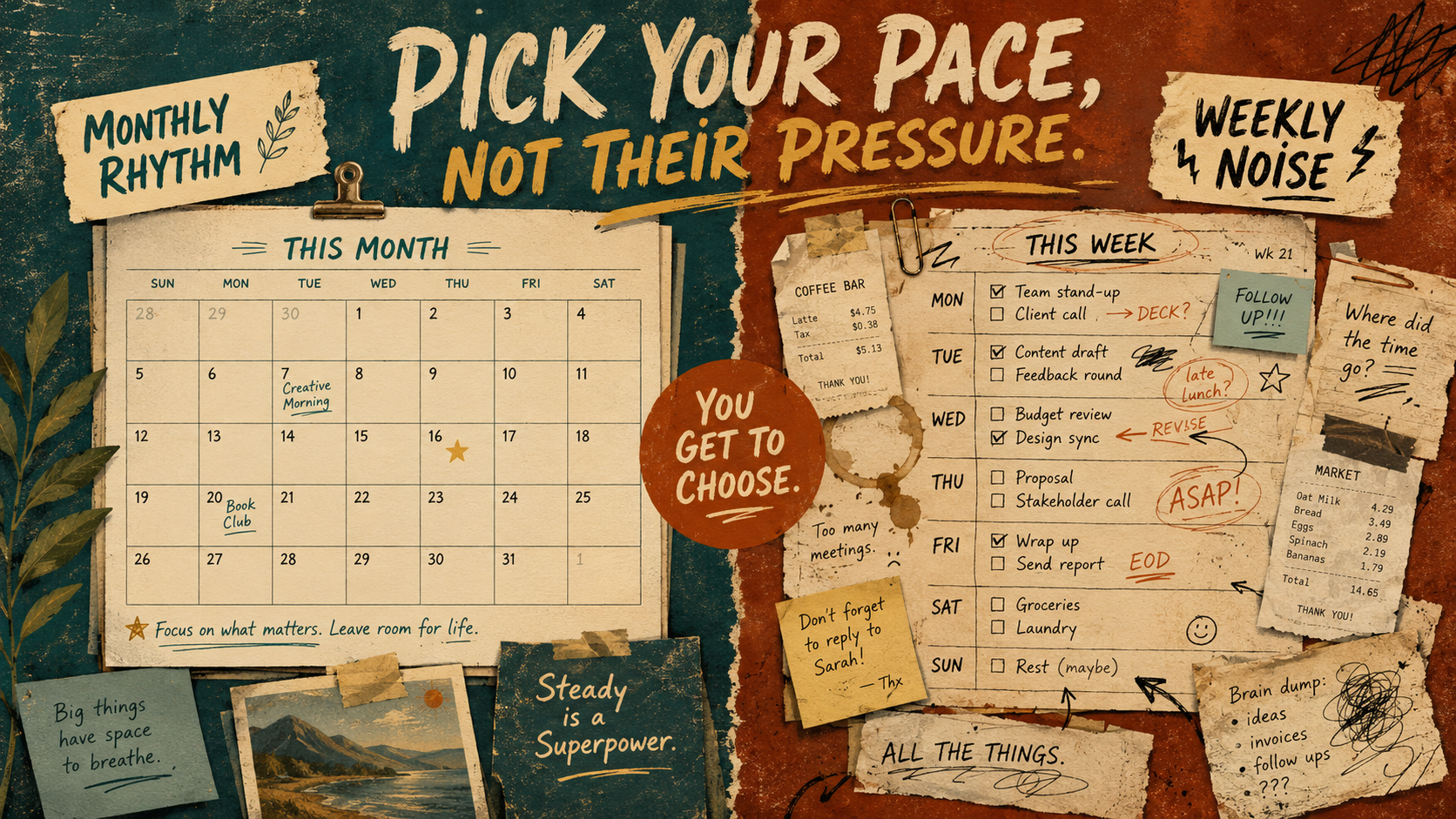
Weekly zero-based budgeting sounds responsible until it turns into a Sunday night fight with your grocery receipt. "Why did we spend $18 on berries?" Because berries exist for 11 edible minutes and children know this.
Monthly ZBB is usually calmer because most bills, pay cycles, subscriptions, rent, mortgage payments, and insurance drafts already think in months. The Federal Reserve uses end-of-month margin as a meaningful household finance signal; in the 2025 SHED, 41% of adults said they always or often had money left over at the end of the month. The month is where a lot of money reality shows up.
YouGov found that 53% of U.S. adults had set a budget for 2026, up from 46% who said they had one in 2025. That does not mean everyone wants a spreadsheet with the emotional temperature of airport security. It means people want a plan that can survive a normal month.
| Cadence | Pros | Cons | Who It's For |
|---|---|---|---|
| Weekly ZBB | Fast feedback, tighter category control, useful for short-term spending resets. | More check-ins, more category shuffling, more chances to treat a tiny overage like a felony. | People paid weekly, people in a temporary debt sprint, or anyone rebuilding trust with their numbers. |
| Monthly ZBB | Matches most bills, reduces decision fatigue, makes rollovers easier, gives buffers time to work. | Requires a little patience, and you may need a mid-month glance if cash flow is tight. | People with mostly stable income, recurring bills, sinking funds, and a low tolerance for budget theater. |
Build Buffers on Purpose
A buffer category is not a confession that you are bad at budgeting. It is a confession that life has elbows.
The rigid-ZBB crowd sometimes treats buffers like contraband. Every dollar must have a sacred, perfectly named purpose. Fine. Name the buffer. Now it has a purpose. Forbidden Finance loophole, legally binding in the court of common sense.
Buffers work because they absorb normal variance without forcing you to raid real categories. Groceries run over by $4? Pull from buffer. Friend has a birthday dinner? Buffer. The kid needs poster board at 8:47 p.m.? Buffer, plus a small prayer to the office supply aisle.
Good buffer categories are specific enough that you know why they exist, but broad enough that you are not creating 47 tiny panic buckets.
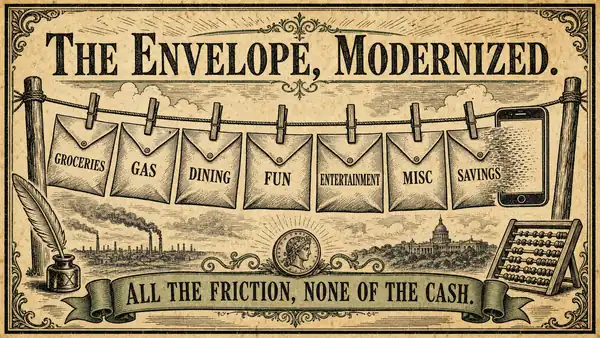
- Misc: tiny uncategorized spending that is not worth a committee meeting.
- Stuff Happens: parking fees, school supplies, one-off household things, replacement phone charger.
- Hangover: recovery money after holidays, weekends away, weddings, birthdays, and other socially sanctioned budget crimes.
- Groceries Overflow: for months when food prices, guests, or appetite reality beat the original number.
- Household Restock: detergent, toothpaste, paper towels, batteries, and the other items that vanish at once.
- Admin Nonsense: fees, postage, document copies, parking tickets, and anything involving a form.
Start with one general buffer if your budget is new. Try $50 to $150 if money is tight, or 2% to 5% of take-home pay if you have room. The exact number matters less than the habit: you are planning for variance before it arrives wearing shoes inside.
The goal is not to make overspending impossible. The goal is to make normal overspending boring.
Rollover Rules Stop the Restart Spiral
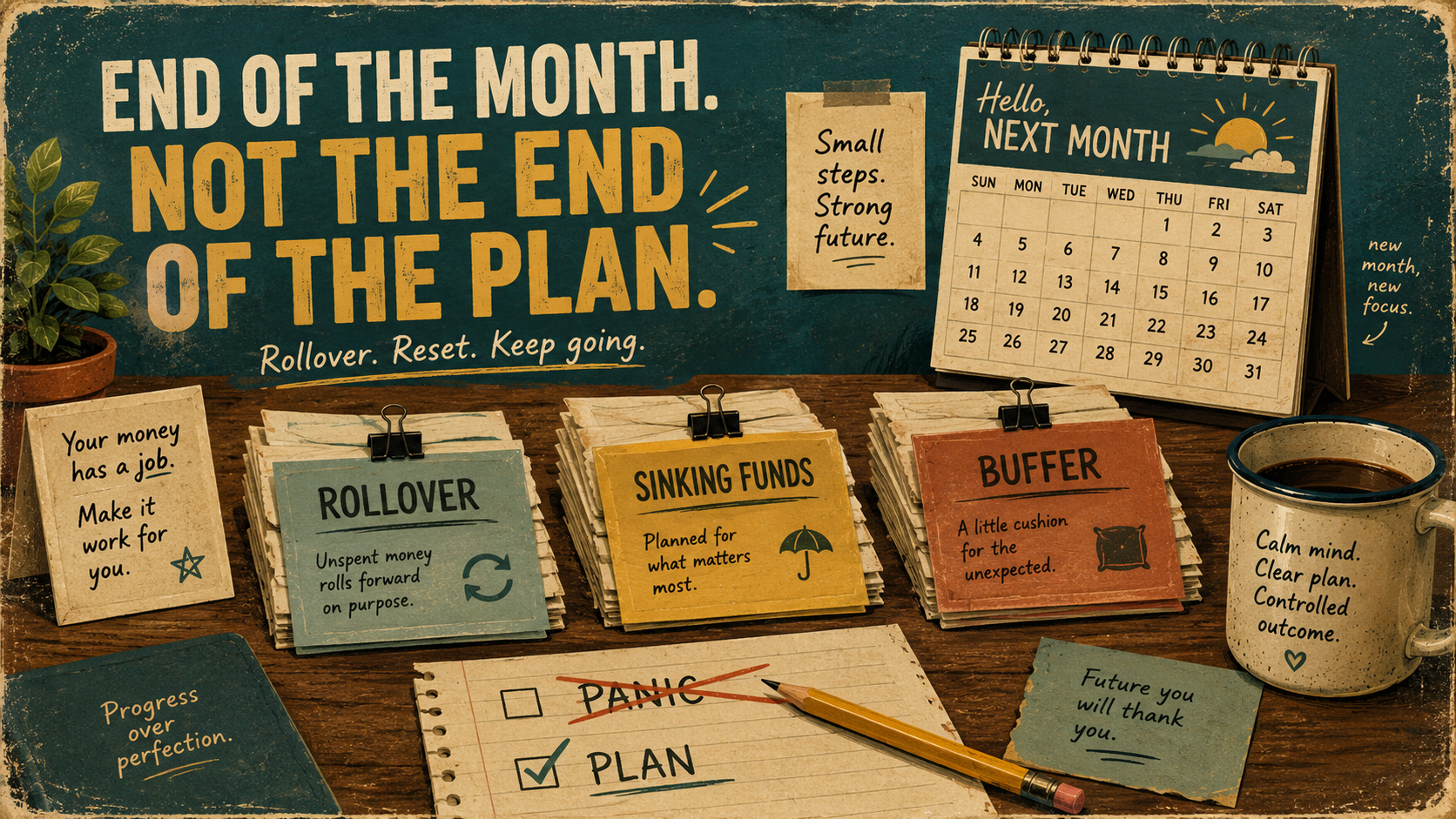
Rollover rules are where zero-based budgeting becomes humane.
Without rollovers, every month feels like a cliff. You overspend groceries by $4, and the budget looks broken. You underspend gas by $38, but the money disappears into the fog. The system has no memory. Very dramatic. Very annoying.
With rollovers, unused category money carries into the next month if you decide it should. Overspending can also roll forward if that makes more sense than raiding another category immediately. This is not cheating. This is accounting with a pulse.
Use three rollover rules:
1. Hard Rollover
Use this for categories where unused money should build up because the expense is uneven.
Examples: car maintenance, medical copays, pet care, gifts, clothing, home repairs, annual subscriptions.
If you put $75 into car maintenance and spend $0, next month starts with $75 already there. Add another $75 and now the category has $150. Congratulations, your future tire is less rude.
2. Soft Rollover
Use this for categories where leftovers can roll, but only up to a cap.
Examples: groceries, dining out, fun money, personal spending.
Maybe groceries can roll up to $150 over the base amount, but anything above that gets swept into savings or debt payoff. This keeps categories flexible without letting "snacks" become a suspiciously well-funded institution.
3. No Rollover
Use this for categories you want to reset every month.
Examples: impulse spending, convenience food, random online shopping, or any category where extra balance turns into "I guess I have to use it."
Some money needs a bedtime.
If you want the broader budget-fit question, Which Budgeting Method Is Right for You? is the place to compare ZBB against the other methods without pretending one spreadsheet rules them all.
Sinking Funds Are Not Optional Side Quests
Sinking funds are the reason monthly ZBB works without monthly panic.
A sinking fund is money you set aside over time for a known future expense. Not an emergency. Not a surprise. A bill wearing a fake mustache.
Car registration is not a surprise. Holiday gifts are not a surprise. Annual insurance premiums are not a surprise. The fact that tires eventually become smooth circles of danger is not a surprise. We act surprised because the expense is not monthly, so the budget forgets it exists.
The Federal Reserve reported that most adults had at least one major unexpected expense in the prior 12 months, with major vehicle repair or replacement the most common. Some expenses really are unexpected. Many are just irregular. ZBB should separate those two, because otherwise your emergency fund gets mugged by predictable life.
Use sinking funds for:
- Car maintenance and registration
- Home repairs and appliance replacement
- Medical and dental costs
- Insurance premiums
- Holiday gifts
- Travel
- School costs
- Pet care
- Clothing refreshes
- Annual software, memberships, and subscriptions
Simple math: if car registration is $240 due in six months, assign $40 per month. If holiday gifts usually run $600 and December is five months away, assign $120 per month. No speech about discipline required. Just arithmetic in a trench coat.
For a full setup, read Sinking Funds Explained: The One Habit That Makes 'Surprise' Expenses Disappear. Sinking funds and ZBB are excellent roommates: one assigns the money, the other tells future expenses to stop jumping out from behind furniture.
What to Do When You Overspend a Category
The anxiety spiral starts when a category goes red and you treat it like a character flaw. Don't. A red category is information. Slightly irritating information, but still information.
Use this order:
1. Check Whether It Was a Timing Problem
Did you buy a month's worth of groceries at once? Did a bill hit early? Did a subscription renew on June 30 instead of July 1 just to be annoying?
If yes, leave the category alone and let the month finish. Budgets hate timing weirdness. Banks love it. Nobody asked banks.
2. Pull From the Matching Buffer
Groceries over by $4? Pull from groceries overflow or misc. Dining over by $22? Pull from hangover. School thing? Stuff Happens.
This keeps the correction close to the problem. You are not raiding rent because tacos happened.
3. Move Money From a Flexible Category
If the buffer is empty, pull from a flexible category before touching savings or sinking funds.
Flexible categories include dining, entertainment, personal spending, convenience purchases, and fun money. Yes, fun money counts. No, you do not have to sacrifice joy every time lettuce gets expensive.
4. Roll It Forward If That Is Cleaner
If the overage is small and the month is almost over, roll it into next month. Then reduce that category by the same amount.
Example: groceries are over by $18 on July 29. Rather than perform budget surgery, start August groceries at $18 less. Calm. Legal. Nobody faints.
This is how you avoid the "I overspent by $4, restart everything" spiral. The budget did not fail. It asked for an adjustment.
When ZBB Is the Wrong Method
Zero-based budgeting fits stable monthly income best. If your income is irregular, seasonal, commission-based, freelance-heavy, or held together by client invoices and vibes, ZBB can turn into a monthly guessing contest.
The Federal Reserve found that 30% of adults had income that varied at least occasionally in 2025, and among self-employed adults, 58% said income varied month to month. That matters. A method built around assigning this month's income before the month begins gets harder when this month's income refuses to RSVP.
If your income is irregular, try one of these instead:
- Income-floor budgeting: build the month around your lowest realistic income, then assign extra money only after it arrives.
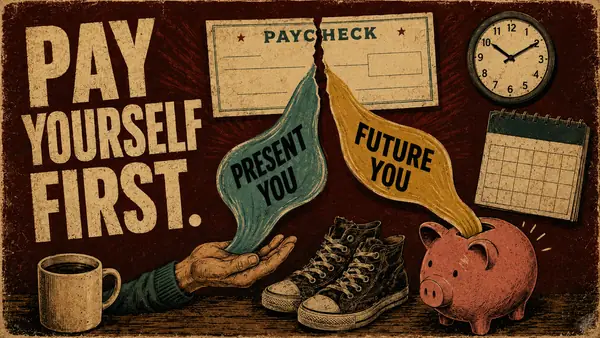
- Pay-yourself-first budgeting: automate the most important savings or debt move, then spend what remains with fewer categories.
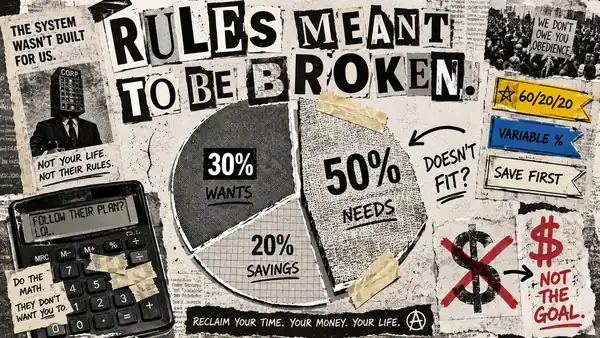
- 50/30/20 or ratio budgeting: use broad percentages when exact category planning creates more noise than value.
- Custom budgeting: combine rollovers, sinking funds, and a cash reserve without forcing every dollar through ZBB every month.
If tracking every category makes you want to fake your own disappearance, Pay Yourself First: The Forbidden Art of Not Tracking Every Latte may fit better. That is not failure. That is method selection.
Your Monthly ZBB Setup Checklist
Here is the practical monthly version. No incense. No shame gong.
1. Pick the Planning Date
Choose one monthly budget date, ideally two to five days before the new month starts. Put it on the calendar. Make it boring enough that you will actually do it.
2. List Confirmed Income
Use take-home income you are confident will arrive during the month. If income varies, use the conservative number. Optimism is lovely, but it does not pay rent until it clears.
3. Assign Fixed Bills First
Rent or mortgage. Utilities. Insurance. Minimum debt payments. Phone. Internet. Childcare. Anything with a due date and consequences.
4. Fund Sinking Funds
Add the monthly amount for each known future expense. This is where the budget stops pretending annual bills are surprise guests.
5. Fund Flexible Categories
Groceries, gas, dining, household, entertainment, personal spending. Keep these realistic. A grocery budget based on your fantasy self who meal-preps lentils every Sunday is fan fiction.
6. Fund Buffers
Add misc, Stuff Happens, and hangover money. If the month includes travel, holidays, weddings, back-to-school, or visitors, increase the buffer before you need it.
7. Assign the Rest
Anything left goes to savings, investing, extra debt payoff, more buffer, or a priority category. Then check the rule: income minus assigned dollars equals zero.
8. Do One Mid-Month Check
Not seven. One.
Look for categories that are already off track, move money calmly, and get out. Your budget is a tool, not a second job with worse snacks.
The Calm Part
Zero-based budgeting is not supposed to make you afraid of your own checking account.
Done badly, it becomes financial micromanagement with a color-coded hat. Done well, it is a monthly map: here is the money coming in, here are the jobs it needs to do, here is the margin for life being life.
Use monthly cadence. Use buffers. Use rollover rules. Use sinking funds. Skip the purity contest. The budget method that works is the one you will still be willing to open after a weird month, not the one that looks most impressive in a screenshot.
Every dollar gets a job. The job can be 'be a buffer.' That counts.
 Forbidden Finance