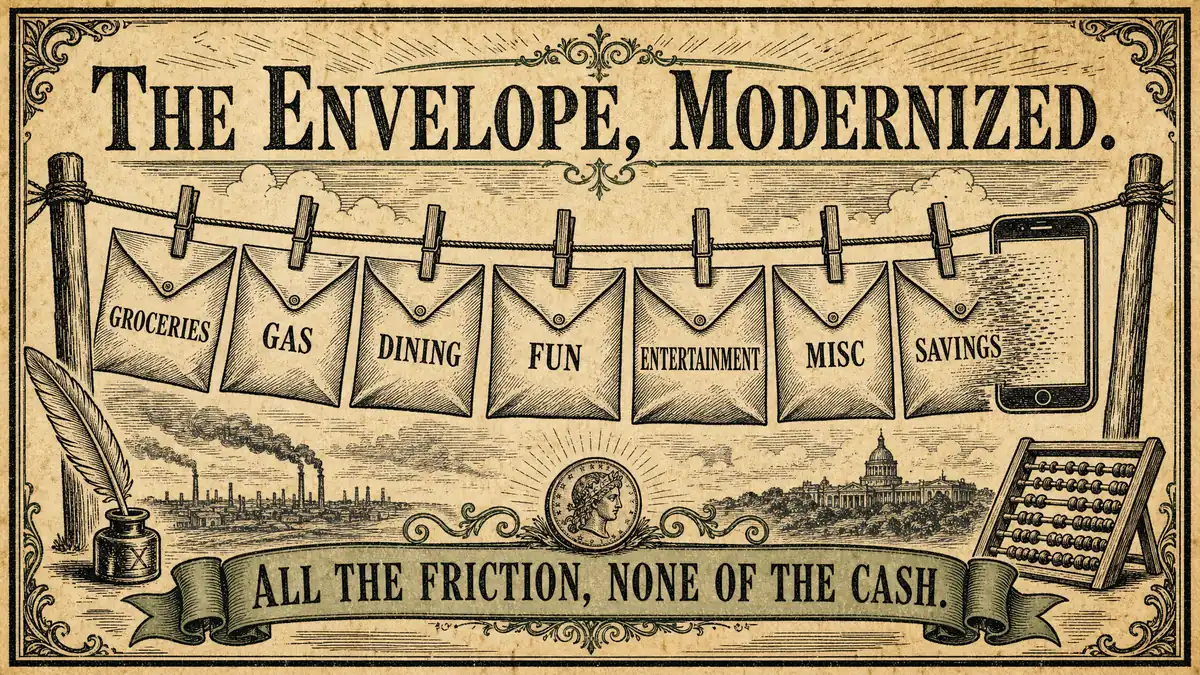
Cash-stuffing videos have a very specific texture: crisp bills, tiny binders, laminated labels, and the soothing sound of someone sorting twenties like they are operating a miniature Treasury Department from a kitchen table.
Is it a little theatrical? Yes. So is buying a $9 drink called “wellness water” because it has cucumber in it. Humans like rituals.
The point is not that cash-stuffing is silly. The point is that it works for some people because it makes money visible, limited, and annoying to spend. That is the entire magic trick. The good news: you can steal the trick without carrying $620 in a plastic binder next to your lip balm.
TL;DR
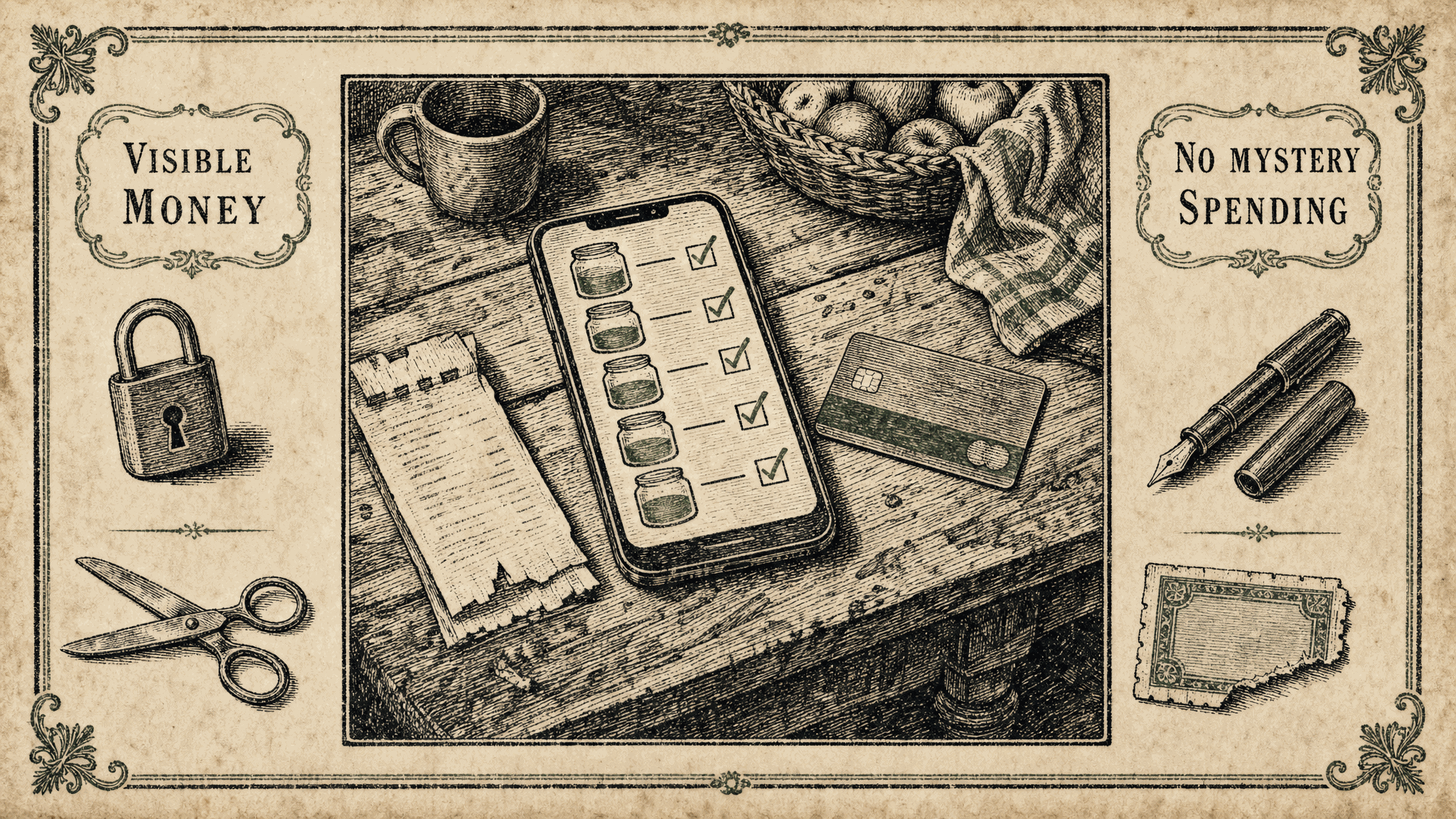
- Digital envelopes recreate cash-stuffing by giving every spending category its own visible balance.
- Rolling balances matter because the “empty envelope” rule only works if overspending has consequences.
- Use this if friction helps your brain; skip it if rewards cards already work cleanly for you.
Cash-Stuffing Is Not Silly. It Is a Friction Machine.
Cash-stuffing is the envelope method wearing better lighting. You withdraw cash, divide it into labeled envelopes, and spend only what is inside each one. Groceries gets $600. Dining gets $180. Fun gets $90, which is somehow both generous and insulting.
The viral version has binders, trackers, tiny stickers, and videos that make budgeting look like stationery ASMR. ABC News covered the trend in 2025 as a TikTok favorite, but the bones are old: separate the money before you spend it, then let each category run out in public where your brain can see it.
That last part is the whole system. It is not about worshiping paper money. It is about making “I have $47 left for restaurants” feel more real than “my checking account still has money in it, therefore sushi is legally required.”
The problem is that cash has become a weird fit for modern life. Rent is electronic. Subscriptions are electronic. Delivery apps are electronic. Your dentist may still mail paper forms, because dentistry apparently operates in 1998, but the bill is probably online.
The Federal Reserve Financial Services 2026 Diary of Consumer Payment Choice found that consumers made an average of 47 payments per month, with 16 by credit card, 15 by debit card, and six by cash. Cash still matters, but cards are doing most of the everyday lifting.
So the modern envelope question is simple: can you keep the spending friction without forcing your life through an ATM?
Yes. You just need better containers.
The Research: Cash Hurts, Except When It Doesn’t
The classic behavioral case for envelopes starts with the “pain of paying.” In plain English: spending money can feel unpleasant, and payment methods change how much you notice that unpleasantness. Cash is immediate. You hand over bills and they leave. Rude, but clear.
Drazen Prelec and George Loewenstein described this in their mental accounting work as payment “coupling.” Cash tightly connects buying and paying. Credit cards loosen that connection because consumption happens now and the bill arrives later, wearing a tiny villain cape.
Some later research supports the idea that payment transparency affects behavior. A 2024 study in the Journal of Economic Behavior & Organization found that cash payments produced more pain of paying than several electronic methods in its survey setting. A 2025 paper in Research in Economics also linked less transparent digital payment methods with overspending.
That does not mean cash is a magic financial vegetable. Eat it daily and your spending becomes pure. No.
The evidence is mixed. A replication study in the Journal of Retailing and Consumer Services did not replicate the traditional credit-card effect across several experiments and found that the effect may be weaker than older studies suggested. Another field experiment by Elif Incekara-Hafalir and George Loewenstein found that credit cards did not increase overall spending in their field experiment.
Translation: physical cash can change spending behavior for some people in some contexts. It is especially useful when it makes tradeoffs visible before you buy. But the paper bills are not sacred. The useful ingredients are visibility, separation, limits, and friction.
That is what digital envelopes try to copy.
How Digital Envelopes Work
A digital envelope budget takes your real money and assigns it to separate jobs. Instead of one checking balance sitting there like a giant permission slip, you create category balances: groceries, restaurants, gas, personal care, clothing, gifts, household chaos, whatever category keeps ambushing you at 9:47 p.m.
There are two main ways to build it.
First, you can use actual sub-accounts. Some banks let you create multiple checking or savings buckets. One account for bills. One for groceries. One for spending. One for sinking funds. This is the account-architecture version, and it pairs nicely with The Two-Account Rule: Why Most Households Need at Least Two Banks (and Sometimes Five).
Second, you can use virtual envelopes inside a budgeting app. The money may sit in one bank account, but the app shows category-level balances. Economically, the dollars are pooled. Psychologically, they are fenced. Tiny budget livestock, basically.
The key is category-level caps. A useful digital envelope does not merely tell you that you spent $312 on dining after the damage is done. It tells you that your dining envelope started at $250, now has $38 left, and one more “quick bite” will turn into the financial equivalent of opening a cabinet and finding only one stale cracker.
This is why digital envelopes are closer to Envelope Budgeting: Your Grandma Was Right (But You Don’t Need Actual Envelopes) than to normal expense tracking. Expense tracking is a mirror. Envelope budgeting is a fence.
Physical Cash-Stuffing vs. Digital Envelopes
Physical cash-stuffing gives you the most tactile version of the method. Digital envelopes give you the more livable version. Neither wins universally. Personal finance people hate that sentence because it refuses to become a commandment.
| Feature | Physical cash-stuffing | Digital envelopes |
|---|---|---|
| Spending friction | Very high. You physically remove bills and watch the pile shrink. | Medium to high. The category balance shrinks, but you need to check it. |
| Best fit | In-person variable spending like groceries, dining, beauty, and cash gifts. | Card spending, online purchases, shared households, and recurring bills. |
| Hard stop | When the envelope is empty, you are done unless you raid another envelope. | When the category hits zero, future spending must wait, roll negative, or be moved from another category. |
| Records | Manual unless you write every purchase down. | Automatic or semi-automatic, depending on the app and bank connection. |
| Rewards | Usually none. | Can preserve card rewards if you pay the statement in full. |
| Security | You may be storing or carrying cash. | Money stays in the banking system, with the usual boring login rituals. |
| Vibe | Extremely satisfying. Tiny labels. Big feelings. | Less cinematic, more sustainable for people who buy things online. |
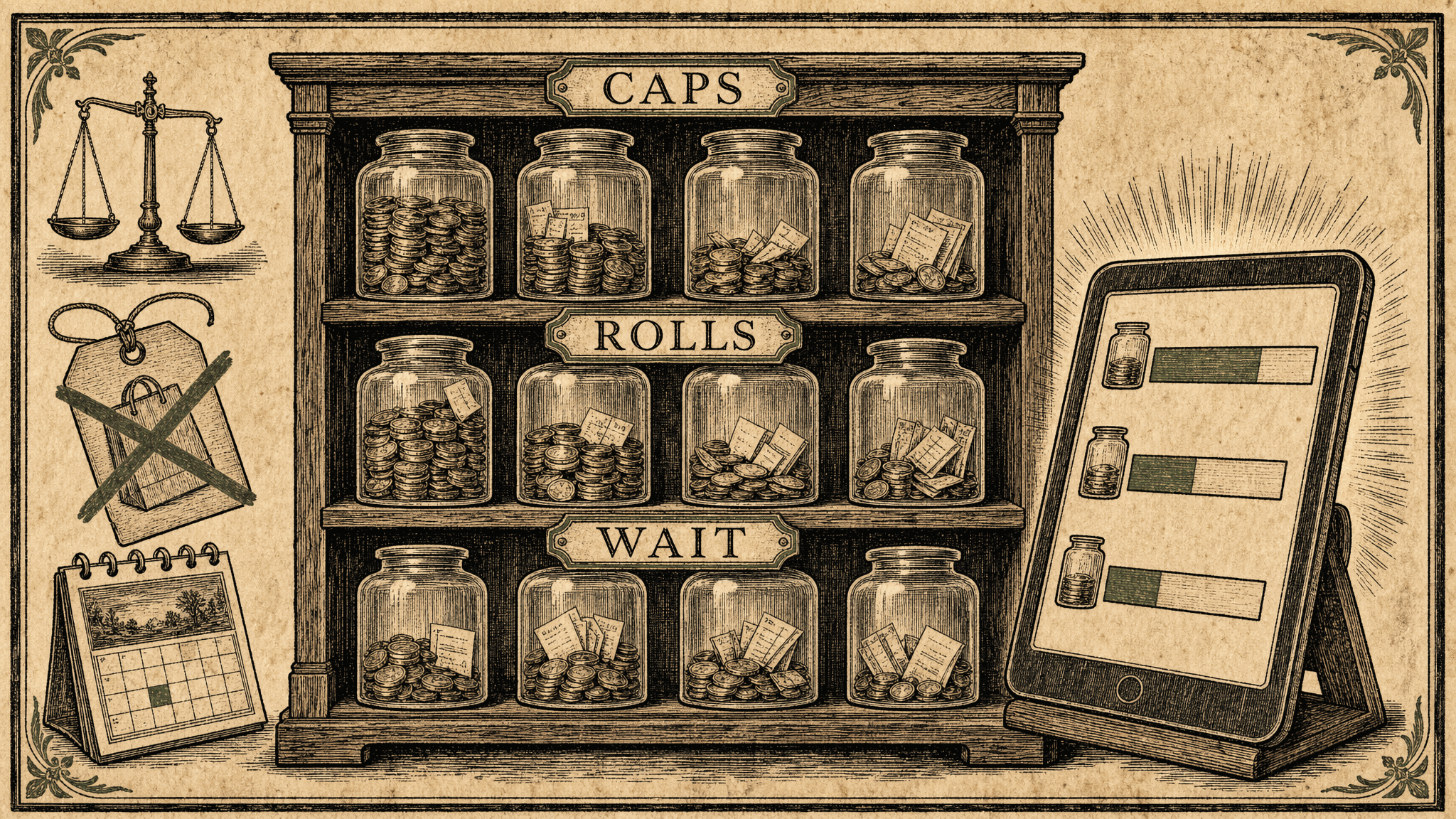
The modern version gets powerful when balances roll.
If your grocery envelope has $600 and you spend $545, the leftover $55 should not vanish into spreadsheet mist. It rolls forward. Next month groceries starts with $655, or you sweep the $55 into debt payoff, savings, or another category.
If you overspend, the opposite happens. Spend $640 on a $600 grocery cap, and next month starts at $560 unless you cover the $40 from somewhere else. That negative roll-forward is what recreates the “empty envelope” hard stop. It makes the tradeoff visible instead of letting overspending dissolve into a checking account fog.
This is also where sinking funds fit. Car repairs, holidays, back-to-school spending, and annual insurance bills do not care that you prefer monthly predictability. They arrive wearing boots. A digital envelope can hold those lumpy categories month after month, which is the same muscle behind Sinking Funds Explained: The One Habit That Makes ‘Surprise’ Expenses Disappear.
Build Your Digital Envelope System
Do not start with 38 categories unless your hobbies include reorganizing spice drawers by emotional significance. Start small. The goal is enough structure to change behavior, not enough structure to make you fake your own disappearance.
1. Name Every Envelope
Use categories where choices happen. Rent is not usually an envelope problem. Rent is rent. The messier categories are groceries, restaurants, bars, coffee, clothing, personal care, kids, hobbies, gifts, home supplies, and “Target, somehow.”
Five to nine envelopes is plenty for month one. You can add detail later if the system earns it.
2. Fund Them From Real Income
On payday, assign money to envelopes before you start spending. This can be literal transfers into sub-accounts or virtual allocations inside your app.
Do not budget with imaginary money from future-you, a person with suspicious optimism and no receipts. Use cleared income. If your income is variable, fund the essentials first, then fill flexible categories in priority order.
3. Set Category-Level Caps
Caps should be based on reality, not vibes. Look back at the last two or three months. If you spent $780 on groceries, setting the envelope at $400 is not discipline. It is fan fiction with a calculator.
Pick a cap that creates a little tension. Tension is useful. Panic is not.
4. Decide the Empty-Envelope Rule
Before the month starts, choose what happens when a category hits zero.
You can stop spending in that category. You can move money from another envelope. You can allow the category to roll negative into next month. All three are valid. The forbidden move is pretending nothing happened and calling it “flexibility” because the word sounds mature.
A good default: needs can borrow, wants must wait. Groceries can pull from restaurants. Restaurants cannot pull from rent. Civilization continues.
5. Review Weekly, Not Constantly
Check envelopes once or twice a week. Daily checking can help at first, but if your budget starts feeling like a needy houseplant, you will stop watering it.
Weekly is enough to catch the drift. Friday is useful because weekend spending has a personality.
Who Should Use This, and Who Should Skip It
Digital envelopes are best if you tend to impulse-spend, lose track of category totals, or need a tactile-feeling system without the actual cash. If your brain responds to visible limits, this method gives it something to push against.
It is also good if you have a few categories that keep causing problems. You do not need to envelope your entire life. You can envelope only the chaos zones. Groceries. Dining. Clothes. Kids’ activities. Home improvement, also known as “we went in for light bulbs and left with a patio fantasy.”
Skip it if you are a high-volume rewards-card user who pays in full, tracks spending cleanly, and would give up meaningful cash-back just to use paper bills. The Federal Reserve Financial Services diary shows credit and debit cards now account for about two-thirds of consumer payments, so designing a budget that fights your actual payment life can get tedious fast.
Also skip full-envelope mode if you hate detail. You may be better off with Pay Yourself First: The Forbidden Art of Not Tracking Every Latte or the broader decision guide, Which Budgeting Method Is Right for You?. The right method is the one you will still run after the novelty leaves and the laundry returns.
That is the larger point. Envelope budgeting is one of eight methods Forbidden Finance supports because different brains need different rails. Some people need hard category walls. Some need automation. Some need a custom budget because every prebuilt system makes them itchy.
Cash-stuffing gets mocked because it looks quaint. But quaint is not the same as dumb. A physical envelope says, “This is the money.” A digital envelope says the same thing with fewer ATM trips and less risk of losing your grocery budget under a car seat.
The envelope was always a metaphor. Pick the metaphor that works for your brain.
 Forbidden Finance