Intro: Five Banks, Five Versions of Your Month
Five bank accounts is not chaos. Five bank accounts can be a system.
One checking account for bills. One joint account for household stuff. One high-yield savings account that does not make you sad. One old credit union account you keep because the ATM is convenient. One side-hustle account where invoices go to sit dramatically until rent asks for attention.
That is not weird. The CFPB says there are no restrictions on how many checking or savings accounts, or how many banks and credit unions, you can use. The problem is not having multiple accounts. The problem is trying to understand them through five separate apps, each acting like it is the main character.
The FDIC found that just 4.2% of U.S. households were unbanked in 2023, and almost half of banked households used mobile banking as their primary way to access accounts. Meanwhile, the Federal Reserve Bank of Atlanta reported that consumers made an average of 47 payments per month in 2025. That is a lot of taps, swipes, bills, transfers, snacks, parking meters, and mysterious drugstore purchases that are somehow always $34.
If your money lives in more than one place, your tracking system has to live above the banks. Not inside one of them. If you are still deciding whether multiple banks make sense, start with The Two-Account Rule: Why Most Households Need at Least Two Banks (and Sometimes Five). If you are already there, welcome. The forbidden move is not simplifying your life by closing useful accounts. It is refusing to let every bank app define reality.
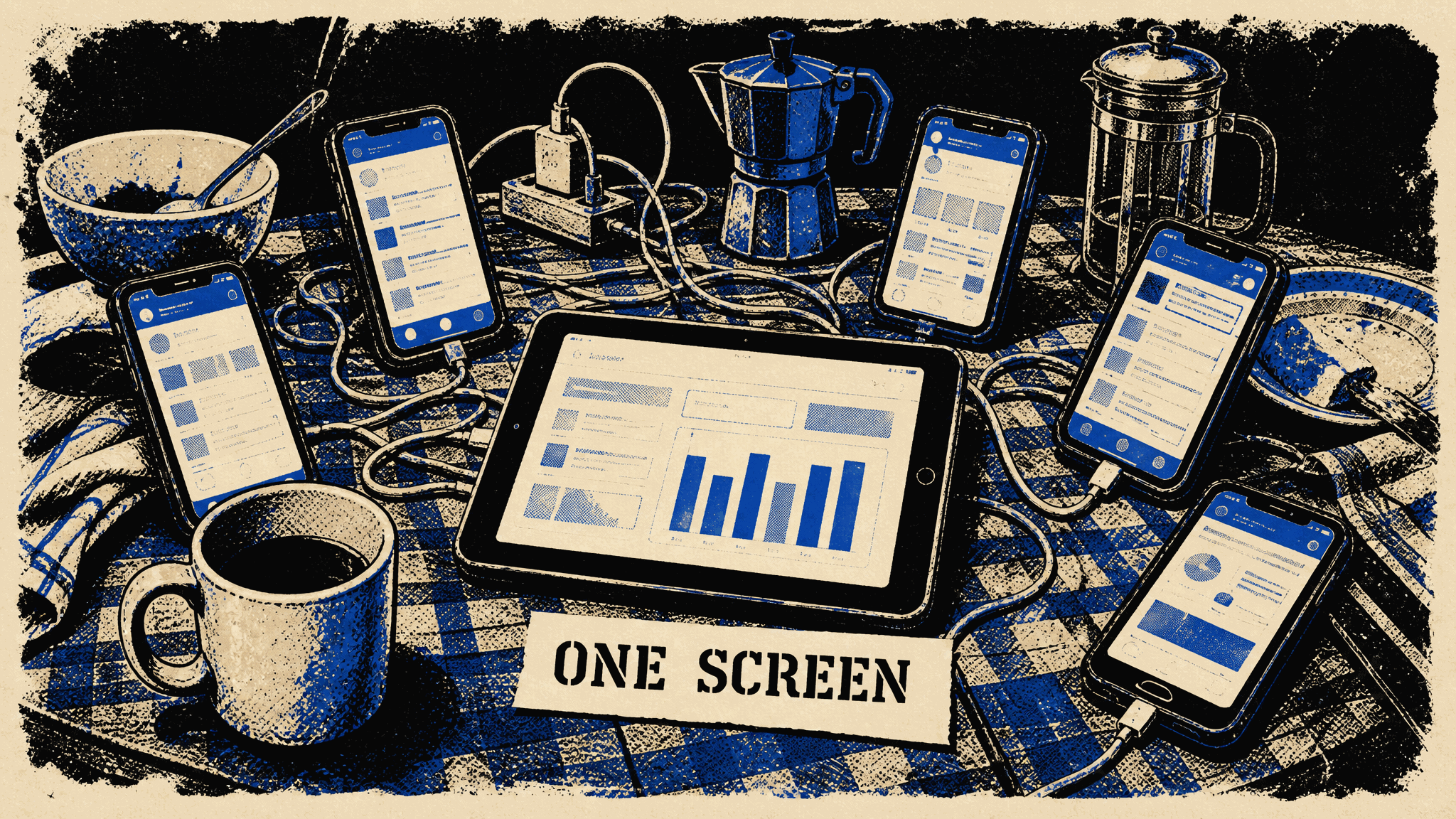
The Case for Aggregation
Logging into five portals every Sunday is not a ritual. It is unpaid clerical work with worse lighting.
You open Bank A. Copy the balance. Open Bank B. Wait for a security code. Open the credit card app. Get distracted by a rewards banner. Open the savings app. Wonder why the transfer is pending. Open the old credit union app. It wants a password reset because apparently 14 days is an era.
By the end, you have numbers. You do not have truth.
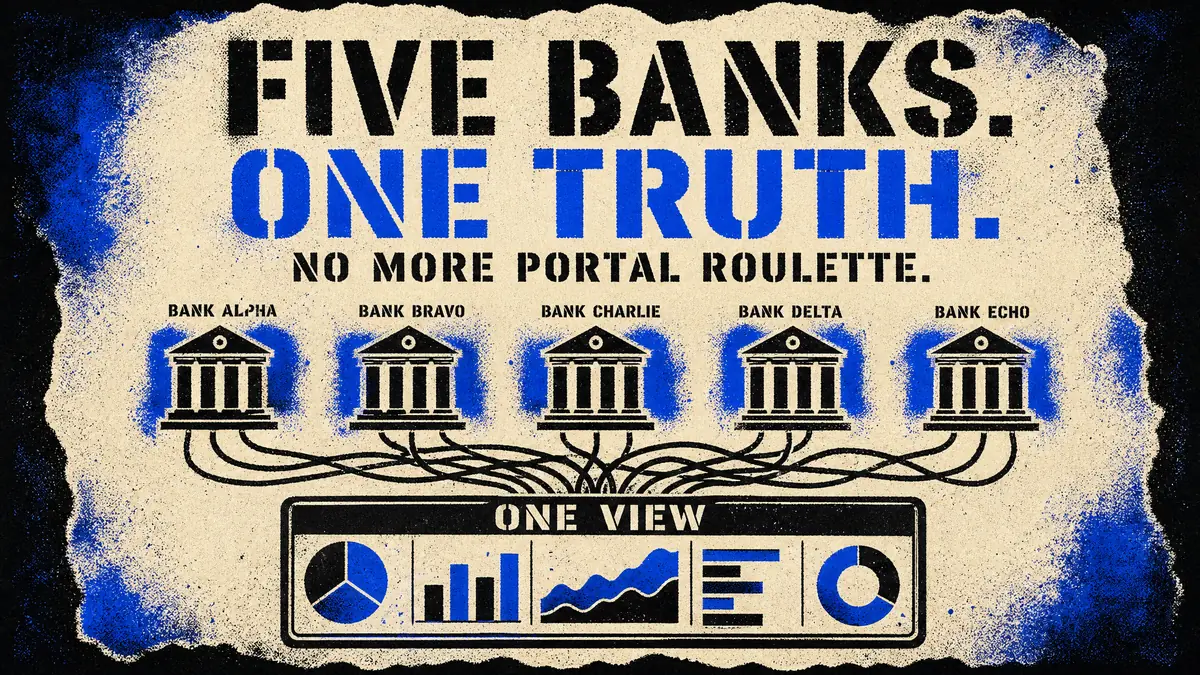
Aggregation fixes the basic geometry. Instead of visiting each institution and trying to mentally stitch together the household, you pull transactions and balances into one place. The accounts stay where they are. The view changes.
That matters because banks are built to show you their slice. Your checking app knows checking. Your card app knows card purchases. Your savings app knows savings. None of them wakes up tenderly concerned about your total grocery spend across debit, credit, Apple Pay, and the card your partner used because it was already in their hand.
A good multi-account view should answer four questions fast:
- What did you actually spend?
- Which accounts changed?
- What is still pending?
- Which transactions are just money moving between your own pockets?
This is also where annual spending gets less fake. If you are trying to calculate your real burn rate, you need the whole messy household feed, not one clean account that misses half the groceries. That is the same reason The Ugly Number: How to Calculate What You Actually Spend in a Year starts with reality instead of vibes.
Categorization Rules
Manual categorizing works until the third coffee shop, the second gas station, and the streaming service that bills under a company name that sounds like a rejected printer driver.
Set rules once. Reuse them everywhere.
The rule should not be tied only to the account. It should be tied to the merchant pattern, transaction type, and your own category logic. If Whole Foods hits the joint card, groceries. If it hits your personal debit card, still groceries. If the same internet provider bills checking in January and a credit card in February, still utilities. The money did not change species because a different plastic rectangle got involved.
Start with obvious recurring names. Mortgage or rent. Utilities. Phone. Insurance. Streaming. Gym. Childcare. Student loans. Pet insurance, because apparently the cat has a better health plan than you do.
Then make the rules specific enough to avoid comedy. A rule that says anything containing Amazon equals shopping may be fine for some people. For others, Amazon includes groceries, work supplies, diapers, books, batteries, and one emotionally questionable late-night lamp. Split those only if the split changes a decision you will actually make.
Good rules have three traits:
- They catch repeat transactions automatically.
- They do not pretend every merchant is one category forever.
- They are easy to override without starting a spreadsheet trial.
For recurring bills, rules are extra useful because you can spot changes. A subscription that was $12.99 and becomes $18.99 should not drift by wearing a tiny fake mustache. Pair category rules with recurring detection, then use Recurring Transactions: The Unsexy Feature That Quietly Saves Most Households $1,000+/Year if you want the unglamorous machinery that actually catches this stuff.
Do not overbuild. If you need 47 categories to feel in control, fine. If you need 8, also fine. The right number is the number that tells you something useful before your brain leaves the room.
Internal-Transfer Handling
Internal transfers are the number one multi-account tracking error because they look like spending from one side and income from the other.
You move $200 from checking to savings. One account shows money leaving. Another shows money arriving. A lazy tracker sees a $200 expense and maybe a $200 income event. Congratulations, you have invented accounting fog.
| account | transaction | true direction | double-count risk |
|---|---|---|---|
| Checking | $200 transfer to savings | Money moved from one owned account to another | Can be counted as $200 spent |
| Savings | $200 transfer from checking | Money arrived from another owned account | Can be counted as income |
| Spending report | Both sides included as normal transactions | No outside-world spending happened | Your totals get loud and wrong |
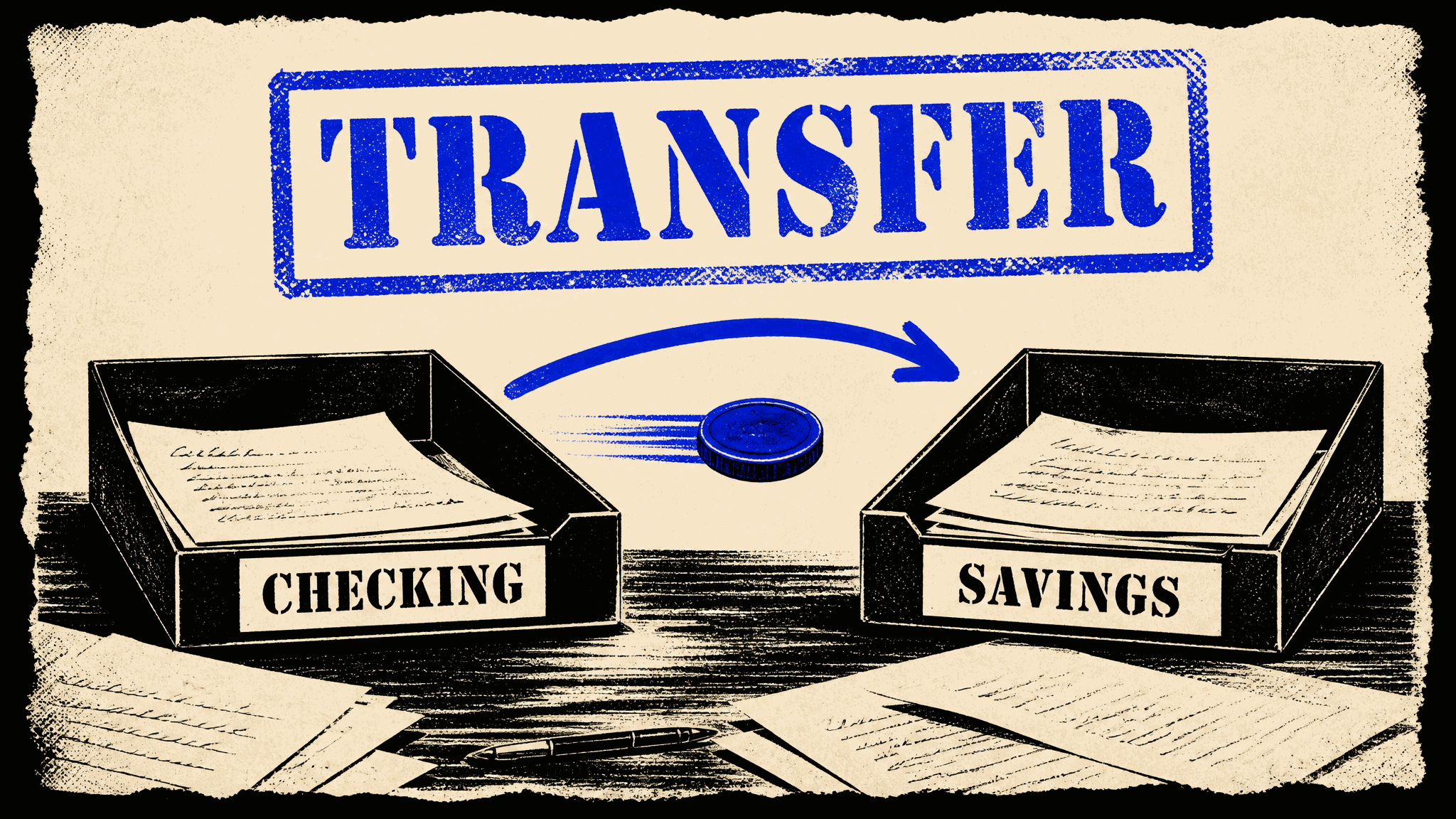
Handle transfers with a dedicated category: Internal Transfer. Then exclude that category from spending and income reports.
Not hidden. Not deleted. Excluded.
That distinction matters. You still want to see that money moved. You just do not want your grocery chart accusing you of eating a savings transfer. The clean setup is simple: match the outgoing and incoming sides when the amount is the same, the dates are close, and both accounts are yours. If only one side has posted, mark it as a pending transfer and wait for the matching leg.
Also decide how to treat credit card payments. Paying a credit card from checking is usually not new spending. The spending happened when you bought the groceries, gas, hotel, or flowers that began dying immediately. The card payment is debt settlement between your own accounts. Count both and your month looks like it went through a copier twice.
The Different Number Trap
Every bank app gives you a different number because every bank app is answering a slightly different question.
One app shows available balance. One emphasizes current balance. One includes pending card authorizations. One delays them. One shows a deposit before it is fully available. One merchant preauthorizes a card, then posts the final amount later. Hotels and gas stations especially enjoy this little theater.
The CFPB warns that pending debit card amounts may not be the same as the final amount that posts, and that pending deposits should not be assumed available before checking the bank or credit union policy. The CFPB’s overdraft circular also explains the difference between ledger balance and available balance, including how pending debits can change what appears available.
So the answer is not to ask which bank app is correct. The answer is to define which number you are using for which job.
For spending reports, use posted transactions. Pending transactions are useful warnings, not final history. The restaurant tip may change. The gas hold may fall off. The grocery pickup may adjust after substitutions, because apparently strawberries now require market timing.
For cash-flow awareness, show pending transactions separately. You want to know what is likely coming, but you do not want it quietly rewriting the past. Pending is a weather forecast. Posted is the sidewalk being wet.
For account safety, watch available balance. That is the number most likely to tell you whether a debit transaction could create trouble today. For long-term tracking, reconcile against statement balances and posted history.
The rule is boring, which is how you know it works:
- Posted transactions feed spending reports.
- Pending transactions feed short-term awareness.
- Internal transfers stay out of spending and income.
- Categories follow merchants and meaning, not whichever bank app shouted first.
Once you do that, five accounts stop being five arguments. They become one system with five inputs.
And no, you do not need a moral lesson about having too many accounts. Sometimes separate accounts are exactly what keeps life sane: bills in one place, savings somewhere harder to raid, household spending where both people can see it, business money away from grocery money, and an emergency fund that does not blink every time you buy tacos.
Five accounts, one screen, one truth. Anything else is the bank’s problem masquerading as yours.

 Forbidden Finance