Patriot Day Is a Good Day to Reduce Guesswork
September 11 is already a day for quiet reflection. Not performance. Not dramatic speeches. Just a sober pause for the people we love, the lives we are responsible for, and the practical things we can do before anyone needs them.
Estate paperwork fits there.
Not because you need to spiral into worst-case scenarios over breakfast. Please do not ruin a perfectly serviceable bagel. Because the people who love you should not have to become detectives at the exact moment they are least equipped to hunt for passwords, guess your wishes, or decode a benefits portal designed by someone who apparently hates humans.
The gap is real. Caring.com reported in its 2025 Wills & Estate Planning Survey that only 24% of respondents said they had a will, while more than half said they had no will at all. Pew Research Center found in a September 2025 survey that 32% of U.S. adults said they had created a will and 31% had created a living will or advance health care directive. Different surveys, same basic message: most adults have not written down the instructions their families would need.
This is financial planning, just quieter. If you already run an emergency fund, review insurance, or read The Fall Financial Reset: 30 Days to Q4-Ready Finances, this belongs in the same folder. Less thrilling than a new spreadsheet tab. More useful under stress.
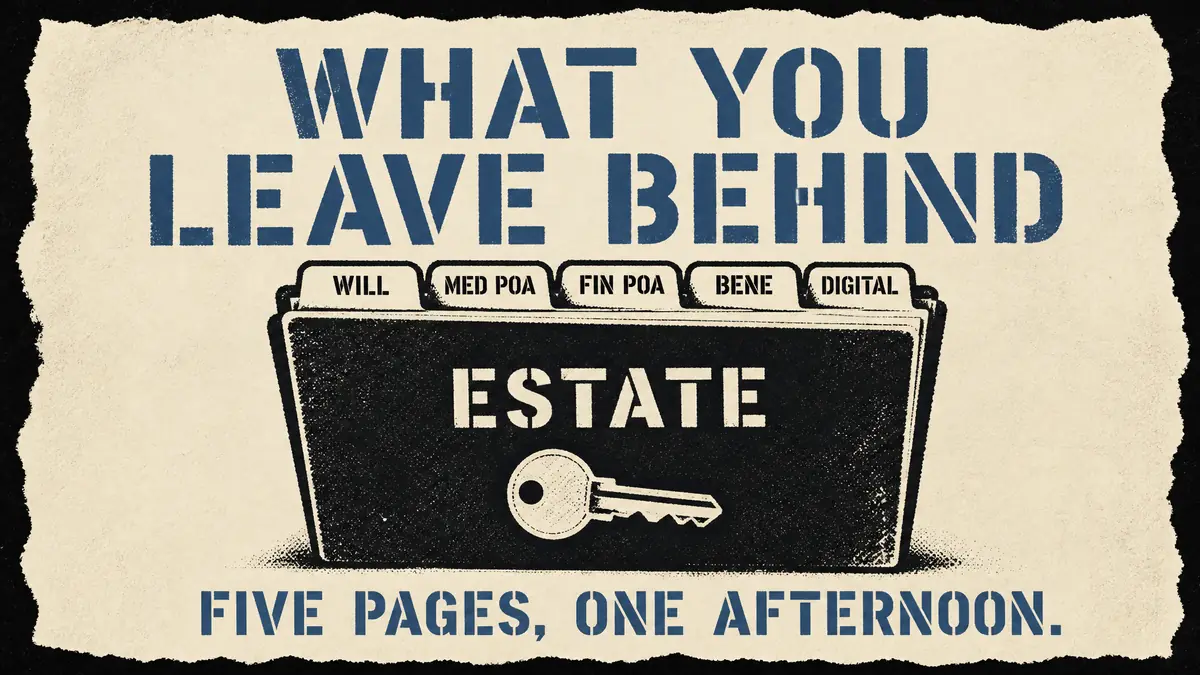
Here are the five documents most people should at least understand, what each one does, when you need it, and what it usually costs to set up.

1. Will
A will is the document most people think of first, and for good reason. It says who should receive the property that passes through your estate, who should manage the process, and who should care for minor children if you have them.
That last part matters. A will is not only for people with vacation homes, taxable estates, or a wine cellar that has its own humidity opinions. If you have children, pets, a car, a checking account, a sentimental watch, or one sibling who gets weird around money, a will gives people instructions.
Without one, your state’s intestacy laws decide who gets what. That may be fine if your life fits the state’s default family tree. Many lives do not. Unmarried partners, blended families, close friends, estranged relatives, and chosen family can all fall through the cracks.
AARP notes that will requirements vary by state, including signing and witnessing rules. That is the boring sentence that saves the whole thing. A will you drafted but did not execute correctly can create the exact confusion you were trying to prevent.
When you need it: Once someone depends on you, once you own property, once you have a child, once you care where your stuff goes, or once your family structure is more complicated than a stock photo.
Typical cost: Basic online wills often run under $100. Attorney-drafted wills cost more, especially if you have children, real estate, a business, a second marriage, or family tension. A 2026 LegalTemplates.net pricing study of 909 law firms found a national median of $625 for a standalone last will and testament, with a middle range of $450 to $1,000. Full estate packages usually cost more.
2. Healthcare Proxy / Medical Power of Attorney
A healthcare proxy, medical power of attorney, or advance health care directive names the person who can make medical decisions for you if you cannot speak for yourself. The label depends on your state, because apparently one name was too emotionally efficient.
This document is not only about end-of-life care. It can matter after an accident, during surgery, during a serious illness, or any time doctors need consent and you are not able to give it.
The point is not to write a 40-page manifesto about every possible medical scenario. The point is to pick the right person and give them enough direction that they are not left guessing. The American Bar Association says these documents let you express medical preferences and appoint someone to communicate for you when you cannot communicate for yourself.
Choose someone steady. Not necessarily the oldest child. Not necessarily the loudest relative. The right person is the one who can ask questions, handle pressure, and follow your wishes even if the room gets emotional.
When you need it: As soon as you are 18. Parents do not automatically get full access to an adult child’s medical decisions just because they still know where the good towels are kept.
Typical cost: Many state advance directive forms are free. The National Institute on Aging says many states provide forms you can complete at little or no cost, and AARP provides free state-by-state advance directive forms. Attorney help may make sense if you split time across states, have religious or care preferences you want worded carefully, or need the health document coordinated with a broader estate plan.
3. Financial Power of Attorney
A financial power of attorney lets someone you trust handle financial and legal tasks for you if you cannot do them yourself. Paying bills. Managing bank accounts. Dealing with insurance. Signing certain documents. Keeping the lights on while everyone else is busy arguing with hospital parking.
This is a lifetime document, not a death document. A will works after death. A financial power of attorney works while you are alive but unable, unavailable, or legally incapable of acting for yourself.
The American Bar Association explains that a power of attorney can be narrow or broad, temporary or permanent, immediate or “springing,” meaning it takes effect after a future event such as incapacity. State rules vary, and the powers you grant should be clear.
This is also a document where trust matters more than politeness. Do not name someone because it would hurt their feelings if you didn’t. Name someone because they can handle money without treating your checking account like a community snack drawer.
When you need it: If you have bills, accounts, property, debt, taxes, insurance, or dependents. Which is a long way of saying: adult life, unfortunately.
Typical cost: Some states provide statutory forms, but a lawyer can tailor the document and help avoid problems with banks refusing vague or outdated paperwork. The 2026 LegalTemplates.net study found a national median of $300 for a standalone power of attorney, with a middle range of $250 to $400. It is often bundled into a larger estate package.
4. Beneficiary Forms
Beneficiary forms are the most skipped piece because they do not feel like estate planning. They feel like account setup. Tiny checkbox energy. Very easy to ignore.
They may also be the document that matters most for your biggest accounts.
Retirement accounts, life insurance policies, some bank accounts, and some brokerage accounts can pass by beneficiary designation. That means the form on file with the institution controls where the money goes. Not your will. Not what you told everyone at Thanksgiving. Not the note in your drawer written in blue gel pen.
AARP says many people do not realize beneficiary designations override the will. The American Bar Association makes the same point for assets with beneficiary designations: they pass under the designation, not under the will or revocable trust.
This is why an old 401(k) beneficiary form can quietly defeat your fresh new will. If your retirement account still names an ex, a deceased parent, or nobody at all, your estate plan has a hole in it with a login screen around it.
Start with accounts that usually have beneficiary forms: 401(k)s, 403(b)s, IRAs, life insurance, annuities, payable-on-death bank accounts, and transfer-on-death brokerage accounts. While you are there, read How to Read Your 401(k) Statement (and Spot the Fees Eating Your Retirement), because beneficiary designations and retirement-account fees both live in the same category of boring details that can move real money.
When you need it: Any time you open a retirement account, buy life insurance, change jobs, marry, divorce, have a child, lose a named beneficiary, or realize your account paperwork was last touched during a different haircut era.
Typical cost: Usually free. You update the form through the financial institution, insurer, or employer plan portal. The cost is mostly attention, plus maybe a phone call where hold music tries to weaken your soul.
5. Letter of Instruction for Digital Assets and Account Access
A letter of instruction is not usually a formal legal document. Think of it as the map. It tells your executor, agent, spouse, adult child, or trusted person where things are and how to begin.
This is where you list accounts, contacts, subscriptions, digital assets, household logistics, funeral preferences, pet instructions, and where the real documents live. It should not replace a will, healthcare proxy, financial power of attorney, or beneficiary forms. It supports them.
Digital access deserves special care. The American Bar Association warns that an executor or personal representative does not automatically gain access to every online account unless the person gave specific consent under applicable law or account tools. AARP also cautions against putting passwords directly in a will, because wills can become public during probate.
Use a password manager, secure digital vault, or another system your trusted person can actually access. “My laptop knows the password” is not a plan. It is a locked door wearing a sticker.
This letter is also where your day-to-day money system helps. If your household already has recurring bills, subscriptions, and shared responsibilities, a written account map keeps people from rebuilding your life from bank statements. Our post Your Forgotten Subscriptions Are Bleeding You Dry is about cleaning up recurring charges while you are alive, which is considerably easier than making someone else do it later with a death certificate and a customer service PIN.
When you need it: Once your life has online accounts, automatic payments, digital photos, crypto, loyalty points, a password manager, cloud storage, or a pet with strong opinions about dinner time.
Typical cost: Free if you write it yourself. A lawyer may charge more if you want digital-asset authority added to your will or financial power of attorney. For the letter itself, the best tool is usually a secure document, a password manager emergency-access feature, and one uncomfortable but loving conversation.
The paperwork is not the whole job. Tell the right people where it is. A perfect document hidden in a mystery folder helps nobody.
| Document | What it does | Typical cost | Where to get it |
|---|---|---|---|
| Will | Names heirs, executor, and guardians for minor children | Often under $100 online; attorney-drafted wills commonly run several hundred dollars | Online legal form service or estate-planning attorney |
| Healthcare proxy / medical power of attorney | Names who can make medical decisions if you cannot speak for yourself | Often free through state forms; attorney help varies | State advance directive form, AARP state forms, hospital resources, or attorney |
| Financial power of attorney | Lets a trusted agent handle financial and legal tasks if you cannot | Often $250-$400 as a standalone attorney document; sometimes bundled | State form, online legal form service, or estate-planning attorney |
| Beneficiary forms | Directs retirement, life insurance, and certain bank or brokerage assets | Usually free | Employer plan portal, insurer, bank, brokerage, or retirement custodian |
| Letter of instruction | Maps accounts, passwords process, contacts, documents, and household details | Free if self-written; attorney cost only if formal digital-asset language is added elsewhere | Secure document, password manager, digital vault, or estate-planning attorney |
None of this has to be dramatic. You can start with one document, then the next. A will this month. Beneficiaries this weekend. The medical form before your next trip. Progress counts.
Our version of estate planning is simple: skip the shame, keep the responsibility. You are not doing this because you are wealthy enough to “need” it. You are doing it because someone may one day need clear instructions from you.
You don’t write these for you. You write them for the people who’d be left guessing.

 Forbidden Finance