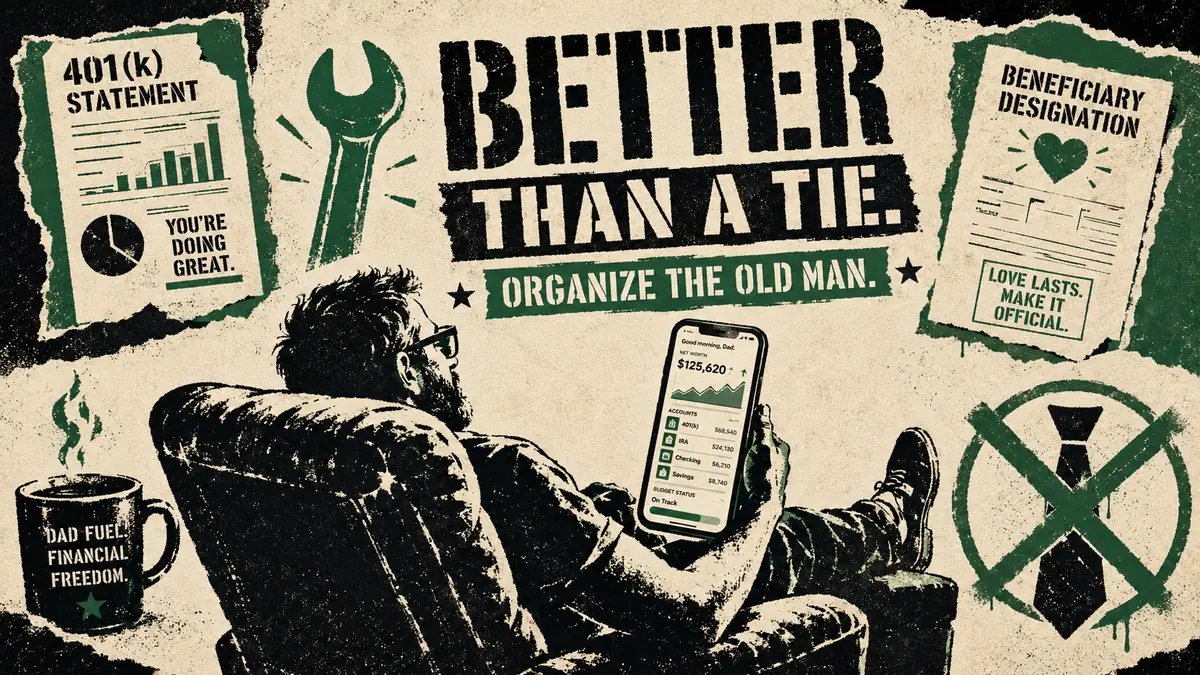
Father's Day gift guides have a supply-chain problem. Somehow everything becomes grilling tools, golf balls, or a tie that says, "I remembered this holiday in a checkout line." If the door is open, helping Dad get his money stuff organized can be warmer, cheaper, and more useful than another rectangle of fabric.
The key phrase is if the door is open. Some parents do not want financial help from their kid, even if that kid now has a mortgage, a spreadsheet, and opinions. So ask first, keep it light, and offer one practical favor instead of a surprise audit with snacks.
Think of this as the financial cousin of The Mid-Year Money Reset: A 10-Step Audit to Run Before June Hits: small checks, less chaos, no moral lecture.

1. Book a One-Hour Money Date
Do not call it a financial summit unless you want him to fake a lawn emergency. Call it coffee, sit down for one hour, and help him map where everything lives: checking, savings, retirement accounts, life insurance, mortgage, passwords, tax docs, and the mysterious folder labeled "IMPORTANT" that contains exactly one expired coupon.
The goal is not to judge the setup. The goal is to leave with a simple inventory, a few login updates, and a clear answer to the question, "If something needed attention next week, where would we even start?"
2. Consolidate Old 401(k)s, If It Actually Makes Sense
Old workplace retirement accounts are very good at becoming financial attic boxes. The Department of Labor says workers can lose track of retirement plans after job changes, mergers, or employers going out of business, and EBSA has recovered more than $7 billion in retirement benefits for missing participants and beneficiaries since 2017.
Your gift can be helping Dad list every former employer plan, compare fees and investment options, and decide whether rolling an old 401(k) into an IRA or a current employer plan makes sense. If he moves money, the boring-but-important phrase is IRS direct rollover, because a check made the wrong way can drag withholding and paperwork into the room like an uninvited uncle.
3. Refresh Beneficiaries on Every Account
This is the least glamorous task on the list, which is how you know it matters. Fidelity notes that beneficiary updates can take only a few minutes, and that accounts without beneficiaries may go through probate or follow plan rules instead of Dad's current wishes.
Help him check retirement accounts, bank payable-on-death settings, brokerage transfer-on-death registrations, life insurance, and annuities. This is not a dramatic estate-planning scene with thunder outside; it is mostly names, birthdays, percentages, and making sure an ex from 1998 is not still quietly winning paperwork roulette.

4. Open a High-Yield Savings Account
If Dad has serious cash parked in a checking account earning lint, this is the easy win. The FDIC listed national deposit rates as of May 18, 2026 at 0.38% for savings and 0.07% for interest checking, which is not exactly "put on sunglasses and retire early" money.
The fix is not exotic. At the time of writing, online high-yield accounts from names like Marcus by Goldman Sachs and American Express were paying in the mid-3% range, and the top accounts on Bankrate's best-of list ran between roughly 3.8% and 4.1% APY. Call the competitive number 3.8% and do the math on $100,000: that 0.38% checking account throws off about $380 a year, while the high-yield account pays roughly $3,800. Same money, same FDIC insurance, about $3,400 extra per year for the crime of opening a different account. Even the low end of the range (around 3.5%) beats the checking account by about $3,100; the high end (around 4.1%) by closer to $3,700.
Help him compare FDIC-insured savings options, check minimums and transfer limits, and move only money that should stay liquid: emergency funds, tax money, upcoming home repairs, or the sacred truck-maintenance stash. The point is not chasing every shiny rate like a caffeinated squirrel; it is stopping idle cash from napping in public.
5. Gift a Budgeting Tool Subscription, If He Wants One
A budgeting app is a good gift only if Dad is open to using one. Otherwise it is just homework with a login, which is how families end up eating potato salad in silence.
If he does want help, choose a tool that fits his style: simple tracking, retirement visibility, shared household planning, or a light category system. Our guide to Which Budgeting Method Is Right for You? is a useful gut check, because the forbidden truth is that the right system is the one he will actually run after Father's Day leftovers are gone.
Worst case: you spend an hour with your dad. Best case: he retires three years better off.

 Forbidden Finance