The Forbidden Premise
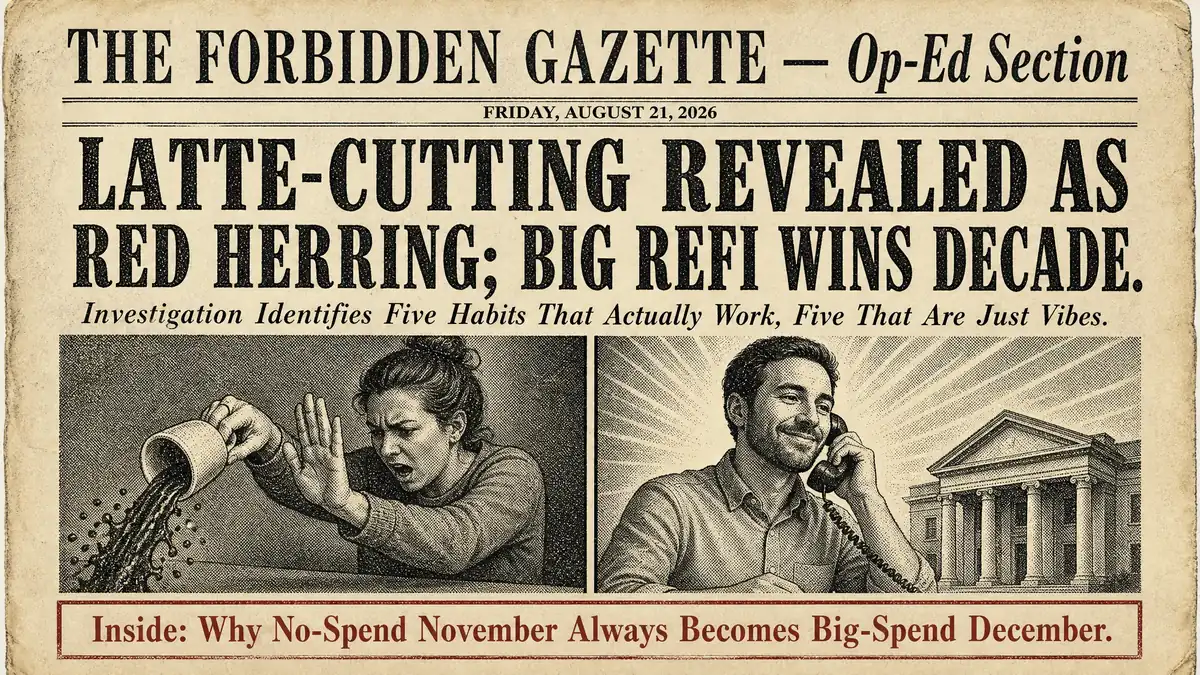
The latte was never the villain. It was just standing near the crime scene wearing a tiny cardboard sleeve.
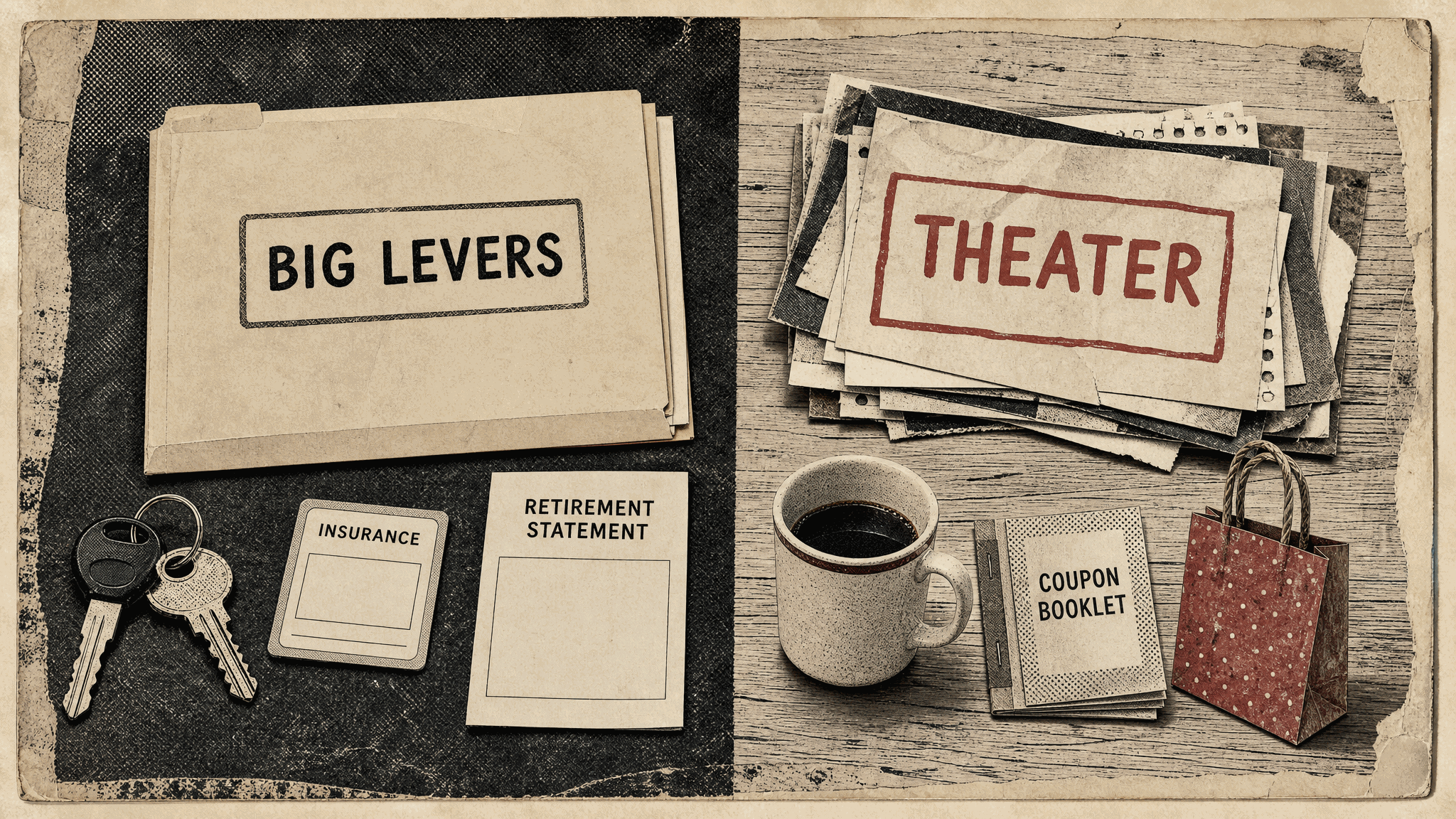
Frugality advice gets weirdly theatrical. People stage a dramatic breakup with coffee, ban themselves from fun for 30 days, and build a coupon binder with the emotional weight of a federal investigation. Meanwhile, the big money sits in recurring bills, housing, insurance, retirement matches, and interest rates, quietly eating the budget in shoes with soft soles.
This is the forbidden frugality take: small habits matter only after the large systems stop leaking. A $6 coffee can be a problem if you buy one twice a day and hate it. A $6 coffee is not the problem if your rent is swallowing half your take-home pay and your employer is offering free retirement money you are politely declining like a cursed appetizer.
The math agrees. The latest annual Consumer Expenditures release from BLS put housing at 33.4% of average annual household spending in 2024, followed by transportation at 17.0% and food at 12.9%. Translation: the budget is not being held hostage by one pastry. It is being held hostage by expensive, repeating stuff.
So here is the list: five forbidden frugality habits that actually move the needle, and five performative ones that mostly make you feel financially serious while your bank account asks for a plot summary.
The Five Real Habits
1. Negotiate recurring bills annually
Your internet provider has a loyalty department, and somehow loyalty means you pay more unless you remember the annual ritual: call, ask for the current promotion, and be very boring until someone finds a discount.
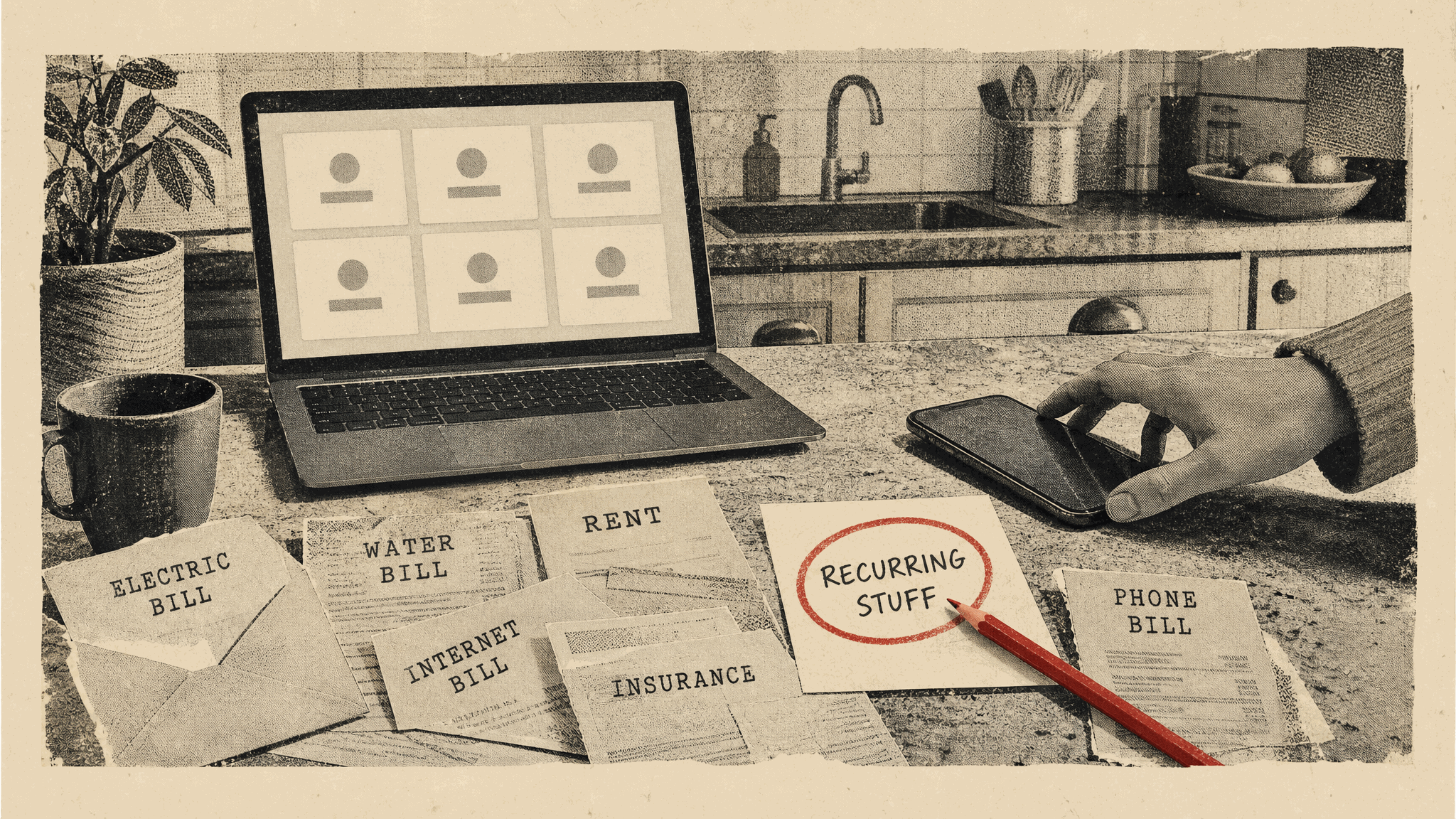
Insurance, internet, phone, streaming bundles, gym memberships, security systems, cloud storage, software subscriptions. The exact list changes by household, but the pattern does not. Recurring charges are dangerous because they become furniture. You stop seeing them.
NerdWallet notes that many recurring bills are negotiable, especially in industries where customers can leave for a competitor. Pair that with a recurring-charge sweep like Sub-Hunting: How to Find $50-$200/Month Hiding in Your Recurring Charges, and suddenly “being frugal” looks less like suffering and more like admin with a calendar invite.
Do it once a year. Put it in the same month as your insurance renewal. Make tea. Become deeply uninteresting on the phone. Profit quietly.
2. Refinance when rates allow
Refinancing is not a personality trait. It is math with paperwork.
If your mortgage, student loan, auto loan, or private debt has a rate meaningfully above what you can qualify for now, the question is not “am I the kind of person who refinances?” The question is whether the interest savings beat closing costs, fees, term reset risk, and hassle.
For mortgages, Freddie Mac publishes weekly Primary Mortgage Market Survey rates. As of August 13, 2026, its 30-year fixed-rate mortgage average was 6.67%, which is useful as a benchmark, not a prophecy carved into a kitchen tile.
If rates drop enough, run the breakeven period. If the breakeven is 18 months and you plan to stay seven years, pay attention. If the breakeven is four years and you are already browsing homes in another state at midnight, maybe do not make a spreadsheet romance novel out of it.
The forbidden rule: refinance only when the new loan improves your actual life, not when it lets you tell people you “optimized.”
3. Raise deductibles intelligently
Lower premiums feel good. So do ankles. Do not break either for sport.
Raising deductibles on auto, home, or renters insurance can reduce premiums, but only if you can cover the deductible without turning a claim into a credit-card hostage situation. NerdWallet’s homeowners insurance analysis found that raising a deductible from $1,000 to $2,500 could save about 9% per year on average, but the same math also means you are accepting more out-of-pocket risk.
If you have cash reserves, a higher deductible can make sense because you are self-insuring the small stuff and keeping insurance for the expensive stuff. If you do not have reserves, the higher deductible is not frugal. It is just risk wearing a thrifted jacket.
Start with the obvious test: could you pay the deductible tomorrow without missing rent, utilities, food, or debt payments? If not, leave it alone and build cash first. Emergency Fund Math: How Much Is Actually Enough in 2026? is the homework, minus the shame.
4. Capture the full employer match
If your employer matches retirement contributions, that is compensation. Not a motivational quote. Not a “future you” abstraction. Money.
Vanguard’s 2026 How America Saves release said matching contributions rose over time to a record 4.7%, strengthening long-term accumulation for participants. If you are contributing below the match, your first frugality habit may not be spending less. It may be redirecting enough payroll money to stop refusing part of your pay.
Yes, cash flow matters. If you are behind on rent, food, or medication, do not let internet retirement math yell at you. But if you can make room, the match is one of the few places where personal finance drops a coupon directly into your paycheck and somehow people still leave it on the floor.
5. Use geographic arbitrage on housing
This is the spicy one because it is real and inconvenient.
Housing dominates the household budget. Again, BLS puts it at the top of average consumer spending. Moving from a high-cost area to a lower-cost one, or even moving neighborhoods, can do more than a decade of clipping grocery coupons with the intensity of a courtroom exhibit.
Geographic arbitrage does not mean “just move,” as if jobs, caregiving, custody arrangements, health care, community, schools, and winter darkness are minor footnotes. They are not. But if remote work, a career change, family support, or timing creates an opening, housing is where the forbidden math gets loud.
A lower rent or mortgage can free hundreds or thousands per month. That can fund debt payoff, investments, childcare, therapy, travel, or the radical act of not panicking every Thursday.
The Five Performative Ones
1. Cutting lattes when you do not drink lattes
The latte advice has become personal-finance cosplay. It is easy to scold because it is visible, small, and vaguely feminine-coded, which is convenient for people who like their budgeting advice with a side of cultural weirdness.
If you drink lattes daily and want the money elsewhere, fine. Cut them. If you do not drink them, stop pretending this is your breakthrough. You cannot save money on a habit you do not have. That is not frugality. That is imaginary austerity.
2. No-spend months that turn into rebound spending
A no-spend month can work as a reset. It can also become financial Lent followed by a mall pilgrimage.
Behavioral researchers Ayelet Fishbach and Ravi Dhar showed in the Journal of Consumer Research that perceived goal progress can “liberate” people to make inconsistent later choices. In money terms: you spend nothing in November, then December arrives wearing a velvet blazer and holding a candle sale.
If a no-spend month helps you notice leaks, great. If it becomes a binge-restrict cycle with receipts, use a calmer tool. Try The 24-Hour Rule, the 30-Day List, and the $100 Test: Three Anti-Impulse-Buy Frameworks instead. Less drama. Fewer decorative baskets purchased in a fugue state.
3. Extreme couponing against your own hourly rate
Couponing is not fake. Time is also not fake.
If you save $18 after three hours of app stacking, receipt scanning, store hopping, and arguing with a register that has seen too much, you made $6 an hour before gas. Maybe you enjoyed it. Hobbies are allowed. But do not confuse a hobby with a high-return financial strategy.
The real question is opportunity cost. Could that time renegotiate insurance, compare mortgage rates, apply for a better job, sell one unused item, meal-plan two weeks of groceries, or nap so you do not impulse-buy a countertop ice machine at 11:42 p.m.? Be honest. Especially about the ice machine.
4. Secondhand-everything as identity
Buying used can be brilliant. Cars, furniture, tools, kids’ clothes, books, and exercise equipment with someone else’s abandoned ambition attached. Beautiful.
But secondhand-everything can become a costume. If you drive across town to save $9 on a lamp, buy three other “finds,” and spend Saturday sanding a chair you secretly hate, the budget did not win. The aesthetic did.
Frugality is not a contest to look the most nobly deprived. Buy used where it saves real money or gets you better quality. Buy new where reliability, fit, hygiene, warranty, or time matters. The rule depends. Forbidden concept, apparently.
5. Foregoing health spending
Skipping preventive care, medication, therapy, dental work, glasses, or basic mobility help is not frugal. It is a bill in disguise.
KFF reported in its April 30, 2026 health-costs brief that 36% of adults said they skipped or postponed needed health care in the past 12 months because of cost, and 43% said they had not taken medication as prescribed due to costs. The lesson is not “be tougher.” The lesson is that health spending is not morally optional because the invoice feels annoying.
Yes, negotiate bills. Ask for cash-pay rates. Use FSAs or HSAs if they fit. Compare pharmacies. Challenge errors. But do not brag about skipping the dentist like plaque is a savings account.
| Forbidden Frugality That Works | Performative Frugality Theater |
|---|---|
| Negotiate recurring bills once a year. | Cancel the latte you never bought. |
| Refinance when the breakeven math works. | Do a no-spend month, then revenge-shop in December. |
| Raise deductibles only when cash reserves can absorb the hit. | Coupon for three hours to save couch-cushion money. |
| Capture the full employer match. | Turn secondhand shopping into a purity ritual. |
| Reduce housing costs when life gives you a real opening. | Skip health care and call the future bill “discipline.” |
The Forbidden Takeaway
The best frugality habit is the one that attacks the biggest line item you can realistically change without making your life stupid.
Sometimes that means a bill-negotiation afternoon. Sometimes it means increasing a 401(k) contribution by one percent at a time. Sometimes it means keeping the coffee because it is cheap joy, cutting the forgotten subscriptions because they are expensive ghosts, and moving only if the move actually fits your life.
This is why one-size-fits-all finance advice gets so annoying. It pretends everyone has the same income, same rent, same health, same family obligations, same commute, same tolerance for spreadsheets, and same mysterious cabinet full of unused lentils.
You do not need to perform frugality for the internet. You need a budget that notices what matters. If a tiny habit helps, keep it. If a big lever is available, pull it. If the advice makes you poorer, sicker, more exhausted, or weirdly proud of suffering, reject the advice.
Frugality isn’t an aesthetic. It’s whether the math works.
 Forbidden Finance