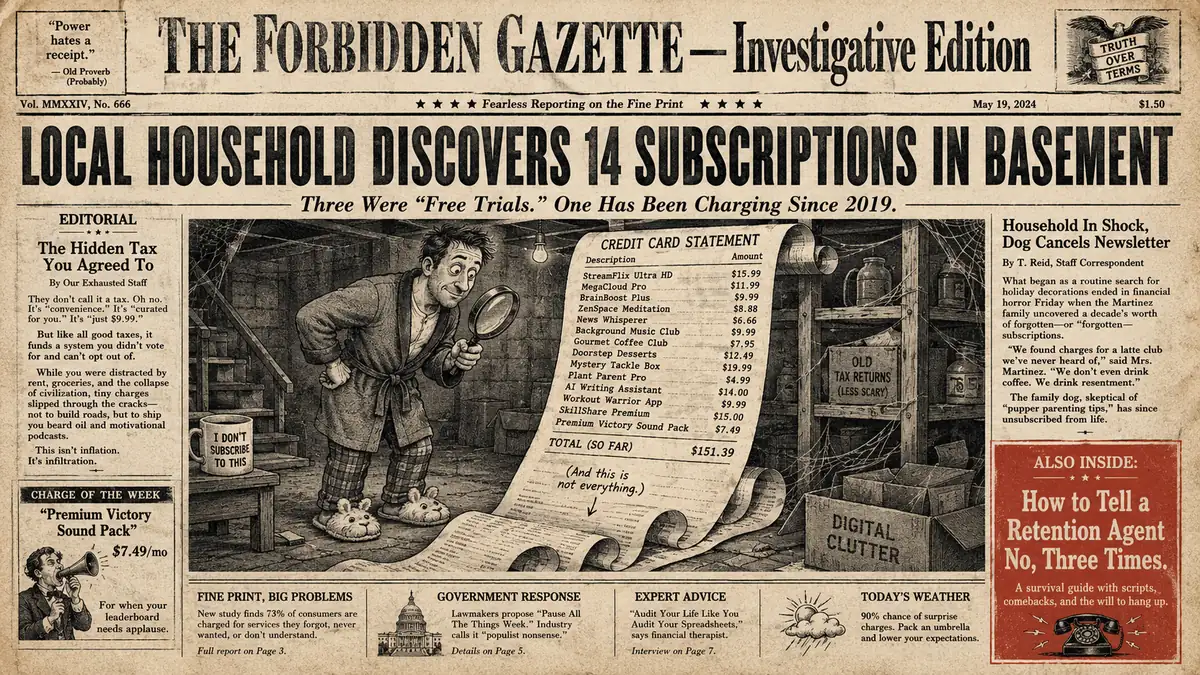
The charge is never dramatic.
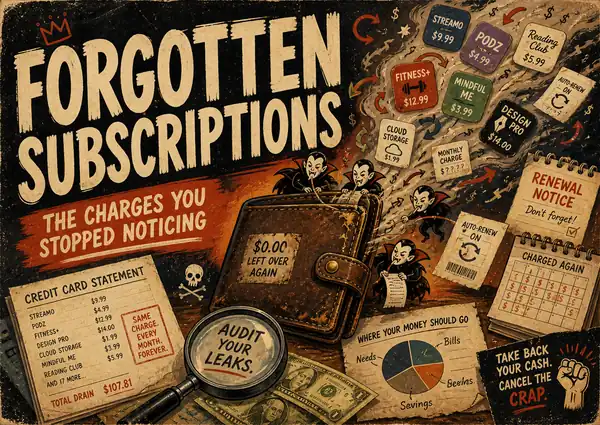
It is $7.99 for something you tried during a bad week. $14.95 for an app you swore would make you organized. $38 for a membership you have technically been “about to cancel” since the previous administration. Each one is small enough to slip past security wearing sunglasses and a tiny hat.
That is the subscription-economy industrial complex. It does not need to steal your wallet. It only needs to nibble.
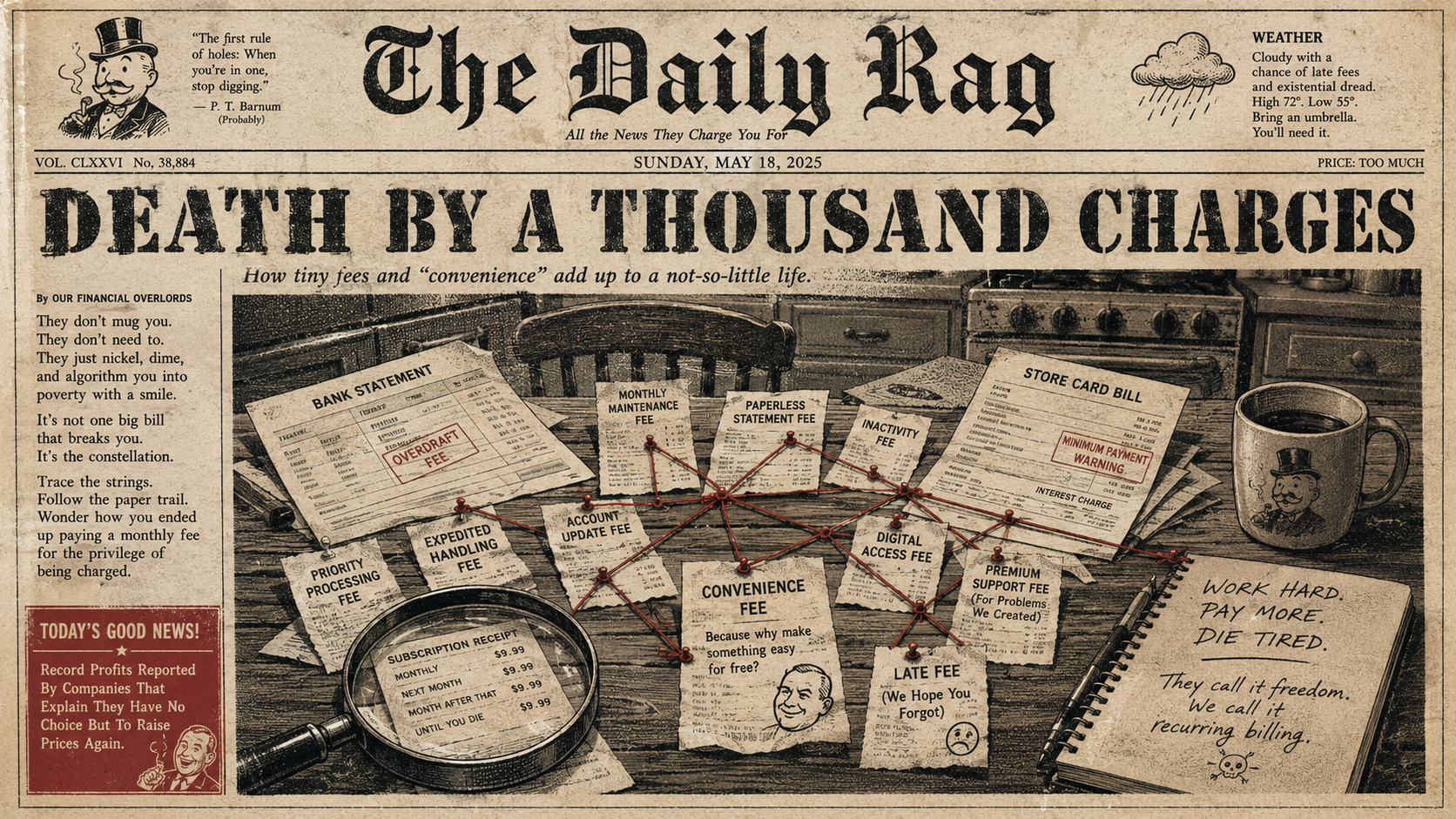
Self Financial’s 2026 survey found that 59.9% of respondents had at least one paid subscription going unused each month, with unused subscriptions averaging $26.79 monthly. C+R Research found a bigger perception gap: people guessed they spent $86 per month on subscriptions, then itemized their way to $219.
So yes, finding $50 to $200 a month is not fantasy math. It is often just looking where the bill goblins live. Fine, not goblins. Payment processors in quarter-zips.
This is a 30-minute subscription audit. No shame cleanse. No “cancel joy and eat plain rice forever” routine. You are hunting for charges that no longer earn their keep.
TL;DR
• Pull 90 days of every statement, because subscriptions hide across cards, banks, wallets, and store accounts.
• Sort each charge into keep, pause, or kill, then annualize the number so $15 becomes $180.
• The forbidden move is not deprivation. It is making each recurring charge re-earn the chair it sits in.
Step 1: Pull 90 Days From Every Account
Start a timer for 30 minutes. The timer matters. Without it, this becomes an archeological dig, and suddenly you are reading a 2021 receipt for decorative pillows. Stay dangerous. Stay focused.
Pull the last 90 days of transactions from every place money leaves:
- Checking accounts
- Credit cards
- Store cards
- Digital wallets
- App-store purchase histories
- Buy-now-pay-later accounts
- Any old card you keep “just in case”
Ninety days catches monthly subscriptions, quarterly renewals, price increases, and weird little add-ons that bill under names you do not recognize. If a merchant name looks like a rejected password, search your email for the dollar amount.
Do not limit this to streaming. The obvious subscriptions are rarely the whole crime scene. Look for cloud storage, antivirus software, meal plans, kids’ apps, fitness memberships, delivery passes, newsletter bundles, photo storage, browser extensions, premium templates, credit-monitoring trials, and anything with the word “pro” attached like a fake mustache.
If you already use recurring-transaction detection, this job gets easier. The point of that radar is exactly what we covered in Your Forgotten Subscriptions Are Bleeding You Dry: recurring charges become visible before they become furniture.
For now, export statements if you can. If not, scroll and write. Your columns are simple: merchant, amount, payment account, billing frequency, next action.
Step 2: Sort Charges Into Keep, Pause, Kill
Now comes the part where you stop asking, “Is this bad?” and ask the useful question: “Is this still doing a job?”
Personal finance gets weirdly moral about small pleasures. Ignore that. A music subscription you use every day is not the villain. A $6.99 app you forgot existed and have not opened since a dentist waiting room in March? Different energy.
Use three columns: keep, pause, kill.
| Column | What Goes Here | Quick Test | Action |
|---|---|---|---|
| Keep | Subscriptions you use often, value clearly, or need for work, health, family, or sanity. | Would you sign up again today at the current price? | Keep it, but note the renewal date and current cost. |
| Pause | Useful sometimes, but not this month. Seasonal services. “Maybe later” tools. Nice-to-haves. | Would pausing it for 60 days materially hurt your life? | Pause, downgrade, or set a restart date. |
| Kill | Unused, duplicated, overpriced, forgotten, or emotionally kept because canceling feels annoying. | Would you be irritated if it charged again tomorrow? | Cancel today and save proof. |
The annualized number is where the table gets rude in a productive way. A $12.99 subscription is not $12.99. It is $155.88 a year. A $39 monthly membership is $468 a year. This is how tiny charges put on a trench coat and become furniture money.
If a subscription supports something you actually care about, keep it without apology. If your spending needs a better “why,” Values-Based Budgeting: Spend Money on What Actually Matters (Forbidden Concept, We Know) is the grown-up version of “do I even like this?”
Step 3: Hunt Annual Subscriptions Separately
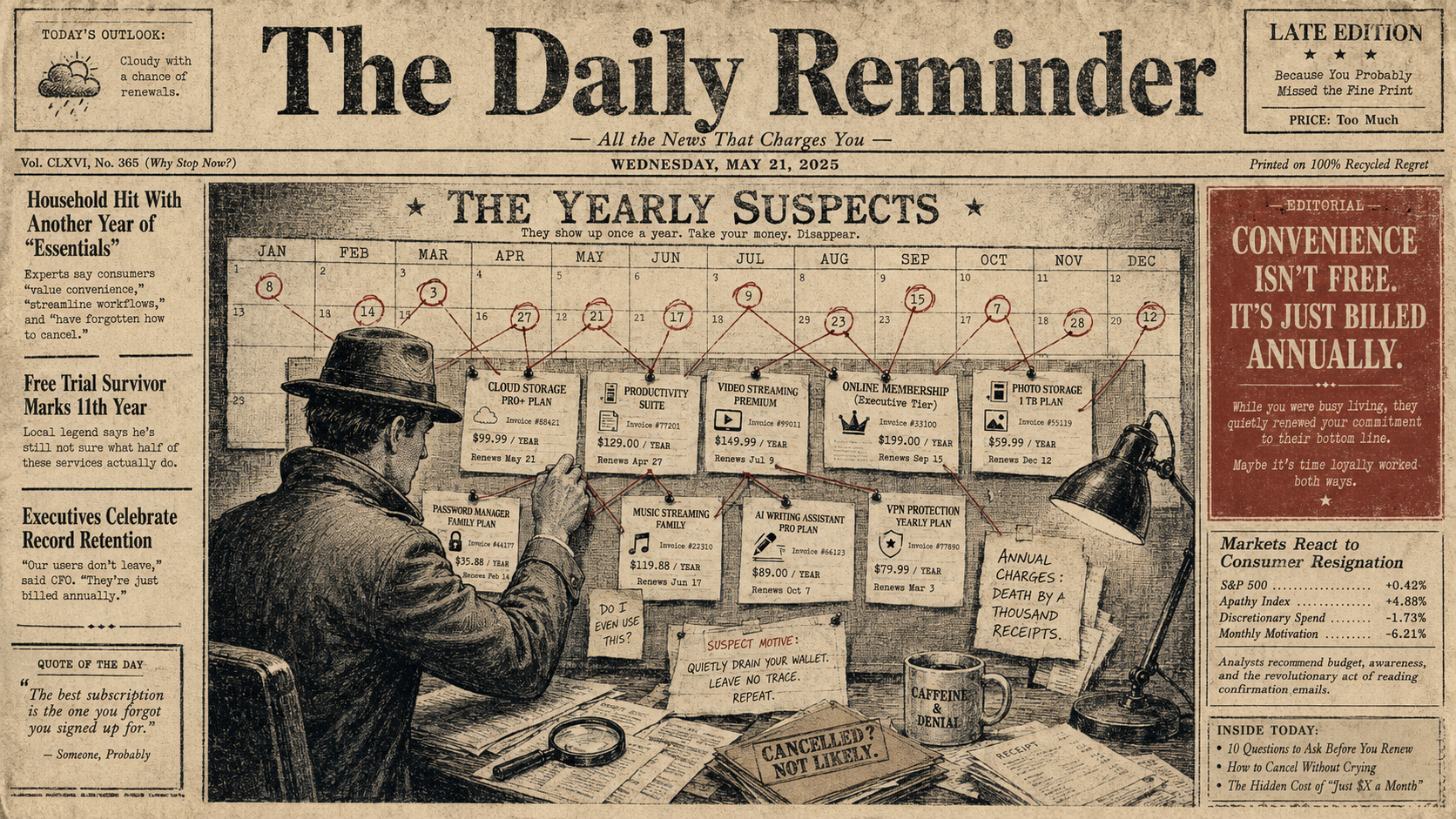
Annual subscriptions are the sneakiest because they do not show up every month and politely ask to be judged. They appear once a year, take $79, $129, or $299, and vanish into the bushes.
Do a separate pass for anything billed yearly. Search your statements and email for:
- Annual
- Renewal
- Yearly
- Plan renews
- Membership
- Invoice
- Receipt
- Trial ending
Then convert each annual charge into a monthly number. A $120 annual plan is $10 a month. A $240 software plan is $20 a month. This keeps your brain from treating annual billing like a meteor strike: unfortunate, loud, and apparently unrelated to planning.
The FTC’s consumer guidance warns that automatic renewals may charge more than the prior price, especially after a promotional rate ends. Translation: the “good deal” you signed up for may have molted into a more expensive creature while you were trying to remember your password.
Create a renewal calendar. Put every annual subscription on it with three details: renewal date, expected amount, and cancel-by date. If the service requires 30 days’ notice, your calendar reminder should not be the day before. That is not a reminder. That is a jump scare.
Step 4: Negotiate Before You Cancel
Some subscriptions are not kill candidates. They are “fine, but not at that price” candidates. This is where retention departments enter wearing a headset and the weary confidence of someone who has heard every excuse from “moving abroad” to “my cat ordered this.”
Your job is not to perform hardship theater. Your job is to be clear, polite, and boringly persistent.
- “I’m reviewing my bills this month and looking to cancel; what’s available to keep me?”
- “That price is still higher than I want. Are there any loyalty discounts, annual discounts, or lower tiers?”
- “If I cancel today, can I restart later at a promotional rate?”
- “I’m not looking to add features. I’m trying to lower the monthly cost.”
- “Please confirm the cancellation date and send written confirmation.”
Say less than you want to. Silence is useful. Retention agents often have a menu of offers, and your extra explaining gives them places to steer the conversation. You are not debating philosophy. You are asking what discount button exists.
If the service bills from your bank account and cancellation gets slippery, CFPB guidance says you can revoke authorization with the company and contact your bank or credit union, while also remembering that stopping the payment method does not cancel any underlying contract you still owe. Annoying? Yes. Important? Also yes.
Keep evidence. Screenshot cancellation pages. Save chat transcripts. Write down dates, names, confirmation numbers, and the exact offer accepted. Future You deserves receipts, not vibes.
Step 5: Stop Free Trials From Coming Back
Free trials are not free. They are auditions for your forgetfulness.
The fix is wonderfully unglamorous: every time you start a trial, create a calendar reminder 24 hours before it converts. Not the day it converts. Not “sometime next week.” Twenty-four hours before. Put the price in the reminder title so your phone says something useful, like “Cancel design app before $29 charge,” instead of “Trial???”
The FTC specifically recommends marking your calendar after signing up for a free trial and monitoring credit and debit card statements for unwanted charges. Dry advice. Correct advice. The best kind of boring.
Use a simple trial rule:
- If you would not pay full price today, set the cancel reminder before you enter the card.
- If cancellation instructions are hard to find, do not sign up.
- If the trial requires a phone call to cancel, decide whether the juice is worth the hold music.
- If you keep it, add it to your recurring-charge list immediately.
This is also where budgets fail if they are built like punishment machines. One forgotten trial does not mean you are bad at money. It means the system needed a guardrail. We have an entire rant for that in Why Most Budgets Fail in Month Three (and How to Build One That Doesn’t).
What to Do Every Quarter
Run this audit four times a year. Put it on the calendar now: January, April, July, October. Or line it up with your own rhythm, like tax prep, summer planning, back-to-school chaos, and the month your spending starts buying holiday decorations with suspicious confidence.
The quarterly version is faster because you are not starting cold. Review new recurring charges, annual renewals due in the next 90 days, anything that increased in price, and anything you paused that quietly restarted.
If you already do a broader money check-in, fold this into it. The subscription audit pairs nicely with The Mid-Year Money Reset: A 10-Step Audit to Run Before June Hits, because subscriptions are rarely isolated. They are little recurring votes for what your money is doing while you are busy living your actual life.
Recurring-transaction detection turns this from a one-time purge into an ongoing radar. The audit becomes automatic: new recurring charge appears, old subscription changes price, annual renewal comes into view, and you get a chance to decide before the charge becomes wallpaper.
That is the forbidden move. Not “never subscribe.” Not “cancel everything fun.” Just make the charge prove it still belongs.
An hour. Sometimes $1,800/year. Bad ROI it is not.
 Forbidden Finance