The college bill arrives wearing a suit: tuition, fees, housing, meal plan. Very official. Very spreadsheet-friendly.
Then move-in week shows up in cargo shorts holding a shower caddy, three extension cords, a mysteriously required lab notebook, and a parent who has said the phrase just one more Target run fourteen times.
College move in costs are not one expense. They are a pile-on. Some are obvious. Some hide inside the word supplies, which is financial aid language for surprise, but make it beige. The goal is not to turn move-in into a military operation. The goal is to know which costs are normal, which are negotiable, and which need a line in the budget before everyone is sweating in a dorm stairwell.

TL;DR
- Plan for dorm setup, books, food gaps, banking, insurance, and at least a $1,000 first-semester cash buffer.
- The sticker price is not the whole move-in cost, and the cart will prove it.
- Write down who pays for what before move-in day gets emotional and humid.
1. The Move-In Cart Is Not a Budget
Start with the stuff. Bedding. Towels. Hangers. Shower shoes. Power strips that comply with dorm rules. Laundry detergent. A fan, because apparently air circulation is an elective.
A realistic dorm setup budget is usually $800 to $1,500 if you are buying most items from scratch. That range gets you basic bedding, storage, desk supplies, laundry gear, towels, toiletries, a mattress topper, a small toolkit, and a few comfort items that make the room feel less like a beige filing cabinet.
The mistake is treating dorm setup like decorating. It is not decorating. It is replacing a household in miniature. The NRF expects college students and families to spend an average of $1,437.79 on back-to-college shopping in 2026, including electronics, furnishings, clothing, food, and personal care. That number is not a commandment. It is a warning flare.
Use three lists: must buy now, can wait two weeks, buy only if the room actually needs it. Mini-fridge? Maybe. Printer? Usually no. Decorative throw pillows? Emotionally powerful, financially suspicious.
If money is tight, buy the sleep and hygiene stuff first. Mattress topper, sheets, towels, shower items, laundry. Then study basics. Then storage. The neon sign shaped like a mushroom can wait. It has waited its whole life.
2. Textbooks Are a Math Problem, Not a Character Test
Textbook advice often sounds like a purity contest. Buy used. Rent everything. Never buy from the bookstore. Be the kind of person who comparison-shops ISBNs before breakfast.
Fine. But the real rule is simpler: run the math by class.
For each course, write down the required book, edition, access code, format options, return window, and whether the professor actually uses it. Then compare four prices: campus bookstore, used online, rental, and digital. Do not assume rental is cheapest. Digital access codes can be cheaper for one semester and useless for resale. A used physical book can cost more upfront but sell back later. A required workbook may have no resale value because someone already filled in chapter two with a pen and optimism.
The BLS tracks educational books and supplies as their own line in the Consumer Price Index, which is a useful national average and a terrible predictor of your particular syllabus. Translation: the index will not save you from one biology bundle with an access code that expires like milk.
The Department of Education includes books, course materials, supplies, and equipment in cost of attendance rules, including rental or upfront purchase of a computer when required for study. That matters because some families forget books are not a cute optional accessory. They are part of the real cost of being enrolled.
Practical move: budget $300 to $700 for first-semester course materials until the syllabus proves otherwise. Then update the number. The budget is allowed to learn. Forbidden concept, apparently.
3. Meal Plans Need a Reality Check
Meal plans are sold like convenience. Sometimes they are. Sometimes they are a prepaid promise that your student will eat breakfast before 10 a.m., which is adorable.
The right meal plan depends on behavior, not parental hope. If the student sleeps late, works evenings, has labs during dining hall hours, or plans to go home most weekends, the biggest plan may turn into very expensive cereal. If the campus is isolated and dining options are limited, too small a plan can push spending into delivery apps, where a sandwich becomes a financial event.
The Department of Education says cost of attendance food allowances for students using institutional food service should provide the equivalent of three meals per day. That does not mean every student needs the largest plan. It means the school has to build a reasonable food allowance into the cost framework.
Before choosing, ask four boring questions. Boring is where the savings live.
How many meals per week will actually happen on campus? Are unused swipes lost? Can dining dollars roll over? Are there cheaper commuter or block plans after the first semester?
Then add a grocery line. Even students with meal plans buy snacks, coffee, fruit, microwave meals, and the emergency peanut butter that holds civilization together. Plan $50 to $150 a month depending on campus access and appetite.
4. The First-Semester Cash Buffer Is Not Optional
A $1,000 cash buffer should be the minimum goal for semester one. Not because students are irresponsible. Because life has fees.
There is the club fee. The lab coat. The parking pass. The winter coat if the student moved north and believed vibes would handle weather. The rideshare after a late shift. The prescription refill. The laptop charger that disappears into the same dimension as socks.
This is where families get into trouble: they budget for the bill, not the first 60 days of living. Move-in is not the finish line. It is the opening ceremony for small expenses with excellent timing.
If $1,000 is not possible, start with $300 to $500 and build. Put it somewhere separate from everyday spending so it does not become pizza money by accident. Pizza has enough institutional power already.
For a deeper version of this same idea, Emergency Fund Math: How Much Is Actually Enough in 2026? is the grown-up cousin of the semester buffer. Same principle, smaller dorm room.
5. Banking Setup Can Leak Money Quietly
A student bank account should do three things: avoid monthly fees, avoid surprise overdraft damage, and give the student free ATM access near campus.
That last part matters. A great hometown bank with no campus ATMs can become a tiny toll booth. If the student pulls cash twice a month and pays out-of-network fees on both ends, congratulations, the bank has invented a subscription you never asked for.
The CFPB warns students to compare ATM fees, overdraft fees, debit card fees, and bill-pay fees because they can add up quickly. The CFPB also says an account advertised as free or no cost cannot have monthly service fees or minimum-balance fees, though it may still have ATM, overdraft, dormant-account, or check-printing fees.
So the checklist is simple. No monthly maintenance fee. No minimum balance trap. Free in-network ATMs on or near campus. Mobile deposit. Easy transfers from parents if parents are helping. Overdraft protection turned off for debit and ATM transactions unless there is a very specific reason to opt in.
If you are comparing account setups, The Two-Account Rule: Why Most Households Need at Least Two Banks (and Sometimes Five) gives you a useful framework without requiring a finance degree or a ceremonial binder.
6. Insurance Gaps Are Boring Until They Are Expensive
Insurance is the section everyone wants to skip, which is exactly why it causes chaos later.
Start with belongings. Laptop, phone, bike, clothes, medication, instruments, camera gear, gaming console. If replacing the stolen or damaged version would hurt, check coverage now.
The NAIC says a school, landlord, or property management company policy usually will not cover a student’s personal items. It also notes that students in on-campus housing under age 26 may have some coverage through a parent’s homeowners or renters policy, but limits and exclusions vary. Off campus, a landlord may require renters insurance. Annoying? Yes. Also less annoying than replacing a laptop with emergency money and rage.
Then check health insurance. Being on a parent’s plan is not the same as having convenient in-network care near campus. HealthCare.gov says students who are 26 or under and live in a different state from a parent can stay on that parent’s plan, but should read the coverage documents and review the provider network for the state where they attend school.
Translation: find the urgent care before someone has a fever. Confirm the pharmacy. Save the insurance card in the phone. Write down what to do after hours. Future sick student will not be in the mood for portal archaeology.
7. The Parent-Student Cost Split Needs Paper
The move-in money conversation should happen before move-in day. Not in the parking lot. Not while holding a rug. Not after someone discovers the bookstore total and develops a thousand-yard stare.
Write down who pays for what. Tuition gap. Housing. Meal plan. Books. Dorm setup. Travel home. Phone. Insurance. Prescriptions. Clubs. Clothes. Entertainment. Emergency travel. The first-semester cash buffer.
This is not about making the student feel guilty. It is about preventing blurry expectations from becoming a fight. Blurry expectations love move-in weekend. They thrive in humidity.
Try three categories: parent-paid, student-paid, shared. Then define shared. Half and half? Parent covers the first $500 and student covers the rest? Student pays for wants, parent pays for required items? There is no one correct split. There is only the split your household can actually run.
If this conversation already feels loaded, The Forbidden Conversation: How to Talk About Money Without Starting a Fight has the same core skill: make the invisible agreement visible before it turns into resentment confetti.
8. A Calm Move-In Budget You Can Actually Use
The College Board’s 2025-26 report puts average total annual undergraduate budgets at $30,990 for public four-year in-state students, $50,920 for public four-year out-of-state students, and $65,470 for private nonprofit four-year students. Those are full-year averages, not your personal bill, and aid can change the net cost dramatically.
The table below is different. It is a practical move-in budget for costs that often hit before or during the first semester, beyond the tuition number everyone already argued about.
| Move-in category | In-state public | Out-of-state public | Private |
|---|---|---|---|
| Dorm or apartment setup | $800-$1,200 | $900-$1,400 | $1,000-$1,500 |
| First-semester books and course materials | $300-$700 | $300-$800 | $400-$900 |
| Food gaps, snacks, and early groceries | $250-$500 | $300-$600 | $300-$700 |
| Travel, transport, parking, or shipping | $150-$600 | $500-$1,500 | $600-$2,000 |
| Clothing, personal care, and weather needs | $250-$600 | $300-$800 | $300-$900 |
| Insurance gaps, health costs, and prescriptions | $0-$300 | $0-$500 | $0-$600 |
| Semester-one cash buffer | $1,000 minimum | $1,000 minimum | $1,000 minimum |
| Practical move-in total | $2,750-$4,900+ | $3,300-$6,600+ | $3,600-$7,600+ |
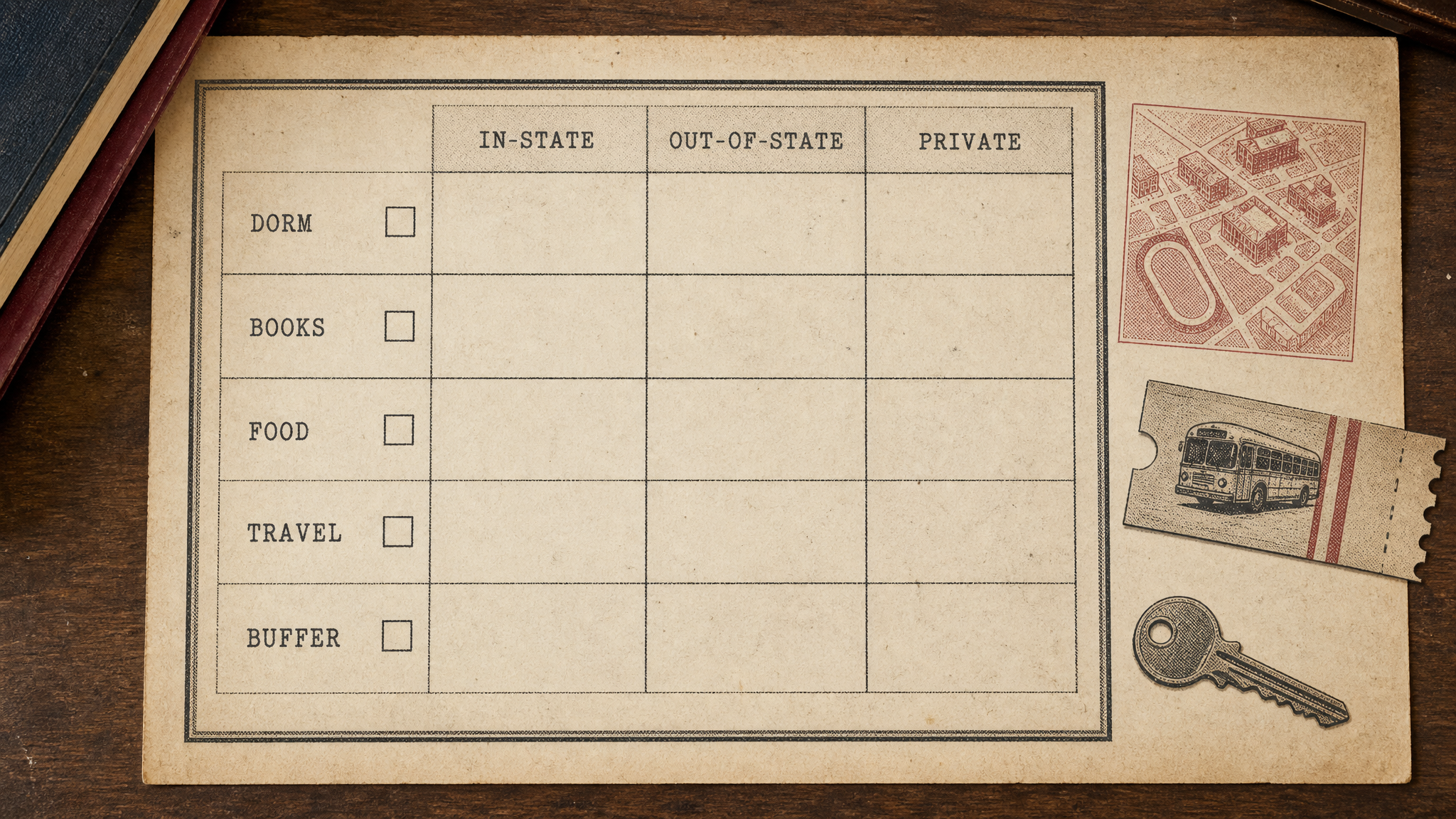
Use the low end if the student is close to home, reusing household items, has a modest course-material list, and can avoid major travel. Use the high end if the student is flying, shipping boxes, buying cold-weather gear, replacing tech, or moving into an apartment.
And remember: this is not a morality play. Some families will buy everything new because time is the scarce resource. Some will thrift half the room and win. Some will do a chaotic hybrid involving one heroic aunt with a Costco membership. Fine.
The forbidden rule is that the right college budget is the one honest enough to survive contact with move-in day.
You can’t budget for surprises. You can budget for things that have happened to every other family.

 Forbidden Finance