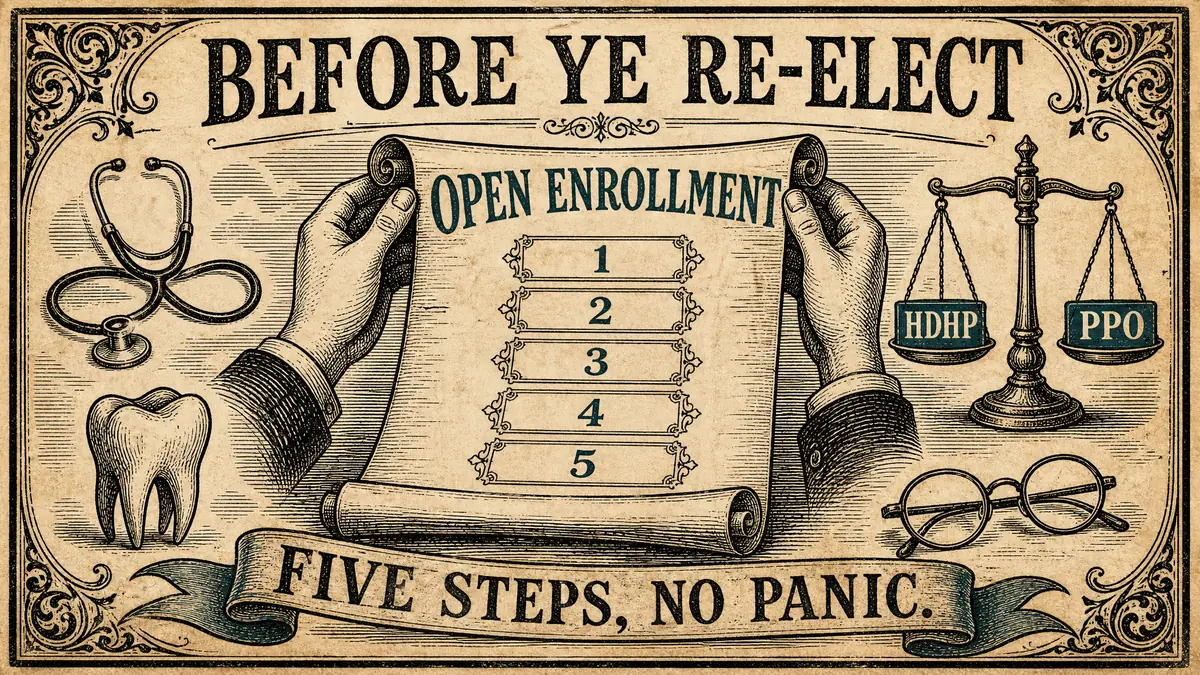
Open Enrollment Is Coming. Your Old Choices Are Not Sacred.
Mid-September is the perfect time to do the least glamorous two-hour errand in personal finance: preparing for open enrollment before HR sends the portal link and the 47-page benefits booklet with one useful paragraph hiding on page 31.
The danger is not that you pick the wrong plan on purpose. Nobody wakes up craving a preventable deductible incident. The danger is that you click “re-elect” because last year’s choices feel familiar, and familiar feels cheaper than thinking.
But your life changed. Maybe you added a medication, stopped therapy, got glasses, had a kid, lost a dependent, changed salary bands, moved, started allergy shots, or finally admitted that your knee makes a sound it should not make. That is not a budgeting failure. That is Tuesday.
And benefits are sticky. The Department of Labor explains that group health plans must offer special enrollment rights for certain events, like losing other coverage, marriage, birth, or adoption, but that does not mean you can casually rewrite your whole benefits setup whenever you regret October. The button matters.
TL;DR
- Do the boring math before the benefits portal opens, not while HR’s countdown clock is blinking at you.
- Compare actual spending, FSA/HSA balances, and salary-level tax impact before copying last year’s elections.
- Your old plan may still fit, but it has to audition again.
Step 1: Pull the Last 12 Months of Medical, Dental, and Vision Spending
Start with reality. Not vibes. Not “I think we barely used the plan.” Pull the last 12 months of actual spending across medical, dental, vision, prescriptions, therapy, urgent care, labs, imaging, and anything else that showed up wearing a tiny paper bracelet.
Grab these numbers:
- Premiums you paid through payroll.
- Deductible spending.
- Copays and coinsurance.
- Prescription costs.
- Dental cleanings, fillings, crowns, orthodontia, and the bill that made you stare silently into the fridge.
- Vision exams, glasses, contacts, lens upgrades, and contact solution if your FSA allows it.
- Out-of-network charges and denied claims.
You are building a personal claims history, not a museum exhibit. Messy is fine. Better a rough total you can use than a perfect spreadsheet you abandon after line four.
Places to check:
- Health insurer claims portal.
- Pharmacy account history.
- Dental and vision carrier portals.
- HSA or FSA transaction history.
- Bank and credit card search for provider names.
- Payroll deductions for premium totals.
This is also where a broader money audit helps. If you already ran something like The Mid-Year Money Reset: A 10-Step Audit to Run Before June Hits, steal that same energy: pull the data, mark the weird stuff, and do not turn one chore into a lifestyle brand.
One forbidden little rule: separate predictable costs from chaos costs. Monthly medication is predictable. A surprise ER visit is chaos. Both matter, but they should not get treated the same way in your next election.
Step 2: Audit Your FSA or HSA Before It Gets Weird
Your FSA or HSA is where open enrollment gets spicy in the least fun way. Same acronyms. Very different consequences. Classic benefits-booklet behavior.
For 2026, the IRS sets HSA contribution limits at $4,400 for self-only HDHP coverage and $8,750 for family HDHP coverage. The same IRS guidance defines 2026 HSA-qualified HDHPs as having minimum deductibles of $1,700 self-only or $3,400 family, with out-of-pocket expenses capped at $8,500 self-only or $17,000 family.
Health FSAs are different. The IRS says the 2026 health FSA salary reduction limit is $3,400, and plans that allow carryover can permit up to $680 to carry over. Your employer’s plan may be stricter, because apparently the benefits gods require suspense.
Pull these details now:
- Current HSA balance, if you have one.
- Current FSA balance, if you have one.
- Amount already reimbursed this year.
- Remaining planned expenses before December 31.
- Employer HSA seed money for next year.
- Whether your FSA has a carryover, grace period, or true use-it-or-lose-it setup.
Do not treat an FSA like a savings account. Unused FSA money is forfeited unless your employer’s plan specifically allows a grace period or a carryover, and those are optional plan features, not a promise. That sentence should be printed on a tiny warning label and stapled to every “just pick the same number” email.
If you underfunded your FSA last year, you left tax savings behind. If you overfunded it, you may have spent December buying extra contact lens solution like a person preparing for optical winter. Neither is a moral issue. It is feedback.
Step 3: Review Last Year’s Election Accuracy
Now judge your old election like a benevolent auditor with a pen and snacks.
Make three columns: expected, actual, and why. The “why” matters more than the miss. You are not trying to predict the future like a wizard with a deductible. You are trying to notice whether last year’s estimate failed because life changed or because your method was bad.
Look for these patterns:
- You picked a high FSA because braces, surgery, therapy, or recurring prescriptions were coming, and the expense actually happened.
- You picked a low FSA because you were scared of forfeiting money, then paid a pile of eligible expenses with after-tax cash.
- You picked an HDHP because the premium was lower, then avoided care because the deductible felt like a locked gate.
- You picked a PPO because it felt safer, then barely used the plan.
- You added voluntary benefits you never touched because the enrollment page made them sound like responsible adult armor.
This is where Which Budgeting Method Is Right for You? sneaks in through the side door. Benefits elections are just another budget method. The right answer depends on the life you are actually running, not the life your October self imagined while speed-reading plan PDFs.
Ask yourself:
- Did I hit the deductible?
- Did I come close to the out-of-pocket max?
- Did I delay care because of cost?
- Did I have known expenses I forgot to include?
- Did anyone in the household gain or lose coverage needs?
- Did my income change enough that pretax contributions feel more or less valuable?
If your plan worked, keep it in the running. If it failed, do not punish yourself with a lecture. Update the inputs.

Step 4: Compare HDHP + HSA vs. PPO at Your Salary Level
The HDHP versus PPO choice is not a personality test. It is math wearing a name badge.
The latest KFF Employer Health Benefits Survey available before this September 2026 enrollment season found that PPOs remained the most common plan type in 2025, with 46% of covered workers enrolled in a PPO and 33% in a high-deductible plan with a savings option. KFF also found average premiums were lower for HDHP/SO coverage than PPO coverage. The catch is in the name: to count as an HDHP/SO at all, a plan needs a deductible of at least $1,000 for single coverage or $2,000 for family coverage. Shocking twist: cheaper monthly premiums often come with more “surprise, pay now” energy.
Your salary level matters because HSA and FSA contributions are generally pretax through payroll, and pretax is worth more when your marginal tax rate is higher. The IRS 2026 brackets put the 22% federal bracket above $50,400 for single filers and $100,800 for married filing jointly, with the 24% bracket above $105,700 and $211,400 respectively. Add state taxes and payroll-tax treatment where applicable, and the math can move.
Compare plans with this mini-formula:
- Annual premium you pay.
- Expected out-of-pocket care.
- Worst-case out-of-pocket max.
- Employer HSA contribution.
- Tax savings from your HSA or FSA contributions.
- Provider access, especially specialists and prescriptions.
Do not stop at premium. Premium is rent for access. Deductible is the cover charge once you actually walk inside.
An HDHP + HSA can fit if:
- You have enough cash to handle the deductible without turning every appointment into a family budget summit.
- Your employer contributes real HSA money.
- You expect low or moderate usage.
- You want portable HSA dollars that can roll forward.
- You can tolerate a bigger bill early in the year.
A PPO can fit if:
- You have recurring care, expensive prescriptions, specialists, therapy, or planned procedures.
- You value predictable copays.
- You have dependents with uneven medical needs.
- Your cash buffer is thin and the deductible would be a genuine problem.
- You use out-of-network care and the PPO handles it better.
If a high-deductible plan only works in your spreadsheet because no one gets sick, the spreadsheet is being cute. People get sick. Knees file complaints.
Step 5: List the Voluntary Benefits Worth a Real Look
Voluntary benefits are the checkout aisle of open enrollment. Some are useful. Some are glitter. Some are a tiny insurance vending machine asking if you fear the future enough to click yes.
SHRM reported that 81% of employers offered PPO plans and 64% offered HDHPs linked with a savings or spending account in 2025. SHRM also found that critical illness insurance was offered by 53% of employers, up for the third straight year, while hospital indemnity had the largest year-over-year increase among the benefits it highlighted. Translation: the add-on menu is not going away.
Here is what deserves a real look:
- Life insurance: Useful if someone depends on your income. Compare employer supplemental rates with outside term-life quotes, especially if you are healthy.
- Disability insurance: Often more important than life insurance for single people, because your paycheck disappearing while you are still alive is financially rude.
- Legal plans: Worth checking if you expect estate documents, adoption paperwork, landlord issues, or other predictable legal chores.
- Pet insurance: Maybe useful for young pets or expensive breeds. Less useful if exclusions eat the whole benefit like a golden retriever with a sock.
- Accident insurance: Can help with set payouts after injuries, but read what triggers payment and what your health plan already covers.
- Critical illness or hospital indemnity: Useful only if the payout rules match your risk and you are not buying it as emotional duct tape.
Your values matter here. If a benefit buys calm in a way your budget can support, fine. If it exists only because the enrollment screen made you feel underinsured for having bones, skip the guilt fog.
For costs that are known but irregular, think like a sinking fund person. Sinking Funds Explained: The One Habit That Makes ‘Surprise’ Expenses Disappear is the same idea in household-budget form: name the expense before it attacks the checking account.
Copy This Worksheet Before You Click Anything
Use this as your two-hour prep sheet. No laminated binder required. HR already has enough binders for all of us.
| Step | What to gather | Where to find it |
|---|---|---|
| 1. Pull 12 months of spending | Premiums, claims, copays, prescriptions, dental, vision, denied claims | Insurer portals, pharmacy account, dental/vision portals, bank search, pay stubs |
| 2. Audit FSA/HSA | Current balance, reimbursed amount, remaining planned expenses, employer contribution, carryover or grace-period rules | FSA/HSA administrator, payroll system, benefits guide, prior reimbursements |
| 3. Review election accuracy | Last year's election, actual use, overfunding, underfunding, care delayed because of cost | Enrollment confirmation, claims history, FSA/HSA transactions, calendar notes |
| 4. Compare HDHP + HSA vs. PPO | Premiums, deductibles, out-of-pocket max, employer HSA money, provider network, prescription coverage | Summary of Benefits and Coverage, plan comparison tool, provider directory, formulary |
| 5. Review voluntary benefits | Life, disability, legal, pet, accident, critical illness, hospital indemnity options | Benefits booklet, carrier PDFs, payroll deductions, outside quote comparisons |
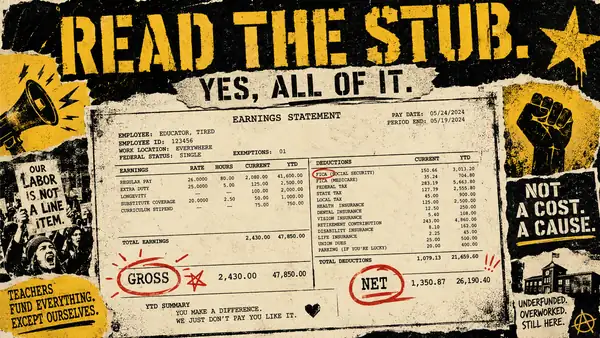
Before you submit, do one final pay-stub check. Your benefits elections hit payroll, and payroll is where good intentions go to become smaller deposits. If that sentence made you squint, start with How to Read a Pay Stub Like You Mean It.
The forbidden move is not picking the cheapest plan or the fanciest plan. It is refusing to pretend last year’s choice is holy just because changing it requires reading a PDF with footnotes.
Two hours in October buys you twelve months of better coverage. Or twelve months of regret.
 Forbidden Finance