Intro: Your Budget Has a Skeleton, Sorry
Most budgets fail in the gap between what you think is coming and what is already on its way.
You open your account and see $1,240. Nice. Adult. Solvent-adjacent. Then rent hits. Then the phone bill. Then the streaming bundle you forgot had upgraded itself from “reasonable” to “luxury cheese board.” Suddenly the $1,240 was not free cash. It was money wearing a costume.
Recurring transactions are the boring little machines that remove the costume.
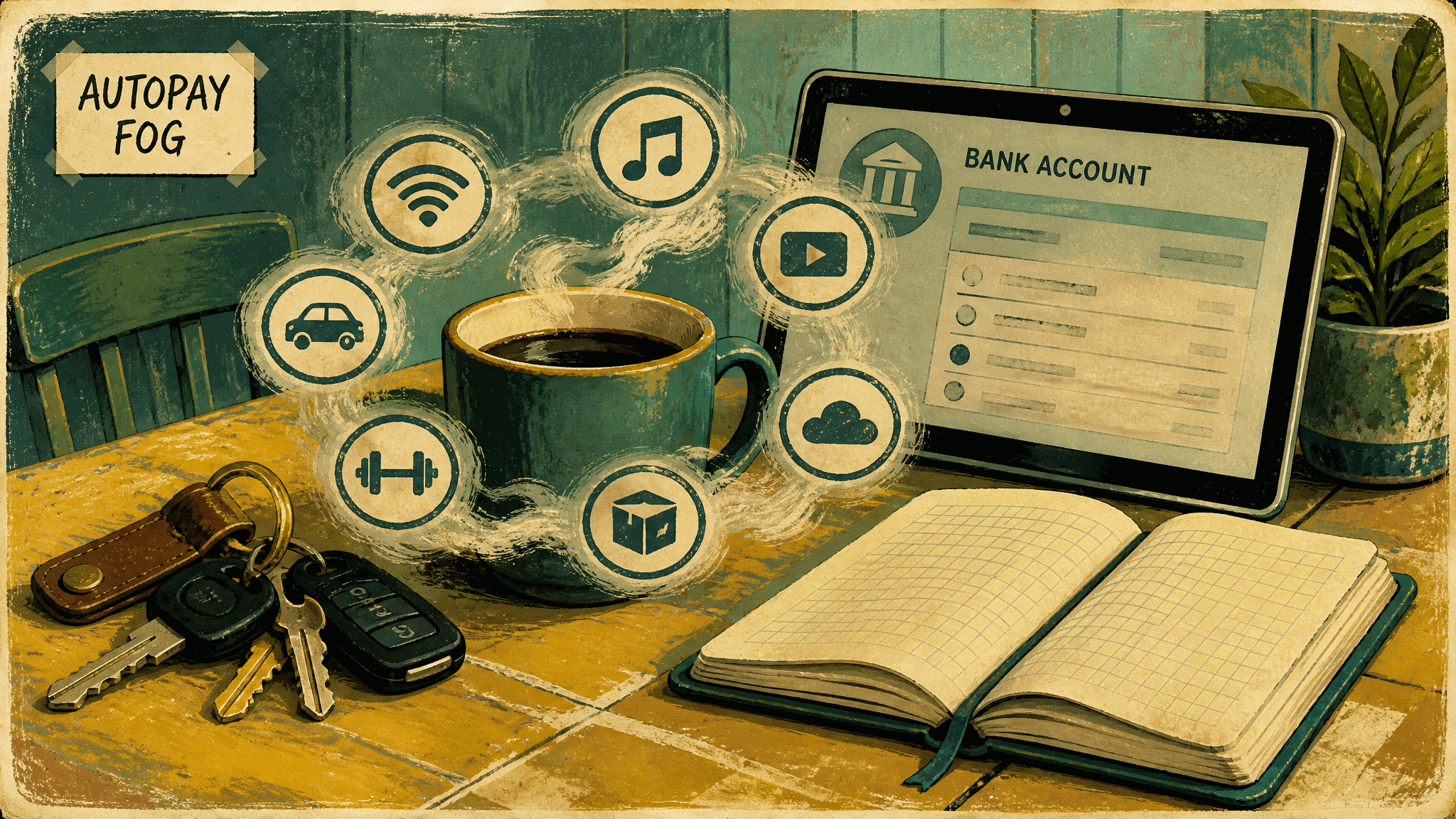
The reason this matters is not theoretical. C+R Research found that consumers initially estimated they spent $86 a month on subscriptions, but an itemized tally put the average at $219. That is a $133 monthly gap, or $1,596 a year. Not because everyone is irresponsible. Because small automatic charges are specifically designed to become wallpaper.
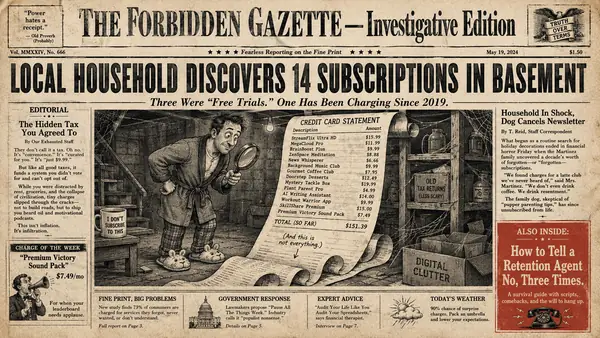
This is also why “just spend less” is such lazy advice. Spend less on what? The coffee you consciously bought, or the $18.99 thing silently billing you while you sleep? The latte is not always your problem. Sometimes your problem is fourteen tiny vampires with excellent UX.
What Recurring Transactions Actually Are
A recurring transaction is any charge or deposit that repeats on a pattern.
Rent. Mortgage. Paychecks. Phone bills. Insurance. Streaming. Gym. Daycare. Student loans. Cloud storage. Pet insurance. The app you downloaded to organize your life and then immediately forgot existed. Strong brand alignment, terrible financial hygiene.
Recurring does not always mean monthly. Some repeat weekly, every two weeks, quarterly, annually, or on weird merchant calendars invented by someone who has never known peace. The useful part is not the label. The useful part is predictability.
Once you can see the repeating structure, your budget stops being a historical document. It becomes a short-term forecast.
That distinction is the whole game. A normal transaction list tells you what already happened. Recurring detection tells you what is probably about to happen. That is the difference between “I had money yesterday” and “I can survive the next two Fridays without accidentally funding chaos.”
If you are still choosing a budgeting style, this works with almost all of them. A zero-based budget uses recurring transactions to assign dollars before they drift off. A looser pay-yourself-first setup uses them to check that the automated savings transfer is not too heroic for the actual month. A spreadsheet can do it too, if you enjoy making VLOOKUPs at 11:43 p.m. We respect the craft.
For the bigger method question, Which Budgeting Method Is Right for You? is the useful place to start. The forbidden answer, as usual, is that the right method depends on your life right now. Annoying. Also true.
How Detection Works Without Needing a Computer Science Degree
Recurring detection sounds fancier than it is. Under the hood, a budgeting tool is usually looking for three things: similar merchant, similar amount, and similar timing.
Merchant matching is the first clue. If “NETFLIX.COM,” “Netflix,” and “Netflix Streaming” all show up, the tool tries to understand that those are probably the same merchant wearing different bank-statement hats. Banks are not famous for poetic consistency. One store can appear as six names, depending on card network, processor, location, and whether Mercury was in retrograde.
Frequency is the second clue. A charge on the 14th of every month is suspiciously organized. So is a deposit every other Friday. So is an annual insurance premium that appears every March like a financially aggressive tulip.
Amount is the third clue. Exact matches are easy. Same merchant, same $12.99, same monthly rhythm. Done. But real life is messier. Utility bills fluctuate. Insurance can change after a renewal. A subscription might add tax. A good detector allows a little wobble without declaring every electric bill a brand-new life event.
Then come heuristics. That is just a formal word for “reasonable guesses with guardrails.” A tool might say: if the merchant name is very similar, the amount is close, and the dates are spaced about a month apart, treat it as recurring. If two of those are true but the third is weird, flag it as possible instead of certain.
No magic. No shame. Just pattern recognition, which is what your brain does too, except your brain is also managing dinner, passwords, and whether that plant is supposed to look like that.
The 30/60-Day Forecast: Your Real Free Cash
Here is the practical move: take your current balance, subtract upcoming recurring debits, add expected recurring income, and look at what remains.
That remaining number is closer to true free cash than your bank balance.
The bank balance is a snapshot. A recurring forecast is a weather report. If your account says $2,400 today but $1,950 of known bills are landing over the next 30 days, you do not have $2,400 to play with. You have $450, plus whatever new income arrives before the bills do.
This is where recurring transactions become useful even if you hate budgets. You do not need a twelve-category moral inventory. You need to know whether buying concert tickets today means overdraft theater next Thursday. (Terrible seats, expensive snacks.)
The CFPB also reminds consumers to monitor accounts after revoking automatic-payment authorization, because stopping the bank payment and canceling the underlying contract are not always the same thing. That matters for forecasting. A charge you think is gone may still be limping toward your account unless both sides are handled.
Here is a simple 60-day example. Assume you start with $2,400 and only list the predictable debits. Income would make the picture better, but the point here is to see the bills already queued up.
| Date | Expected debit | Running balance |
|---|---|---|
| Sept. 16 | Rent, $1,350 | $1,050 |
| Sept. 18 | Internet, $82 | $968 |
| Sept. 22 | Car insurance, $146 | $822 |
| Sept. 29 | Streaming bundle, $31 | $791 |
| Oct. 1 | Student loan, $220 | $571 |
| Oct. 7 | Phone, $96 | $475 |
| Oct. 16 | Rent, $1,350 | -$875 |
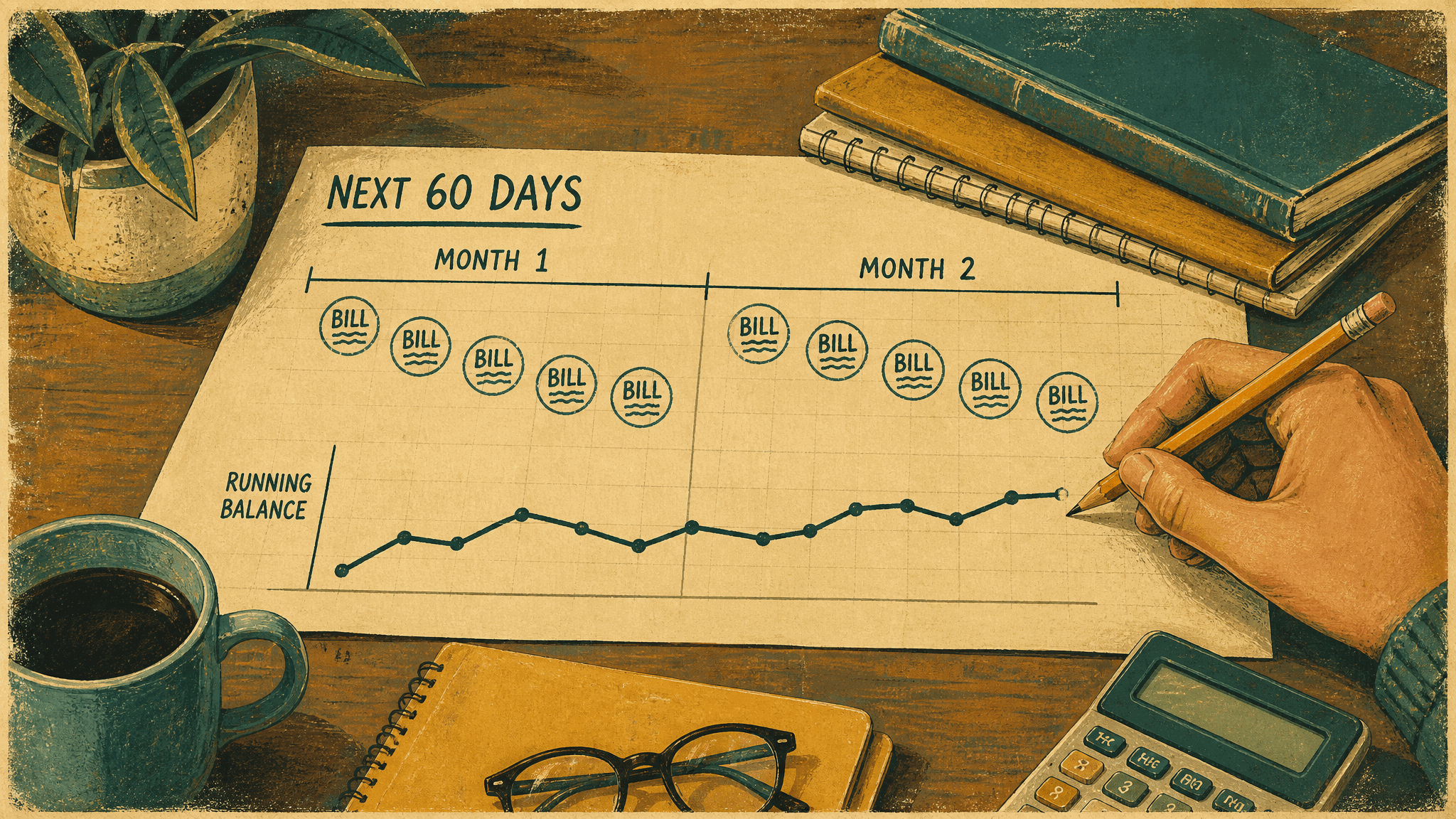
That negative number is not failure. It is a warning light with enough time attached to be useful. Maybe a paycheck lands before then. Maybe rent is actually on the 18th. Maybe you need to move one optional payment or delay a transfer. The point is that now you are negotiating with the calendar before the calendar kicks in the door.
If your expenses are irregular, recurring detection still helps because it separates the known from the weird. Then you can handle the weird with a buffer or sinking fund. Sinking Funds Explained: The One Habit That Makes ‘Surprise’ Expenses Disappear is the companion piece for that part.
The Price-Creep Audit
Recurring detection is not only about finding forgotten subscriptions. It is also about catching subscriptions that stayed visible but quietly got more expensive.
That is the price-creep audit.
Open each recurring merchant and compare today’s charge with the oldest matching charge you can find. Do not ask, “Do I still use this?” yet. That question gets emotional fast. First ask a colder question: “What did this cost before, and what does it cost now?”
Streaming is the cleanest example because the increases are easy to miss. Deloitte reported that surveyed U.S. SVOD subscribers said their total streaming cost rose 13% in the prior year, from $61 to $69 per month on average, while the average number of paid services stayed at four. Same pile of apps. Bigger bill. Fun little trap door.
Nielsen’s Gracenote also found in its 2025 State of Play report that 45% of streaming users said the experience was overwhelming, and 49% were willing to cancel a service if finding something to watch was difficult. That is useful audit data. If a service costs more and makes you spend twelve minutes hunting for anything decent, it has volunteered for review.
Use four buckets:
- Keep: you use it, value it, and the price still makes sense.
- Downgrade: you still want it, but not at the fancy tier.
- Rotate: cancel now, return when a specific season, sport, or project comes back.
- Kill: you forgot it existed, which is a strong product review.
This is where Sub-Hunting: How to Find $50-$200/Month Hiding in Your Recurring Charges goes deeper. The short version: do not look for one dramatic villain. Look for eight small charges wearing invisibility cloaks and billing politely.
A $3 increase is not a crisis. Eight $3 increases are lunch money, gas money, or the exact amount that makes you mutter at your bank app in public.
The forbidden move is not “cancel joy.” Keep the service that makes Friday night better. Keep the gym if you go. Keep the meditation app if it prevents you from answering work email like a haunted fax machine. Just make the charge re-earn its place.
Closing: Boring Is the Point
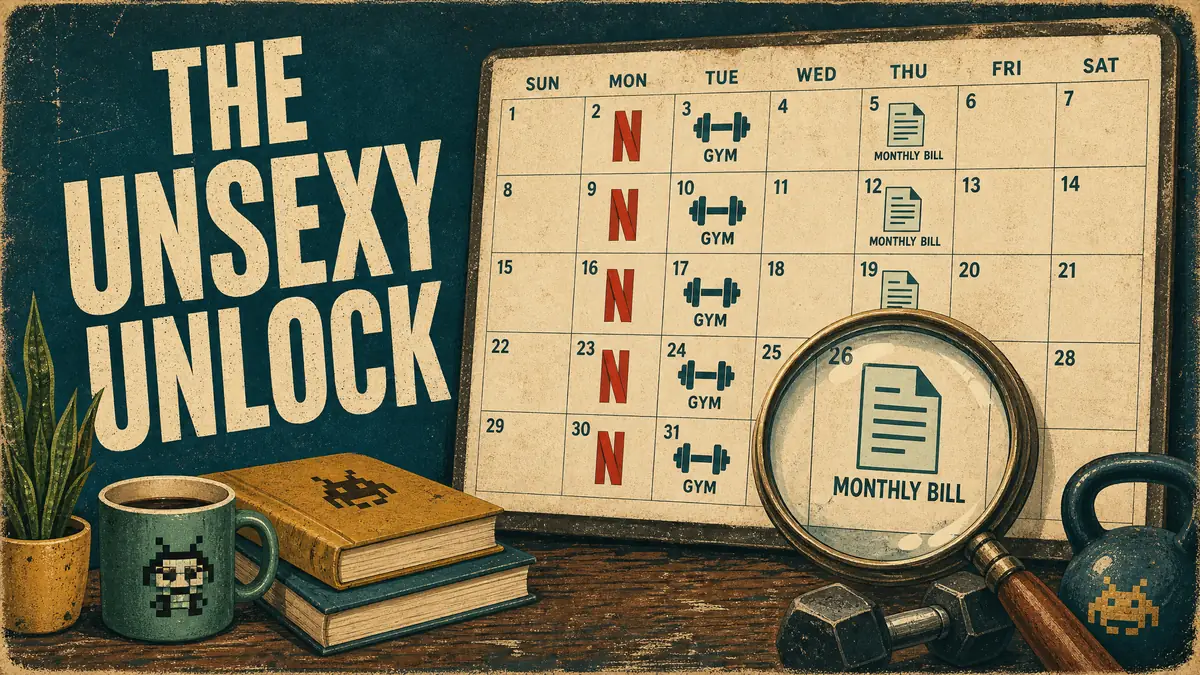
Recurring transactions will never be the sexiest feature in a finance app. They do not sparkle. They do not promise that you will become a millionaire by Tuesday. They mostly sit there, recognize patterns, and make the future less blurry.
That is exactly why they matter.
A budget without recurring transactions is a rearview mirror. Helpful, but not enough. A budget with recurring transactions becomes a calendar, a cash-flow forecast, and a subscription audit all at once. It tells you what is already committed before you make new decisions with money that was never truly available.
Use a budgeting app. Use a spreadsheet. Use a notebook with three columns and a pen you stole from a hotel. The tool matters less than the habit: identify what repeats, project it forward, and check whether the old price is still the real price.
The most boring feature is also the one doing the most work. Like all good infrastructure.
 Forbidden Finance