Most budgeting apps feel like punishment with charts
Let’s be honest: most budgeting apps feel like they were designed by someone who thinks buying a coffee is a moral failure.
You open the app, it gives you a color-coded guilt spiral, and suddenly your financial life is being judged because you ordered takeout twice in one week. Apparently, if you are not meal-prepping lentils and logging every toothpaste purchase with monk-like discipline, you have “failed at budgeting.”
Very inspiring. Very sustainable.
That whole approach is exactly why so many people quit.
Not because they do not care about their money. Not because they are reckless. And definitely not because they need another lecture from an app that acts like a disappointed guidance counselor. People quit budgeting because most finance tools take something already stressful and turn it into homework with shame notifications.
We built Forbidden Finance because we thought there had to be a less annoying way to do this.
Personal finance is personal. Revolutionary, apparently.
The big problem with most budgeting apps is not that they lack charts, calculators, or another dashboard pretending to fix your life. It is that they assume everyone should manage money the same way.
That has never made sense.
Some people need a simple system that keeps things clear without turning every purchase into a philosophical crisis. Some want a more reflective approach that helps them understand their habits. Some are trying to get out of survival mode. Some are aiming for financial independence and want to track net worth, investments, and long-term FIRE projections with the intensity of a person who absolutely has a favorite spreadsheet tab.
These are not the same person. So why are they always being handed the same budgeting method?
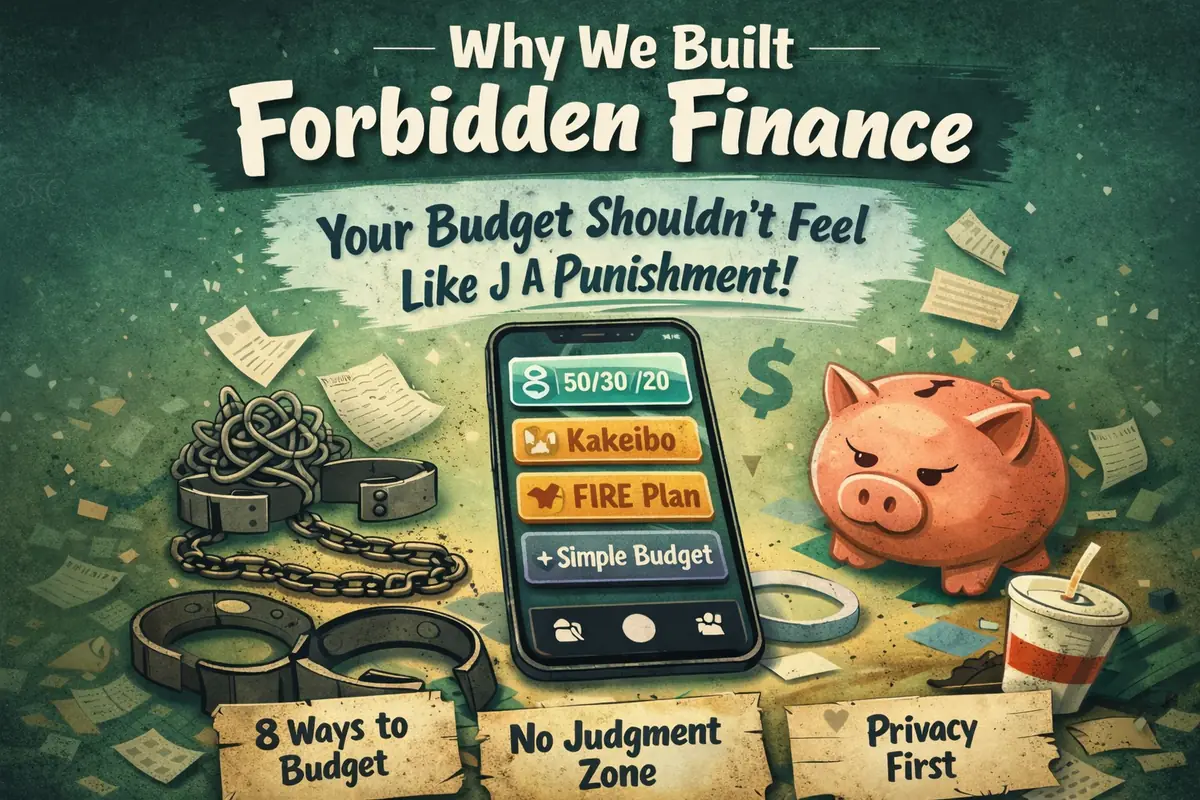
Forbidden Finance was built around the idea that people are different, and their budgeting tools should act like it. That is why we support eight distinct budgeting methods, from the familiar 50/30/20 rule to Japanese Kakeibo to more long-range FIRE-focused planning.
Not because more options are automatically better. Because forcing everyone into one rigid system is exactly why so many people give up.
The best budgeting method is not the one someone on the internet says is superior. It is the one that actually fits your life and that you will still be using three months from now.
It should work whether you are just starting or planning your escape
A person just starting out should not need to become a personal finance hobbyist overnight.
If you want to track your accounts manually, build a simple budget, and get your bearings without paying for a giant stack of features you do not need yet, you should be able to do that. That is exactly why the free tier exists.
But if you are further along, and you want to track investments, monitor net worth, and model your path toward financial independence, you should not have to abandon your app and stitch together some cursed workflow involving three subscriptions and a spreadsheet with seventeen tabs.
Most finance apps are weirdly committed to meeting you in exactly one phase of life and then becoming useless the moment you evolve. They are either too simple too fast or too complicated too soon.
We wanted something that could grow with you instead.
Switching finance apps should not feel like filing an appeal
We also know one of the fastest ways to make someone hate a finance app is to make them rebuild their financial history from scratch.
Nothing says “welcome” like spending your Saturday night manually fixing column headers because one app exported dates differently from another.
So importing had to be painless.
If you are coming from YNAB, Mint, or Monarch, Forbidden Finance can auto-detect the file format so you do not have to manually map every column like a punished office intern. If your data is coming from somewhere else, generic CSV and JSON imports are supported too, with mapping available when needed.
Because migrating your money should not feel like arguing with a spreadsheet at 11:30 p.m.
Shared finances should not require a referee
Money gets more complicated the second another human is involved.
One person tracks every expense immediately. One person thinks receipts are more of a suggestion. Both somehow still have strong opinions about the grocery budget.
Shared finances should not require a mediator.
That is why households can share accounts with role-based permissions like Viewer, Editor, and Admin, and see spending broken out as Yours, Mine, and Ours. Simple in concept. Extremely useful in practice.
Because the goal is clarity, not turning every shared Target run into a courtroom exhibit.
Privacy should not be the edgy option
We also cared a lot about privacy, because somehow in modern finance tech, “we do not sell your data” sounds rebellious when it should just be the bare minimum.
Forbidden Finance is privacy-first by design. We use self-hosted authentication rather than handing identity off to another giant auth middleman. Bank tokens are encrypted with AES-256-GCM.
For US users, bank syncing is available through Plaid. UK and EU bank support is on the way.
Which means yes, we want this to be useful in real life, not just in a polished launch demo.
And yes, it will be available on iOS, Android, and Web, because your financial life does not happen in one place and your app should probably know that by now.
Why we built Forbidden Finance
At the end of the day, Forbidden Finance is really about rejecting the parts of personal finance that never should have been normal in the first place.
The shame.
The rigidity.
The fake simplicity.
The idea that there is one correct way to manage money and everyone who struggles just needs to “try harder.”
No thanks.
We did not build Forbidden Finance to lecture people. We built it to make money management more flexible, more useful, and way less insufferable than what is already out there.
Personal finance should help you feel more in control, not more judged.
That is the whole point.
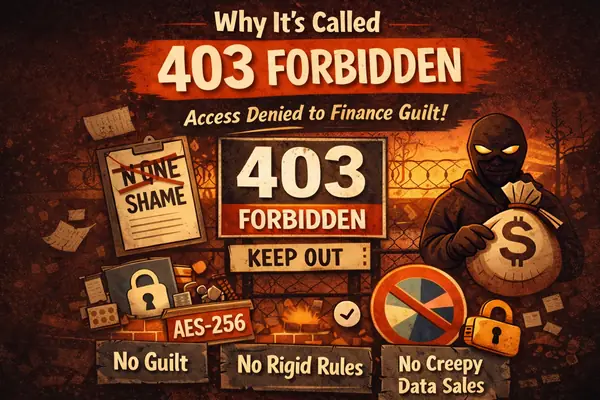
Wondering where the name came from? Read: Why It’s Called 403 Finance: The Meaning Behind Forbidden Finance.
 Forbidden Finance