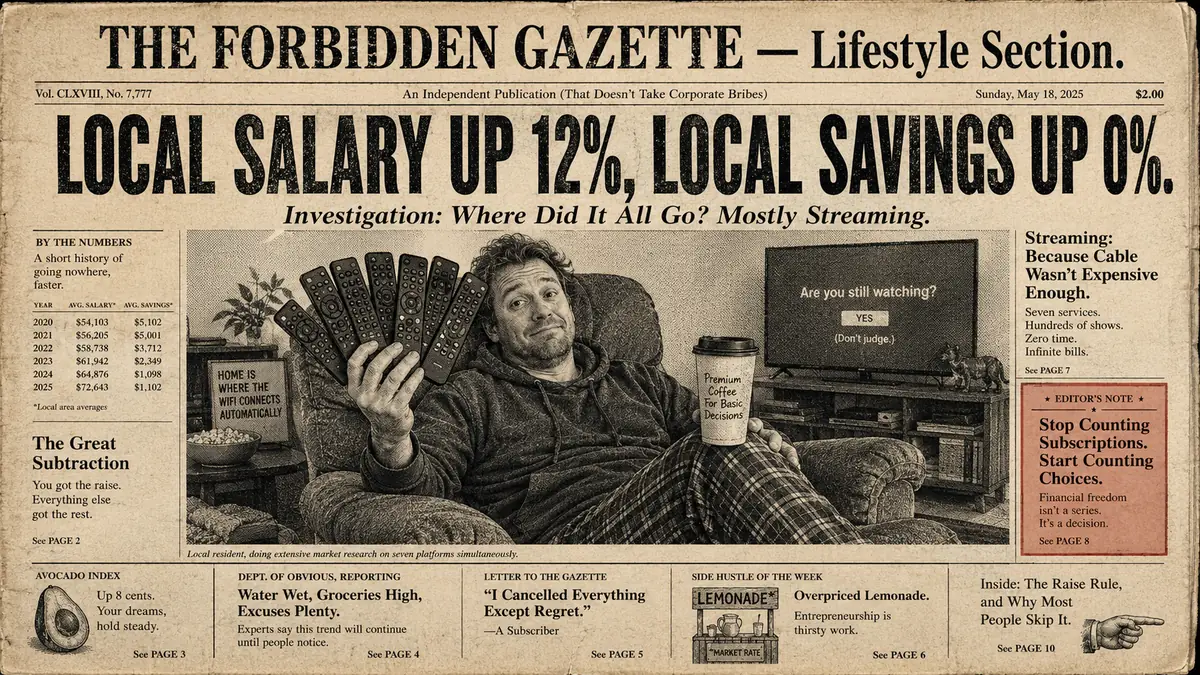
Lifestyle Creep Is Spending Drift, Not Sin
The first sign is usually not a yacht. It is a $9 coffee you do not remember buying, three streaming apps you forgot existed, and a rent payment that somehow got promoted to executive vice president.
Lifestyle creep is the quiet rise in your spending as your income rises. You earn more, so your normal gets more expensive. Not dramatically. Politely. Like it brought a bottle of wine and then moved into the guest room.
This is not a moral failure. It is just physics. The BLS reported average annual consumer-unit spending of $78,535 in 2024, with the highest income quintile averaging $150,342. Higher income does not merely create more room to save. It also creates more room for nicer defaults.
The BEA put the U.S. personal saving rate at 2.6% in April 2026, a useful reminder that savings rates are not personality traits. They are outputs. Inputs change. Rent changes. Kids happen. A raise lands and suddenly your checking account starts acting suspiciously well-dressed.
Behavioral economists Frederick and Loewenstein called this hedonic adaptation: the new nice thing becomes normal faster than your budget spreadsheet can say, "Excuse me?"
If you want a budget style that matches your actual life stage, not some one-size-fits-all money sermon, start with Which Budgeting Method Is Right for You?. Lifestyle creep is easier to catch when the system fits the human using it.
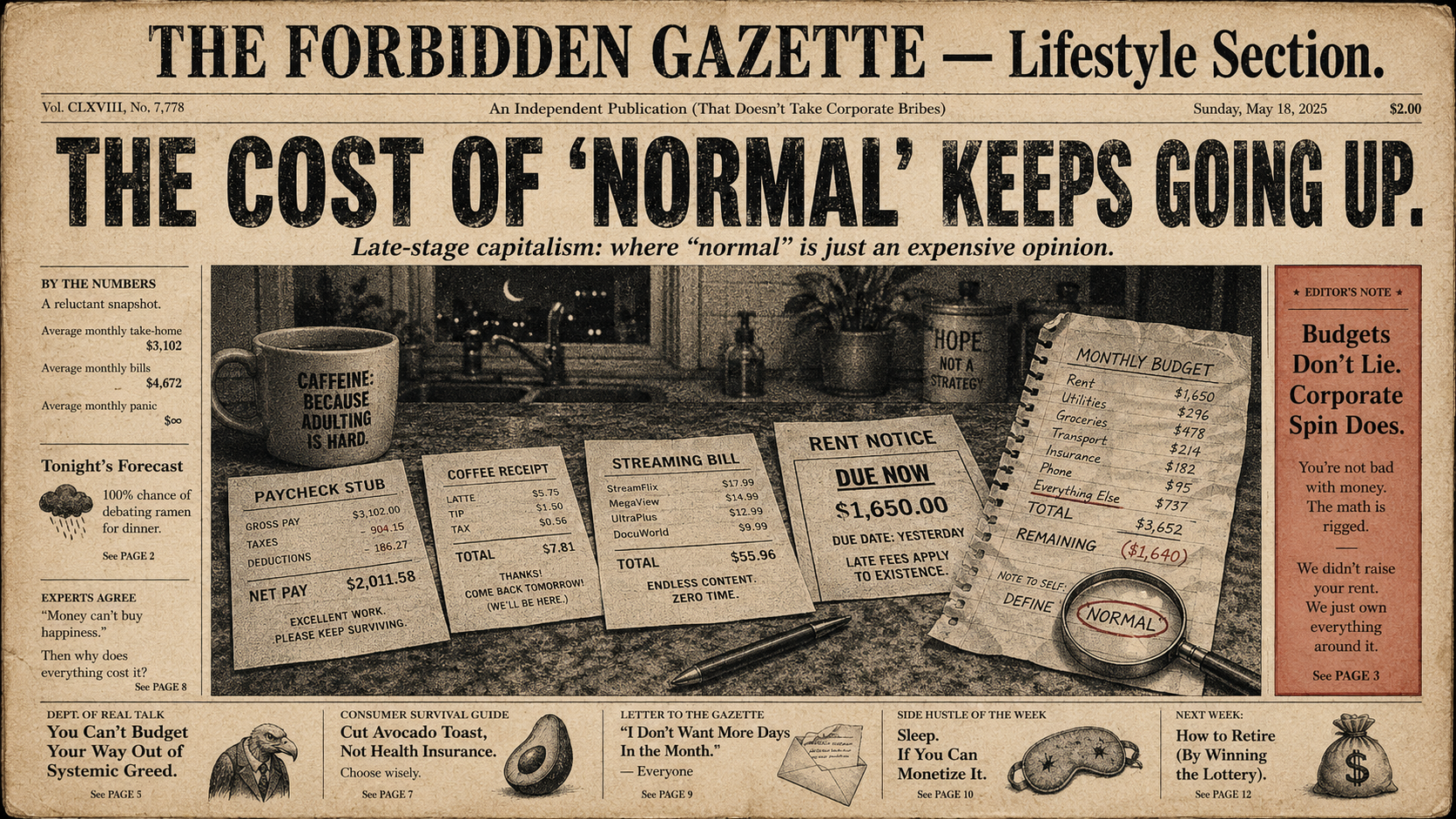
Signal 1: Subscription Bloat
Subscription bloat is the most polite version of money leakage. Nothing looks outrageous alone. $7.99 here. $12.99 there. A cloud storage plan because your phone screamed at you in public. A meal app. A fitness app. A meditation app you opened once and then immediately needed meditation about.
The problem is not subscriptions. The problem is subscriptions that outlive their job.
A useful test: if every recurring charge had to re-apply for its place in your life this month, which ones would get rehired?
- Keep the ones you use without resentment.
- Cancel the ones you keep "just in case."
- Pause the ones you only remember after the charge posts.
This is where creep gets caught early because recurring charges tell the truth. They do not care about your intentions. They just show up wearing tiny automatic-payment shoes. For a deeper cleanup, read Your Forgotten Subscriptions Are Bleeding You Dry.
Signal 2: Small Upgrades That Compound
The latte is not your problem. The pattern might be.
Small upgrades become lifestyle creep when premium becomes the new default everywhere: premium gas station snack, premium coffee, premium grocery store, premium delivery window, premium version of the thing you used to buy without consulting a mood board.
The BLS 2024 data shows spending spread across ordinary categories that touch daily life: food, transportation, personal care, entertainment, housing. That is why creep hides so well. It does not need one giant villain expense. It has committees.
Try the downgrade audit, which sounds sad but is mostly funny. Pick one category and ask: would the basic version make my life meaningfully worse?
- Store-brand pasta? Probably fine.
- The coffee that makes mornings less feral? Maybe keep it.
- The upgraded gas-station drink that costs more than a small mutual fund contribution? We should talk.
This is not about becoming cheap. It is about making the upgrade earn its seat. If spending reflects what you actually care about, Values-Based Budgeting: Spend Money on What Actually Matters (Forbidden Concept, We Know) is the less annoying way to sort the keepers from the freeloaders.
Signal 3: Dining-Out Drift
Dining-out drift starts as a weekend treat and becomes default Tuesday lunch. Nobody announces it. One day you are celebrating Friday. A few months later you are paying $18 for a desk salad with the emotional range of wet cardboard.
The BLS reported average food-away-from-home spending of $3,945 in 2024. That number is not a commandment. Some households are busy, some are tired, some are feeding toddlers who believe all meals should be beige. Life has terms and conditions.
The signal is the rolling delta: the gap between what dining out was supposed to be and what it became.
Ask two questions:
- Which meals still feel like enjoyment?
- Which meals are just logistics with a tip screen?
Keep the joy. Cut the autopilot. Brunch reservation, $80. Pretending the wait time is part of the experience, free.
Signal 4: The Housing-Cost Ratchet
Housing creep is the big one. The latte discourse is loud because coffee is visible. Rent and mortgages are quieter because they arrive wearing adult pants.
The danger is the housing-cost ratchet: every move is 15% to 25% up. First it is more space. Then a better neighborhood. Then a garage. Then a second bathroom because everyone deserves dignity and fewer hallway negotiations.
Better housing can be worth it. The forbidden point is not "never upgrade." It is "make the upgrade compete against everything else your future wants." The BLS found housing was 33.4% of average annual expenditures in 2024, and housing was the only major category with a statistically significant increase that year.
Before each move, price the new place against your savings rate, not your old rent. Old rent is history. Your savings rate is the pulse.
A 20% housing bump can feel normal after three months. Your retirement account does not adapt as politely.
Signal 5: Kid-Cost Expansion
Kids are wonderful. Kids are also tiny subscription bundles with shoes.
Kid-cost expansion rarely looks silly in isolation. Tutoring, sports, camp, birthday parties, school pictures, childcare gaps, clothes that fit for eleven minutes, the snack economy. You do not buy "lifestyle creep." You buy cleats. Then replacement cleats. Then a tournament hotel because apparently children now have away games like regional sales directors.
The latest official USDA child-cost estimate, for a child born in 2015, projected $233,610 from birth through age 17 for a middle-income married-couple family, excluding college. The report also found higher-income families were projected to spend much more. Translation: kid costs expand into available space.
The catch is not to deny your kids good things. The catch is to notice when every "good thing" becomes mandatory.
- Pick the paid activities that genuinely matter.
- Let some boredom remain free.
- Build kid costs into sinking funds before the season starts.
No shame. Just logistics. Parenting already comes with enough surprise fluids.
The 5% Math: A Small Creep Becomes a Missing Salary
Now for the part where the spreadsheet removes its sunglasses.
A savings rate is just the share of income you keep. The BEA uses the same basic idea at the national level: personal saving as a percentage of disposable personal income.
Here is a simple household example. Salary starts at $100,000 and grows 3% per year. The original plan saves 20%. Lifestyle creep pulls the household down to 15%. That five-point gap is not dramatic in any single month. Over ten years, it is loud.
| Year | Salary | Savings Rate | Gap to Original Baseline |
|---|---|---|---|
| 1 | $100,000 | 15% | $5,000 |
| 2 | $103,000 | 15% | $5,150 |
| 3 | $106,090 | 15% | $5,305 |
| 4 | $109,273 | 15% | $5,464 |
| 5 | $112,551 | 15% | $5,628 |
| 6 | $115,927 | 15% | $5,796 |
| 7 | $119,405 | 15% | $5,970 |
| 8 | $122,987 | 15% | $6,149 |
| 9 | $126,677 | 15% | $6,334 |
| 10 | $130,477 | 15% | $6,524 |
| 10-year total | n/a | 15% vs. 20% | $57,319 |
That is $57,319 in contributions alone. If those missed dollars would have been invested and compounded at 7% annually for 15 years from the start of the example, they grow to roughly $109,000. That is about one starting salary gone missing, and nobody even got a villain monologue.
If your creep happens gradually, the early damage is smaller and the late damage is larger. The useful lesson survives: five percentage points can quietly eat a future year of work.
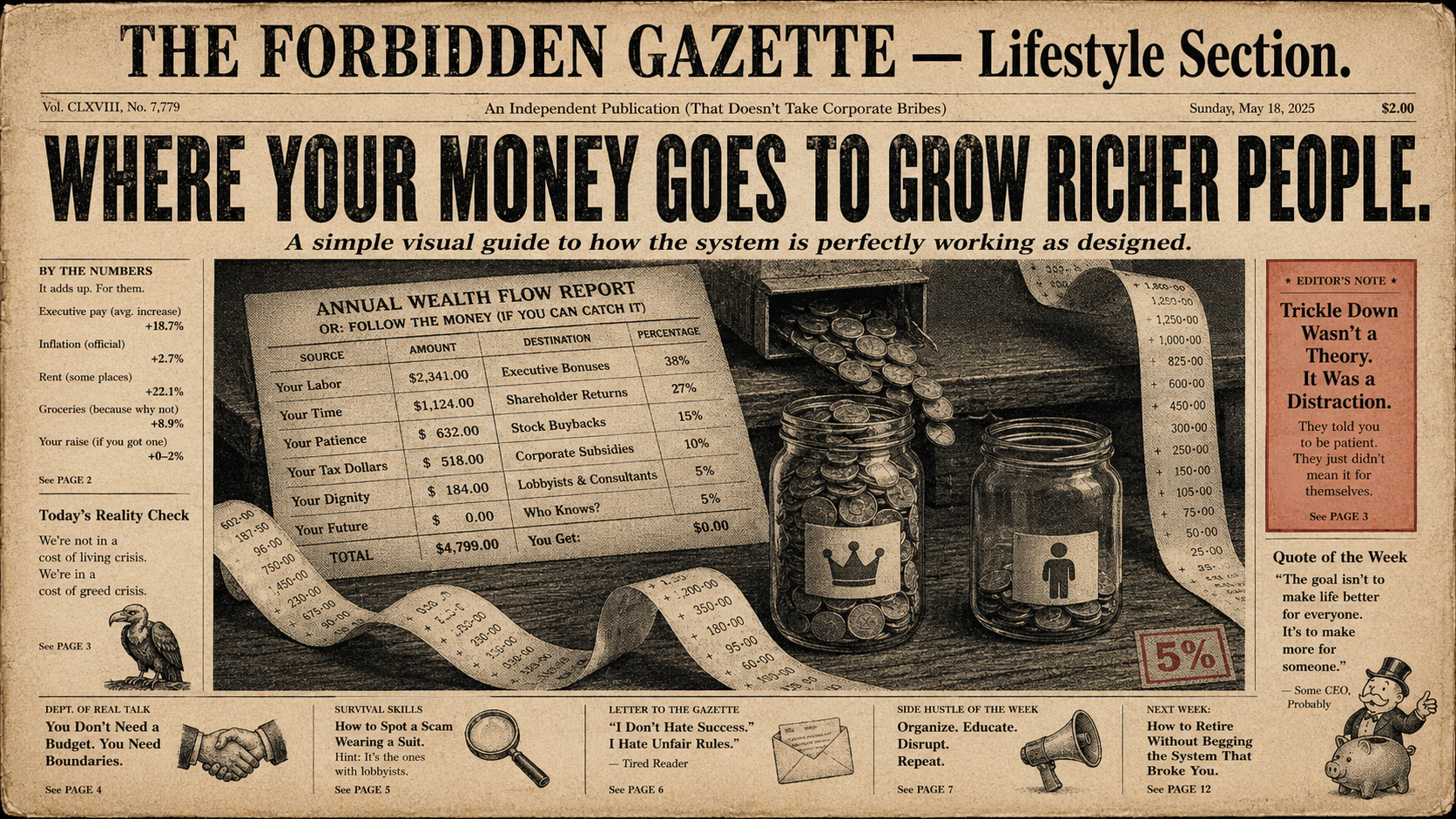
The Raise Rule
The raise rule is simple: whenever income increases, route 50% of the increase to savings or investing automatically before it lands in checking.
Raise, bonus, side-hustle money, retention payout, freelance invoice, the mysterious reimbursement you forgot about. Half goes to future you. Half goes to current you.
This works because it does not ask you to be heroic every month. It catches the money at the border. Very forbidden. Very boring. Very effective.
Example: your take-home pay rises by $600 a month. Set an automatic transfer or payroll contribution for $300. The remaining $300 can upgrade life without letting the whole raise disappear into premium-normal fog.
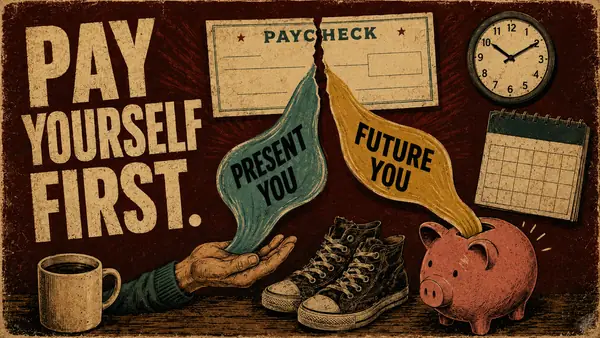
This is the same spirit as Pay Yourself First: The Forbidden Art of Not Tracking Every Latte. You are not trying to inspect every receipt like a suspicious nightclub bouncer. You are deciding the split before lifestyle creep gets a vote.
And yes, you can spend some of the raise. Please do. Life is not a spreadsheet punishment ritual. The point is to enjoy the raise without donating the whole thing to future background noise.
Lifestyle creep is easiest to stop at the income increase. After the money becomes normal, cutting it feels like loss.
The forbidden secret is that every raise is a fork in the road. Pick which version of you gets it.
 Forbidden Finance