HR has handed you a benefits PDF with 47 pages, six acronyms, and the emotional warmth of a parking ticket.
Somewhere inside it, your future self is either saving hundreds in taxes or accidentally paying extra for a plan you picked because the deductible looked less terrifying at 11:42 p.m.
Open enrollment is not a personality test. It is not a loyalty oath to Team PPO or Team HSA. It is math wearing a lanyard.

TL;DR
- HDHP+HSA usually wins for healthy savers who can fund the HSA and handle surprise bills.
- PPO can win when regular care, prescriptions, or family claims push you toward the out-of-pocket max.
- Your employer’s premiums, HSA seed, deductible, network, and drug tiers decide the answer.
The Four Doors HR Pretends Are Equally Great
Your employer may describe every plan as thoughtfully designed, flexible, and valuable. Sure. And every airport sandwich is artisanal.
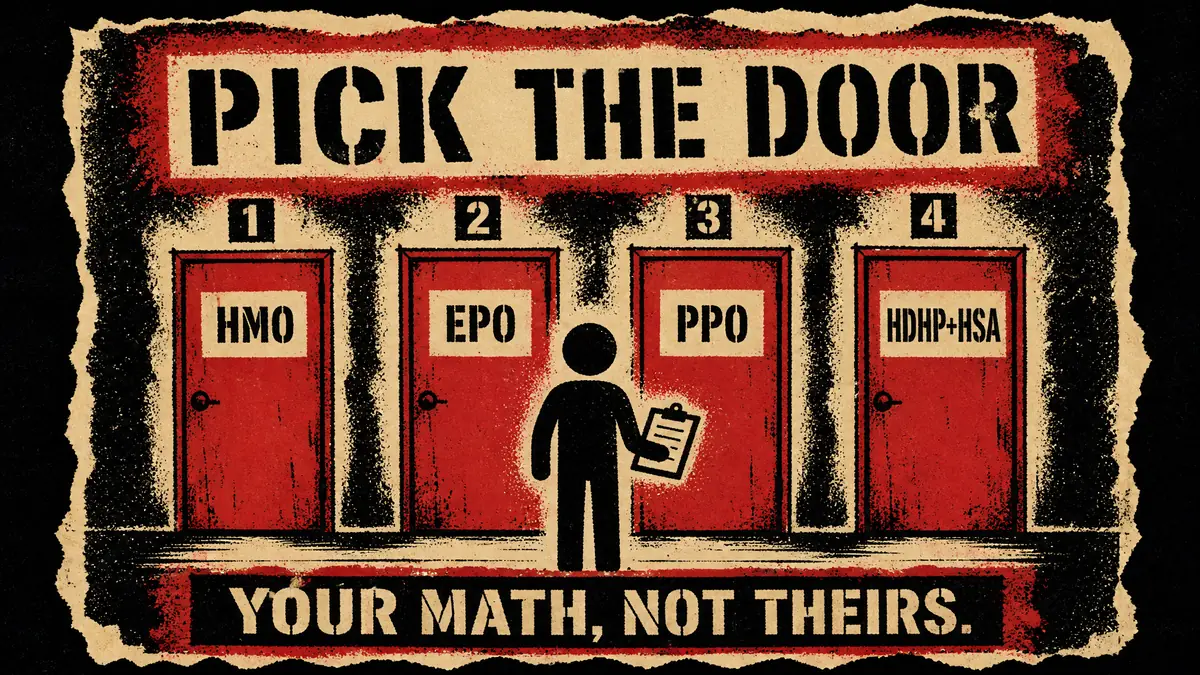
Start with the basic architecture. HealthCare.gov defines EPOs as plans that generally cover care only in-network except emergencies, HMOs as plans that usually limit coverage to contracted doctors, and PPOs as plans that let you go out-of-network without a referral, usually for more money. An HDHP is a high-deductible health plan, and if it is HSA-eligible, it can pair with the account everyone either ignores or accidentally turns into a retirement cheat code.
| Plan type | Network rules | Referrals | Typical premium | Typical deductible |
|---|---|---|---|---|
| HMO | Usually in-network only, except emergencies | Often required for specialists | Lower | Lower to medium |
| EPO | In-network only, except emergencies | Usually not required | Lower to medium | Medium |
| PPO | In-network is cheaper; out-of-network is allowed | Usually not required | Higher | Lower to medium |
| HDHP+HSA | Depends on whether the underlying plan is HMO, EPO, or PPO style | Depends on plan design | Often lower | Higher by design |
That last row is where people get tripped. HDHP is not a network type. It is a cost-sharing structure. You can have an HSA-eligible plan with different network rules, which is why picking by acronym alone is how adults with mortgages end up whispering at provider directories like they are ancient scrolls.

The HSA Part Everyone Underprices
For 2027 coverage, the IRS says an HSA-compatible HDHP must have a deductible of at least $1,750 for self-only coverage or $3,500 for family coverage, with HDHP out-of-pocket expenses capped at $8,700 self-only or $17,400 family. The 2027 HSA contribution limit is $4,500 self-only or $9,000 family.
That matters because the HSA is not just a medical shoebox. If contributions go through a cafeteria plan at work, IRS Publication 15 says they are not wages for federal income tax withholding or employment taxes. Translation: the tax shield can include federal income tax plus FICA, not just a cute little deduction you remember in April.
At $75,000, a single filer using the 2026 standard deduction lands in the 22% federal bracket before the HSA math. At $150,000, that same simplified single filer lands in the 24% bracket, based on the IRS 2026 brackets. Add the employee FICA rate, 6.2% Social Security plus 1.45% Medicare from the Social Security Administration, and the HSA tax break gets very real, very fast.
This is the forbidden bit: the higher deductible is not automatically bad. It is bad if you cannot cover it. It is annoying if you can. It is potentially profitable if the lower premium, employer HSA contribution, and tax shield outrun the extra medical costs.
For a deeper HSA rabbit hole, read HSA: The Most Misunderstood Account in American Finance. Bring snacks. Maybe a spreadsheet.
The Comparison Assumptions
The latest KFF Employer Health Benefits Survey shows average single deductibles of $1,337 for PPO workers with deductibles and $2,578 for HSA-qualified HDHP workers in 2025. KFF also found average employer HSA contributions of $690 for single coverage.
Mercer reported a similar shape for large employers: average employee premium contributions of $191 per month for individual PPO coverage versus $109 per month for an HSA plan, with average deductibles of $1,064 and $2,481 respectively. Translation: the HSA plan usually asks you to take more first-dollar risk, then bribes you with lower premiums and tax treatment. Elegant? No. Useful? Often.
For the tables below, assume a single employee choosing 2027 coverage. These are illustrative examples, not quotes from your employer’s plan booklet, which is probably hiding in a portal called something like MyBenefitsCentralPlus.
HDHP+HSA assumptions: $1,308 annual employee premium, $2,500 deductible, $8,000 in-network out-of-pocket max, $750 employer HSA seed, and $3,750 employee payroll HSA contribution to reach the 2027 self-only HSA limit.
PPO assumptions: $2,292 annual employee premium, $1,100 deductible, $4,000 in-network out-of-pocket max, and no HSA.
All-in cost means annual premiums plus current-year medical out-of-pocket costs, minus the employer HSA seed and HSA tax shield for the HDHP. Your own HSA contribution is not counted as a cost because it remains your money unless you spend it.
The $75K Earner: Healthy Saver Math
For this $75,000 example, assume a single filer, standard deduction, no state tax, and payroll HSA contributions. The tax shield is 22% federal income tax plus 7.65% FICA, or 29.65%. On a $3,750 employee HSA contribution, that is $1,112.
| Utilization scenario | HDHP+HSA premium | HDHP care OOP | HDHP offsets | HDHP all-in cost | PPO premium | PPO care OOP | PPO all-in cost | Illustrative winner |
|---|---|---|---|---|---|---|---|---|
| Low: 1 PCP visit/year | $1,308 | $160 | -$1,862 | -$394 | $2,292 | $35 | $2,327 | HDHP+HSA |
| Moderate: 2-3 visits plus occasional specialist | $1,308 | $900 | -$1,862 | $346 | $2,292 | $350 | $2,642 | HDHP+HSA |
| Chronic: regular specialist plus Rx, hits max | $1,308 | $8,000 | -$1,862 | $7,446 | $2,292 | $4,000 | $6,292 | PPO |
Yes, the low-use HDHP row goes negative. That does not mean the insurance company sends you flowers and an apology note. It means the employer HSA money plus payroll-tax savings exceed the medical costs in this narrow current-year view. You still moved $3,750 into an HSA, which is less liquid than checking, but it is still yours.
This is why healthy savers should not stop at the deductible. The deductible is the scary number. The net math is the useful number. Different species.
The $150K Earner: Same Plans, Bigger Tax Shield
At $150,000, the plan design did not change. Your tax rate did.
Assume a single filer, standard deduction, no state tax, and payroll HSA contributions. The tax shield is 24% federal income tax plus 7.65% FICA, or 31.65%. On the same $3,750 employee HSA contribution, that is $1,187.
| Utilization scenario | HDHP+HSA premium | HDHP care OOP | HDHP offsets | HDHP all-in cost | PPO premium | PPO care OOP | PPO all-in cost | Illustrative winner |
|---|---|---|---|---|---|---|---|---|
| Low: 1 PCP visit/year | $1,308 | $160 | -$1,937 | -$469 | $2,292 | $35 | $2,327 | HDHP+HSA |
| Moderate: 2-3 visits plus occasional specialist | $1,308 | $900 | -$1,937 | $271 | $2,292 | $350 | $2,642 | HDHP+HSA |
| Chronic: regular specialist plus Rx, hits max | $1,308 | $8,000 | -$1,937 | $7,371 | $2,292 | $4,000 | $6,292 | PPO |
The higher earner gets a bigger HSA tax shield because each sheltered dollar avoids a higher marginal federal bracket. This is one reason HSAs show up in wealth-building conversations, not just open enrollment panic sessions. See also: Year-End Tax Moves to Start in September (Not December), because December planning is just procrastination with tinsel.
But the chronic-care row still flips to PPO. Lower premium and tax savings are great. A lower out-of-pocket max is also great, especially when the year includes imaging, specialist visits, branded prescriptions, or a body part filing a formal complaint.
Where PPO Wins Without Apologizing
The PPO is not the bad plan. The PPO is the expensive plan that sometimes earns its rent.
PPOs tend to work better when you need specific doctors, out-of-network flexibility, lower first-dollar friction, or a smaller in-network out-of-pocket max. If you know you will hit the max, premium differences matter less. The ceiling matters more.
Family coverage can make this even sharper. The KFF Employer Health Benefits Survey found average aggregate family deductibles of $3,118 for PPOs and $4,932 for HSA-qualified HDHPs in 2025. That gap can be tolerable for a healthy household with cash reserves. It can also be a January faceplant if two kids, one surgery, and one specialty medication decide to collaborate.
The EBRI and Greenwald Research consumer survey found provider networks were the most important plan-choice factor, and traditional-plan enrollees put especially high weight on low out-of-pocket costs when seeing the doctor. That is not irrational. That is people knowing they do not want a surprise bill side quest.
If your household cash buffer is thin, the HDHP can still be mathematically attractive and emotionally terrible. Both can be true. Personal finance loves pretending those are opposites.
The Salary-Level Decision Framework
Run the plan like this.
First, compare payroll deductions. Annualize the per-paycheck premium difference. If PPO costs $82 more per month than HDHP, that is $984 a year before anyone sees a doctor.
Second, subtract employer HSA money. SHRM’s 2026 Employee Benefits Survey puts the average maximum employer HSA contribution at $1,060 for individual coverage. If your employer seeds your HSA, treat that as real money. If they seed nothing, treat that as HR handing you a beautifully formatted shrug.
Third, estimate your HSA tax shield. Use federal marginal rate plus payroll tax if contributions are made through payroll. If you need a refresher on what actually disappears from gross pay, How to Read a Pay Stub Like You Mean It is the less painful version of squinting at abbreviations.
Fourth, estimate usage. Low is preventive care plus maybe one sick visit. Moderate is a few visits, a specialist, and normal prescriptions. Chronic means you should price the deductible, coinsurance, drug tiers, and out-of-pocket max like they are going to matter, because they probably are.
Fifth, check networks and formularies. Not vibes. Names. Doctors, hospitals, mental health providers, medications. A plan that saves $900 but drops your specialist is not frugal. It is a paperwork hobby with medical lighting.
Run Your Actual Election, Then Ignore Everyone Else
Open enrollment advice gets weird because people turn one good personal outcome into a universal law. Your coworker loved the HDHP because they had two quiet medical years and maxed the HSA. Great. Your friend hated it because their toddler met the deductible before Valentine’s Day. Also valid. Toddlers are expensive subscription services with shoes.
The right answer changes with salary, savings, family structure, known care, prescription tiers, and risk tolerance. If you are still building cash, Emergency Fund Math: How Much Is Actually Enough in 2026? belongs in the same conversation as your deductible. If the deductible would force debt, the tax math does not magically fix the liquidity problem.

So build your two-column comparison. Premiums. Deductibles. Employer HSA seed. Expected visits. Prescriptions. Worst-case out-of-pocket max. HSA contribution you can actually afford.
Then pick the plan that wins your math.
The right plan is the one that wins your specific math, not your friend’s.

 Forbidden Finance