Intro: The Number Before The Number
Full FIRE gets all the dramatic lighting. Quit forever. Delete Slack. Become a mysterious person who buys peaches at 10:14 a.m. on a Tuesday.
Nice fantasy. Slightly annoying math.
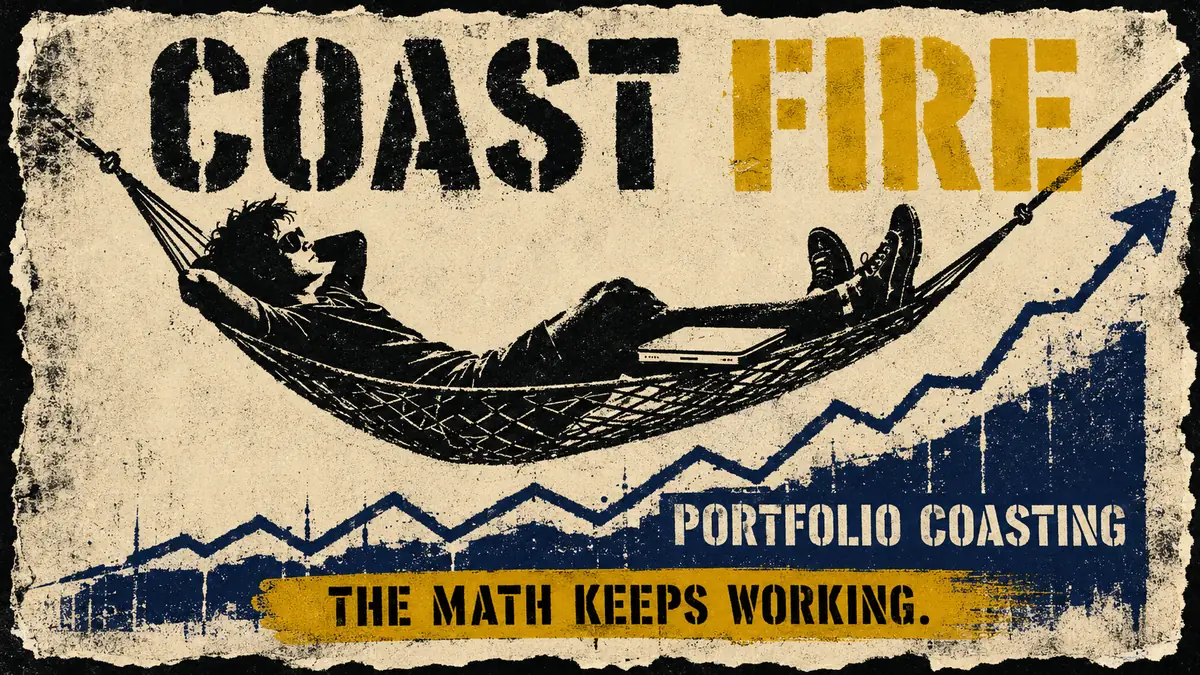
Coast FIRE is the less theatrical number most people should run first. It asks one clean question: if you never added another dollar to your retirement investments, would what you already have grow into enough by retirement age? That is it. No monastery budget. No spreadsheet cosplay. No pretending you will happily eat lentils forever because a forum said beans are freedom.
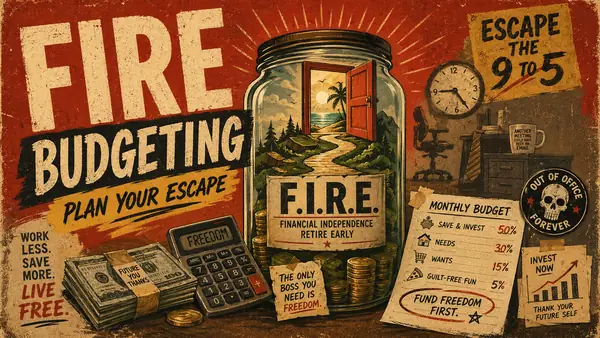
The regular FIRE conversation starts with escape. Coast FIRE starts with pressure. It tells you when your past saving has done enough heavy lifting that your future saving can become optional, slower, or redirected. If you want the broader FIRE framework, FIRE Budgeting: The Forbidden Path to Telling Your Boss Goodbye covers the bigger game. This post is about the math before the manifesto.
TL;DR
- Coast FIRE tells you the portfolio balance needed today so compounding can finish retirement without future contributions.
- Using a 7% real return, a 35-year-old targeting $1.8 million by 67 needs about $206,500 invested.
- Full FIRE is freedom from work; Coast FIRE is freedom from panic-saving.
The Math
Coast FIRE works backwards. Start with your retirement target, pick a retirement age, choose a real return assumption, then discount the future number back to today.
The basic formula:
Coast number = retirement target / (1 + real return) ^ years until retirement
For this explainer, we are using a 7% real return assumption. Real means after inflation. That matters because saying you need $1.5 million in 2065 dollars and $1.5 million in today’s buying power are not the same sandwich. One buys groceries. The other buys a haunted receipt.
Where does the retirement target come from? A common starting shortcut is 25 times annual retirement spending, which corresponds to a 4% starting withdrawal rate. The old-school support comes from research like the Trinity Study, which tested historical portfolios and found that portfolios with at least 75% stock supported 4% to 5% inflation-adjusted withdrawals across common retirement periods. Bengen’s original 1994 withdrawal-rate study also used historical data to study maximum sustainable withdrawals.
That does not make 4% holy scripture. It makes it a useful first draft. Current withdrawal research is more cautious and more flexible. Morningstar’s 2026 withdrawal-rate research pegs 3.9% as a base-case safe starting rate for a 30-year retirement with a 90% success target, while also noting that flexible spending can support higher initial withdrawals. Translation: the number depends. Forbidden concept, we know.
The same is true for the 7% real return assumption. It is a clean modeling input, not a market promise in a fake mustache. Vanguard’s 2026 capital markets model explicitly says its return assumptions are hypothetical, market-dependent, and not guarantees. Vanguard also described its U.S. stock return forecast as muted in its 2026 economic and market outlook. So run the math at 7%, then rerun it at 5% and 6% if you want a sterner adult in the room.
Here is the trick: Coast FIRE is not asking whether you can retire now. It asks whether your invested pile is big enough that time can finish the retirement job. You still need income for rent, groceries, insurance, kids, tires, dental nonsense, and the mysterious $17 subscription you keep forgetting to cancel.
Three Example Calculations
These examples assume retirement at 67, a 7% real annual return, and a retirement target based on roughly 25 times desired annual retirement spending. The years-to-Coast column assumes the person keeps saving 15% of salary annually until hitting the Coast number, borrowing that 15% savings-rate benchmark from Fidelity’s retirement guideline, which also suggests 10 times income by age 67 as a broad benchmark.
| Age | Current portfolio | Salary | Coast number | Years to Coast |
|---|---|---|---|---|
| 28 | $55,000 | $75,000 | $107,000 | 6 |
| 35 | $165,000 | $105,000 | $206,500 | 4 |
| 45 | $420,000 | $130,000 | $474,000 | 4 |
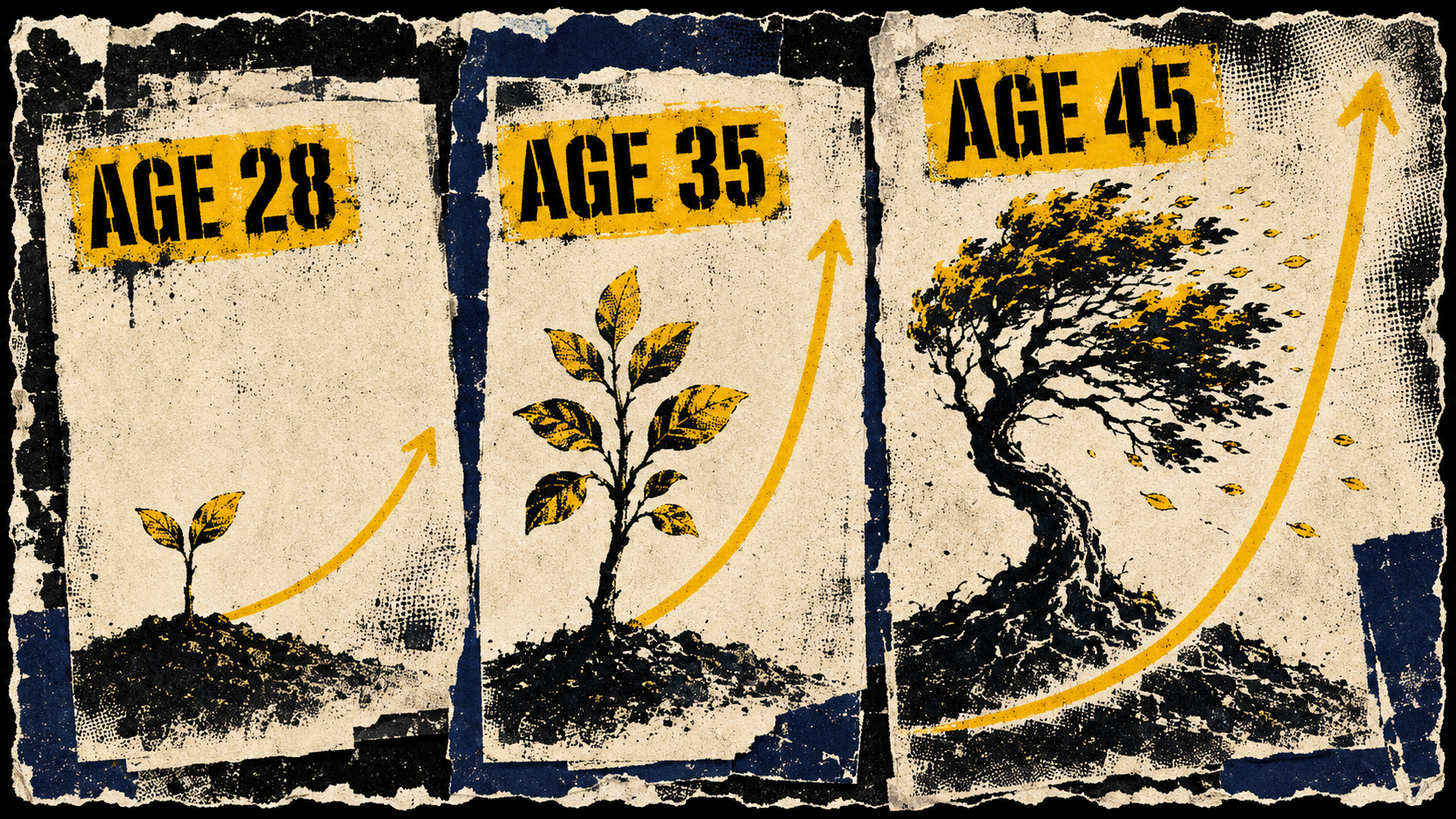
Example one: age 28, $55,000 invested, $75,000 salary. Say the target retirement portfolio is $1.5 million in today’s dollars. With 39 years until 67, the current Coast number is about $107,000. They are not there yet, but they are not in the swamp either. Saving 15% of salary gets them there in about six years, assuming the return path behaves. Markets do not behave. They have never once read the calendar invite.
Example two: age 35, $165,000 invested, $105,000 salary. Target: $1.8 million. With 32 years until 67, the Coast number is about $206,500. This person is close. Four more years of 15% saving gets them over the line. After that, retirement contributions could slow while they cash-flow daycare, elder care, a sabbatical, a business, or simply a life that is less optimized and more livable.
Example three: age 45, $420,000 invested, $130,000 salary. Target: $2.1 million. With 22 years until 67, the Coast number is about $474,000. This one looks psychologically different. They are only about $54,000 short, and 15% annual saving closes the gap in roughly four years. The lesson is not that age 45 is easy. The lesson is that a decent existing portfolio can quietly become more powerful than your new contributions.
The salary column is there for context, not ego. Your salary is not the scoreboard. Your invested assets are doing the compounding. If that distinction still feels a little illegal, read Your Salary Is Not Your Net Worth (And That’s the Forbidden Truth) and come back less impressed by gross pay.
What Changes When You Hit Coast
Hitting Coast FIRE changes the job your money has to do. Before Coast, your retirement plan needs new contributions plus investment growth. After Coast, the retirement piece can theoretically run on growth alone.
That can open up very normal, very non-influencer choices. You might reduce retirement contributions and build a house fund. You might keep saving aggressively because future you likes options. You might take a lower-paying job that does not make your left eye twitch. You might fund a career change. You might simply stop treating every nonessential purchase like a courtroom deposition.
Coast FIRE is especially useful because it separates retirement adequacy from full financial independence. Lean FIRE says you can quit if you keep spending very low. Regular FIRE says your portfolio can support your normal life. Fat FIRE says your portfolio can support an upgraded life with more comfort, travel, margin, and possibly sheets that cost a suspicious amount. Coast FIRE says none of that yet. It says your retirement account is on track if you keep covering life from income.
That is the key difference. Full FIRE is an exit strategy. Coast FIRE is a permission structure.
A good Coast FIRE check also belongs in your normal planning rhythm. Pair it with The Mid-Year FIRE Check-In: Are You On Track for the Number? so the number does not become a tattoo you got during a bull market.
Common Mistakes
Mistake one: treating Coast FIRE like permission to stop earning. No. Coast FIRE assumes you can still cover current expenses without retirement saving. Rent still wants money. So does health insurance. So does your car, because apparently rubber circles are expensive now.
Mistake two: using a retirement target you have not sanity-checked. If your current lifestyle costs $90,000 a year and you model retirement at $42,000 because you plan to become spiritually different at 67, fine, but at least admit the spreadsheet is wearing a costume. Fidelity’s own retirement guidance says your personal goal depends on retirement age and desired lifestyle, even while offering its 10x income benchmark as a starting point.
Mistake three: ignoring return sensitivity. The formula is brutally sensitive to the assumed return. A 28-year-old has 39 years until 67, so small return changes can swing the Coast number by tens of thousands of dollars. Vanguard’s forecast notes are a useful splash of cold water here: forecasts depend on conditions, change over time, and are not guarantees. Run 5%, 6%, and 7%. If your plan only works in the cutest column, keep working.
Mistake four: forgetting sequence risk later. Coast FIRE math is about accumulation, not retirement withdrawals. The danger changes once you start pulling money out. Kitces research on withdrawal rates notes that classic safe-withdrawal studies assume stable inflation-adjusted spending, while actual retirement spending can vary and planning margins should fit the person. That is a polite way of saying: your retirement plan should not be one brittle number balanced on a wine cork.
Mistake five: confusing Coast with done. You may be done making required retirement contributions under the model. You are not done with cash reserves, insurance, debt choices, taxes, career risk, family obligations, or surprise expenses with little teeth. Coast FIRE does not replace an emergency fund. It does not make lifestyle creep harmless. It does not guarantee markets send handwritten apologies after bad years.
Closing
Coast FIRE is useful because it gives you a smaller, earlier, more humane milestone than full FIRE. Full FIRE asks, Can I leave work forever? Coast FIRE asks, Has my retirement math reached the point where time can do the rest?
That question is worth running first because most people are not deciding between cubicle prison and eternal hammock. They are deciding whether to keep maxing everything, reduce pressure for a season, change jobs, support family, start a business, or stop feeling behind because they did not become financially independent by 31. Very rude of reality.
Use the Coast number as a checkpoint, not a commandment. Rerun it when your spending changes. Rerun it after big market moves. Rerun it when your life changes shape. If you want age-based context beside the Coast number, How Much Should You Have Saved by 30, 40, 50, 60? Honest Benchmarks (and What to Do If You’re Behind) gives you the broader benchmark map.
The forbidden truth is that financial independence has levels. You do not have to chase the most extreme one first.
Coast FIRE isn’t quitting. It’s the moment the math stops needing you.
 Forbidden Finance