Say It Out Loud
The most expensive sentence in your budget is not “I bought a latte.” It is “Sure, I’m in,” typed into a group chat while your checking account quietly leaves the room.
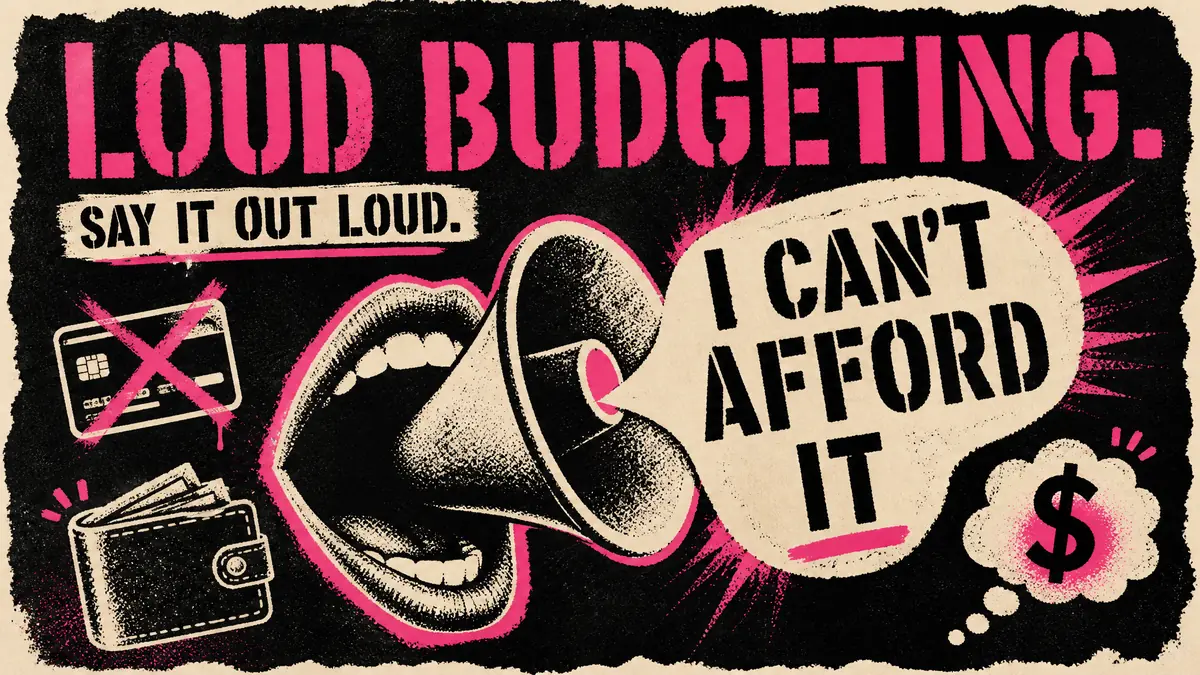
Loud budgeting is the social-media money trend that says the quiet part out loud: you have a budget, it has limits, and pretending otherwise is expensive. WalletHub describes it as being vocal about your budget and speaking up when you cannot afford to spend more, a TikTok-born idea popularized by Lukas Battle as the opposite of quiet luxury.
Good. Quiet luxury was never paying your rent anyway.
The serious part is this: loud budgeting gives you a script for the moment money meets social pressure. Not in a spreadsheet. Not during your Sunday reset while you drink green tea like a reformed villain. In the actual danger zone: brunch, birthdays, group trips, delivery orders, last-minute concert tickets, and flowers that begin dying immediately.
The Real Budget Killer Is the Group Chat
Personal finance content loves blaming the tiny daily purchase because it photographs well. The latte sits there, foamy and guilty. Very convenient.
But social pressure is sneakier. Nobody texts, “Would you like to ruin your sinking fund at 7:30?” They text, “Dinner Friday?” Then dinner becomes drinks, drinks become rideshare, rideshare becomes “we should all split appetizers,” and suddenly your budget has been gently escorted into an alley.
This is not imaginary. Ally found in 2025 that only 18% of Gen Z and millennials surveyed had a strict budget for activities with friends, while 59% said spending on friend activities affected their financial goals. Forty-two percent said they overspent on friend activities several months a year.
Travel makes the same problem wear linen. Experian found that among Gen Z and millennials who travel with friends, more than half reported a money-related disagreement, and only 1 in 4 travelers said their friend group sets a budget upfront. Apparently “we’ll figure it out later” is not a financial plan. Stunning development.
Behavioral economics is not shocked. The Becker Friedman Institute has research showing that people adjust spending after seeing how peers spend, especially when they learn they are spending more than similar people. Humans are social creatures. We look sideways. We calibrate. We copy. Then we call it “just one night.”
Loud budgeting interrupts the spell. It changes the public signal from “I can probably make it work” to “I have already decided where this money goes.” That is why it pairs naturally with Which Budgeting Method Is Right for You?. The best method is not the fanciest one. It is the one that survives contact with your actual calendar.
The Eight Decline Scripts
You do not need to submit a notarized affidavit explaining your cash flow. You need one clean sentence, said early, without apology confetti.
Use these. Steal them. Slightly adjust the seasoning.
- “I’m not in a brunch season right now, but I’m very much in a walk-and-coffee season.”
- “That’s not in my plan this month. I’m free for something lower-key.”
- “I’d love to, but I’m saving for X, so I’m sitting this one out.”
- “I already spent my social money for the week. Please send photos, selectively flattering.”
- “I can do dinner or drinks, not both.”
- “That price is a no for me. If the plan changes, I’m in.”
- “I’m keeping August boring on purpose.”
- “I’m not putting this on a credit card for Future Me to discover like a cursed artifact.”
The trick is to offer a boundary, not a courtroom defense. “That’s not in my plan this month” is enough. You can add an alternative if you want the connection, not the cost: park walk, at-home dinner, one drink, matinee, potluck, FaceTime while folding laundry like two elegant peasants.
This is especially useful during expensive seasons. Weddings, group vacations, holidays, and birthday months have a way of multiplying like tabs left open in a browser. If your social calendar is currently doing cardio, Wedding Season Survival: How to Be a Guest Without Going Broke is the same energy in formalwear.
Loud Budgeting Is Not Martyr Budgeting
This part matters, because the internet can turn any decent idea into a personality disorder with ring lighting.
Loud budgeting is honest. Martyr budgeting is theatrical.
Loud budgeting says, “That is not in my plan this month.” Martyr budgeting says, “Must be nice to afford dinner while some of us are trying to be responsible.” One sets a boundary. The other throws a tiny budget grenade into the guacamole.
Loud budgeting says, “I’m saving for a trip, so I’m skipping extras.” Martyr budgeting says, “I guess I just care about my future more than everyone else.” Congratulations, you have saved $38 and made the table weird.
The forbidden move is restraint without superiority. You are allowed to say no without making everyone else’s yes look morally suspicious. Your friend can buy the cocktail. You can buy the club soda. The waiter can pretend this is normal. Peace in our time.
This is why loud budgeting works best when it is specific, calm, and boring. Not “I’m broke.” Not “I’m poor.” Not “I could never.” Try “I’m prioritizing my emergency fund,” or “I’m keeping eating out to once this week,” or “I’m funding something else.” Constraints sound less heavy when they are attached to a choice.
Values-Based Budgeting Got Louder
Loud budgeting is not a replacement for budgeting. It is a social layer on top of it.
That makes it the natural evolution of Values-Based Budgeting: Spend Money on What Actually Matters (Forbidden Concept, We Know). Values-based budgeting asks, “What do I actually care about?” Loud budgeting adds, “Can I say that out loud when someone invites me to spend against it?”
That second question is where the money hack lives.
Maybe you value travel more than weekly restaurants. Maybe you value debt payoff more than another matching outfit for a bachelorette weekend. Maybe you value rest, which is deeply suspicious behavior in a culture that keeps trying to monetize your Saturday.
Loud budgeting turns those values into language. “I’m saving for X” is not a rejection of your friends. It is a tiny flag planted in your own life. If they are good friends, they will adapt. If they make it weird every time, that is useful data wearing lip gloss.
You also do not have to be loud about everything. Nobody needs your full net worth, credit-card APR, and childhood money story between appetizers. Loud budgeting is not financial oversharing. It is selective honesty at the exact moment silence would cost you.
Start small. Decline one plan without inventing a fake stomachache. Suggest one cheaper option before the expensive one becomes assumed. Tell one friend what you are saving for. Put a name on the tradeoff.
Because the point is not to become the budget police. The point is to stop letting other people’s spending defaults quietly become your obligations.
You don’t owe the table a yes. You owe yourself the truth.
 Forbidden Finance