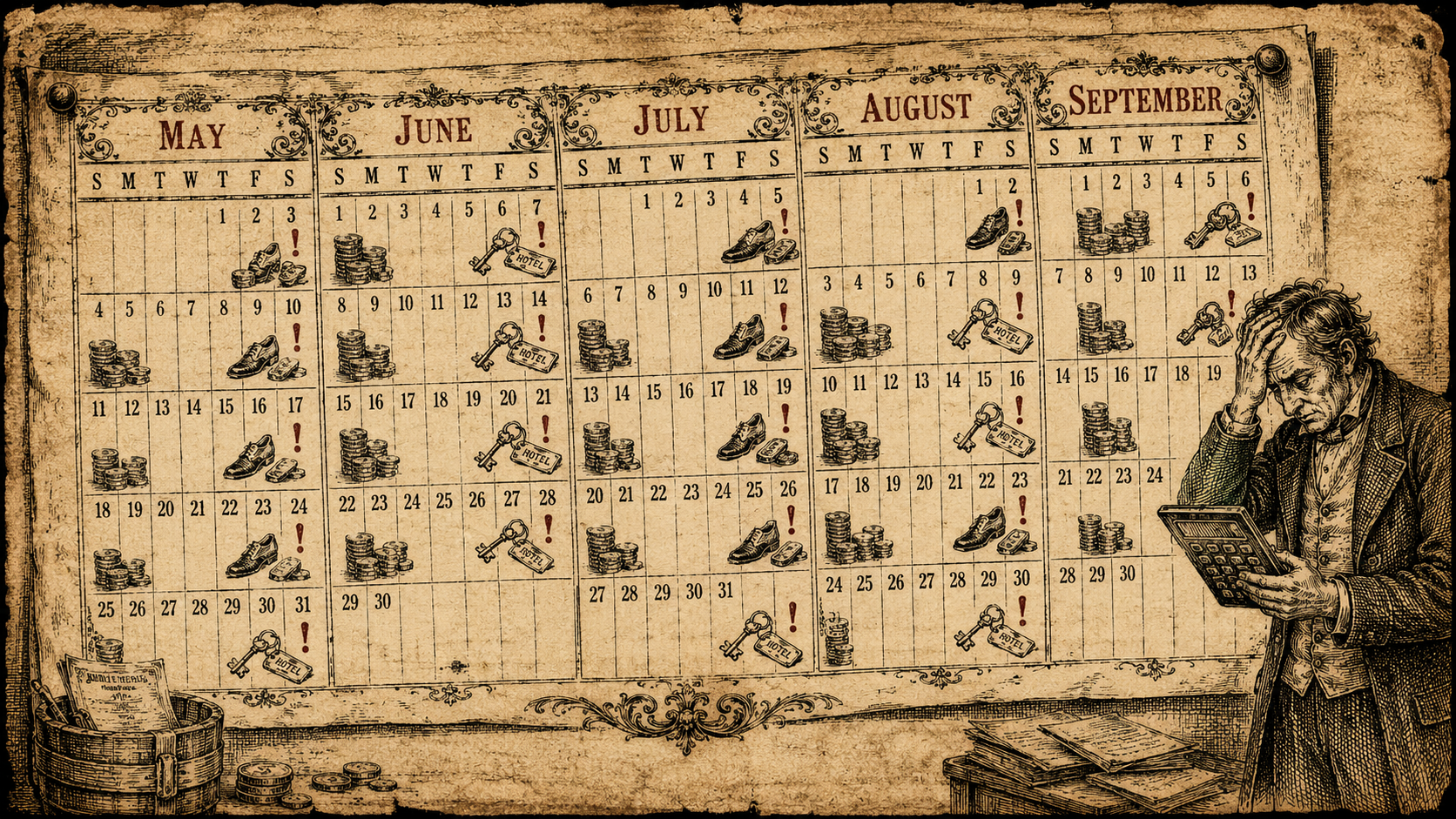
TL;DR: Wedding season is not one event. It is a five-month obstacle course with catering, airfare, shoes that hate your feet, and one group chat named something like Bride Tribe 2026.
May arrives, and suddenly your fridge has three save-the-dates, your calendar has no weekends, and your checking account is looking at you like you betrayed it personally. The Knot puts the average cost of attending a wedding at $610, with hometown weddings averaging $270, drive-to weddings averaging $840, and fly-to weddings averaging $1,680.
We are not wedding experts. We will not tell you whether the chiffon overlay is overkill or whether monogrammed cocktail napkins are gauche. The budget side of this gauntlet, however, we have covered.
So yes, a three-invite summer can slide into the $1,500-$5,000 zone without anyone doing anything especially extravagant. That is the wedding-guest gauntlet: one gift here, one hotel there, one black-tie dress code, one bachelorette weekend where brunch has a cancellation policy. Very normal. Completely deranged.
1. The Gift
The gift is the cost stack everyone pretends is simple. It is not. It is a social math problem wearing wrapping paper.
The Knot reports the average wedding gift at $150, with close friends, family, and wedding party members typically spending around $160, plus-ones around $120, and casual friends around $140. Their gift guidance also says $50-$200 is a reasonable range, which is a rare blessed moment of sanity in the wedding industrial fog machine.
- Coworker, distant cousin, plus-one: $50-$100.
- Friend or regular relative: $100-$150.
- Close friend, sibling, wedding party: $150-$200 if it fits your budget.
- Destination wedding or expensive travel: $50-$100, a card, or a smaller registry item is fine. You already bought a plane ticket, not a character flaw.
Ignore the old "cover your plate" rule. You are not a restaurant reimbursement department. Give based on your relationship, your cash flow, and whether you already spent $900 getting to a vineyard with no cell service.
2. Travel and Lodging
Travel is where wedding season stops nibbling and starts biting. A nearby wedding might be annoying but survivable. A flight wedding is where the budget puts on a tiny black veil.
The Knot's guest study found fly-to weddings averaging $1,680 all-in, which is why "destination wedding" and "just come if you can" should be treated as separate legal documents. And according to the March 2026 Bureau of Labor Statistics CPI release, airline fares were up 14.9% over the prior year, while hotel and motel lodging was up 2.1%.
- Local wedding: $25-$150 for rideshare, parking, gas, or one very aggressive toll road.
- Drive-to wedding: $250-$900 for gas, hotel, food, pet care, and the breakfast you bought because the hotel coffee tasted like boiled carpet.
- Fly-to wedding: $900-$2,000+ for airfare, lodging, ground transport, meals, checked bags, and the airport sandwich of financial despair.
- Destination wedding: $1,500+ is normal once flights and multi-night lodging enter the chat.
Set your travel rule before you look at flights. For example: "I can attend one fly-to wedding this year" or "I can travel if lodging stays under $200 a night." Rules work better before you have already clicked through four tabs and convinced yourself that a 6:05 a.m. flight is a personality upgrade.
3. Attire, Shoes, and the Tailoring Trap
The outfit is never just the outfit. It is the outfit, shoes, undergarments, tailoring, dry cleaning, accessories, and the emotional tax of decoding "garden formal" like it is a sacred scroll.
The Knot says 46% of guests reported scaling back wardrobe spending because of the economy, and 19% of weddings require formal or black-tie attire. Translation: a lot of people are being asked to dress like old money while budgeting like Tuesday groceries.
- Reuse what you own: $0-$40 for cleaning, steaming, or replacing one missing button.
- Rent or thrift: $40-$150 for a dress, suit, jumpsuit, or accessory refresh.
- Buy new: $75-$350 for a guest outfit that will hopefully survive more than one photo album.
- Shoes and accessories: $30-$200, especially if the dress code quietly requires new footwear.
- Tailoring: $25-$150 for hems, straps, waist adjustments, or pants that stop puddling like defeated curtains.
Use the repeat rule: if the outfit cannot work for at least three events, it needs to be cheap, rented, borrowed, or left in the fantasy cart. Nobody remembers whether you wore navy twice. They remember if you gave a good toast and did not start a family feud near the dessert table.
4. Bachelor/ette and Shower Obligation Cascade
This is the part where the wedding becomes a subscription. Engagement party. Shower. Bach weekend. Welcome drinks. Ceremony. Brunch. Brunch reservation, $80. Pretending the wait time is part of the experience, free.
A separate The Knot bach party study found the average bach celebration cost $1,400 in 2023, with bachelorettes averaging $1,300 and bachelor parties averaging $1,500. Bachelorette attendees who flew spent an average of $2,000. That is not a party favor. That is a small emergency fund in matching sunglasses.
Zola's 2025 wedding trends report found that 55.08% of couples planned a bachelor or bachelorette party and 39.77% planned a wedding shower. Zola also found 91% of surveyed couples considered declining a wedding invite acceptable, and 90% considered declining a pre-wedding event acceptable. The data has spoken. The group chat may need a minute.
- Local shower gift: $30-$75.
- Local bach night: $75-$250 for dinner, drinks, rideshare, and splitting the guest of honor's tab.
- Drive-to bach weekend: $400-$1,000.
- Fly-to bach weekend: $1,000-$2,500+, especially in major party cities.
- Wedding party role: add attire, hair, makeup, lodging, gifts, and many tiny Venmo requests with cutesy notes.
Here is the forbidden bit: it is okay to skip a wedding for financial reasons. Saying that out loud is healthier than attending, overdrafting, and resenting two people who just wanted cake and legal paperwork.
Use scripts. Not essays. Nobody needs a 900-word memoir about your checking account.
- Declining a destination wedding entirely: "I love you both and I am so happy for you. I need to be honest that the travel cost is outside my budget this year, so I will not be able to attend. I will be cheering you on from here and would love to celebrate with you after the wedding."
- Attending the wedding but skipping the bachelorette: "I am excited to be at the wedding, but I need to sit out the bachelorette weekend for budget reasons. I hope it is an amazing trip, and I would love to take you to coffee or drinks locally before the big day."
- Asking if pooled gifting is welcome: "A few of us were thinking of going in together on one registry item or cash fund contribution. Would that be helpful, or would you prefer individual gifts?"

5. Build the Wedding Sinking Fund
The fix is boring, which is how you know it works. A wedding sinking fund is just money set aside every month before the invitations arrive and start acting like surprise invoices.
Pick a monthly amount based on your normal wedding exposure. If you usually have one or two weddings a year, $40 a month gives you $480. If your social circle is in its "everyone got engaged after one Italy trip" era, $75 a month gives you $900. Add cash gifts, travel, attire, and pre-wedding events to the same bucket so the whole beast is visible.
- Light wedding year: $40/month, or $480/year.
- Typical wedding year: $50/month, or $600/year.
- Heavy wedding year: $75/month, or $900/year.
- Known destination wedding: add a separate $100-$200/month until flights and lodging are covered.
This is basically the modern version of cash envelopes. If that system makes your brain happy, read Envelope Budgeting: Your Grandma Was Right (But You Don't Need Actual Envelopes). If you would rather automate it and never lovingly caress a spreadsheet, Pay Yourself First: The Forbidden Art of Not Tracking Every Latte is the cleaner move.
The wedding fund also gives you a decision tool. If the bucket has $600 and the destination wedding costs $1,800, the answer is not "panic and finance friendship." The answer is no, or yes with a smaller gift, or yes to the wedding and no to the bach trip.
That is the whole point. You are not trying to become the cheapest guest in North America. You are trying to celebrate people you love without turning their marriage into your credit card balance.
Your friendship is the gift. The other gift is also the gift. But it's $75, not $300.
 Forbidden Finance