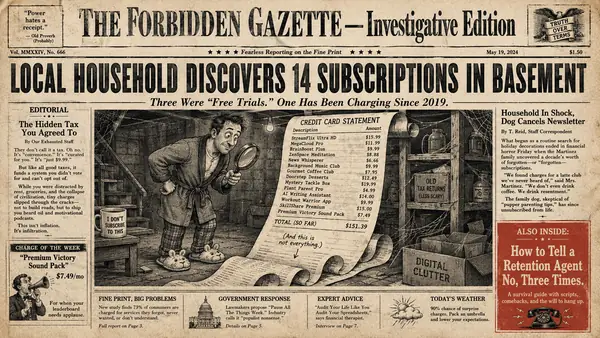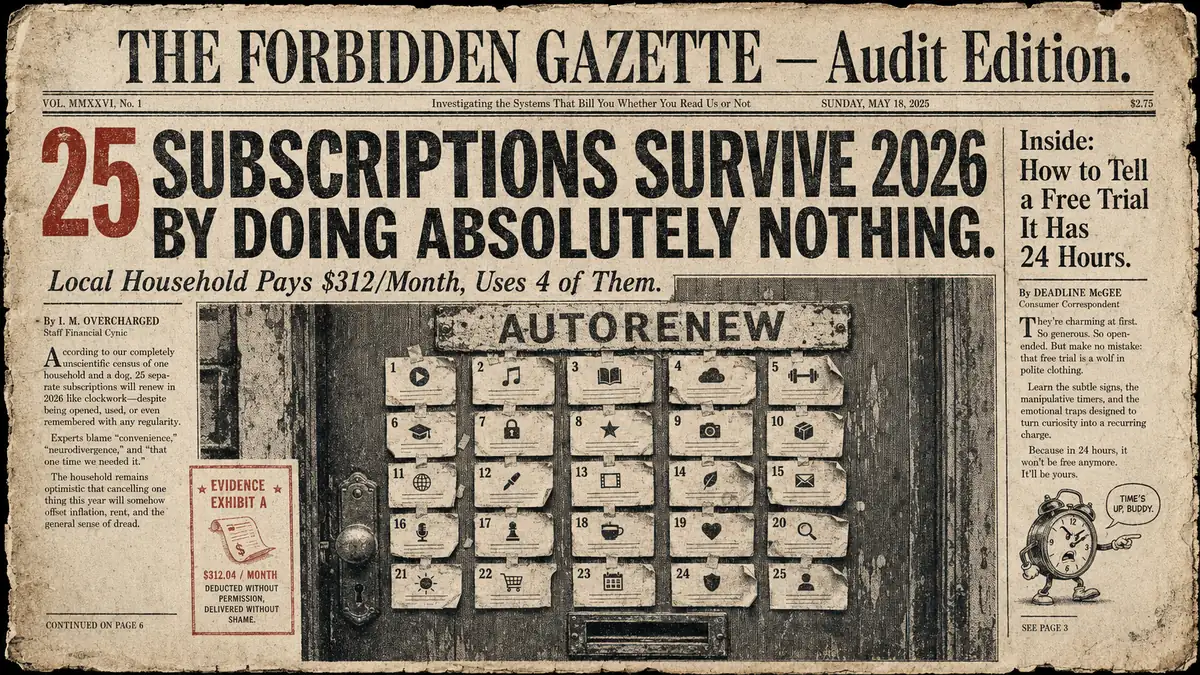
July is a beautiful time to discover that your bank account has been quietly funding apps you have not opened since jacket weather.
This is not about becoming the household finance police. Nobody needs a lecture because they enjoy television, audiobooks, workouts, fantasy football, or a weather app that tells them rain is wet. The problem is quieter: recurring charges are built to fade into the wallpaper. C+R Research found that consumers initially estimated $86 a month on subscriptions, then landed at $219 after itemizing them. That is not a budget leak. That is a tiny basement flood wearing a streaming logo.
Self Financial reported in its 2026 survey that 59.9% of respondents had at least one paid subscription going unused each month. So yes, mid-summer is a good time for a subscription audit. Not because joy is forbidden. Because paying for ghost services is how the subscription industrial complex buys itself a little yacht.
Entertainment Charges That Multiplied While You Were Making Dinner
-
Streaming services, including multiple tiers of the same one. The family signed up for one ad-free upgrade, one sports add-on, one kid profile miracle, and suddenly the TV bill has grown legs. Worth keeping? Only if someone used it in the last 30 days and you know exactly which tier you are paying for.
-
Audiobook services. These sneak in because credits feel like money, except they are money wearing a library costume. Worth keeping? Keep it if you finish at least one book a month; cancel or pause if your unused credits could build a small paperback fort.
-
Magazine auto-renewals. A $12 annual offer becomes a $49 renewal, then the magazine arrives under a stack of mail and silently judges your countertop. Worth keeping? Keep the one you actually read, not the one that represents the person you planned to become in 2023.
-
Digital newspaper trials. You subscribed for one election map, one recipe, or one paywalled article about local zoning drama. Worth keeping? Keep it if you check it weekly; cancel if it has become a civic-duty tax with a password reset screen.
-
News bundles and premium newsletters. Good journalism costs money, but five overlapping subscriptions can turn “staying informed” into “funding seven push alerts about the same thing.” Worth keeping? Pick the source you trust and read. Let the rest go gently into the unsubscribe swamp.
Health, Body, And The Apps That Think March Never Ended
-
Fitness apps. You downloaded one during a heroic Monday and then your dumbbells became decorative floor hazards. Worth keeping? Keep it if it is part of your actual week, not your aspirational personality board.
-
The gym membership you stopped using in March. The gym knows. The treadmill knows. Your key tag, dusty in a drawer, absolutely knows. Worth keeping? If you have not gone in 60 days, either schedule two visits this week or cancel before another month bills you for guilt.
-
Multiple meditation apps. Paying three apps to tell you to breathe is very 2026, and also a little funny. Worth keeping? Choose the one whose sessions you actually complete; inner peace does not require duplicate billing.
-
Recipe app premiums. You paid to remove ads, save recipes, and meal-plan like a serene linen-apron person. Then Tuesday arrived and everyone ate cereal. Worth keeping? Keep it if it changes your grocery bill or dinner routine; cancel if you still search “chicken easy” at 5:41 p.m.
-
Weather app premiums. Hyperlocal radar is useful if weather affects your work, commute, sports, or basement. Worth keeping? If you only check whether it will be hot, your free app, your window, and your own face can probably collaborate.
Dating, Games, And Tiny In-App Toll Booths
-
Dating apps long since uninstalled. Deleting the app is not the same as canceling the subscription. This is how your past self keeps buying roses for strangers you never met. Worth keeping? If the app is not on your phone, the charge should not be on your statement.
-
In-app premium tiers. These are the $2.99, $4.99, and $9.99 charges that look harmless until they form a little chorus. Worth keeping? Keep only the ones that remove a real friction you would pay for again today.
-
Fantasy sports subscriptions. Draft tools, rankings, premium projections, and “edge” packages can hang around long after the season ends. Worth keeping? If your league is inactive until fall, pause it; bragging rights do not need summer rent.
-
Kids’ learning apps. Some are genuinely useful. Some are animated guilt wrapped in a monthly plan. Worth keeping? Keep it if your kid uses it without a 14-step negotiation involving cookies.
-
Browser-extension subscriptions. Coupon finders, writing tools, tab managers, shopping widgets, and tiny productivity spells can all bill in the background. Worth keeping? Open your extensions page and ask: would you reinstall and pay today?
Productivity, Security, And Paying Twice For Calm
-
Cloud storage. Phone backup, family photo backup, work backup, old laptop backup. Soon you are paying for four digital closets and still cannot find the 2018 beach photo. Worth keeping? Keep the system that actually backs up your important files; consolidate duplicates.
-
Photo storage. This overlaps with cloud storage but deserves its own audit because photos are emotional blackmail with thumbnails. Worth keeping? Keep it if it is your real archive; cancel the extra plan after confirming your photos are safely exported or migrated.
-
Productivity tools. Notes, calendars, task boards, scanners, AI helpers, PDF editors. All useful, until your tools need their own manager. Worth keeping? If the app saves time every week, fine. If it stores three lists named “new system,” cancel.
-
Password managers. You need one good password manager. You do not need three, unless your hobby is paying for digital keychains. Worth keeping? Pick the one your household actually uses and make sure everyone can recover access.
-
VPN services. A VPN can be practical for travel, public Wi-Fi, or specific privacy needs. Worth keeping? If you cannot remember why you bought it, that is not privacy. That is fog with a login screen.
Overlap, Insurance, And Other Expensive Déjà Vu
-
AAA plus roadside double-coverage. Roadside assistance might already be included through your auto insurance, credit card, or car warranty. Worth keeping? Keep the version with the coverage limits and service area you actually need, not all of them “just in case.”
-
Dual identity-theft protection. Banks, credit cards, employers, insurers, and breach settlements love handing out identity-monitoring offers. Worth keeping? Keep one strong setup if it fits your risk, but two dashboards yelling about the same email address is not extra safety.
-
Cell-phone insurance you also have via the carrier. The phone store, wireless bill, credit card, and device maker may all be trying to sell peace of mind in monthly form. Worth keeping? Compare deductibles, exclusions, and how fast replacement works before paying twice for the same cracked-screen panic.
-
Extended warranties on subscription auto-renew. This one is deeply theatrical: insurance for appliances, gadgets, furniture, or electronics that may already be covered elsewhere. Worth keeping? If the item is cheap to replace or the warranty is full of exclusions, cancel the little protection racket.
-
Language-learning apps. You were going to become casually conversational by vacation. Then life happened, which is rude but consistent. Worth keeping? Keep it if you are on a real streak and using it for a trip, family, work, or joy. Cancel if the owl has become a landlord.
The Audit Rule
Do not turn this into a purity test. A subscription can be worth it because it saves time, keeps your kid learning, protects files, helps you train, or makes Thursday night less bleak. That is allowed. Forbidden, even.
The test is simpler: would you intentionally buy it again this month at the current price?
If yes, keep it. If no, cancel it, pause it, downgrade it, or put a reminder on the annual renewal. For a practical workflow, start with Sub-Hunting: How to Find $50-$200/Month Hiding in Your Recurring Charges, then plug the savings into a system that fits your life. If your current budget feels too rigid, Which Budgeting Method Is Right for You? can help you pick a lighter one. If the real issue is everyday friction piling up into monthly leakage, read The Real Cost of ‘Convenience’: Auditing Delivery, Subscriptions, and Same-Day Everything.
And if a company makes canceling weirdly hard, the Consumer Financial Protection Bureau has warned that companies can get into legal trouble when they hide terms, fail to get informed consent, or make cancellation unreasonably difficult. For bank-account autopay, the CFPB also says you can revoke authorization for automatic debits, while still needing to cancel the underlying contract if one exists.
You’re not cheap if you cancel. You’re awake.
 Forbidden Finance