The boots cost $160. The checkout button says $40. Your brain has already spent the other $120 on groceries, electricity, and being a person.
That is the useful trick, and the dangerous one, inside buy now, pay later: the payment gets smaller. The purchase does not.
You can use BNPL sensibly. You can also turn November into a collection of tiny debts wearing friendly fonts. The difference is whether you chose the purchase first, understand the terms, and can see every payment competing for your next paycheck.

TL;DR
- BNPL can work for planned purchases when every installment fits your cash flow.
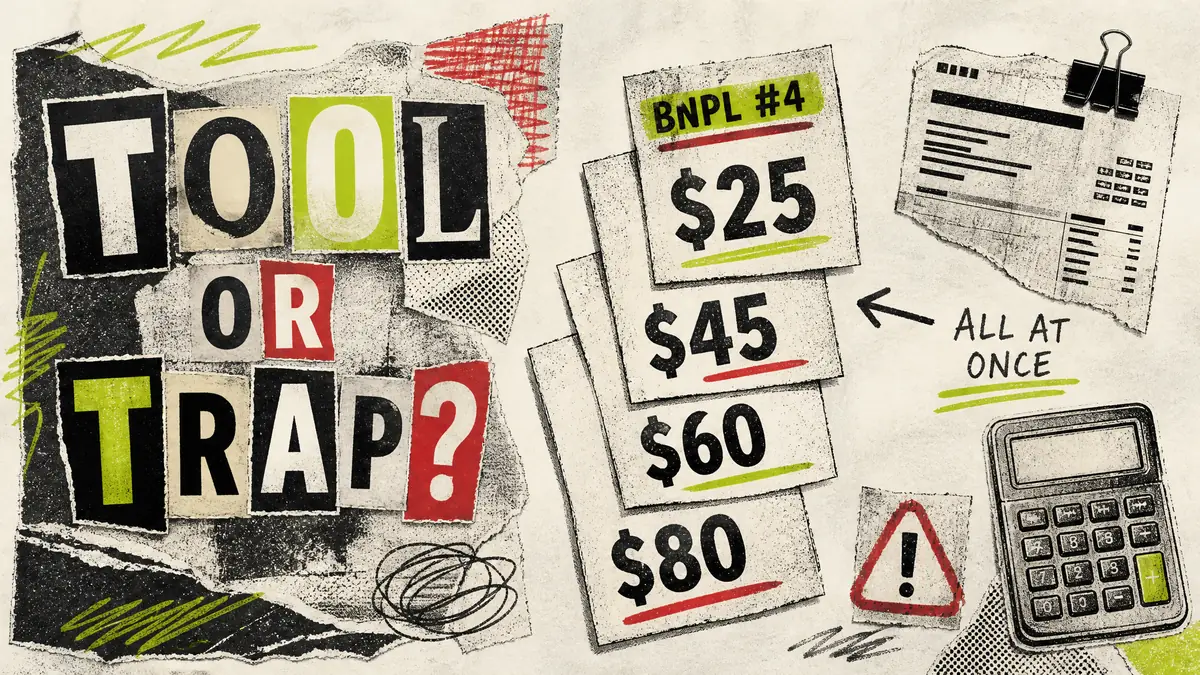
- Four overlapping plans in our example demand $210 every two weeks.
- Credit reporting is changing, but appearing on a report and affecting a score are different things.
- Your total commitment matters more than the checkout button.
What the latest BNPL numbers actually say
The CFPB’s December 2025 market report found that six large lenders originated 335.8 million pay-in-four loans in 2023. That is the data year, not a typo. Research arrives after the shopping bags.
Among those loans, 4.1% incurred a late fee, down from 5.2% in 2022. The loan charge-off rate, meaning loans written off as uncollectible, fell from 2.63% to 1.83%.
For a newer view, the Federal Reserve’s August 2026 analysis, using its 2025 household survey, found that 16% of adults had used BNPL in the previous year. Among users, 26% reported paying late at least once, and 11% said a BNPL payment triggered an overdraft or insufficient-funds fee.
Those figures measure different things: individual loans versus people, late fees versus late payments, different years. Comparing them as one delinquency trend would be statistical soup.
The fair reading: most loans get repaid, while a meaningful share of users experience payment trouble. Both can be true. Numbers are allowed to have nuance, despite what the internet has requested.
Three situations where BNPL earns its keep
For the common pay-in-four structure, you pay a quarter upfront and the rest in three installments two weeks apart, as the CFPB explains. Other installment products can carry different terms. Check the actual agreement, including fees and total cost.
These are three reasonable uses, alongside three ways the arrangement goes sideways:
| Legitimate use | What makes it rational | The trap to watch |
|---|---|---|
| Interest-free split on a known recurring purchase | The same $120 pet-food order you already budgeted for, at the same total price, with every payment covered. | Adding BNPL while existing credit-card balances already consume your spare cash. |
| Smoothing a tight pay cycle | An essential purchase comes before a dependable payday; the full repayment schedule fits after bills. | Using the smaller payment to justify an impulse purchase you would reject at its full cash price. |
| A large, budgeted single purchase | An $800 mattress you already selected and funded, split into four $200 payments without extra cost. | Opening several individually manageable plans until their combined payments become unmanageable. |
For recurring purchases, check the next reorder too. If this batch is still unpaid when you buy the next one, the schedule may create permanent overlap.
For payday smoothing, distinguish money arriving late from money never being enough. A delayed paycheck and a recurring monthly shortfall need different fixes.
For the mattress, keep the reserved money reserved. Your spine gets support; your budget should too. Sinking Funds Explained: The One Habit That Makes ‘Surprise’ Expenses Disappear offers another way to prepare for that purchase before checkout.
The traps start before you miss a payment
Debt stacking means BNPL lands on top of credit-card balances, minimum payments, and everything else already promised to your income.
The CFPB’s January 2025 borrower study found that borrowers using BNPL in a given month held more non-BNPL unsecured debt than nonusers across the categories examined. It did not establish that BNPL caused that extra debt.
For your own decision, add the proposed installments to existing obligations. If repayment requires putting groceries on a card you cannot clear, the debt has changed outfits.
Impulse financing starts with “I wouldn’t spend $240 on that” and ends with “but $60 is fine.” It is still $240. The lamp does not become cheaper because you pay for its shade separately in your imagination.
Try asking: would I choose this at the full price if installments disappeared? If the answer is no, give the purchase some time. The 24-Hour Rule, the 30-Day List, and the $100 Test: Three Anti-Impulse-Buy Frameworks gives you several ways to create that pause.
Plan stacking is subtler. You can afford each payment when you inspect it alone. Unfortunately, your checking account receives the ensemble cast.
Four plans, one paycheck: the actual math
Here is an illustration, not a survey average. Assume four interest-free, fee-free purchases all start November 6, 2026, with equal payments every two weeks.
| Plan | Full purchase | Nov. 6 | Nov. 20 | Dec. 4 | Dec. 18 |
|---|---|---|---|---|---|
| A | $320 | $80 | $80 | $80 | $80 |
| B | $240 | $60 | $60 | $60 | $60 |
| C | $180 | $45 | $45 | $45 | $45 |
| D | $100 | $25 | $25 | $25 | $25 |
| Total | $840 | $210 | $210 | $210 | $210 |
After checkout, you still owe $630. You have committed $210 from each of three future two-week periods before buying another thing.
Suppose your next paycheck leaves $250 after essentials and existing debt payments. Those installments leave $40. Add a hypothetical $120 fifth purchase, with its first $30 payment on that payday, and you have $10 left.
No interest required. Just addition with excellent camouflage.
With staggered purchases, the dates scatter instead of lining up neatly. Four to six plans can turn a manageable total into an awkward sequence of withdrawals between paydays.
This is cash-flow compounding, not compound interest: new commitments crowd older ones. Fees or borrowing elsewhere can add actual financing costs later.
The 2026 credit-reporting update needs an asterisk
“BNPL never appears on your credit report” is no longer a safe assumption. Neither is “every installment now changes your score.” Credit reporting apparently needed its own terms and conditions.
Experian says reported BNPL accounts appear on its consumer credit reports marked as BNPL, while that information is not currently factored into existing traditional credit scores. Reporting varies by provider and bureau.
Separately, FICO announced FICO Score 10 BNPL and FICO Score 10 T BNPL in June 2025, designed to incorporate BNPL data.
That announcement does not establish that every lender uses those models in 2026. The Federal Reserve’s August 2026 review still described most BNPL lenders as not reporting these loans.
Your practical questions are: does this provider report this product, to which bureau, and which scoring model does a future lender use? Review your reports rather than treating BNPL as invisible or assuming timely payments will build your score. Experian also warns that unpaid balances sent to collections can hurt credit.
Put the whole obligation in one place
The CFPB’s January 2025 study found that 63% of borrowers had simultaneous loans at some point in 2022; 33% had overlapping loans across multiple firms.
So overlapping plans were common. Overlapping providers were a substantial minority, not “everyone.”
Build one list containing each provider, remaining balance, next payment, all remaining dates, and payment account. Then total what leaves before each payday. A notes app works. So does a spreadsheet. Nobody gets bonus solvency for premium stationery.
How to Track Spending Across Five Bank Accounts Without Losing Your Mind tackles the related problem of seeing money scattered across accounts.
Posted withdrawals show payments already made. They do not necessarily reveal every future installment. Reconcile your list with each provider’s schedule, and distinguish purchase spending from repayments so you do not count the same purchase twice.
Choose the tool that fits this month
Before another plan, check the full price, total financing cost, remaining commitments, and lowest projected cash balance before payday.
If those numbers work, BNPL may be useful. You do not need to earn permission by performing financial purity.
If they do not work, pause new plans, map the existing payments, and contact the provider before a payment you cannot cover. Choose the next step that makes your actual life easier. The spreadsheet has never had to replace school shoes on a Tuesday.
You might use BNPL once for a mattress and never again. You might prefer saving ahead. You might need simpler tracking this month and more detail next month. The method can change.
BNPL isn’t a moral failure. It’s a tool. Tools become traps when you stop seeing them clearly.
 Forbidden Finance