The blender wasn’t on your list. Now it’s in your cart, wearing a red discount badge and apparently responsible for your future happiness. You already own a blender. It blends.
Welcome to Black Friday.
The National Retail Federation estimated that 202.9 million consumers shopped over Thanksgiving through Cyber Monday in 2025; Cyber Monday alone attracted 75.9 million online shoppers. Plenty of company. No guarantee of a bargain.
For 2026, Black Friday falls on November 27 and Cyber Monday on November 30. Your advantage starts earlier: knowing what you want, what it normally costs, and what happens if you need to send it back.
Already have your spending ceiling? Good. How to Set a Holiday Budget That Survives First Contact With Black Friday handles that groundwork. This is the buying-strategy companion.

TL;DR
- Lock your list before November and check price history before trusting a discount.
- Judge the whole cart, including extras, and try waiting for a recovery coupon when timing allows.
- Verify each return deadline and skip purchases whose only selling point is being on sale.
Check the price’s past before buying its story
A crossed-out price is a claim. Give it a background check.
In a Consumers’ Checkbook investigation published in November 2025, researchers tracked prices weekly for 24 weeks at 25 national chains. For the tracked merchandise, 21 chains advertised sale prices more than half the time. That wasn’t a census of Black Friday offers. It was evidence that a “sale” label can describe an ordinary price wearing party clothes.
Before November, use a historical price tracker covering your chosen store and exact product. Look across several months. Record the usual selling range, recurring discounts, and the lowest comparable offer you can actually explain.
Compare identical model numbers, storage, sizes, condition, and sellers. A refurbished device and a new one aren’t interchangeable data points.
Consider this hypothetical: headphones show “was $200, now $120,” but their recent normal price was $130. Your useful comparison is a $10 reduction, rather less cinematic than the advertised $80.
The FTC recommends comparing model details and total costs, including shipping and fees. Apply that to the historical comparison too.
A historical low tied to a sold-out listing, different seller, or coupon you weren’t eligible for isn’t necessarily a repeatable target. Note those conditions. Set a sensible buying range instead of waiting forever for one mysterious Tuesday.
If the tracker has gaps, don’t fill them with optimism. Check other sellers and save dated screenshots. You don’t need the lowest price in recorded civilization. You need a worthwhile price for something you want.
Lock the list before November 1
Write down your intended purchases before November 1. Anything added afterward gets a raised eyebrow.
This is a personal checkpoint, not a scientifically sacred date. October-you gets to brief November-you before November-you starts describing a countertop ice maker as “infrastructure.”
For each item, record the job it needs to do, essential specifications, acceptable substitutes, and a maximum checkout price. Name the need clearly enough that you can reject a cheaper product that doesn’t meet it.
“Laptop for editing photos” needs more definition. “Laptop with enough memory and storage for my existing workflow” gives you something to test against.
Keep later discoveries on a separate consideration list. Ask: what changed besides the advertising?
A broken washing machine qualifies. A newly confirmed gift request might qualify. A sponsored video showing someone frothing milk in a kitchen bigger than your apartment deserves a pause.
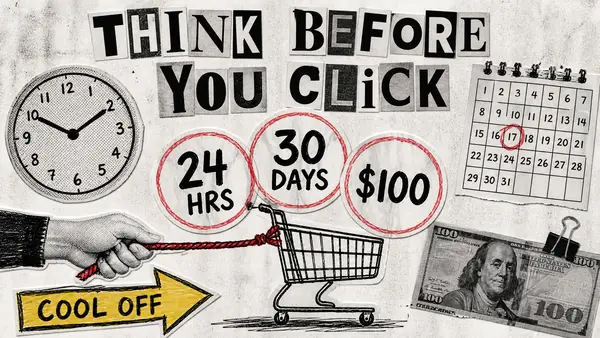
The 24-Hour Rule, the 30-Day List, and the $100 Test: Three Anti-Impulse-Buy Frameworks offers ways to create that pause. Pick the friction that fits your life.
The list can change when your circumstances change. Its job is to make the change visible, so an ad doesn’t quietly become a household requirement.
Do the doorbuster math on the whole cart
The spectacular deal can be real. The shopping trip can still cost you more.
Shopify describes loss-leader pricing as selling a product very cheaply, sometimes even at a loss, to attract buyers who then purchase additional, higher-margin items, and discusses Black Friday as an application.
But “doorbuster” doesn’t prove “sold at a loss.” Without the retailer’s cost figures, you can’t establish that most doorbusters lose money. What you can do is recognize the invitation to buy more while you’re here.
Run a hypothetical cart: a planned appliance normally costs $150. You find it for $100, then add $35 of accessories and $30 of unrelated candles. Your checkout is $165 before tax.
You got the appliance discount. You also spent $15 more than buying only the appliance at its ordinary price. The candles have excellent margins on your attention.
Accessories you actually need belong in the comparison. Compare a complete usable setup against another complete usable setup. An optional upgrade deserves its own decision.
Likewise, if you’re $18 short of free shipping and delivery costs $7, adding an unwanted $20 item increases your outlay by $13. The shipping became free. The shopping didn’t.
Check the full basket again before paying, especially after accepting a bundle or adding a membership. Give every extra a reason beyond proximity.
Leave the cart. Let the inbox try harder.
For a planned purchase that can wait, cart abandonment is worth an experiment.
Shopify’s abandoned-cart guide recommends a follow-up email 24–48 hours after abandonment that can include an offer or discount. That’s merchant guidance, not evidence that every retailer sends every shopper a coupon.
Add the item, associate the cart with your email through an existing account or checkout email field, and leave before paying. Log out if you like, then close the tab. Logging out itself isn’t a coupon button. Anonymous browsing gives the store nowhere to send its pleading little envelope.
If you’re comfortable receiving messages, watch your inbox over the next couple of days. Read any code’s exclusions, minimum purchase, and expiry. Compare the resulting checkout total with the deal you already found.
A reminder saying “You forgot something” contains no financial obligation. You didn’t forget. You left.
Use this when missing the item would be acceptable. Waiting may mean losing stock or an existing promotion; no eventual coupon is guaranteed. And don’t add unwanted merchandise to qualify for the rescue offer. That’s the doorbuster problem with better email design.
Put the return deadline on your calendar
“I can return it after Christmas” is a policy claim. Your confidence is not the policy.
Holiday extensions can carry eligible fall purchases into January. For example, Best Buy’s published 2025 holiday policy extended eligible purchases made October 31–December 31, 2025, through January 15, 2026, with exclusions.
That’s last season’s example, not a promise for your November 2026 purchase. Check the current policy before paying, even if you’ve shopped there for years.
The FTC advises checking return shipping costs, deadlines, restocking fees, and separate rules for sale merchandise. Make a note beside each order:
- The exact return deadline and whether the item must arrive by then.
- Whether opening or using it changes eligibility.
- Any excluded category, final-sale restriction, or third-party seller policy.
- Shipping or restocking charges, and whether you receive money back or store credit.
Save the policy with your order confirmation. Put a reminder comfortably before the deadline, leaving room for packaging and a drop-off trip.
For gifts, check whether the recipient can return the item themselves. A gift receipt is only useful if the purchase qualifies.
A box beside the front door is not a returns process. It’s furniture with unresolved potential.
Keep this trap sheet beside checkout
Use this for the final glance, especially when your browser resembles an airport departures board.
| Black Friday trap | Your counter-strategy |
|---|---|
| Huge discount against a crossed-out price | Check the exact item's price history and current alternatives. |
| A new “need” discovered during the sale | Compare it with your pre-November list; pause and explain the change. |
| A doorbuster followed by unplanned extras | Compare complete baskets and justify each extra separately. |
| Buying unwanted filler for free shipping | Compare the delivery fee with the extra cash leaving your account. |
| A cart-recovery email treated as a command | Check the final price and terms; buying remains optional. |
| Assuming every holiday return lasts until January | Save the current policy and calendar the item's actual deadline. |
Buy for your life, not for the banner
You can enjoy the sale. You can buy the fancy thing. Nobody needs to interrogate your character because you wanted comfortable headphones.
The useful distinction is whether the purchase serves a purpose you recognize after the red badge disappears. The ‘Forbidden’ Frugality Habits That Actually Work (and the Performative Ones That Don’t) applies the same practical lens to saving money.
Keep the research proportionate. A major appliance deserves more checking than replacement socks. Your Saturday has value, too.
The meta-rule: a deal you weren’t going to buy anyway is not a deal.
Black Friday rewards the prepared. It punishes the impulsive. Pick which one you’ll be on Nov 27.
 Forbidden Finance