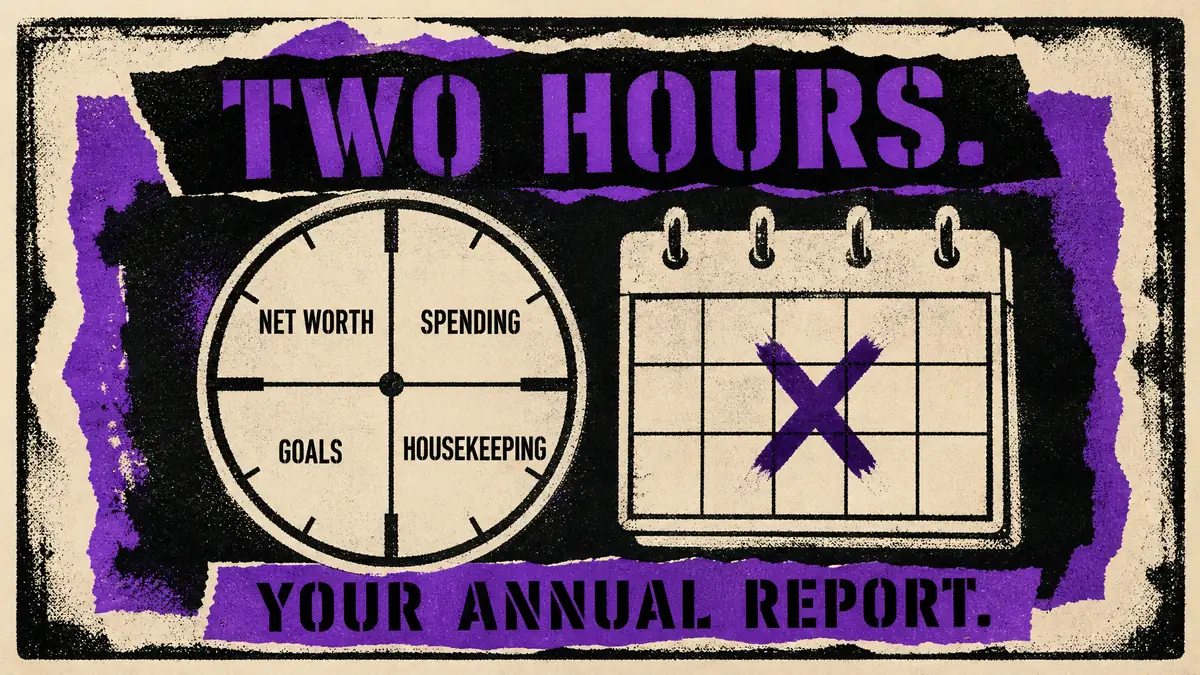
Put your money review on the calendar
Your calendar has a dentist appointment, a delivery window, and drinks with someone whose surname you still don’t know. Your entire financial year currently has “get around to it.”
Give it an actual appointment. Block December 6, 2026, from 10 a.m. to noon, or another two-hour slot before holiday logistics eat your remaining brain cells. Name it “2026 Money Review.” Invite your partner if you share finances.
Bring your balances, transaction history, latest pay stub, and whatever goals you wrote in January. A notebook works. So does a spreadsheet. Buying a special planner is optional administrative theater.
In their 2014 fresh-start study, Hengchen Dai, Katherine Milkman, and Jason Riis found increased aspirational activity around landmarks such as new weeks and years. Borrow that opening: review 2026, then give 2027 a specific starting action.
Set a timer for each segment. When something needs deeper work, record the next action and its date. Keep moving.

TL;DR
- Book two hours and split them into four equal blocks.
- Capture net worth and savings, then investigate three spending surprises.
- Review your old goals and write just two for 2027.
- Check paperwork and account security, then schedule your next quarterly review.
Minutes 0–30: Capture net worth and your YTD savings rate
Start with a dated snapshot. If you’re reviewing in early December, your figures are year-to-date, not finished annual results. Label December forecasts separately. Future paychecks haven’t arrived just because your spreadsheet feels optimistic.
- First 15 minutes: Add cash, investments, retirement balances, and reasonable current property values. Subtract mortgages, loans, credit-card balances, and other debts. Record each balance’s date and flag stale figures.
- Next 10 minutes: Calculate your year-to-date savings rate using income and savings covering the same period.
- Last five minutes: Compare with your previous snapshot and check whether your investment mix has drifted from your intended allocation.
Assets minus debts equals net worth. Include the full home value and subtract its mortgage, rather than counting equity and subtracting the mortgage again. Your house has enough expenses without being charged twice for existing.
Use the same valuation approach each review. If you need help drawing the boundaries, How to Calculate Your Real Net Worth (and What the Number Actually Tells You) walks through the calculation.
For this review, define savings rate as new savings from income, minus withdrawals used for spending, divided by after-tax income before voluntary savings deductions. Multiply by 100. Include your own retirement contributions and new money retained in cash or investments; exclude employer contributions, market gains, and transfers of existing savings. Keep reserves for upcoming bills separate.
Example: $10,000 saved from $50,000 of income on that basis equals 20%. Track debt principal paid separately so you can see that progress too. This is a consistent working definition, not a universal scorecard.
Vanguard reports that annual rebalancing works well for many investors and frames its purpose as managing risk. Note any allocation mismatch; consider taxes and costs before trading.
Output: One dated net-worth figure, one clearly defined savings rate, and a short explanation of what changed.
Minutes 30–60: Find your three spending surprises
Every year has three. Groceries developed a luxury habit. Travel included five weddings. Home repairs introduced you to a specialist whose opening sentence cost money.
Treat three as today’s investigation limit. If only two categories surprise you, congratulations on your unusually cooperative year.
- First 10 minutes: Compare actual spending by category with your plan for the same elapsed period. Exclude transfers between your accounts and avoid counting both card purchases and their repayments as spending.
- Next 15 minutes: Choose three surprising categories. Write the planned amount, actual amount, dollar difference, and likely explanation for each.
- Final five minutes: Give each category one decision: keep the spending, change it, or fund it differently next year.
Suppose your January-through-November grocery plan was $6,600 and you spent $7,700. That’s a $1,100 gap to investigate. Did prices change, another person move in, or did “groceries” quietly absorb cleaning supplies and pet food?
Read a few transactions before issuing a verdict. A category can be wrong. So can the original plan.
For travel, separate a genuinely unusual trip from annual family visits you keep treating as breaking news. For home repairs, ask whether you need a recurring reserve rather than another promise to “spend less.”
If you never had category targets, use last year’s comparable period or write “no plan” beside the actual amount. Don’t manufacture a budget retroactively just to fail it. The ‘Ugly Number’: How to Calculate What You Actually Spend in a Year can help you build next year’s baseline.
You can keep the Friday takeout. Decide what it costs and where it fits. Permission granted; funding still required.
Output: Three explanations and three decisions you can carry into 2027.

Minutes 60–90: Review 2026, then write two goals for 2027
Open January’s goals. Be kind to the person who wrote them. They hadn’t met March yet.
Spend 10 minutes on the post-mortem and 20 on next year’s choices. You are allowed to retire a goal whose purpose disappeared.
- Record what you did: Include partial progress, such as paying down $1,800 of a planned $3,000 debt reduction.
- Record what you didn’t: Name the missed action without turning it into a personality diagnosis.
- Write what you’d change: Separate an unrealistic target, a broken process, and a changed life circumstance.
- Choose exactly two 2027 goals: Give each a starting balance, target, deadline, funding source, and first calendar action.
“Save more” is a decorative sentence. Try: “Increase emergency savings from $1,200 to $3,600 by December 31, 2027, with $200 monthly transfers beginning January 5.”
A second example: “Reduce this card’s balance from $2,000 to zero by December 31, 2027; start with $200 monthly payments on January 8 and check the payoff estimate, including interest, each quarter.” Confirm the payments fit your cash flow before committing.
Those are examples, not your assigned homework. Your two goals might concern debt, parental leave, retirement, or finally funding dental work that has become a recurring negotiation with a molar.
Check the combined monthly cost against the money you actually have available. If it doesn’t fit, change the amount, deadline, or spending plan now. With irregular income, you might choose a percentage of each payment instead of a fixed transfer.
Your method can change too. Which Budgeting Method Is Right for You? gives you options if your current setup requires more attention than your life allows.
Output: A brief 2026 post-mortem and two written goals with funded first steps.
Minutes 90–120: Handle the paperwork and book the next review
This is the drawer-of-important-things segment. Glamour has left the building. Useful work remains.
Use roughly eight minutes each for beneficiaries, estate documents, and account security. Reserve the final six for deadlines and scheduling. Larger problems get their own appointments.
- Check beneficiaries: Open retirement and life-insurance records. Review primary and contingent beneficiaries, names, contact details, and allocations. Confirm submitted changes were accepted; flag complicated family circumstances for professional help.
- Review your will and powers of attorney: Can you find the signed documents? Are the people named still appropriate and willing? Note changes in family, residence, or wishes. Book legal help for missing or outdated documents.
- Review password rotation: Replace weak, reused, or compromised financial-account passwords with unique ones stored in a password manager. Check multifactor authentication and recovery details, including the email account used for resets.
- Add relevant deadlines: Record tax and provider deadlines that apply to you, with an earlier reminder to act.
- Book next quarter: Put March 7, 2027, at 10 a.m. on the calendar for a 30-minute check. Attach this review and your two goals.
On passwords, skip the annual ritual of changing “December2026” to “December2027.” NIST’s current authentication guidance tells service providers not to require periodic password changes and to require changes when compromise is evident. Fix specific weaknesses instead of performing calendar-based password gymnastics.
For U.S. taxpayers making estimated payments, the IRS’s 2026 Form 1040-ES lists January 15, 2027 as the standard fourth-payment deadline. Check applicable exceptions or relief; a CPA can confirm your situation. Put a preparation reminder in early January rather than discovering the deadline over breakfast that morning.
Save everything in one annual-review document. Keep sensitive account details in secure storage; your calendar needs the agenda, not your passwords.
Output: Checked records, dated follow-ups, and a quarterly appointment that already exists.
| Segment | Time | Output |
|---|---|---|
| Net worth and savings | 10:00–10:30 | Dated snapshot and YTD savings rate |
| Spending review | 10:30–11:00 | Three surprises explained; three decisions |
| Goals | 11:00–11:30 | 2026 post-mortem and two written 2027 goals |
| Housekeeping | 11:30–12:00 | Records checked, follow-ups dated, next review booked |
Two hours. One annual report. The next year starts here.

 Forbidden Finance