October is when your employer asks you to predict your 2027 medical life with the confidence of a suspiciously calm airport fortune teller.
Will your kid need braces? Will your knee behave? Will your glasses survive another year of being cleaned on a T-shirt? Who knows. But the benefits portal would like an answer by Friday.
This is where FSA vs. HSA gets expensive fast. The two accounts sound interchangeable because benefits acronyms were clearly designed by someone who labels moving boxes “misc.” They are not interchangeable. One is a spending bucket with a fuse. The other is a savings and investing account attached to a specific kind of health plan.
According to SHRM, 64% of employers offered an HDHP linked with a savings or spending account in 2025, 61% offered an HSA, and 60% offered a medical FSA. Translation: plenty of people will see both acronyms during open enrollment and quietly wonder which one is the trapdoor.
If you are already working through the broader menu, pair this with Open Enrollment Is Coming: A 5-Step Prep Guide Before You Click ‘Re-Elect’. This article is the quick-decision version: what changes, what rolls, what vanishes, and why October is the right month to care.

The October Choice
An FSA is a Flexible Spending Arrangement. Spending is the key word. You choose an amount for the plan year, it comes out of payroll before tax, and you use it for eligible medical expenses. Great for predictable spending. Less great if your crystal ball has the accuracy of a weather app at a beach wedding.
An HSA is a Health Savings Account. Savings is the key word. You can contribute only if you meet HSA eligibility rules, mainly being covered by an HSA-qualified high-deductible health plan. But once money is inside, the account can roll forward, earn, and stay with you.
The forbidden move is not picking the “best” account because a finance article scolded you into it. The move is matching the account to your actual life. If you have predictable prescriptions, dental work, and a plan that is not HSA-eligible, an FSA may be useful. If you are eligible for an HSA and can fund it, the tax treatment is unusually good. Annoyingly good. Like finding a parking spot directly outside the dentist.
Side-by-Side Mechanics
Quick calendar note: the enrollment you do this month covers 2027. The IRS has already published the 2027 HSA numbers. IRS Revenue Procedure 2026-24 sets them at $4,500 for self-only HDHP coverage and $9,000 for family HDHP coverage. The 2027 health FSA cap usually lands later in the fall, so for now the reference point is 2026: a $3,400 salary-reduction limit and a $680 maximum carryover (if your plan allows carryover), per IRS Revenue Procedure 2025-32. Your benefits portal will show the 2027 FSA cap once it exists.
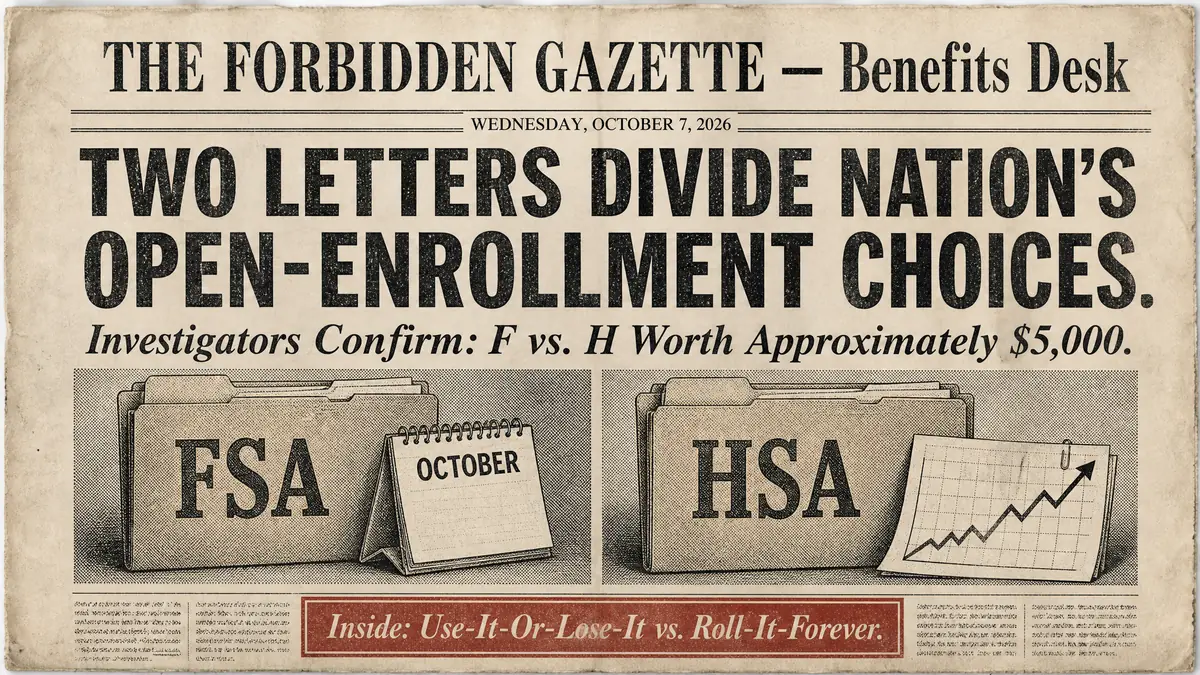
That family HSA number is why the “about $5,000” line is not just drama in a nice coat. Compared with a $3,400 health FSA election, a $9,000 family HSA limit gives you $5,600 more tax-advantaged contribution room, before any age-55 catch-up. Even if the FSA cap creeps up a bit for 2027, the gap stays north of $5,000. That is not guaranteed savings. It is capacity. Still, capacity matters.
| Dimension | FSA | HSA |
|---|---|---|
| Contribution limit | $3,400 for 2026. The 2027 cap is due from the IRS later this fall. | 2027: $4,500 self-only or $9,000 family coverage. Age 55 or older may add a $1,000 catch-up contribution if eligible. |
| Rollover rules | Mostly use-it-or-lose-it. Employer may offer a grace period up to 2 1/2 months or a carryover up to $680 for 2026, but not both. | Unused money stays in the account and generally carries over year after year. |
| Eligibility | Usually available only through an employer cafeteria plan if offered. | Requires HSA eligibility, including HSA-qualified HDHP coverage and no disqualifying other coverage. |
| Tax treatment | Payroll contributions are generally pre-tax, and reimbursements for qualified expenses are tax-free. | Contributions can be pre-tax or deductible, earnings are tax-free while held, and qualified medical withdrawals can be tax-free. |
| If you leave your job | Unused balance is generally forfeited unless COBRA continuation applies and you elect it. | The account is portable. It stays with you if you change employers or leave the workforce. |
| Best fit | Known, near-term medical costs you expect to spend during the plan year. | Eligible households that want current tax savings plus long-term medical savings flexibility. |

The rollover row is the psychological center of the whole thing. IRS Publication 969 says FSAs are generally use-it-or-lose-it, although a plan may provide either a grace period or a carryover. The same publication says HSA amounts remaining at year-end are generally carried over, and earnings are not included in income while held in the HSA.
Small difference in letters. Very large difference in expiration energy.
Eligibility: The Tiny Trap Door
You do not choose an HSA just because you like the idea of an HSA. The IRS Publication 969 eligibility test starts with being covered under an HDHP on the first day of the month. You also generally cannot have disqualifying other health coverage, cannot be enrolled in Medicare, and cannot be claimed as someone else’s dependent.
The HDHP itself has to meet IRS thresholds, and those move every year too. For 2027, IRS Revenue Procedure 2026-24 says the annual deductible must be at least $1,750 for self-only coverage or $3,500 for family coverage, and out-of-pocket expenses cannot exceed $8,700 self-only or $17,400 family, not counting premiums.
That means “high deductible” in casual conversation is not enough. Your plan has to be HSA-qualified. A plan can feel expensive, rude, and spiritually deductible-ish without qualifying. Health insurance: somehow both boring and petty.
FSAs are simpler, but employer-dependent. If your employer offers one, you can usually elect it during open enrollment. The account is tied to the job benefit structure, not to a special HDHP requirement. That makes it accessible for many people with PPOs, HMOs, or other non-HDHP plans.
If you are deciding among plan types first, read Open Enrollment Decoded: HSA vs. PPO vs. EPO vs. HMO at Your Salary Level before you obsess over the account. The account rides on top of the insurance decision. Do not pick the seat warmer before checking whether the car has brakes.
Common Mistakes
Mistake one: funding the FSA like it is a warehouse club cart. The FSA is excellent for costs you can reasonably predict: copays, prescriptions, glasses, contacts, dental work, orthodontia payments, physical therapy. It is not excellent for vibes-based optimism. If you put in $3,400 and only have $900 of eligible expenses, the leftover money can become a tiny haunted house unless your plan has a grace period or carryover.
IRS Publication 969 is blunt here: unused FSA amounts above the permitted carryover are forfeited, and an employer is not permitted to refund the balance to you. The account is not a secret savings account. It is a medical spending account with a calendar glaring at you.
Mistake two: under-funding an HSA when you are eligible and have the cash flow. HSA money can go in pre-tax through payroll or be deductible if contributed outside payroll, can grow tax-free while held, and can come out tax-free for qualified medical expenses, as described by IRS Publication 969. That is the triple-tax advantage people keep talking about, and for once the hype is not entirely wearing a fake mustache.
Mistake three: assuming every medicine cabinet purchase qualifies. IRS Publication 502 is the broader IRS reference for medical and dental expenses, but your FSA or HSA administrator may still require documentation and may apply plan-specific rules. Keep receipts. Future You does not want to reconstruct a February pharmacy run from a blurry bank transaction that says only “STORE 1842.”
Mistake four: forgetting what happens when you leave. IRS Notice 2013-71 says unused health FSA amounts at termination are forfeited unless, if applicable, the employee elects COBRA continuation coverage for the health FSA. An HSA is different. Publication 969 says it is portable and stays with you if you change employers or leave the workforce.
That portability is a big deal if your career has plot twists. Layoffs, startups, relocations, a boss who says “we are a family” one too many times. Life changes. Your HSA can come with you.
The Decision Rule
Use an FSA for planned spending. Use an HSA for eligible long-term flexibility.
That is the short version, but October deserves slightly more respect than a sticky note. Start with the health plan. If you are not HSA-eligible, the HSA is off the table for new contributions. Then estimate known 2027 expenses: prescriptions, appointments, therapy, contacts, dental, orthodontia, expected procedures. For that exercise, The October Money Calendar: Six Things Worth Doing This Month is useful because open enrollment is exactly the kind of calendar chore that quietly costs real money if ignored.
If you have an FSA option, elect close to the expenses you expect to actually incur during the plan year. Not dream expenses. Not “maybe I become a person who finally goes to every specialist.” Real expenses. The forbidden rule here is merciful: precision beats ambition.
If you are HSA-eligible, decide how much you can contribute without starving the rest of your cash flow. The account is powerful, but rent remains undefeated. If you can contribute more, especially with a family HDHP, the 2027 limit creates materially more room than the FSA limit. If you can only start small, start small. A good system fits your life before it tries to impress a spreadsheet.
For a deeper HSA strategy, bookmark HSA: The Most Misunderstood Account in American Finance. For this decision, remember the split: FSA money wants a near-term job. HSA money can have a long career.
Two letters of difference. About $5,000 of decision.

 Forbidden Finance